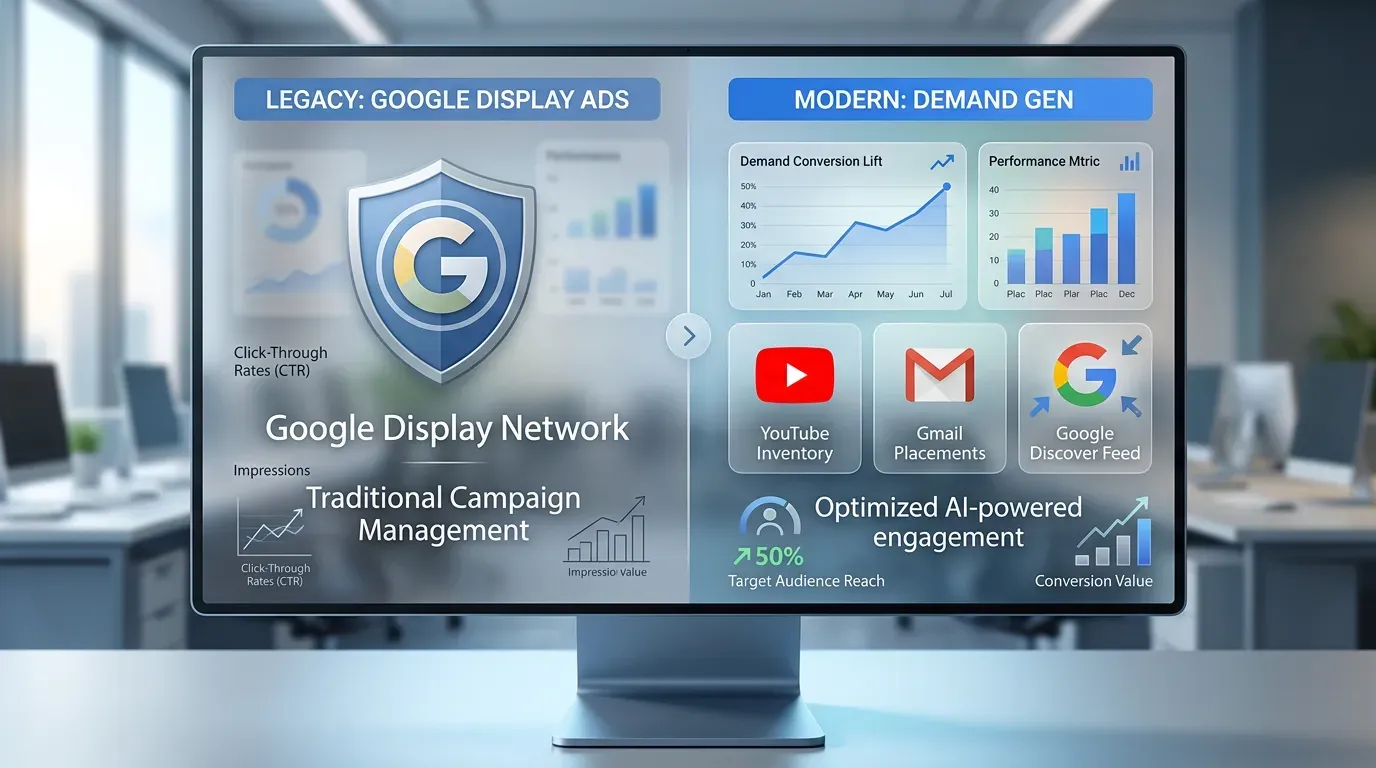
Most advertisers think conquesting means bidding on a rival's brand name and calling it a day. The marketers stealing competitor customers are doing something different. They intercept buyers at the exact moment those buyers are ready to switch, using a two-part system to do it.
Here's what that system is built on:
This article breaks down how to build that system, step by step.
- Mapping Competitor Audience States in Demand Gen
- Capturing Competitor Searches Without Wasting Budget. Is It Possible?
Mapping Competitor Audience States in Demand Gen
Before someone types "[Competitor] alternatives" into Google, something sets that search in motion. Maybe they got hit with a renewal price increase. Maybe a feature they relied on broke. Maybe a colleague sent them a review link. Demand gen lets you reach those people during that pre-search window, on YouTube, Gmail, and Discover, before they even start comparing options.
The key is matching your creative and audience targeting to where that person actually is mentally, not just which competitor they use.
Three Intent Buckets That Drive Switching Behavior
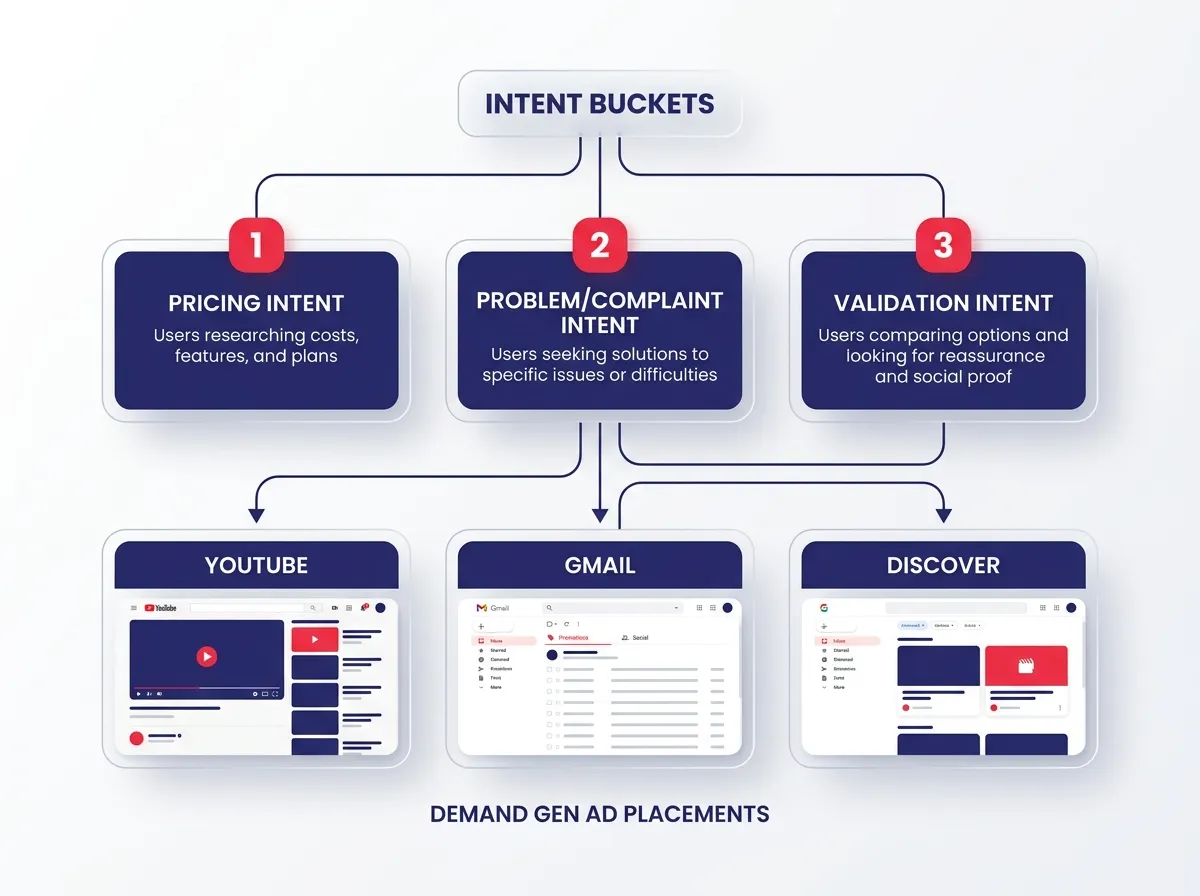
Every competitor audience can be sorted into three buckets based on what's motivating their potential switch.
1. Pricing intent (budget shock and loss aversion)
These users just received a price increase, hit a usage cap, or realized they're paying for features they never touch. They're not necessarily unhappy with the product yet, but money is now a factor. Ads targeting this group should lead with cost transparency or total value framing.
2. Problem/complaint intent (churn-risk frustration)
These users have hit a wall. Something broke, customer support let them down, or a workflow they depend on simply doesn't work anymore. They're already venting on Reddit or leaving reviews on G2. This group needs empathy-forward messaging that acknowledges the specific failure, not generic "we're better" claims.
3. Validation intent (risk-averse buyers checking alternatives)
These users aren't necessarily unhappy, but they're due for a review. They're reading comparison content, checking Capterra, or asking peers for recommendations. They need proof, not persuasion. Case studies, certifications, and side-by-side feature comparisons work here.
Each bucket requires a different creative angle and a different audience signal inside Google Ads demand gen.
Using Custom Segments to Build your Demand Gen Conquesting Audiences
Custom segments in demand gen let you build audiences based on competitor website visits and competitor-related search terms. This is more precise than interest targeting alone.
A reliable setup looks like this:
- Competitor website visitors: Target users who have browsed competitor domains within recent windows. Start with 90 days, then test 30 and 60-day cuts as your data builds.
- Search-based custom segments: Add competitor brand terms and product-specific queries as "people who searched for" signals. This captures active researchers before they convert elsewhere.
- Layered intent signals: Combine competitor site visit signals with category-level intent to sharpen who sees your ads.
The 30-60-90 day refinement cycle matters. Audiences built on 90-day windows are broader, good for awareness. Tighter 30-day windows catch higher-intent users who are closer to a decision. Running both at the same time, at different bid strategies, gives you coverage across the funnel.
| Intent bucket | Custom segment signal | Ad format | Landing page type |
|---|---|---|---|
| Pricing intent | Competitor site visitors (30-day) | YouTube pre-roll with price comparison | TCO calculator or pricing page |
| Problem/complaint | Search terms: "[Competitor] not working," "[Competitor] issues" | Gmail responsive ad with empathy hook | Feature comparison + testimonials |
| Validation intent | Competitor site visitors (90-day) | Discover an image ad with social proof | G2/Capterra badge landing page |
Visual Storytelling That Stops the Scroll and Triggers the Switch
Creative is where most demand gen conquesting campaigns fall flat. Generic product demos don't move these audiences; "Specificity" does.
For pricing-intent audiences, show a real scenario, a user discovering they've been overpaying, and frame your product as the sensible alternative. For problem-intent audiences, open with the exact frustration your target users describe in reviews ("tired of crashes mid-meeting?"). For validation audiences, lead with third-party proof before you say anything about your own product.
The goal is that the viewer feels understood in the first three seconds, not sold to.
Capturing competitor searches without wasting budget. Is It Possible?
Yes, but only if you build the keyword and exclusion structure correctly. Most conquesting campaigns on the search side bleed budget on the wrong users because they skip two steps: targeting negative-intent keywords and blocking existing customers of the competitor.
The Negative-intent Keyword Targets Worth Bidding On
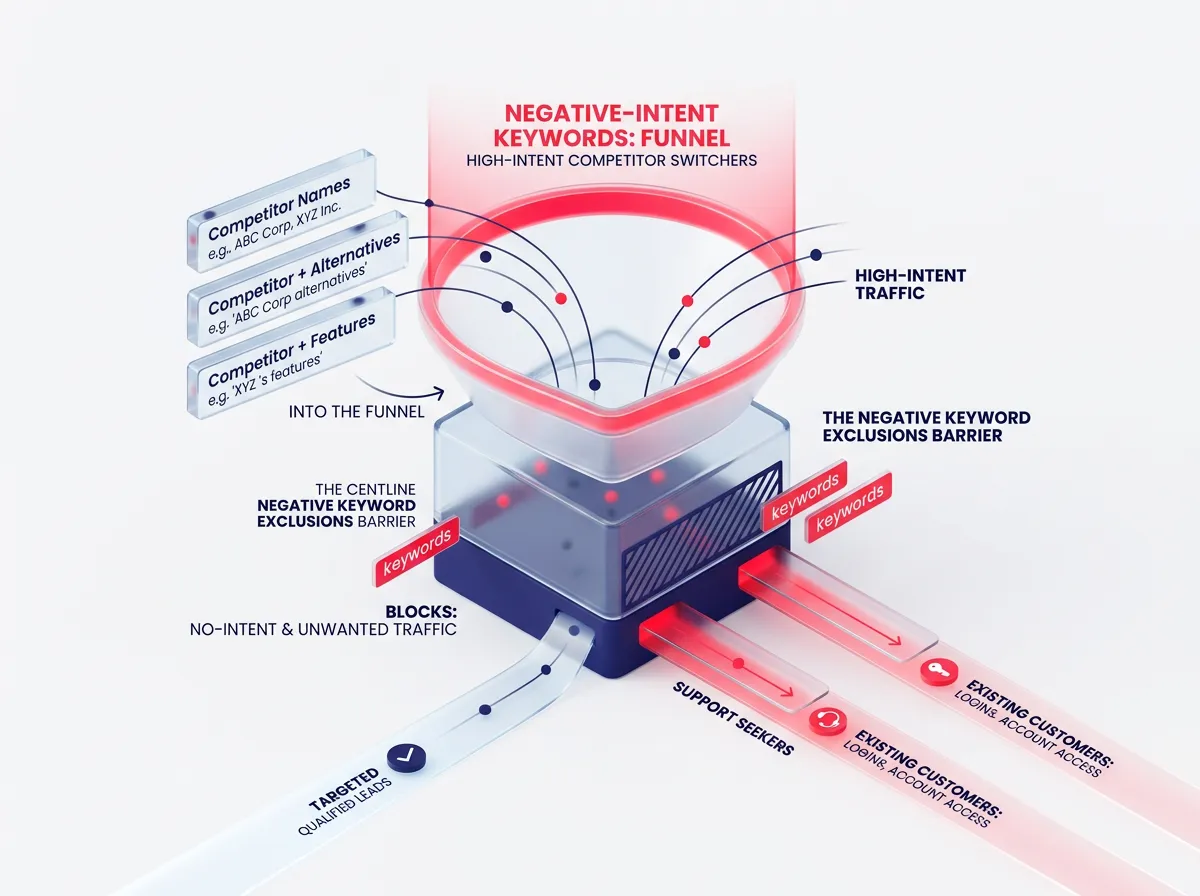
Negative-intent keywords are queries that signal dissatisfaction or active comparison. These aren't people casually browsing. Their decision-making process is already moving.
High-value targets include:
- "[Competitor] alternatives" - The clearest switching signal in search. Bid on these aggressively.
- "[Competitor] problems" or "[Competitor] not working" - Users hitting a specific failure point.
- "[Competitor] vs [Category]" - Comparison queries where you can position directly.
- "[Competitor] pricing" - Users questioning whether the cost is justified.
- "[Competitor] reviews" - Validation-stage users looking for social proof before deciding.
These queries represent buyers already in active consideration. The competition for these terms is real, but the intent quality is high enough to justify the spend.
Use exact and phrase match types for tighter control. Broad match on competitor terms tends to pull in irrelevant traffic and inflate costs fast.
The "Support Leak": Negative Keyword Lists That Protect Your Budget
The single most overlooked budget drain in conquesting campaigns is spending ad dollars on a competitor's existing account holders, people who have no intention of switching and are just trying to log in or get help.
Build a negative keyword list that excludes terms like:
- login / sign in / my account
- support / help / customer service
- billing / invoice / payment
- download / install / setup
- [Competitor] app / [Competitor] portal
Applying these exclusions in a single optimization pass routinely improves lead quality by eliminating zero-intent traffic. Adding them as a shared negative list at the campaign level makes them easy to maintain across all conquesting campaigns. Review this list quarterly. Competitors change their product terminology over time, and new support-related queries keep showing up.
Switch Incentive Landing Pages and Trademark-Safe Ad Copy
Generic landing pages fail for conquesting because they don't match what the visitor was just searching for. Someone who searched "[Competitor] alternatives" and lands on a generic homepage gets no acknowledgment of their context. They bounce.
A switch incentive landing page addresses the visitor's specific situation. It should include:
- A headline that speaks to the switching context (without naming the competitor directly in the headline)
- A feature-by-feature comparison matrix or total cost of ownership breakdown
- Migration support messaging (what does switching actually look like for them?)
- Social proof from users who made the switch
On ad copy, trademark policy limits how you reference competitors directly. The safe approach is category-level framing: "the leading alternative to enterprise project management software" instead of naming the specific product. This keeps your campaigns compliant while still triggering relevance for the right queries.
Pair this copy with landing pages that do the naming work through review badges, comparison charts pulled from public data, and customer quotes. Users searching for alternatives already know who they're comparing. You don't need to spell it out in the headline to convert them.
Demand generation and negative-intent keywords, used together, give you reach at the pre-search stage and precision at the moment of active comparison. Getting both sides of this framework right is what separates campaigns that consistently pull in competitor customers from campaigns that just look like conquesting on paper.