TL;DR
- Google's Business Agent for Leads, powered by Gemini, acts as a conversational layer between a searcher's intent and the business, answering product or service questions and qualifying interest without the user ever landing on the website.
- The Gemini-powered system generates those answers from a brand's existing website content, so a product description buried three levels deep can become the first thing a prospect hears about the brand.
- AI Max for Shopping adds final URL expansion plus AI-generated dynamic titles, letting Google match a query to the most relevant page across the whole site rather than the URL originally submitted.
- Google's Meridian is an open-source marketing mix model using a Bayesian framework to estimate channel contribution including channels with no click event, and it depends on clean first-party data syncs.
- The post splits automation trust by business type: high-volume ecommerce with short purchase cycles can lean on AI Max and Smart Bidding, while high-ticket and B2B accounts with long offline cycles need tighter audience signals, conservative URL expansion and stricter negative keyword lists.
For nearly two decades, the Google Ads playbook was refreshingly simple. Pick a keyword, write an ad, bid for a click, win a customer. The whole system was predictable enough that entire agencies were built around mastering it. That playbook is now being rewritten, and the pace of change is faster than most advertisers seem to realize.
Google’s latest AI-powered ad formats are not a minor product update. They represent a genuine rethinking of what advertising inside a search engine even means. We are moving from a world where ads interrupt a search result to a world where ads are woven into conversations, recommendations, and AI-generated answers. The brands that understand how this machinery works will have a real edge over those still waiting on the sidelines.
Google is no longer just selling traffic. It is selling qualification. By embedding ads directly inside AI-powered conversations, Google is positioning itself as the intermediary between intent and outcome, not just between query and click. Whether you run a small ecommerce store or a large B2B lead generation operation, this shift changes your strategy at every level.
- How Google’s AI Ad Formats Actually Work Under the Hood
- The Strategic Shift from Clicks to Predicted Outcomes in Google Ads
- What Brands Must Do Right Now to Stay Competitive in AI-Driven Google Ads
How Google’s AI Ad Formats Actually Work Under the Hood
To make smart decisions, you need to understand what is actually happening when a user interacts with one of these new AI-driven formats. The mechanics are meaningfully different from traditional search ads, and those differences have real consequences for how you build and manage your campaigns.
Conversational Discovery and the Business Agent for Leads
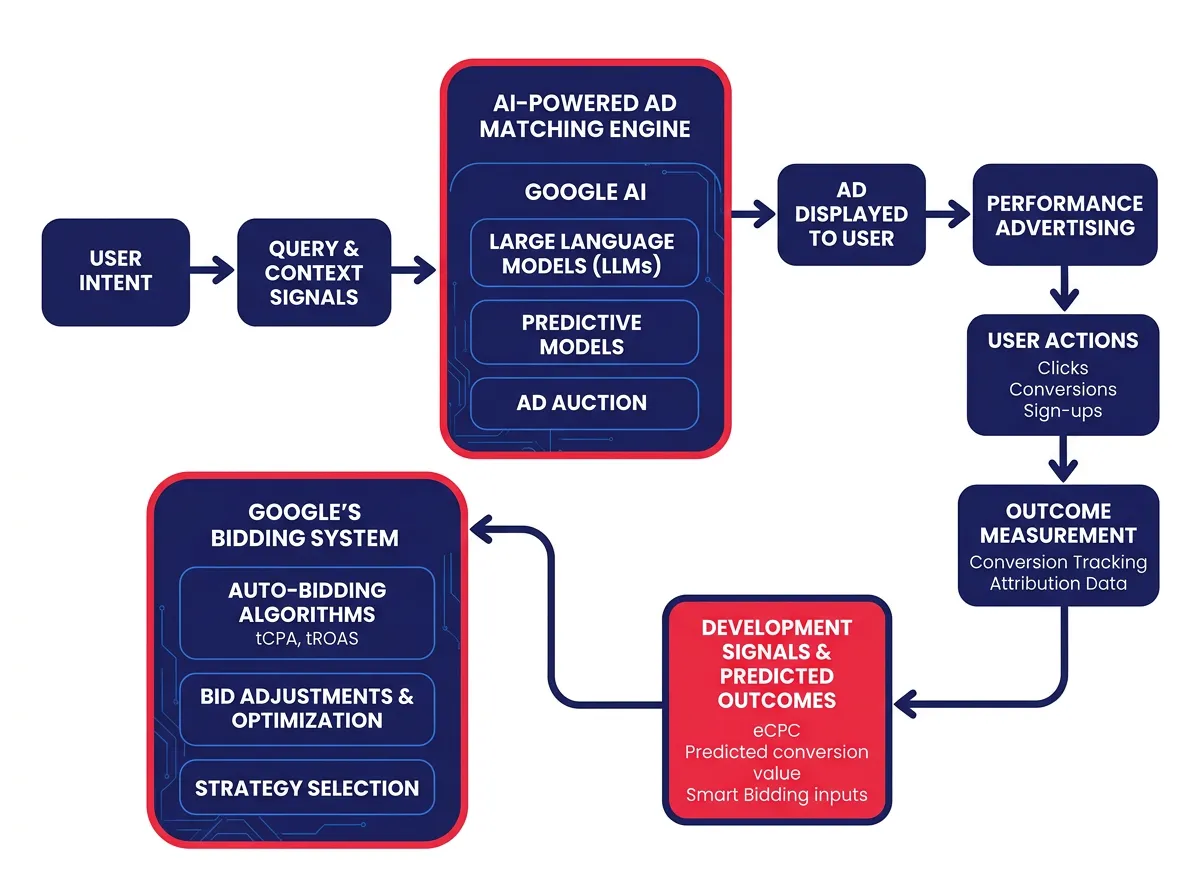
Google’s Business Agent for Leads is one of the more striking products to come out of the AI advertising push. Powered by Gemini, it works as a conversational layer that sits between a user’s expressed intent and your business. When someone asks a question inside an AI-powered search experience, the agent can surface your business, answer questions about your products or services, and qualify interest, all without the user ever landing on your website.
Here is the part that changes everything for your creative strategy: the Gemini-powered system draws on your existing website content to generate those conversational responses. Your site copy is no longer just the destination someone reaches after clicking your ad. It is an active input feeding the AI’s answers. A product description buried three levels deep in your site could become the first thing a potential customer hears about your brand inside a conversation.
That means the quality and clarity of your web content matters more than it ever did in a pure pay-per-click world. Vague copy, outdated descriptions, unclear value propositions: these do not just hurt your conversion rate anymore. They actively shape what the AI says on your behalf to warm leads.
The agent also handles basic qualification tasks. It can ask clarifying questions, confirm service areas, and filter out mismatched inquiries before a lead ever reaches your CRM. For service businesses that burn hours chasing unqualified leads, that sounds genuinely useful. But it also means you are trusting an AI system to represent your brand in real-time conversations, which raises fair questions about oversight and accuracy.

AI Max for Shopping and the End of the Static Landing Page
AI Max for Shopping takes a different but equally significant approach. Traditional Shopping campaigns sent users to a specific product page, a fixed destination with a fixed message. AI Max changes that by introducing final URL expansion combined with AI-generated dynamic titles.
In practice, Google’s AI can now match a user’s query to the most relevant page across your entire site, not just the URL you originally submitted. It can also rewrite the title of your product listing on the fly to better match the specific language the user used. Your product feed becomes a living, adaptive storefront rather than a static catalog.
For high-volume ecommerce brands with well-organized feeds, this is genuinely useful. A single product can be discovered through dozens of different conversational entry points that a human campaign manager would never have targeted manually.
The catch is obvious: if your product feed is messy, your descriptions are thin, or your site structure is inconsistent, the AI has less quality material to work with. Garbage in, garbage out applies here with more commercial consequences than ever before. A poorly served AI-generated result does not just fail to convert. It misrepresents your brand in a conversational context where trust is the primary currency.
The Strategic Shift from Clicks to Predicted Outcomes in Google Ads
Understanding the mechanics is one thing. Understanding what it means for your overall strategy is another. Google Ads in the age of AI is repositioning the metrics that matter, and marketers still optimizing for click-through rates and impression volume are playing a game that is increasingly disconnected from how the platform actually allocates budget and rewards performance.
Why Google Is Prioritizing Predicted Outcomes Over Raw Click Volume
Google’s Smart Bidding algorithms have always used predicted conversion probability as a core signal. What has changed is the depth of what counts as a meaningful conversion signal. The platform now actively rewards campaigns that demonstrate downstream business value.
Offline conversion imports, phone call outcomes, and CRM-matched lead quality scores are no longer optional add-ons for sophisticated advertisers. They are increasingly what you need just to compete effectively. If your competitor is feeding Google real closed-deal data and you are only sending click and form-fill signals, their algorithm has a richer picture of what a good customer looks like. Over time, their targeting gets sharper and their cost-per-acquisition improves relative to yours.
The strategic implication is direct. Winning in AI-driven search advertising is less about writing better ad copy or finding smarter keyword combinations and more about building better data pipelines between your CRM, your sales process, and Google’s systems. The creative work is increasingly handled by AI. The competitive moat is increasingly built in your data infrastructure.
This also shifts what it means to generate intent. In the old model, a high search volume keyword was inherently valuable because volume implied opportunity. In the AI model, intent quality beats intent volume. A thousand vague clicks are worth far less than a hundred high-signal interactions from users whose behavioral patterns match your best customers.
Measurement in a Zero-Click World: From Last-Click Attribution to Predictive Models
The zero-click reality is one of the more uncomfortable truths in modern search marketing. A growing share of users who see an AI-generated answer or interact with a conversational ad will never click through to your website. They get the answer they need, they form an impression of your brand, and they move on. Sometimes they convert later through a completely different channel.
Last-click attribution, which was already a flawed model, becomes almost meaningless in this environment. Crediting the last click with the full value of a conversion ignores every AI-assisted touchpoint that shaped the user’s decision before they reached that final action.
Google’s Meridian is an open-source marketing mix model built to address exactly this problem. It uses a Bayesian statistical framework to estimate the true contribution of different marketing channels and touchpoints, including channels where no click event exists. But Meridian is only as useful as the data you feed it. It needs first-party data syncs as a foundation. Without clean, consistent first-party data flowing through your systems, you are running predictive models with incomplete information and making budget decisions based on a distorted picture.
The practical action here is unglamorous but necessary: audit your first-party data collection, make sure your Google tag fires correctly on all key events, set up enhanced conversions if you have not already, and build a regular process for importing offline conversion data. These are the foundations on which everything else depends.
What Brands Must Do Right Now to Stay Competitive in AI-Driven Google Ads
Strategy without action is just reading. Here is what actually needs to happen in your accounts and your operations to stay competitive as Google Ads in the age of AI becomes the default reality.
Feed Hygiene Is Now Your Brand Strategy
This point deserves more attention than most ecommerce teams give it. In a world where an AI agent can surface your product, answer questions about it, and facilitate a purchase without ever sending the user to your website, your product feed metadata and descriptions become the landing page experience.
Think about what that means concretely. The quality of your product titles, the completeness of your attribute data, the accuracy of your availability and pricing signals, the richness of your product descriptions: all of these things now directly shape how your brand shows up in conversational contexts. A thin product description that was fine sitting on a rarely-visited category page is now potentially the basis for an AI-generated pitch to a warm prospect.
Feed hygiene is no longer a back-office operational concern. It is a front-line brand and revenue concern. Brands that invest in structured, detailed, regularly updated product data will have their products represented accurately in AI-driven formats. Brands that let their feeds go stale will find their products either misrepresented or deprioritized in favor of competitors whose data is cleaner.
Practically, this means assigning ownership of feed quality to someone who understands both data management and brand voice. It means building a review cadence, not just for pricing and availability, but for description quality and completeness. And it means treating your product feed as a living document, not a one-time upload.
When to Trust the Machine and When to Take Back Control
Not every business should apply the same level of automation trust, and one of the most important decisions you can make right now is figuring out where your business sits on that spectrum.
High-volume ecommerce retailers with tight product-market fit, clear conversion signals, and short purchase cycles are generally well-suited to lean into AI Max and Smart Bidding with relatively light human oversight. The volume of conversions gives the algorithm enough data to optimize effectively, and the cost of an occasional mismatch is low compared to the efficiency gains from automation.
The calculus looks very different for high-ticket businesses and B2B lead generation operations with long offline conversion cycles. For these businesses, the cost of a misqualified lead is proportionally far higher. If your sales team spends two hours on a discovery call with a prospect the AI agent should have filtered out, that is not a minor inefficiency. It is a real cost that compounds across hundreds of misqualified leads over a quarter.
For these businesses, tighter human oversight of AI Max is not excessive caution. It is just common sense. That means more precisely defined audience signals, more conservative final URL expansion settings, stricter negative keyword lists, and a more rigorous feedback loop between your sales team’s lead quality assessments and the conversion signals you feed back to Google.
The temptation to treat AI automation as a binary choice between full trust and full manual control is worth resisting. The best-performing advertisers right now are using AI for what it genuinely does well: processing massive volumes of signals at speed. They are keeping humans in the loop for the decisions where context, judgment, and brand standards actually matter.
Conversational advertising is not coming. It is already here, and it is reshaping search marketing faster than most teams are prepared for. The brands that take the mechanics seriously, invest in their data foundations, and develop a thoughtful approach to AI oversight will build a real and durable advantage over competitors still running 2019 strategies in a 2026 search environment.