
TL;DR
- The Knowledge Graph is a database of entities, people, places, organisations and concepts, and the relationships between them, marking search's move from strings to things.
- It powers knowledge panels, the People Also Ask section and AI Overviews, which rely on its factual data to verify their answers.
- The repository is built from high-trust sources including Wikipedia and Wikidata, licensed industry databases holding official records, schema markup supplied by site owners, and user feedback or suggested edits.
- To influence entity data, apply schema markup to the organisation, products, staff and physical offices, and keep business name, address, phone number and primary URL identical across every directory and social profile.
If you have ever searched for a complex topic and found the answer staring back at you without having to click a single link, you have used the Google Knowledge Graph. It provides summaries, factual snippets, and related concepts in a polished layout. This shift represents a massive change in how search engines operate. They are no longer just comparing keywords; they are building a map of how things and ideas relate to one another. For any business, understanding this transition is essential for long-term growth. “How Google Knowledge Graph Impacts SEO and Search Visibility” is not just a technical topic—it is a change in how we approach content strategy.
Moving from keyword matching to entity understanding is arguably the most important shift in search technology over the last decade. In the past, Google looked for pages containing your specific search terms. Now, it looks for what those terms represent. This is the move from “strings” to “things.” By focusing on concepts rather than just words, Google provides more utility and accuracy. It acts less like a library index and more like a massive, interconnected knowledge bank.

- What Is the Google Knowledge Graph and Why It Matters
- How the Knowledge Graph Powers Search Features
- Behind the Data: How Google Builds Its Knowledge Repository
- Strategies to Improve Your Brand Presence in the Knowledge Graph
What Is the Google Knowledge Graph and Why It Matters
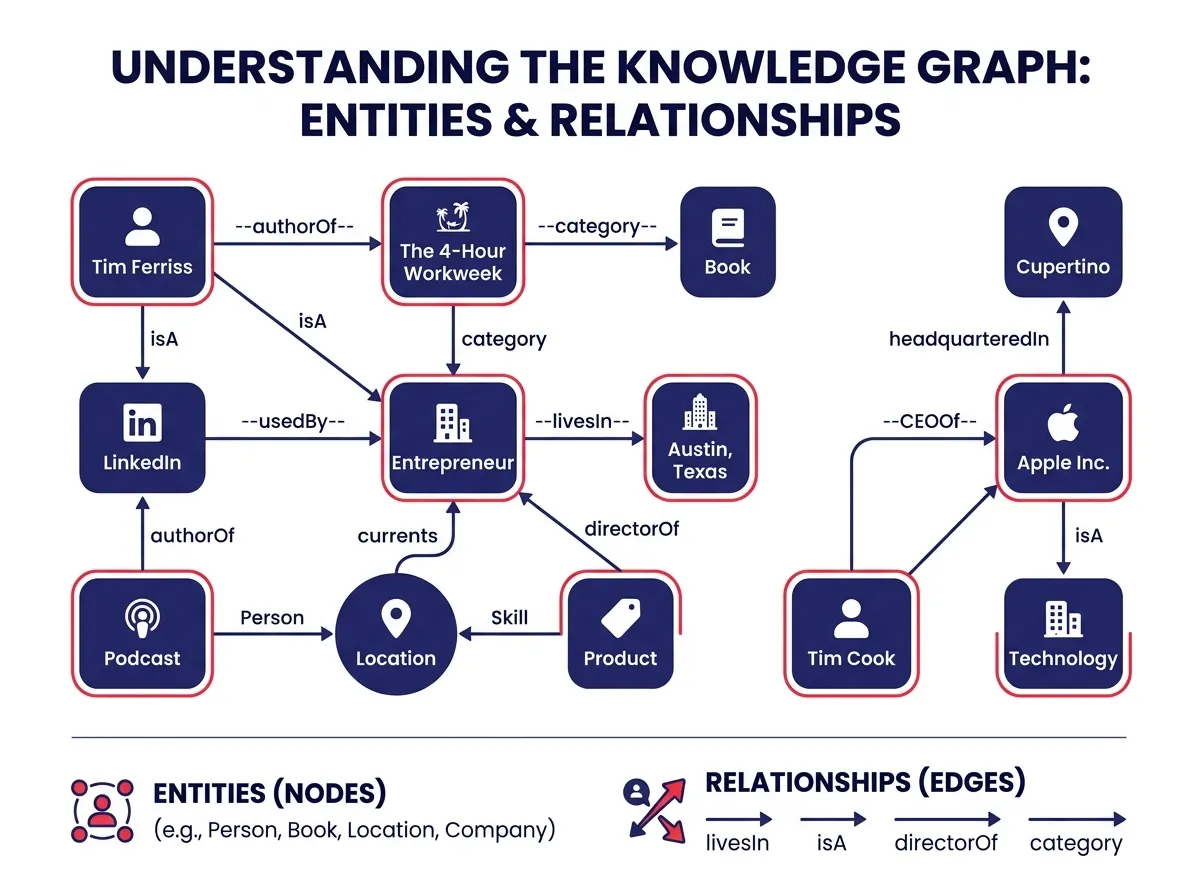
The Knowledge Graph is a massive database that stores structured information about people, places, organizations, and concepts. It tracks the attributes of these entities and, more importantly, how they connect. Instead of just listing sites, Google understands that a company is a business, who its CEO is, where it sits on a map, and which industry it serves.
Defining Entities and Ontologies
At the core of this are entities and ontologies. An entity is simply a distinct thing—a brand name, a job title, or a specific product. An ontology is the way Google organizes these pieces of information. It maps out the connections. Think of a giant web: every point is a piece of information, and every line is a relationship. When you look at a brand, the graph connects it to its founder, its location, its competitors, and its product lines.
This structure lets Google answer questions without visiting your website. If someone searches for your company, the engine already has the foundational facts stored in its network. For businesses, this means your accuracy and reputation inside the database are just as important as your page rankings.
From Strings to Things in Modern Search
The old way of search lived and died by keyword matching. The problem is that language is messy. A single word can mean something completely different depending on the context. By pivoting to entity based mapping, Google reduces the guess-work. When a user searches for “Apple,” Google uses clues from the query and user history to decide if they want the fruit or the tech giant.
SEO today is not just about keywords on a page. It is about helping Google connect the dots between your brand and the entities you want to be associated with. Using structured data helps the machine perform this mapping process faster. That is how you gain influence in the results pages and ensure your brand identity remains accurate across different platforms.
How the Knowledge Graph Powers Search Features
The Knowledge Graph is the engine behind the high-visibility elements on your search page. If you have seen information boxes on the right side of your desktop or summarized answers at the top of a mobile screen, you are looking at data pulled directly from this graph.
Knowledge Panels and People Also Ask
Knowledge panels are the most prominent feature powered by the graph. They offer a quick snapshot of essential details. For a business, this is a prime spot for credibility. It shows potential customers your location, phone number, social channels, and a summary of your services. This makes it much easier for a user to make a quick decision.
Then there is the “People Also Ask” section. This pulls from relationship data in the graph. The system knows that a user asking about a software tool will likely have follow-up questions about pricing or competitor comparisons. By understanding the relationship between these entities, Google anticipates what the user needs before they even type the next query.
AI Overviews and Emerging Search Formats
As AI tools become standard, search results are becoming even more integrated. AI overviews synthesize data to provide instantaneous answers. These tools rely heavily on the refined, factual data stored in the Knowledge Graph to verify their responses. If you want your business to appear as a source, you need to be a trusted entity in the eyes of the machine.
This is why managing your digital footprint matters. If your website information is inconsistent, the AI may choose a different, more reliable source. Creating clear, factual, and well-structured content helps ensure that your business remains the go-to authority in AI-powered environments.
Behind the Data: How Google Builds Its Knowledge Repository
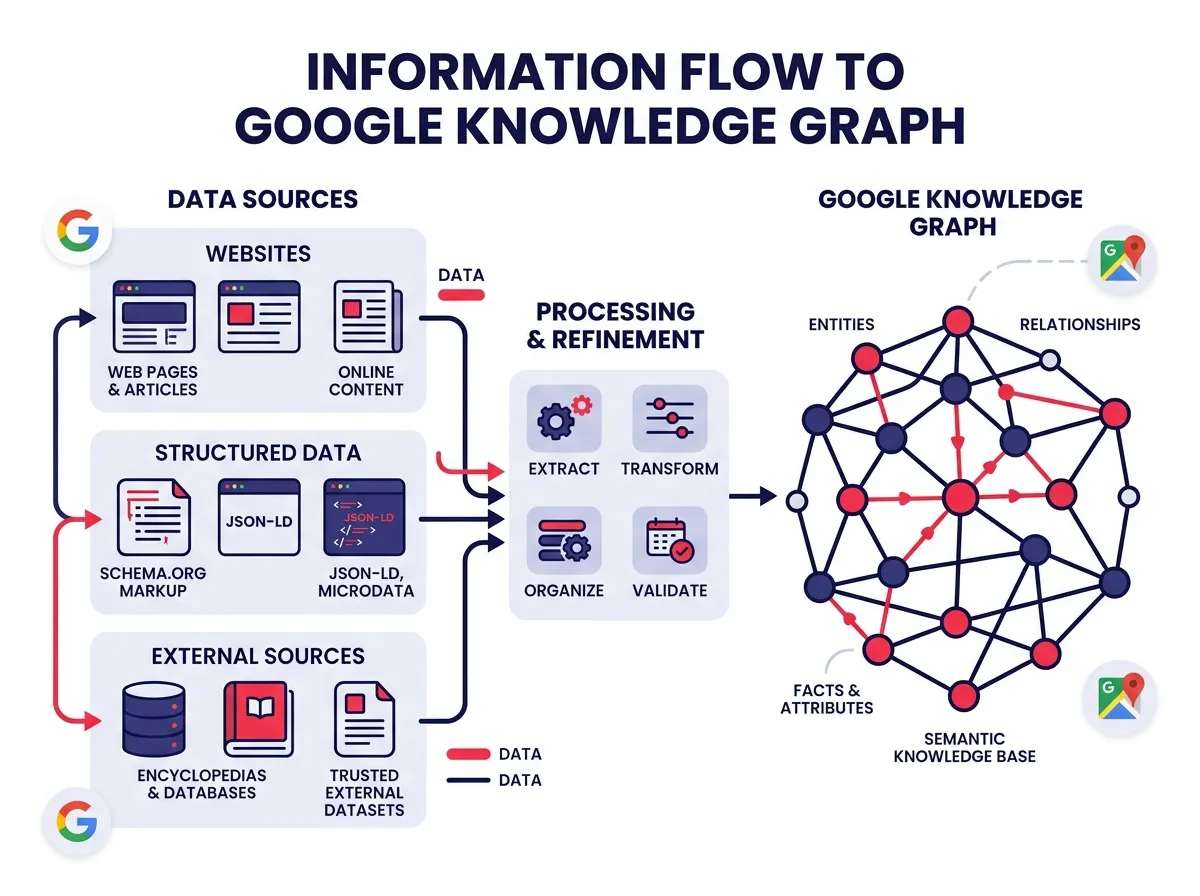
You might wonder where all this information originates. It is a mix of public knowledge, user feedback, and signals provided by site owners through code. Google works to compile the most accurate version of the truth by cross-referencing multiple sources.
Public and Licensed Data Streams
A large portion of the repository is built from high-trust sources. This includes platforms like Wikipedia or Wikidata, as well as licensed industry databases that house official records. By comparing these stable points, Google keeps its data current.
This creates both a challenge and an opportunity. If your business presence exists on sites that Google trusts, the likelihood of having a comprehensive knowledge panel increases. It is important to treat your profiles on credible industry platforms as part of your broader strategy. Keep your details—like your domain, legal name, and address—exactly the same across every site.
The Role of Structured Markup and User Feedback
Structured data is a specific way to write code on your site to tell Google what your content means. By using schema markup, you speak the same language as the search engine. This code clarifies specific points: “Here is my location,” “These are my hours,” or “This is my author profile.”
User feedback also keeps the data fresh. If enough people interact with a knowledge panel or suggest edits through the interface, the database can update. This is why you must monitor your own brand presence. If you spot incorrect information in your panel, fix it through the proper channels to maintain your brand trust.
Strategies to Improve Your Brand Presence in the Knowledge Graph
If you want to influence your visibility, you must take control of how your entities appear online. This requires a disciplined approach to your website structure and your broader digital footprint.
Implementation of Strategic Schema Markup
The most direct way to speak to Google is through technical documentation. Use schema markup to define your business entities clearly. Implement schema for your organization, products, staff, and physical offices.
Start by marking up your core, high-traffic pages. A contact page should use location schema, while an events page should use events schema. This creates a clear map for the machine to follow. When your site is easier to parse, Google is more likely to trust the data you provide. Keep in mind that this is not just an SEO task; it is about ensuring your customers find the right details fast.
Consistency and Authority Building Across Assets
A fragmented brand image confuses the search machine. If your website says your business is in one neighborhood, but a directory site places you somewhere else, the graph may struggle to link your identity correctly. Authority builds when Google sees identical information across multiple trusted websites.
Audit your social media platforms and directory listings. Ensure your business name, address, phone number, and primary URL are identical in every single place. When you build this consistency, you are telling the machine that you are a stable, reliable entity. This creates a baseline of trust.
High-quality content also builds status. When you answer common industry questions with clarity, you increase the chances that Google identifies you as an authority. If you build helpful guides about your sector, you can eventually become the entity cited in knowledge panels or AI summaries. This is how you shift from merely appearing in search results to being the preferred answer.
Focus on a long-term strategy that prioritizes clean, factual data. When you treat your data as a critical business asset, the way Google interacts with your site changes. It stops seeing your site as just a collection of pages and starts viewing your brand as an established entity with verified information.
When reviewing your efforts, look for more than just rank positions. Monitor your knowledge panel and check if you appear in featured answers. These are the real markers of success in a landscape defined by entity based retrieval. By remaining consistent and providing genuine value, you establish a firm place in the modern search environment.
Consider the role of your staff, too. In professional services, the experts behind your content are entities in their own right. By marking up your authors and connecting them to your brand, you allow the machine to understand that you have a team of trusted professionals behind the work. This adds a critical layer of credibility.
Keep in mind that search results are never static. They are constantly updated based on new information and user behavior. A strong strategy today requires continuous monitoring. Periodically check your presence, update your structured data as you grow, and ensure your digital citations remain precise.
When you prioritize clarity and structure, you remove the obstacles that prevent Google from understanding you. This reduces the risk of confusion and ensures that your best information is what the machine presents to potential customers. It is a disciplined, thoughtful approach that rewards organization.
Building a brand in this environment requires the mindset of an information architect. You are responsible for how the machine perceives your business. Every piece of content, every social link, and every line of code contributes to that perception. The goal is not to trick the system but to provide the clearest path for the search engine to deliver your value to the right person.
As you refine your approach, watch how your customers search. Use that same language in your headers and on your pages. When your terminology matches the real-world needs of your audience, it is much easier for the engine to align the two. That is the core of smart search strategy.
Finally, do not forget the human component. While the machine processes the data, it is a human who eventually consumes it. Your goal is to make the information helpful, clean, and clear. If you succeed there, the technical bits like structured markup just help that audience find your work faster. Keep your focus on providing genuine answers and maintaining an orderly representation of your business across the web.
Consistency is the bedrock of authority. When you manage your information effectively, you set the stage for long-term growth. Because search rankings are always learning, your commitment to clean data sets you apart. It shows a level of professionalism that signals quality to both the computer and your potential clients. That is how you create an enduring presence in a changing digital world.
As you move forward, keep a watchful eye on how your competitors manage their entity data. If they ignore schema or have inconsistent information across sources, you have a clear opportunity to pull ahead simply by being better organized. This is a quiet, powerful way to improve visibility without needing to spend a fortune on aggressive campaigns.
Small, steady improvements to your site architecture pay off. Think of it as investing in your reputation. You are ensuring that every time your brand is requested, the machine reaches into its database and pulls out the most accurate, detailed, and trusted information available. This is the essence of how knowledge impacts your business growth.
Never underestimate the power of a simple, correct answer. Business professionals often overengineer their approach hoping to find a secret trick to rank higher. But the system is designed to favor the truth and the most direct path to a common solution. Lean into that, and you become the obvious choice for both the algorithm and the human user.
The way you structure your site today acts as the foundation for tomorrow. As AI, voice search, and other formats continue to evolve, having a rock-solid, entity-based foundation will be your biggest asset. It ensures that no matter how the results page changes, you have provided the raw materials needed for your business to be included.
Stick to the basics of good architecture, clear communication, and factual accuracy. These pillars support a successful long-term strategy for any professional organization. Your brand is more than just a domain name—it is a real-world entity that deserves to be accurately reflected in the collective knowledge of the world. Ensure you are the one steering that reflection by being active and intentional with your data and identity.
Every effort put into refining your presence today is an investment in your future visibility. Whether you are adding an author profile, updating a service location, or cleaning up citations, each step clarifies your role in the industry. The result is a more resilient and recognizable brand.
A final note on patience. These shifts do not happen overnight. Google needs time to re-index, verify, and process your updates. Once you implement a change, trust that it will pay off as part of a larger plan. Keep your standards high and your information clear.
By taking control of your entity data, you are participating in the conversation. You are telling the machine exactly what you want your customers to know. This proactive stance is what separates casual users from the professionals who see consistent results. Stay focused on the quality of your input and the consistency of your output. That is the path toward lasting success.
In summary, modern search is all about clarity and relationships. The more clear you are about who you are, what you offer, and who you serve, the more successfully the machine can connect you with the right people. Use the available tools, keep your records in order, and focus on the real-world impact of your professional services. This will guide your growth and solidify your standing for years to come.
As the ecosystem develops, your ability to adapt will be tested. Some brands will try to chase every new trend. Others will focus on the solid, unchanging principles of factual representation. The latter is almost always the more effective strategy.
Remember that the system reflects the reality you build for it. If you build it with care, honesty, and precision, the system acknowledges that. That is the standard to hold for your own efforts. Stay consistent, remain clear, and focus on helping people find the exact information they need from a source they can trust.
When you look back on your work in the coming months, you will see that the most effective tasks were the ones that made sense to both sides of the screen. You clarified your brand, you used the right language, and you simplified the path for users to reach you. That is the winning strategy. Keep iterating on this foundation and you will continue to see the benefits across your entire search performance.
The future of your brand is being written in that graph right now. Make sure every entry you contribute is accurate and meaningful. Your authority depends on it.
Your business is complex, but describing it to a machine should be straightforward. Use the tools at your disposal, be diligent with your data, and always aim to be the most helpful source of information in your niche. That is how you win, how you stay relevant, and how you grow.