TL;DR
- LLMs build their picture of a brand from affiliate content, reviews, listicles and blog posts, so a brand described as great for small businesses in one place, enterprise-ready in another and built for modern teams on its homepage dilutes how confidently AI systems recommend it.
- The suggested fix is an audit of the top 20 to 30 affiliate and comparison articles mentioning the brand, followed by a short document carrying three to five core messages, not a 40-page style guide, briefed out to affiliates.
- The proposed model pairs a flat monthly or quarterly media fee for a guaranteed position inside a review or comparison article with the standard sales commission, since no affiliate platform has an AI mention metric and an affiliate paid $8 on a $200 commission is credited only for the click.
- Sites already linking to a brand are named the easiest affiliate recruits, since affiliate revenue gives a publisher a financial reason to keep the link live, and recruitment can buy a place in top-five comparison articles that AI systems summarize.
AI is reshaping how search engines surface content and how brands get discovered. If you work in SEO or affiliate marketing, the question isn’t whether your role will change. It’s whether you’ll change with it.
Most teams still treat these two channels as separate operations. SEO teams chase rankings. Affiliate managers chase commissions. Neither group spends much time in each other’s strategy sessions, and that separation is quietly becoming a liability.
Here’s what’s actually going on. SEO and affiliate marketing are more intertwined than most teams realize, and that overlap is now a strategic advantage worth exploiting. When AI Overviews pull from third-party content to answer a searcher’s question, that content is often affiliate-driven. When a large language model builds an understanding of what a brand offers and who it serves, it’s drawing from review sites, comparison articles, and listicles that are usually monetized through affiliate programs.
The way brands get recommended is shifting fast, from AI Overviews to LLMs, and your playbook needs to catch up. The three strategies below are practical, specific, and built for teams who want to stay competitive as this shift continues.
- Align Your Brand Messaging Across SEO and Affiliate Channels
- Update Your Affiliate Payment Models to Reflect Modern Attribution
- Cross-Recruit Link Building and Affiliate Programs for Compounding SEO Gains
Align your brand messaging across SEO and affiliate channels
If your affiliate content says one thing about your product and your own website says something slightly different, you’re leaving a gap that AI systems will notice, even when humans won’t.
This isn’t about enforcing rigid brand guidelines. It’s about making sure that when LLMs scan the web to understand what your brand does, who it helps, and why someone should care, they’re finding a consistent, reinforcing story across every source that mentions you.
Why LLMs reward consistent brand signals
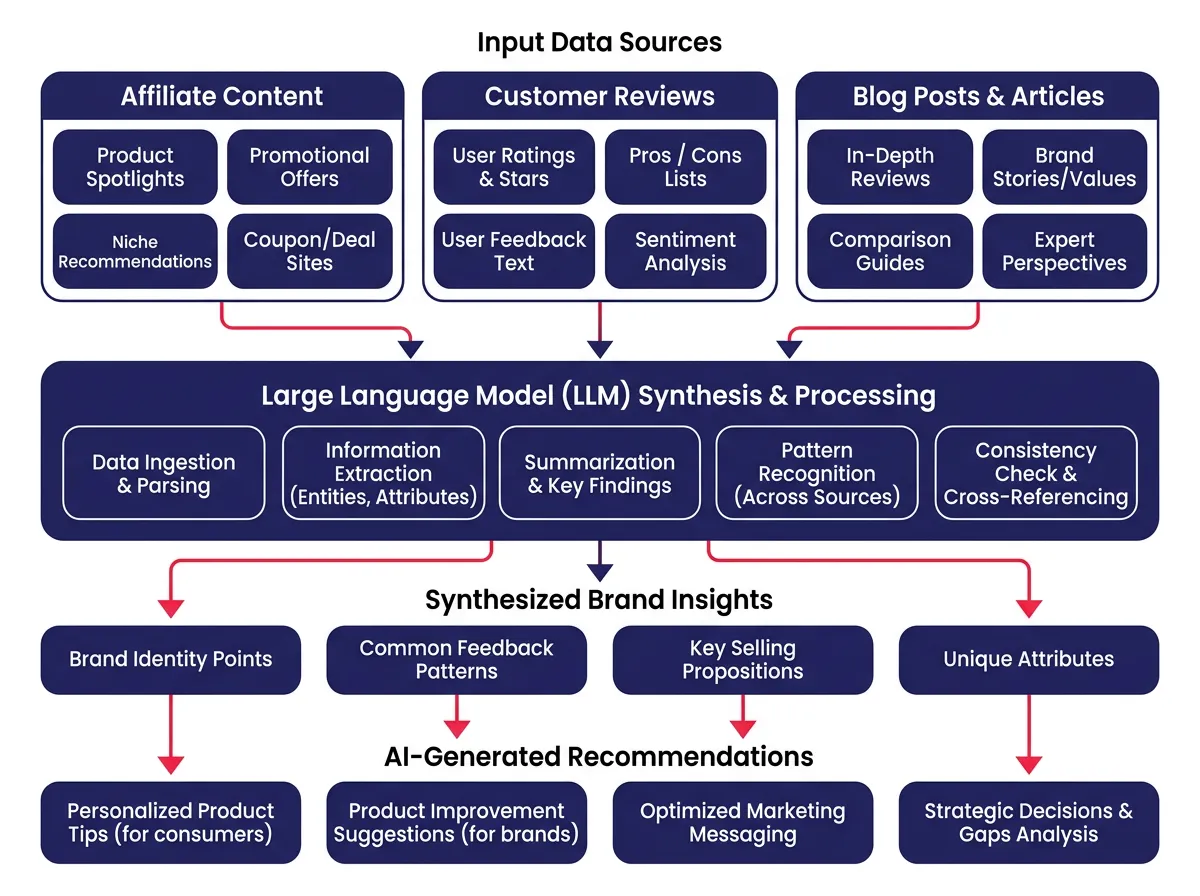
Large language models don’t rank pages the way Google’s traditional algorithm does. They synthesize information from a wide range of sources to build an understanding of a topic or a brand. That synthesis process rewards brands that show up clearly and consistently across many independent sources, not just their own website.
Think about what happens when someone asks an AI assistant which project management tool is best for remote teams. The model has probably processed thousands of articles, reviews, and comparison posts on that topic. If your brand appears in many of those sources with the same core message (say, that you’re built specifically for distributed teams and integrate with the tools remote workers already use), that message starts showing up in the model’s outputs.
But if your affiliate content says you’re “great for small businesses,” your blog says you’re “enterprise-ready,” and your homepage says you’re “built for modern teams,” the model is trying to reconcile three different stories. That inconsistency dilutes how confidently AI systems recommend or describe you.
LLMs pull from affiliate content, reviews, listicles, and blog posts to form an understanding of what a brand does and who it serves. Inconsistent messaging across those sources creates gaps that competitors with tighter narratives can fill.
There’s a practical implication here that a lot of people aren’t talking about yet: whoever controls your affiliate brief is now partially responsible for your AI visibility. Most affiliate managers have never been told that.
How SEO and affiliate teams can build a shared messaging framework
The fix is collaborative and honestly simpler to start than most teams expect.
SEO teams are already doing keyword research, content audits, and competitive gap analyses. They know which selling points are missing from the organic content landscape and which angles are helping competitors rank or get referenced in AI Overviews. That knowledge is genuinely useful for affiliate briefs, but it almost never gets shared.
Start with an audit. Pull the top 20 to 30 affiliate articles and comparison posts that mention your brand. Read them alongside your own content. Look for contradictions, missed opportunities, and competitor talking points you’re not addressing.
From there, build a short document (not a 40-page style guide) that gives affiliates the three to five core messages your brand needs reinforced. Ground it in what your actual customers say about you. Include specific phrases that SEO research shows are being searched for and that AI Overviews are already picking up on.
Then brief your affiliates. Most affiliate managers don’t send content briefs at all. The ones who do tend to send vague instructions about word count and disclosure requirements. A brief that says “please work in these three specific value propositions naturally when you update your review” is a completely different level of strategic engagement, and affiliates who care about their content will appreciate the direction.
SEO teams can identify missing selling points and brief affiliates to incorporate them naturally, improving both LLM knowledge bases and reader relevance. When this works well, you’re essentially coordinating a distributed content team without putting anyone on payroll.
Update your affiliate payment models to reflect modern attribution
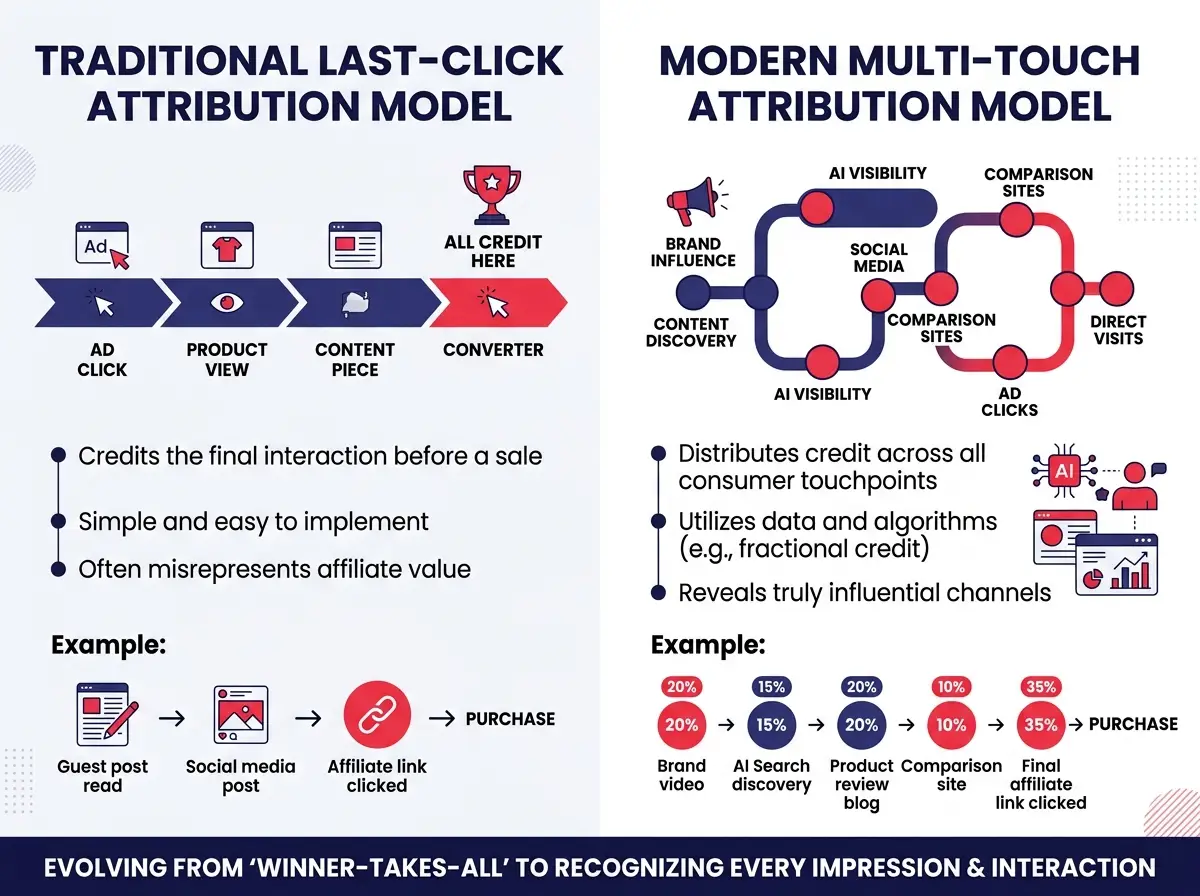
The standard affiliate commission structure was designed for a world where tracking was binary. Someone clicked a link, bought a product, and the affiliate got a percentage. That made sense when the buyer’s journey was linear and search was the main discovery channel.
That world is gone.
Today, a potential customer might encounter your brand in an AI Overview, read an affiliate comparison article, watch a YouTube review, and then come back to search your brand name directly before buying. In that scenario, the affiliate article played a real role in the sale but might not receive credit under a last-click attribution model.
This isn’t just a fairness issue. It’s a strategic one. If your payment model doesn’t reflect the actual value your affiliate partners are creating, you’ll underpay the ones who matter most and eventually lose them.
Why the old commission model no longer covers the full picture
Affiliates who show up consistently in AI Overviews and get sourced by LLMs when someone asks a question related to your product are doing something more valuable than driving last-click conversions. They’re shaping how AI systems understand and recommend your brand.
That kind of visibility doesn’t show up in a standard affiliate dashboard. There’s no “AI mention” metric in most affiliate platforms yet. But the effect is real. Brands that regularly surface through AI assistants and search overviews are building a kind of ambient awareness that pays off in direct search volume, branded queries, and long-term customer acquisition.
The problem is that the affiliate receiving $8 on a $200 commission for driving that kind of awareness is being measured only by the click they drove, not the role they played in the full journey. That creates a mismatch between strategic value and compensation, and over time, those affiliates will prioritize partners who understand what they’re actually worth.
Affiliates who are regularly sourced by AI Overviews and LLMs represent untapped visibility assets, and the payment model should reflect that strategic value, not just last-click conversions.
Building a payment structure that works across SEO and AI visibility goals
A more modern affiliate payment structure combines two things: a media fee for guaranteed placements and a traditional commission for sales.
The media fee is a flat payment, often monthly or quarterly, for maintaining a specific position within a review or comparison article. This is not buying a fake review. It’s paying for guaranteed real estate in a piece of content that’s already ranking well or getting sourced by AI systems. The placement stays as long as the fee is paid, and the content stays genuine.
On top of that, the standard commission still applies. When a sale happens through the affiliate’s link, they earn their percentage. The two structures work together rather than replacing each other.
This approach does a few things well. It gives affiliates a predictable income stream beyond commission volatility. It gives brands guaranteed coverage in high-value content. And it creates an honest economic relationship that acknowledges both the conversion role and the visibility role that affiliate content actually plays.
Media fees for guaranteed placements, combined with traditional commission structures, create a more honest and durable partnership framework. Teams that implement this structure often find that affiliates become more communicative partners, more willing to update content and incorporate new messaging, because the relationship feels like a real business arrangement rather than a passive revenue share.
The attribution conversation will only get more complex as AI search grows. Getting ahead of it now by building more sophisticated payment models positions your affiliate program as a premium partner destination, which draws better content creators and stronger placements.
Cross-recruit link building and affiliate programs for compounding SEO gains
Most SEO teams have a list of sites they want links from. Most affiliate managers have a list of sites they want to recruit into the program. In the majority of companies, these two lists are never compared.
That’s a missed opportunity hiding in plain sight.
When you combine link building outreach with affiliate recruitment, you create a flywheel where SEO goals and affiliate goals reinforce each other. A site that joins your affiliate program has a direct financial reason to keep your link live, update their content when you launch new products, and add your brand to comparison articles they write going forward.
Turning existing linkers into affiliate partners
The easiest affiliate recruits are the sites already linking to you.
These sites have already decided your brand is worth mentioning. They don’t need a pitch convincing them you’re legitimate. The conversation is simple: you’re already sending your audience to us, and we’d like to pay you for the referrals that convert.
That outreach converts at a much higher rate than cold affiliate recruitment. The site already has context about your brand. The editor or writer has already done the work of including you in their content. Bringing them into the affiliate program formalizes and rewards something they’re already doing.
It also protects your link profile. An affiliate partner has a financial incentive to maintain that link and keep it in a natural, editorially appropriate position. A site that isn’t monetized through your program has no particular reason to keep the link live, update the anchor text, or maintain the content. Affiliate partnerships create durability.
Sites already linking to a brand are the easiest affiliate recruits because the pitch is simple: get paid for something you’re already doing.
Using affiliate recruitment to fill SEO coverage gaps
Not every site you want coverage on will respond to a traditional link building pitch. Some publishers have policies against adding links without a business reason. Some just aren’t motivated by the standard “we think this would be useful for your readers” angle.
Affiliate recruitment changes the dynamic. When you approach a site with a revenue opportunity tied to natural, relevant coverage of your product, the conversation shifts. You’re not asking for a favor. You’re proposing a business partnership.
This is especially useful for content categories where SEO can’t secure organic coverage on its own. If a key comparison article in your space consistently ranks in the top five positions and your brand isn’t mentioned, an affiliate relationship with that publisher gives them a monetized reason to include you. The link comes along with the placement as part of the natural content structure.
When SEO can’t secure organic coverage, bringing a site into the affiliate program creates a monetized incentive for natural mentions, while keeping competitors from claiming that space. This matters for LLMs too. If the top-ranking articles in a category aren’t mentioning your brand, AI systems summarizing that topic won’t mention you either. Affiliate recruitment in this context isn’t just a sales play. It’s an AI visibility play.
The teams that win in this environment are the ones that stop thinking of SEO and affiliate marketing as separate lanes. The brands getting pulled into AI-generated recommendations aren’t always the ones with the best products. They’re the ones with the broadest, most consistent presence across the content sources that AI systems trust.
Building that presence means SEO and affiliate teams working from the same strategy, sharing the same data, and measuring success with a shared understanding of what visibility actually means when AI is doing the searching.
The playbook has changed. These three strategies are a solid place to start rebuilding it.