TL;DR
- OpenAI opened a self-serve Ads Manager inside ChatGPT with CPC bidding and conversion tracking, letting advertisers register, upload creative, set budgets and pacing and launch without an agency relationship or a custom insertion order.
- Access was limited to U.S.-based advertisers at the time of writing, with no announced minimum spend for self-serve and no confirmed timeline for other markets.
- The earlier phase was an invite-only pilot with select agency partners including Dentsu, Omnicom, Publicis and WPP, and the original model was CPM-based before the move to CPC.
- Conversion measurement runs server-side through Conversions API integration plus pixel-based tracking on the advertiser's own site; reporting is aggregated, with no session-level data and no conversation content shared with advertisers.
- Public benchmarks for CPC, conversion rate and return on ad spend were still limited, so the post frames ChatGPT as a funded test channel with conversion tracking, CPC bidding and success criteria all defined before launch.
OpenAI just made ChatGPT advertising accessible to any business with a budget and a browser, and the platform looks a lot more familiar than most people expected. What started as a closed, invite-only experiment has turned into a real self-serve channel with tools performance marketers already know how to use.
ChatGPT has officially launched a self-serve Ads Manager with CPC bidding and conversion tracking. That combination moves this platform well past the experimental phase and puts it in the same conversation as more established digital advertising channels. Whether you’re running a small in-house team or managing campaigns for multiple clients, this changes how seriously you need to take ChatGPT as an ad placement.
This guide breaks down exactly what changed, how the new tools work, what advertisers should expect when they get started, and whether now is the right time to test this channel for your business.
- What OpenAI Just Launched Inside ChatGPT
- CPC bidding and conversion tracking: the features that change everything
- Should you test ChatGPT ads in 2026? A practical advertiser perspective
What OpenAI Just Launched Inside ChatGPT
For most of its life, ChatGPT has been an ad-free product. OpenAI focused on subscription growth, API revenue, and enterprise contracts. Advertising was always somewhere on the roadmap, though, and now it’s here in a much more structured form than many people anticipated.
From pilot program to self-serve platform
Before any self-serve buying was available, OpenAI ran a carefully controlled pilot with a short list of select agency partners. Dentsu, Omnicom, Publicis, and WPP were among the first to get access. This gave OpenAI a way to test ad formats inside the ChatGPT experience without fully opening the floodgates, while also getting feedback from sophisticated buyers who could help shape the product.
That invite-only phase served its purpose. It let OpenAI build out the infrastructure, test how ads performed in a conversational AI environment, and figure out what formats made sense without disrupting the user experience too aggressively. Working closely with major holding companies also helped define what a self-serve product would actually need to include before it could stand on its own.
Now the platform has moved beyond that invite-only model. The new self-serve Ads Manager inside ChatGPT is available to U.S. advertisers and lets businesses register, set up campaigns, and go live without needing a managed relationship with an agency or a direct deal with OpenAI’s sales team. That is a real shift in who can participate and how quickly they can get started.
 The new platform includes the tools you’d expect from a self-serve buying experience. Advertisers can upload creative assets, set campaign budgets, control pacing, choose bidding methods, and monitor performance data, all without calling anyone or signing a custom insertion order. You sign up, build your campaign, and launch it yourself.
For brands and agencies that were waiting to see whether ChatGPT advertising would become a real channel or stay a niche experiment, this launch is the signal they were looking for.
Who can access ChatGPT ads right now
Access is currently limited to U.S.-based advertisers. OpenAI hasn’t confirmed a firm timeline for expanding to other markets, but given how quickly the platform evolved from pilot to self-serve, international availability will probably follow. If you’re based outside the U.S., this is worth tracking even if you can’t test it yet.
For U.S. advertisers, the process is fairly straightforward. You register through the Ads Manager, go through OpenAI’s verification steps, and then start building campaigns. There’s no minimum spend commitment announced for self-serve access, which means smaller businesses and in-house teams can get in at a manageable budget without committing to large deals upfront.
The types of businesses that make the most sense for early access are those selling products or services where research and consideration play a big role in the purchase process. ChatGPT users are often in active problem-solving mode. They’re comparing options, asking detailed questions, and looking for recommendations. Advertisers who can show up in those moments with relevant messaging are working with a real intent signal.
CPC bidding and conversion tracking: the features that change everything
When OpenAI first started testing ads inside ChatGPT, the model was CPM-based. You paid for impressions and hoped the visibility led somewhere measurable. That approach works fine for brand awareness goals, but it’s a hard sell for performance-focused advertisers who need a direct connection between spending and outcomes.
CPC bidding and conversion tracking change that equation entirely.
Why CPC bidding makes ChatGPT feel like a real performance channel
CPC bidding is a familiar framework for anyone who has run campaigns on Google, Meta, or Microsoft Advertising. You set a bid for a click, your budget is spent when someone engages, and you can compare cost-per-click against other channels to evaluate efficiency. It’s not a perfect measure of ROI on its own, but it gives you a starting point most performance marketers are comfortable with.
The reason this matters for ChatGPT specifically comes down to the nature of the user base. People who use ChatGPT regularly tend to be engaged, research-driven, and often mid-funnel in their decision-making. They’re asking detailed questions, comparing products, requesting recommendations on services, and actively working through problems. An impression in that environment carries different weight than a scroll-past on a social feed.
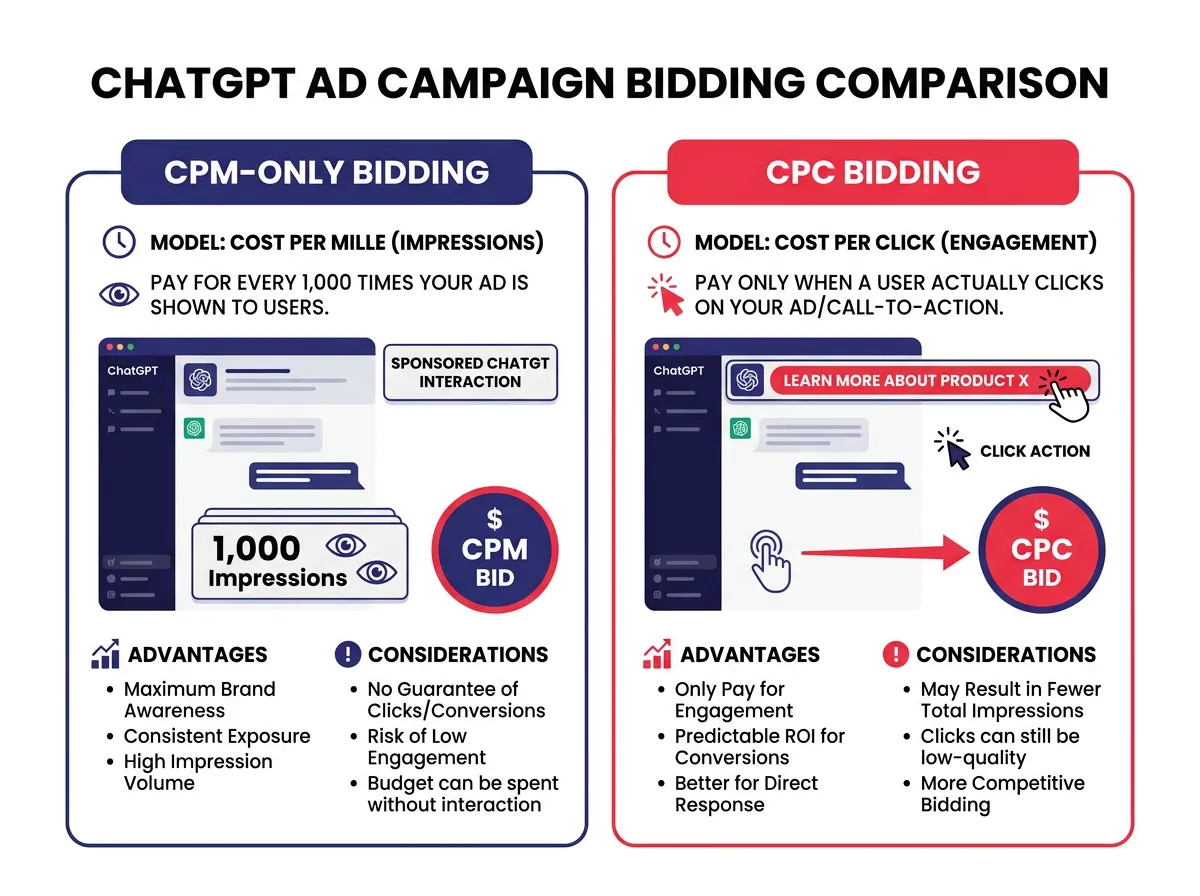 With CPC bidding, you’re only paying when someone actually clicks through. That ties your spend to genuine engagement rather than passive exposure. For a channel where users are already highly active and intentional, paying on a per-click basis is a reasonable way to test whether that intent is converting into real business results.
The shift also says something about how OpenAI wants ChatGPT ads to be perceived. By adopting performance bidding models, they’re positioning this as a channel that can deliver measurable outcomes, not just brand impressions. That framing matters as they try to pull budget away from more established platforms.
How conversion measurement works without compromising privacy
Conversion tracking in a conversational AI environment raises real questions. ChatGPT conversations are private, and users have a reasonable expectation that their interactions aren’t being shared with advertisers. OpenAI has addressed this by supporting server-side measurement tools rather than relying on conversation-level data.
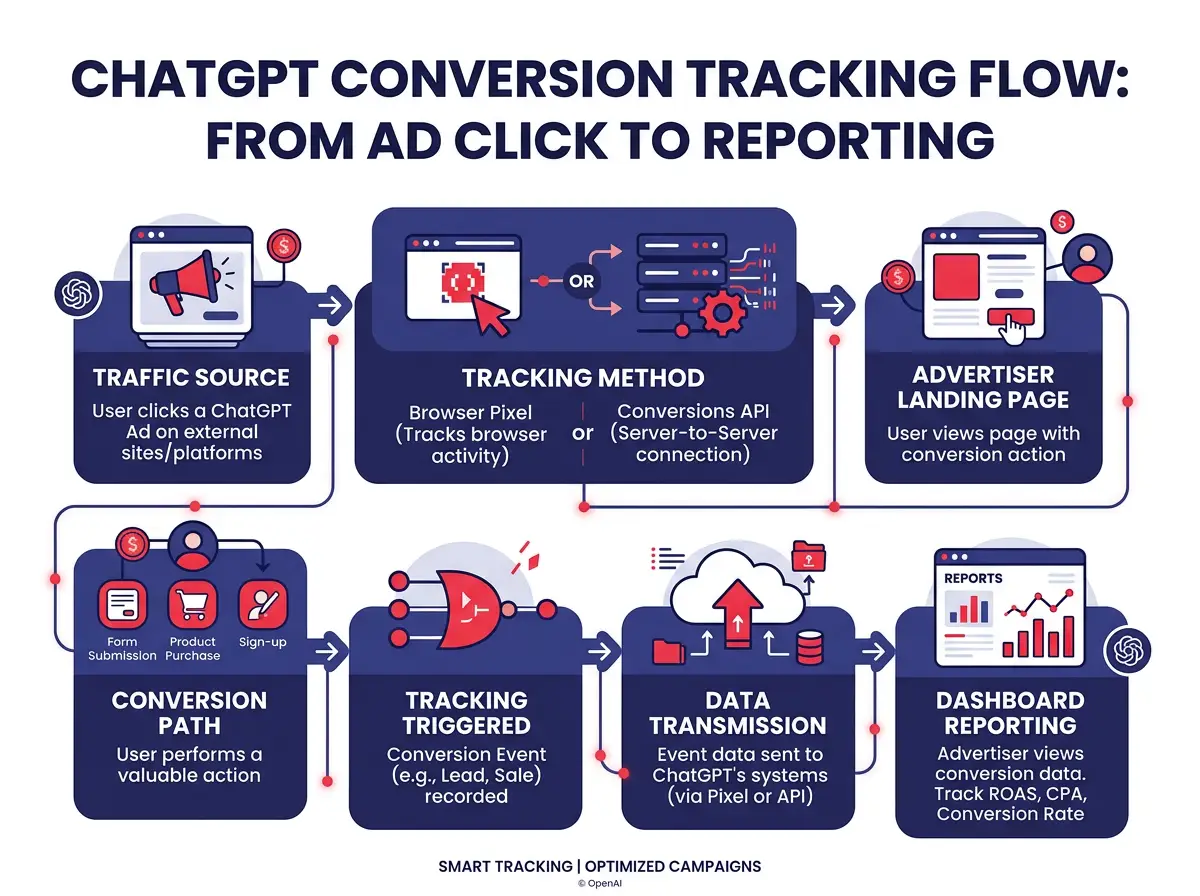
The platform supports Conversions API integration, a server-side approach many advertisers already know from Meta and other platforms. It also supports pixel-based tracking for events that happen on your own website after a user clicks through from a ChatGPT ad. You can measure purchases, sign-ups, lead form submissions, and other downstream actions without OpenAI sharing individual conversation data with advertisers.
Reporting is aggregated. You can see that a campaign drove a certain number of conversions at a certain cost, but you’re not getting session-level data or any information about what specific users asked or said inside ChatGPT. That’s an intentional constraint, and it lines up with the privacy standards becoming more common across the industry.
For advertisers already running Conversions API on Meta or server-side tagging through Google Tag Manager, the integration should feel familiar. It’s not a completely new technical lift. For smaller teams without existing server-side infrastructure, the pixel-based option is a simpler starting point.
 The measurement story is still developing. Benchmarks for expected conversion rates, average CPC, and typical return on ad spend in ChatGPT campaigns are limited right now because the self-serve platform is new. Early adopters will be building those benchmarks themselves, which is both a challenge and an opportunity depending on your appetite for testing.
Should you test ChatGPT ads in 2026? A practical advertiser’s perspective
Anytime a new ad platform opens up, the instinct for performance marketers is to evaluate it quickly and move on if it doesn’t fit. That’s usually the right call. Not every platform deserves your budget. But there are a few things about ChatGPT advertising that make it worth a more careful look.
What makes ChatGPT a genuinely different ad environment
User behavior inside ChatGPT is different from almost every other ad platform you’re probably using. On social platforms, users are primarily browsing, entertaining themselves, or staying connected. Search captures intent at a high level but often at a very early or very late stage of the journey. ChatGPT is different because people come with specific questions and problems they’re actively working through in real time.
When someone asks ChatGPT to compare project management tools for a growing team, recommend a credit card for frequent travelers, or explain what to look for when choosing a home insurance policy, they’re in research mode. The intent is explicit and the engagement is deep. That’s a rare combination in paid advertising.
Self-serve access lowers the barrier to entry significantly for smaller businesses and in-house teams. You don’t need agency backing or a six-figure minimum spend to test this channel. CPC bidding makes it easy to set a realistic budget for an early experiment and evaluate performance against other channels you’re already running. The feedback loop is more direct than it was during the pilot phase.
The categories that seem most naturally suited to this environment include SaaS and B2B tools, financial services products, education and training programs, high-consideration consumer purchases, and anything where the buyer typically does extensive research before committing. If your customers tend to ask a lot of questions before converting, ChatGPT is a place those questions are happening.
Setting realistic expectations while the platform is still maturing
Being honest about where this platform stands right now matters if you want to avoid setting yourself up for disappointment. Self-serve access is live, the tools are functional, and the infrastructure is real. But this is still a young channel with limited public benchmarking data.
You probably won’t have strong comparisons for what a “good” CPC looks like on ChatGPT versus Google, or what a competitive conversion rate should be for your category. That data will accumulate over time as more advertisers run campaigns and the industry starts reporting on results. Right now, you’re working with limited external reference points.
That also means your early tests will contribute to your own benchmarks, which is genuinely valuable. Brands that start building performance data on ChatGPT now will have a real advantage as the platform scales and competition for ad placements increases.
The speed at which ChatGPT has adopted standard ad infrastructure tells you something about where this is headed. In a relatively short period, the platform went from an invite-only pilot with major agency partners to a fully functional self-serve buying experience with CPC bidding, conversion tracking, Conversions API support, and integrations with established third-party measurement tools. That is not the roadmap of a company dabbling in advertising.
For advertisers, the practical move is to treat ChatGPT as a test channel worth real budget right now. Not your biggest channel, not your primary focus, but a line item with enough behind it to generate meaningful data. Set up proper conversion tracking before you launch. Use CPC bidding so you have a familiar metric to evaluate. Define what success looks like before you spend a dollar.
If the early results show promise for your category, you’ll be ahead of the brands that wait until ChatGPT advertising becomes the obvious choice. If the results don’t pan out, you’ll have learned something useful and spent a controlled amount finding out. Either way, the new self-serve Ads Manager makes that kind of disciplined early testing more accessible than it’s ever been.