TL;DR
- Nikola Todorovic, Google's Director of Software Engineering, speaking with Martin Splitt, said there is no simple roadmap any single website can follow to guarantee it appears in AI-generated responses or holds its traffic.
- He tied the advice to provide value to external signals Google tracks: branded search volume, click behavior, return visits and how long people stay.
- He placed AI in two legitimate SEO jobs, analyzing your own traffic and ranking data and mapping competitors, and rejected bulk AI content generation; the support uses listed are grammar edits, structure review, headline and meta description variants, and repurposing.
- The reverse knowledge search technique pastes finished content into an AI tool and asks which specific questions it fully and directly answers, to test focus before publishing.
- In the worked example the tool returned about eight questions matching the target queries, and after publishing the article ranked number one on Google for its primary target and appeared in Bing's featured snippets, organic results and news section.
Google’s Director of Software Engineering recently gave SEOs and business owners some unusually direct advice about surviving the age of AI search. And it goes a lot deeper than the “just create good content” line you’ve probably heard a hundred times.
Nikola Todorovic, alongside Google’s Martin Splitt, talked openly about how AI features like AI Overviews and AI Mode are shifting what it actually means to rank well. Their core message: stop treating AI as a threat and start using it with some deliberate purpose. But what does that look like day to day? And what does Google actually reward when AI is now generating answers before users ever click a result?
That’s what this article gets into, from what Google is genuinely saying about value and ranking signals, to specific ways AI tools can improve your SEO strategy, to a concrete prompt technique that helped push a page to the number one spot on Google.
- What Google Is Actually Saying About AI and the Web Ecosystem
- Using AI Tools In the Right Way for SEO and Content Strategy
- A Practical AI Prompt Strategy That Gets Pages to Rank Higher
What Google Is Actually Saying About AI and the Web Ecosystem
The Question Every SEO and Business Owner Is Asking
If you’ve been paying attention to SEO for the past couple of years, you’ve probably asked some version of the same thing: does any of this still matter now that AI is writing answers directly into search results?
AI Overviews surface information before users even scroll to organic results. AI Mode goes further, letting people run multi-step conversational queries that skip traditional results entirely. Traffic patterns are shifting, clicks are down for a lot of publishers, and the anxiety in SEO circles is real.
So when Martin Splitt sat down with Nikola Todorovic to talk about this publicly, people paid attention.
The honest answer Todorovic gave? There’s no simple roadmap any one website can follow to guarantee it shows up in AI-generated responses or holds its traffic as search behavior keeps changing. That’s a frustrating answer. But it’s also an honest one, and understanding why he said it is more useful than wishing for something more reassuring.

Why “Provide Value” Is Not Just a Platitude
Here’s where this gets more interesting than most coverage lets on.
When Google says “provide value to users,” a lot of people tune out because it sounds like advice that means nothing in practice. But Todorovic connected that idea directly to how Google’s systems actually measure and reward sites, and that context changes things.
Google tracks what are often called external signals: branded search volume (people specifically searching for your site or brand name), click behavior, return visits, how long people stay. These signals feed into the algorithmic side of how Google figures out which sites are genuinely useful and which ones are just technically well-optimized.
So “provide value” isn’t a fluffy suggestion. It’s describing a real mechanism. When users find your content helpful enough to come back and search for your brand by name, or when they click your result and don’t bounce straight back to the search page, those behaviors register in Google’s systems. They influence ranking.
The practical implication is this: if you’re publishing content primarily to game rankings without actually serving users well, the system is built to eventually detect that gap. Not always quickly. But it compounds over time.
Focusing on user-driven value isn’t separate from your SEO strategy. For Google, it basically is the strategy, just expressed in plainer language than most practitioners prefer to hear.
Using AI Tools In the Right Way for SEO and Content Strategy
AI for Data Analysis and Competitive Research
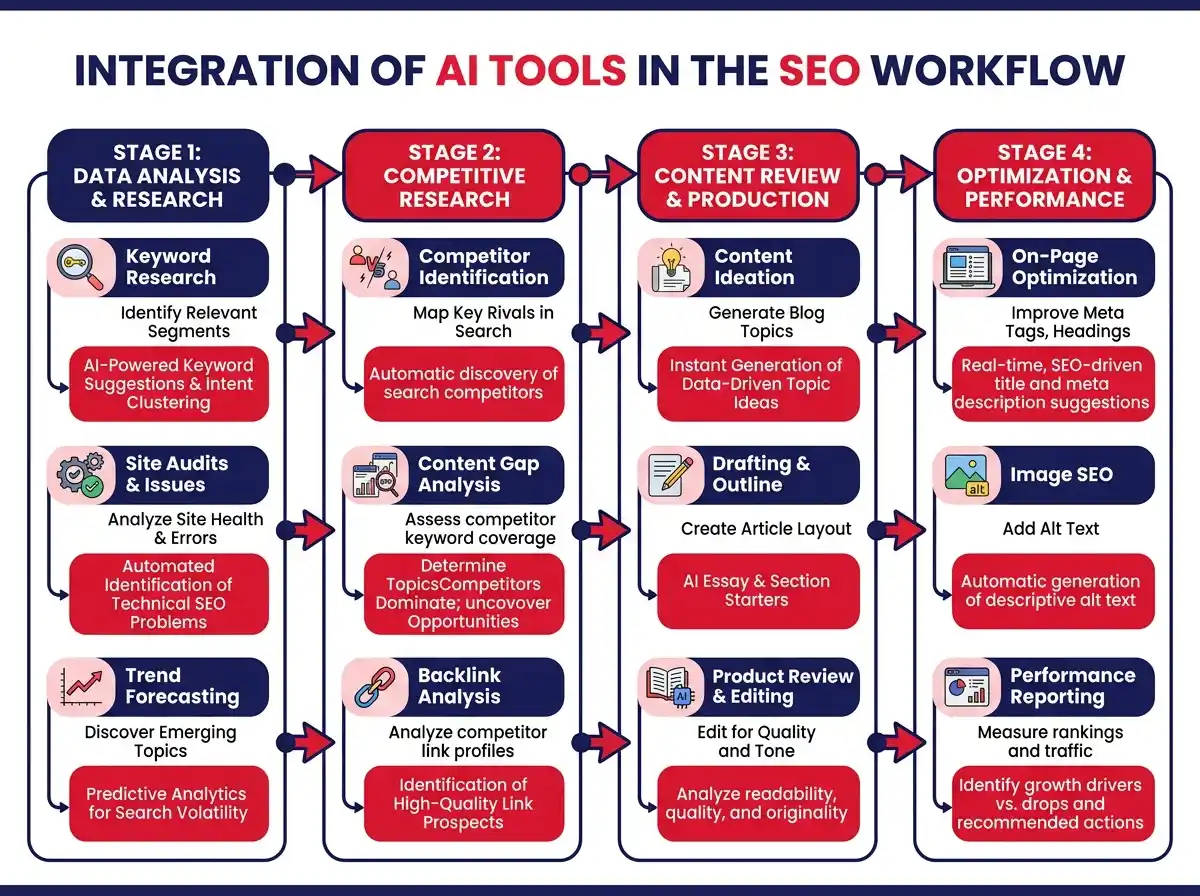
Todorovic got specific about where AI fits into a legitimate SEO workflow. He pointed to two areas: understanding your own data better and understanding your competition better.
Both are genuinely underused, whether by people avoiding AI entirely or by those using it in ways that aren’t going to pay off long-term.
On the data side, this means feeding AI tools your traffic trends, top-performing pages, and keyword rankings, then asking it to surface patterns you might not catch manually. Which pages are holding steady while others slip? Which content clusters seem to drive the most return visits? Where are you sitting on page two or three for terms that a small update might push into the top five?
AI can move through large data sets fast and surface angles worth investigating. It won’t replace your judgment about what to do next, but it cuts the research phase down considerably.
On the competitive side, AI can help you map out what competitors are covering, where the gaps are, and what types of content seem to perform well in your niche. Not to copy anyone, but to understand the playing field well enough to find opportunities they’re missing. Processing multiple sources at once and summarizing the landscape used to take days. Now it takes hours, and that time back can go into content that’s actually differentiated from everyone else’s.
Where AI Helps and Where It Falls Short
Here’s the part that trips a lot of people up.
Todorovic was clear that bulk AI content generation, feeding prompts and publishing output at scale, isn’t the answer. Not because Google has some perfect AI detection system catching everything (the reality is more complicated than that), but because mass-produced AI content tends to lack the actual substance and lived experience that makes content worth reading.
Think about it from the reader’s side. If someone lands on your page looking for help with a specific problem and your content could have been written about any website in any industry, they leave. That behavior tells Google the page didn’t deliver.
Where AI genuinely helps beyond data and competitive research:
- Grammar and clarity: running a draft through an AI tool to tighten sentences and catch awkward phrasing is completely fine. Your ideas, your expertise, just cleaner.
- Structure review: AI can flag whether a piece is organized clearly, whether key points are well-supported, or whether the article actually answers what it promises.
- Headline and meta description options: generating several variations quickly to test which framing lands better.
- Repurposing existing content: turning a long-form post into social snippets, or expanding a shorter piece into a more complete guide.
The line Todorovic drew is worth taking seriously: use AI to sharpen and improve your work, not to replace the thinking and expertise that makes the content yours in the first place. The substance has to come from actual people.
A Practical AI Prompt Strategy That Gets Pages to Rank Higher
The Reverse Knowledge Search Prompt Explained
This is where things get concrete.
One of the more effective ways to use AI for SEO right now has nothing to do with generating content. It’s about analyzing what you’ve already written.
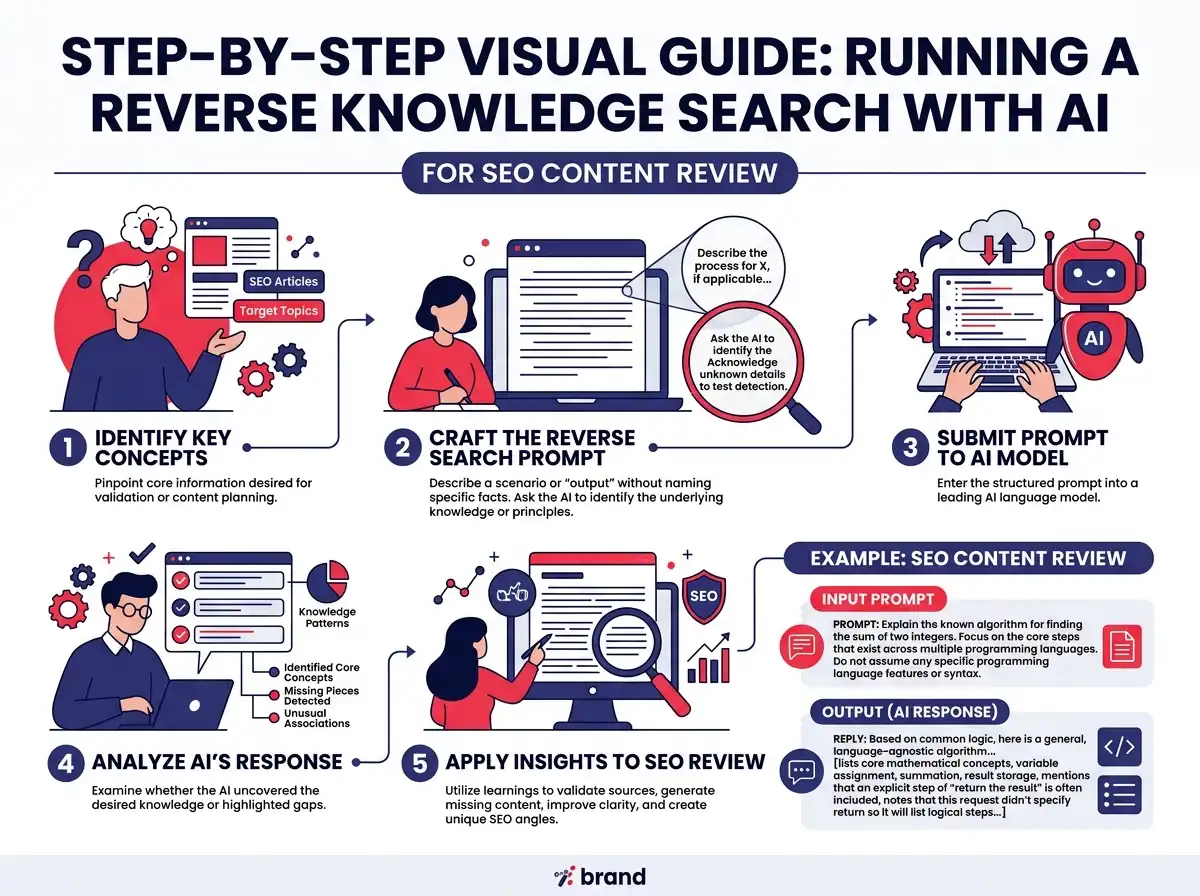
The technique is called a reverse knowledge search. Here’s how it works.
You take a piece of content you’ve already written, paste it into an AI tool, and give it this prompt: “Read this content and tell me which specific questions it fully and directly answers. Be precise. Only include questions where the answer is clearly and completely covered in the text.”
That prompt forces the AI to extract what your content is actually positioned to answer based on what it genuinely covers. Not what you think it covers. Not what you hoped it would cover when you first drafted it. What it demonstrably delivers from a reader’s perspective.
This matters because one of the most common reasons pages underperform is a mismatch between what the writer thought they were addressing and what the content actually delivers. You might think you wrote a thorough guide on a topic, but if your content circles around the specifics without really landing the answers, users feel that gap. And when users feel it, Google picks it up too.
The reverse knowledge search gives you a clear, honest picture of your content’s actual focus. Then you can make a real call: does this page cover what I want it to cover? If not, what needs to be added or tightened before publishing?
Testing Your Content Focus Without Reverse-Engineering Search Engines
This technique isn’t about gaming algorithms. There are no loopholes here, no trick to stuffing specific questions into your content so AI Overviews pull from you instead of someone else.
It’s about verification. Making sure the content you’ve put real effort into is actually aligned with the questions you want it to answer.
Here’s how it played out in practice. An article was run through this reverse knowledge search prompt before publishing. The AI returned a list of about eight specific questions the content fully addressed. Those questions mapped closely to the search queries the article was targeting. After publishing, the article ranked number one on Google for its primary target. It also showed up in Bing’s featured snippets, its organic results, and its news section.
None of that came from AI writing the content. A person with real knowledge of the topic wrote it. The AI was used only to verify that the content’s focus was tight and its answers were complete.
That’s the model Todorovic’s advice points toward, even if he didn’t use this exact example. You use the tool to get smarter about what you’re already doing. You don’t use it to skip the thinking.
A few ways to extend this approach:
- Run the reverse knowledge search before you finalize a draft, not just after publishing. If the AI finds your content only fully answers two vague questions, you know it needs more depth before it goes live.
- Use the extracted questions to inform your header structure. If the AI found that your content clearly answers a question but that question isn’t reflected in a heading, adding that heading improves scannability and helps search systems understand what the page covers.
- Compare the questions your content answers against your actual keyword data. If there’s a mismatch, either adjust the content or adjust your expectations for what that page will rank for.
The bigger picture here is that how AI is reshaping SEO isn’t only about what Google does on its end. It’s also about how you use AI on your end to make better decisions, not just faster ones.
Google’s message through Todorovic and Splitt is consistent with what thoughtful SEO practitioners have been saying for years. The sites that hold their rankings through algorithm changes, through new AI features, and through shifting user behavior are the ones genuinely trying to help people. The difference now is that AI tools give you more ways to verify you’re actually doing that, rather than just assuming you are.
The SEOs and businesses that come out ahead in this environment probably won’t be the ones who generated the most content with AI. They’ll be the ones who used AI to understand their audience better, sharpen their focus, and build something users find worth coming back to.