TL;DR
- The IAB Polska Point of Youth report surveyed 300 Polish adults aged 18 to 30 about the digital marketing industry, and the single largest group answered neutral rather than positive or negative.
- 45% of respondents held a positive view of digital marketing as a career path, and nearly two-thirds associated the field with creativity and inventiveness, yet IT still came out on top when the same respondents named their most aspirational careers.
- 35% named competition as the biggest barrier to entering digital marketing, ahead of pay, lack of opportunity or too few entry-level roles.
- AI split the under-30 respondents, between those treating fluency with generative tools as a career accelerant and those seeing automation erase the junior tasks (first-draft copy, basic reports, image editing, social scheduling) that were the traditional way in.
- Young respondents ranked creativity and innovation above salary among the benefits of the work, and the relationship with a direct manager ranked as a stronger driver of job satisfaction than organizational benefits or formal employment conditions.
Here is a strange thing to sit with: the generation that grew up on Instagram, TikTok, and YouTube, that instinctively understands algorithms, content formats, and audience behavior, is also the generation least likely to feel genuinely excited about a career in digital marketing.
Not opposed. Not hostile. Just… fine with it.
That quiet shrug is the core tension revealed by the IAB Polska “Point of Youth” report, which surveyed 300 Polish adults between the ages of 18 and 30 about their perceptions of the digital marketing industry. The findings are worth sitting with, especially if you lead a marketing team and you’ve been wondering why your junior pipeline feels thin, or why the talent you do hire sometimes seems like they’re keeping their options open rather than actually building a career.
The dominant attitude that came out of that research was neutral. Not aspirational. Not dismissive. Just neutral. And for marketing teams competing against tech companies, consulting firms, and startups for the same talented young candidates, neutral is a problem. It means the industry hasn’t made a compelling case for itself. It means digital marketing careers are landing somewhere in the middle of the list rather than near the top.
This article breaks down what the research actually tells us, why Gen Z talent is hesitant, and what marketing teams can do about it without overhauling their entire hiring strategy.
- Why Young Talent Sees Digital Marketing as ‘Fine’ Rather Than Exciting
- Performance Pressure, AI Anxiety, and the Real Barriers Blocking New Marketing Talent
- What Marketing Teams Can Do Right Now to Attract and Keep Young Digital Talent
Why Young Talent Sees Digital Marketing as ‘Fine’ Rather Than Exciting
What the Numbers Actually Say About Gen Z Career Attitudes
Start with what the IAB Polska data actually shows, because the headline numbers are more nuanced than they first appear.
45% of respondents held a positive view of digital marketing as a career path. That sounds decent until you realize the single largest group didn’t land on positive or negative. They landed on neutral. That middle-ground response is what marketing teams should be paying attention to, because neutral isn’t loyalty and it isn’t rejection. It’s an open door that nobody has walked through yet.
For recruiting teams, this is both a warning and an opening. A warning because it signals the industry hasn’t successfully communicated what makes a career in digital marketing genuinely worthwhile. An opening because neutral sentiment is movable. These aren’t candidates who have made up their minds. They’re candidates who haven’t been given a good enough reason to lean one way or the other.
The marketing industry has a perception problem, and it’s not the kind that a clever ad campaign fixes. It’s the kind that requires marketing leaders to be honest about what the day-to-day actually looks like, what growth paths genuinely exist, and how the work connects to something bigger than campaign metrics.
 ### Creativity scores high, but IT still wins the talent war
Here is where the tension gets sharper. Nearly two-thirds of respondents associate digital marketing with creativity and inventiveness. That’s a strong positive association. Young people broadly understand that this is a field where ideas matter, where there’s room to be expressive, where the work isn’t just rote process.
And yet, when those same respondents were asked about their most aspirational careers, IT consistently came out on top. So you have a generation that sees digital marketing as creative and interesting, but still puts it lower on the wish list than software development, data science, or product roles.
Why does that gap exist? A few reasons tend to come up when you talk to younger candidates or look at research in this space.
First, salary narratives in tech are louder and more specific. Everyone has heard the story about the software engineer who landed a six-figure entry-level role. Digital marketing careers don’t have an equivalent cultural myth pulling people in at that level.
Second, the career ladder in marketing is blurrier. Tech roles often have clearer certification paths, promotion criteria, and titles that signal progression. Marketing careers are more fluid, which can feel like freedom to someone already in the field but feels like uncertainty to someone considering entering it.
Third, the way the marketing industry describes itself isn’t helping. Job postings are often vague. Responsibilities blur across roles. And the gap between “what this job sounds like” and “what this job actually involves” can be wide, which creates hesitation in candidates doing their homework before applying.
For marketing teams, this means recruiting from a talent pool that sees you as a second-choice option. That’s workable, but only if you’re intentional about changing the framing.
Performance Pressure, AI Anxiety, and the Real Barriers Blocking New Marketing Talent
Why ‘Too Much Competition’ Beats Salary as The Top Barrier to Entry
Ask most marketing leaders what stops young people from entering the field, and they’ll probably say something about salaries not being competitive enough. The IAB Polska research suggests that’s not the primary issue.
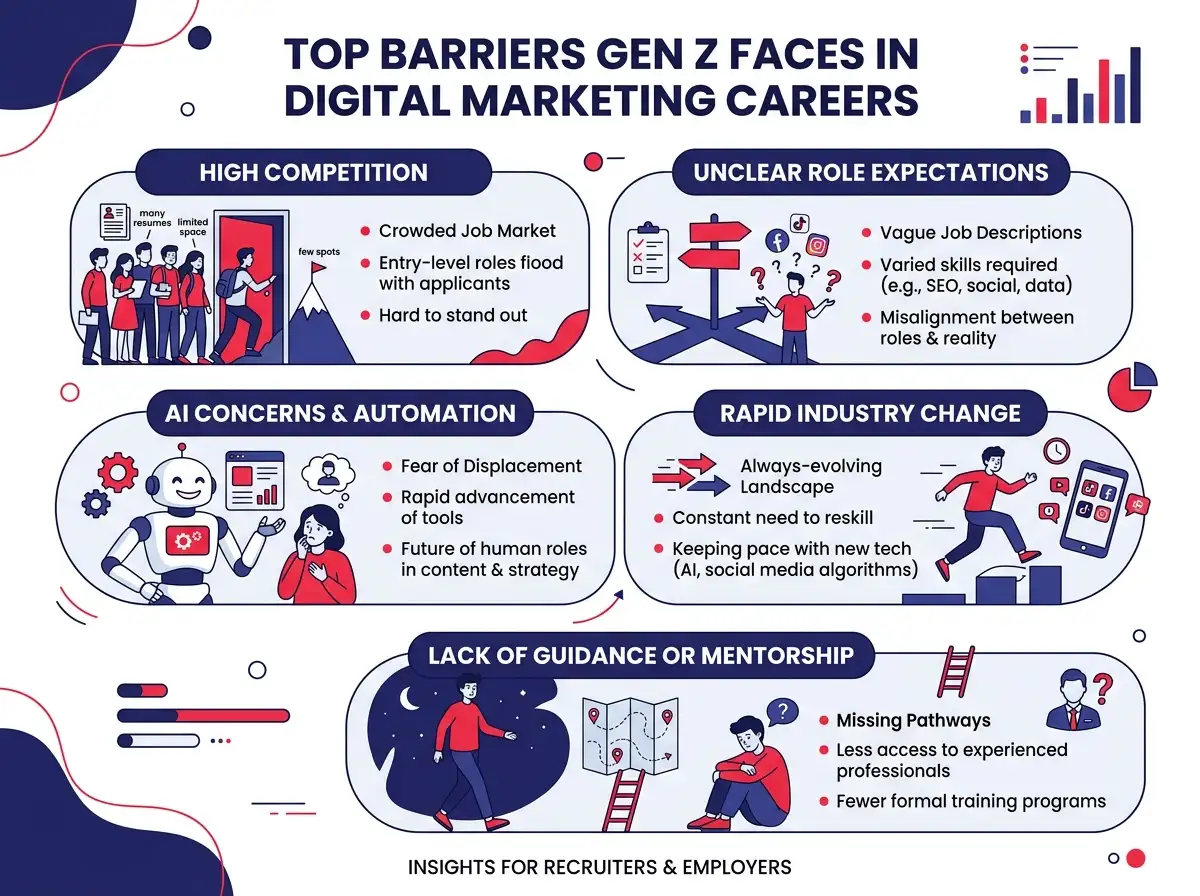
35% of respondents named competition as the biggest barrier to entering digital marketing. Not pay, not lack of opportunity, not insufficient entry-level roles. Competition. The sense that the field is crowded, that everyone has a portfolio now, that the bar to stand out has gotten impossibly high.
This reflects something real. The rise of content creation as a hobby-turned-career has meant that millions of young people have digital marketing skills without formal training or experience. When someone who has been building personal brands since they were sixteen looks at the candidate pool for a junior marketing role, it can feel overwhelming. Imposter syndrome in marketing is a genuine psychological barrier, not a soft issue to wave away.
Unclear day-to-day expectations in many marketing job listings make this worse. When you don’t fully understand what you’d be doing, it’s harder to know whether you’d be good at it. Uncertainty feeds hesitation, and hesitation keeps talented people from applying.
For marketing team leaders, this is actionable. Clearer job descriptions, realistic role previews, and transparent hiring processes directly address the perception that digital marketing is an intimidating field to break into. Small shifts in how you write a job posting can meaningfully change who feels confident enough to apply.
 ### AI splits the room: opportunity vs. threat among under-30s
The IAB Polska report found that AI in digital marketing generates more polarized responses than almost any other topic in the research. It’s worth understanding why that split exists rather than just noting that it does.
On one side, there’s a group of younger candidates who see AI as a career accelerant. If you already understand prompt engineering, know how to use generative tools, and can move faster because of automation, then AI makes you more valuable, not less. These candidates are actively seeking roles where AI fluency is an asset.
On the other side, there’s a group that sees AI as an existential threat to the junior marketing roles that have historically been the entry point into the field. Think about the tasks that used to define entry-level marketing work: writing first drafts of copy, building basic reports, editing images, scheduling social content. A lot of those tasks are now automated or AI-assisted. If the traditional rung on the ladder disappears, how do people get started?
This is a legitimate concern, and marketing teams that dismiss it are missing something important. The junior roles that remain need to be redefined around what AI can’t easily do: strategic thinking, creative judgment, relationship building, cultural reading. That redefinition needs to show up in how you recruit, not just in how you internally structure work.
Being upfront about how your team uses AI, what skills you actually value, and how junior hires grow into senior contributors isn’t just good recruitment messaging. It’s the kind of honesty that builds trust with a generation that has excellent filters for corporate language that doesn’t mean anything.
What Marketing Teams Can Do Right Now to Attract and Keep Young Digital Talent
Lead with creativity in recruitment, not career ladders
The IAB Polska research found that young respondents ranked creativity and innovation above salary when naming the benefits of digital marketing work. If that’s true (and the data suggests it is), then recruitment messaging built around compensation benchmarks and promotion timelines is targeting the wrong psychological levers for this cohort.
That’s a significant shift from how many marketing teams currently talk about themselves to candidates. Salary ranges, benefit packages, remote work policies, and annual review cycles aren’t leading with what actually draws this generation in. Creativity is.
What does leading with creativity actually look like in practice?
- Show the work. Not the awards it won. The actual work, the brief it responded to, the problem it solved, the creative decisions that shaped it.
- Introduce the people. Gen Z candidates respond strongly to authentic representation of who they’d actually be working with and what those people care about.
- Be specific about creative autonomy. Vague promises about “having a voice” mean nothing. Specific examples of how junior team members have shaped campaigns, contributed ideas, or led projects from the ground up are far more compelling.
- Reframe the technical-creative overlap. Many young candidates don’t yet see data analysis or SEO as creative work. Marketing teams that can credibly frame those skills as creative problem-solving open up a wider, more motivated candidate pool.
 University partnerships are also underused here. Building relationships with programs in communications, business, psychology, and even design gives marketing teams access to students who haven’t yet been fully recruited by tech, and who might find the creative-technical blend of digital marketing genuinely compelling if it’s presented well.
Build the manager relationship that makes juniors stay
The IAB Polska research surfaced a finding that should change how marketing leaders think about retention: the relationship with a direct manager ranked as a stronger driver of job satisfaction among young respondents than organizational benefits or formal employment conditions.
Not the bonus structure. Not the remote work policy. Not the company brand. The manager.
That means retaining marketing talent, especially junior talent, is fundamentally a people management problem before it’s a compensation or perks problem. And for marketing teams that have promoted strong individual contributors into leadership roles without investing in their management skills, this is a gap worth taking seriously.
What does good management look like for Gen Z employees, based on what the research signals?
- Regular, specific, actionable feedback on work that’s already been submitted. Not annual reviews. Gen Z employees tend to want to know quickly whether they’re on track.
- Psychological safety. The willingness to try something new, pitch an idea, or flag a problem without fear of being dismissed or penalized. This matters a lot in a field where creative risk-taking is part of the job.
- Real growth conversations. Not check-the-box career development meetings, but actual discussions about where a person wants to go, what skills they’re building, and how their current work connects to future opportunities.
- Respect for boundaries. Gen Z workplace expectations around work-life balance aren’t a weakness. They’re a signal that sustainable working practices matter to this cohort, and teams that model them will have a retention advantage.
Marketing leadership skills aren’t automatically learned by being good at marketing. They require investment, coaching, and honest self-assessment. Teams that treat management development as a secondary priority will keep seeing their best junior hires exit after twelve to eighteen months, not because of the work, but because of the experience of being managed.
The good news is that none of this requires massive structural change. Most of what makes young marketing talent feel seen, supported, and excited about building a career in digital marketing comes down to how their direct manager shows up day to day. That’s a lever marketing leaders can pull right now, without waiting for an HR policy update or a budget cycle.
Digital marketing careers aren’t in crisis. But they are at a crossroads. The generation that should be the most natural fit for this work is currently shrugging at it. That shrug is a brief window to do something different before it becomes a turning away. Marketing teams that lead with creativity, build better managers, and talk honestly about what the work actually involves will find the talent they’re looking for. The ones that don’t will keep recruiting from the bottom of someone else’s priority list.