TL;DR
- Reels account for roughly 50% of all time spent on Instagram, YouTube Shorts pull in over 200 billion views per day, and TikTok still leads average time-on-app across most age groups.
- Snapchat's AR Specs launch in 2026 moves augmented reality beyond filters and lenses into wearable, location-triggered and image-recognition advertising.
- The flood of AI-generated images and video is making users less willing to share content, so user-generated content, behind-the-scenes footage and employee storytelling now carry more credibility.
- AI chatbots and search engines increasingly cite Reddit threads as credible sources, which has made Reddit a target for brand infiltration that would erode the community value those citations depend on.
- Threads has grown to 400 million monthly active users in two years and is becoming the default real-time conversation platform for sports, breaking news and cultural moments.
The rules of digital marketing are being rewritten faster than most marketing teams can keep up with. What worked reliably eighteen months ago, steady organic reach, algorithm-friendly content cadences, a few solid platform bets, is getting disrupted by a wave of changes all happening at once. Short-form video has gone from a trend to a requirement. AR hardware is moving from prototype to consumer shelves. AI-generated content is flooding feeds and eroding the trust that made social media sharing so valuable in the first place. And platforms like Reddit and Threads are forcing marketers to rethink where they should be showing up and why.
These are not distant possibilities sitting on a trend report you can revisit next year. The digital marketing trends shaping how marketing teams plan for 2026 are active shifts already affecting budgets, content strategies, and audience behavior right now. Marketing teams that get ahead of these changes will have a real advantage. Those that wait for full certainty before acting will find themselves behind on channels where early movers already have a head start.
This article breaks down the seven most important shifts happening across content formats, platform dynamics, and audience behavior, and what each one means for how you should be thinking about the months ahead.
- Short-Form Video, AR, and the New Attention Economy
- How AI content, algorithm changes, and Reddit are reshaping digital marketing strategy
- Emerging platforms, teen audiences, and where marketing teams should be placing bets
Short-form video, AR, and the new attention economy
Attention has always been the currency of marketing, but how audiences spend that attention has shifted in ways that are hard to ignore. Short-form video is the dominant format across every major social platform. And a new hardware category is about to open up a channel that most marketing teams haven’t seriously considered yet.
Why short-form video is no longer optional for marketing teams
The numbers are not subtle. Reels account for roughly 50% of all time spent on Instagram. YouTube Shorts pull in over 200 billion views per day. TikTok still leads average time-on-app across most age groups. If your content strategy treats short-form video as a nice-to-have, you are choosing to be invisible to a large portion of your potential audience. That’s not a dramatic way of putting it. That’s just what the data says.
What makes this more than a format preference is the way platforms reward short-form content at the algorithm level. Reach for short-form video consistently outperforms static posts, carousels, and longer formats on almost every platform. For teams managing limited budgets, that matters. It means better return on content investment when short-form is prioritized.
The challenge for most brands is producing quality content at volume. Short-form video needs to be fast, visually engaging, and built for each platform’s specific culture. A video that performs well on TikTok usually needs to be reedited and reframed for Reels or Shorts. Teams that build repeatable production systems, rather than treating each video as a one-off project, will be much better positioned to keep pace with what the algorithm rewards.
For social media content strategy, short-form video is no longer a line item you can defer. It’s the foundation that other content formats should be built around.

AR glasses are coming and marketers need to pay attention now
Snapchat’s AR Specs launch in 2026 is a real turning point for AR marketing. For years, augmented reality in marketing has mostly meant Instagram filters and Snapchat lenses, entertaining but largely passive. Functional AR glasses change the situation entirely by moving AR into the physical world on a wearable device.
What this opens up for marketers is location-triggered, image-recognition-based advertising that feels native to the user’s environment. A user walking past your retail storefront could see a personalized offer layered into their view. Someone scanning a product on a shelf could be served contextual reviews without pulling out their phone. These aren’t hypothetical scenarios. They’re the use cases Snapchat and other AR hardware players are actively building toward.
The reason marketing teams need to start thinking about AR marketing 2026 now, rather than waiting for mass adoption, is the same reason early movers on Instagram Stories or TikTok saw outsized returns. The cost to experiment and build AR creative assets is lower before the space gets competitive, and the things you learn early will matter a lot when mainstream adoption arrives.
You don’t need to commit a significant chunk of your budget to AR right now. But you do need someone on your team tracking the hardware rollouts and building the internal knowledge base that lets you move quickly when the moment comes.
How AI content, algorithm changes, and Reddit are reshaping digital marketing strategy
Short-form video and AR are about capturing attention. This section is about a more complicated problem: what happens when the trust that made content marketing valuable starts to erode, and what do you do when the platforms you’ve built your strategy around start playing by new rules.
AI-generated content is killing organic sharing and what that means for your brand
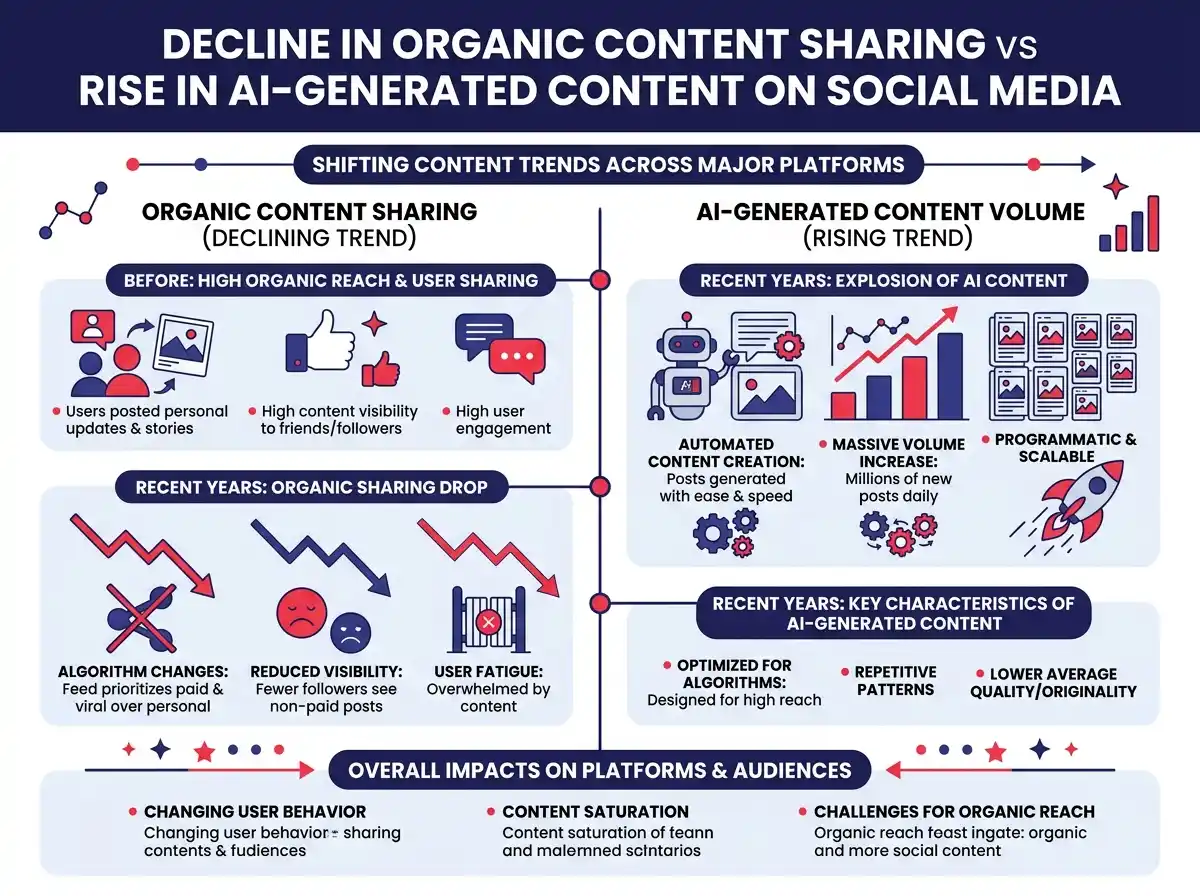
AI content marketing has been a complicated story through most of 2025 and into 2026. On one side, AI tools have made content production faster and more scalable than ever. On the other side, the flood of AI-generated images and video filling social feeds is making users more skeptical about what they see and, more importantly, what they share.
Sharing behavior is one of the most valuable forms of organic distribution a brand can earn. When someone shares your content, they’re lending you their credibility with their own audience. But as users grow less confident in the authenticity of what they’re looking at, that sharing is declining. People are less likely to share something that might make them look gullible if it turns out to be fake.
For brands, the implication is fairly direct: AI-assisted content creation is fine, but the content that actually earns organic reach needs to feel genuinely human. Real people, real stories, real moments that clearly couldn’t have been generated by a model. User-generated content, behind-the-scenes footage, employee storytelling, and raw unpolished video all carry more credibility now than they did two years ago. There’s something almost counterintuitive about it. The more polished and “optimized” content looks, the less trustworthy it feels.
This doesn’t mean abandoning AI tools. It means being honest with yourself about where authenticity matters most and where efficiency is the better call.
Reddit, algorithm opt-outs, and the fight for authentic audience reach
Two things are happening at the same time, and marketing teams need to track both carefully.
First, Reddit has quietly become one of the most important platforms for SEO-minded marketers, but not in the way most brands are approaching it. AI chatbots and search engines are increasingly citing Reddit threads as credible, community-driven sources. That’s made Reddit a target for brand infiltration, with teams trying to seed conversations and plant mentions that will get picked up by AI citations.
The problem is that Reddit’s value comes entirely from its communities being real. Marketers who are too aggressive, too promotional, or too obviously brand-affiliated aren’t just getting banned from subreddits. They’re eroding the credibility of the platform they’re trying to use. If Reddit stops feeling like a genuine community space, the AI citation value disappears with it. A smarter Reddit marketing strategy means contributing real value, being transparent about brand affiliation when it’s relevant, and playing a long game rather than chasing short-term SEO wins.
Second, there’s a growing conversation around algorithm opt-outs, which could fundamentally change how content gets distributed on major platforms. If users get more control over what they see, brands that have been coasting on algorithmic amplification will need to earn their audience more directly. That puts a premium on building genuine communities, email lists, and owned channels rather than depending entirely on platform algorithms for distribution.
Organic reach is declining and that decline is accelerating. The teams that manage it best will be the ones building across multiple distribution channels and not treating any single platform as a reliable long-term bet.
Emerging platforms, teen audiences, and where marketing teams should be placing bets
Platform diversification has been a talking point for years, but the specific platforms worth paying attention to right now have shifted. Threads is no longer an early-stage experiment. And demographic disruptions in the teen social media space are about to create opportunities that most brands will miss simply because they’re not watching closely enough.
Why Threads deserves a serious place in your 2026 platform strategy
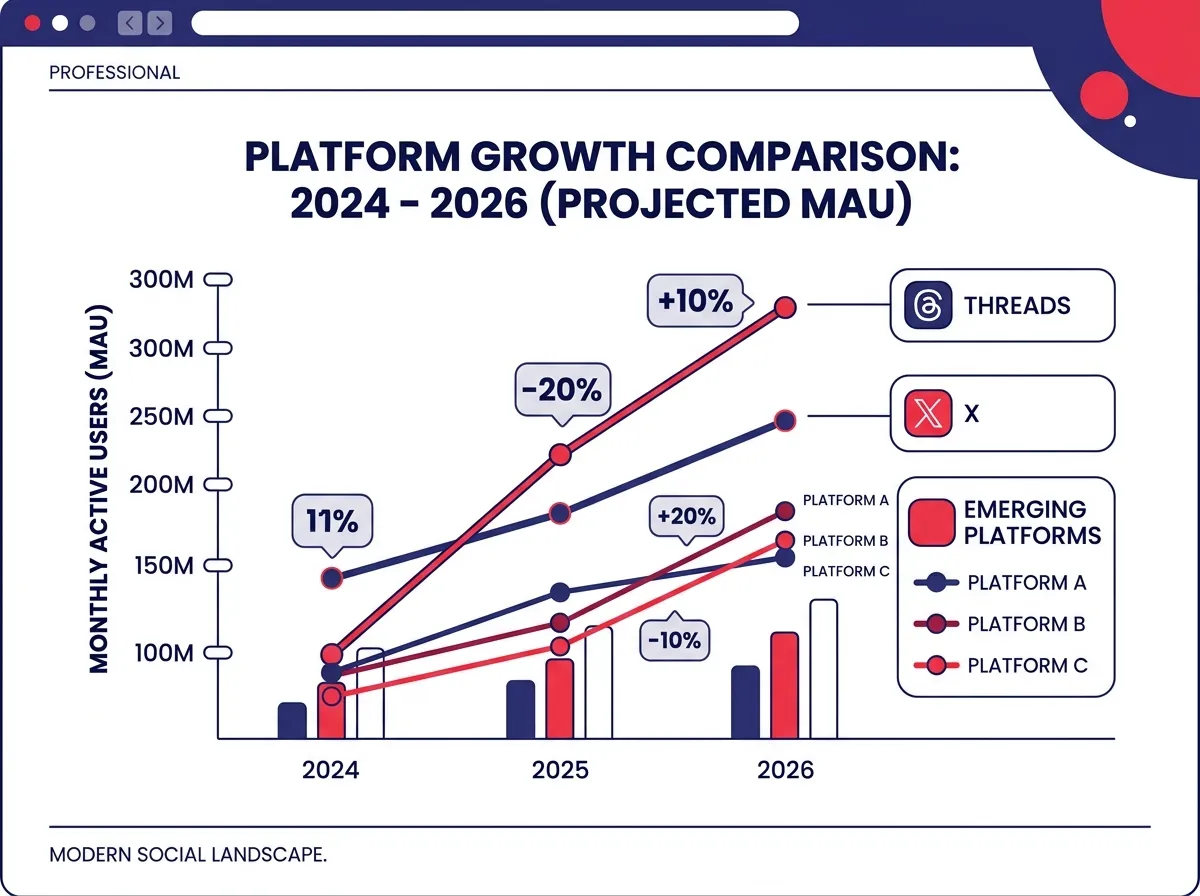
Threads has grown to 400 million monthly active users in just two years. It’s increasingly the default real-time conversation platform for sports, breaking news, and cultural moments. For marketing teams that have been relying on X for that kind of engagement, Threads is now a credible alternative, and for a lot of brands, a noticeably less chaotic one.
The platform dynamic on Threads right now mirrors what Instagram felt like in its early growth years: less noise, higher organic reach for brands that show up consistently, and an audience that’s still relatively open to discovering new accounts. That window doesn’t stay open forever. The brands building Threads audiences now will have a meaningful advantage when the platform matures and organic reach tightens, as it always does.
Threads also benefits from its connection to the Instagram ecosystem. If your brand already has a strong Instagram presence, the cross-platform integration lowers the barrier to building a Threads following considerably. The content that works on Threads leans toward conversation starters, opinions, and fast commentary rather than polished brand content. Teams with a more informal, spontaneous voice will find it easier to gain traction.
For marketing teams structuring platform investment as part of a broader digital marketing strategy, Threads should be on the active investment list, not the watch-and-wait list.
Teen social media restrictions will spawn new platforms and new opportunities
Across multiple regions, legislation and platform-level restrictions are limiting how younger users interact with social media. Australia, parts of Europe, and several U.S. states have introduced or are pursuing age-based restrictions on social media access for teens. The instinct is to read this as a shrinking audience opportunity. That’s the wrong interpretation.
Teen audiences don’t stop wanting to connect online just because existing platforms create friction. What tends to happen is that new platforms emerge to serve that demand in ways that slip between the cracks of existing regulations or feel more native to the generation navigating those restrictions. This is how every major wave of platform adoption has worked, from early social networks to Snapchat to TikTok.
For marketing teams focused on emerging social media platforms 2026, the opportunity is in watching what fills the gap. New platforms targeting younger users will move fast. The brands that establish a presence early, before mainstream adoption and before advertising markets get competitive, will have access to highly engaged audiences at a fraction of the cost they’d pay on established platforms.
That requires a team structure that actually allows for rapid experimentation. Not every new platform will stick. Most won’t. But the cost of being present and learning early is low compared to the cost of playing catch-up once a platform has scaled. The digital marketing trends shaping how marketing teams plan for 2026 are, in a lot of ways, a story about timing. The teams that act while opportunities are still in early formation will build advantages that compound for years.
Staying ahead also means watching for behavioral signals from teen audiences on existing platforms, what they’re sharing, what formats they’re creating, where conversations are migrating. Those signals tend to show up before the platforms themselves do.