
TL;DR
- Audit tools weight every flag equally: a missing H1 on a low-traffic blog post from three years ago gets the same red icon as a noindex tag accidentally applied to the homepage.
- Third-party audit scores are not ranking signals, and pages sitting in the top three for competitive keywords often carry redirect chains, suboptimal Core Web Vitals and duplicate content.
- The four-filter triage model asks about impact, reach, effort and risk before a flagged issue reaches the roadmap, which the post says cuts roughly 70 percent of a typical SEO to-do list.
- Real blockers named are systemic crawlability problems, site migrations, broken navigation, broken canonicals, indexation issues, mobile usability failures and anything touching security or compliance.
- The high-leverage work listed is defending page-one rankings, lifting pages sitting in positions 11 to 30, building and expanding topic clusters, and fixing true technical blockers.
You open your SEO audit tool and it hands you 847 issues. Broken links, missing alt tags, crawl errors, and a spreadsheet that seems to grow every time you look at it. The instinct is to start fixing. But what if that instinct is quietly sabotaging your results?
Here’s what most SEO guides won’t tell you: audit tools flag every issue equally, but not every issue deserves equal attention or resources. Confusing activity with impact is one of the most common and costly mistakes SEO teams make, and it keeps sites stuck in neutral while competitors pull ahead.
- What Your SEO Audit Tool Is Not Telling You
- How High-Performing SEO Teams Actually Prioritize Their Work
What your SEO audit tool is not telling you
SEO tools are genuinely impressive. They crawl thousands of pages in minutes, flag duplicate metadata, surface crawl errors, and track Core Web Vitals in real time. That capability is useful. The problem isn’t the tool itself. The problem is what the tool implies.
The tool score vs. ranking reality gap
When your SEO audit platform spits out a score of 61 with 847 issues, it creates this psychological pressure to fix everything on the list. But look closely at how those flags are weighted. A missing H1 on a low-traffic blog post from three years ago gets the same red icon as a noindex tag accidentally applied to your homepage. These are not remotely the same problem, and the tool treats them like they are.
Google has been pretty clear that third-party SEO tool scores aren’t ranking signals. The algorithm rewards relevance and user satisfaction, not technical flawlessness. Sites sitting in the top three results for competitive keywords often have redirect chains, suboptimal Core Web Vitals, and duplicate content issues. They rank because they serve the user’s intent better than anyone else on the page, not because they passed a technical checklist.
Chasing a perfect audit score is a false goal. Your score going from 61 to 94 doesn’t mean your traffic will follow.

The opportunity cost nobody talks about
Every hour spent fixing low-impact issues is an hour not spent on work that actually grows traffic. This is opportunity cost, and it’s the quiet killer of SEO programs that look busy but stay flat.
Dev bandwidth is limited. When that bandwidth goes toward clearing 200 legacy 404 errors or shaving 0.2 seconds off a page that already loads fine, it’s not available for the work that actually moves things:
- Refreshing page-one content to defend and improve rankings
- Building internal links from your most authoritative pages
- Creating content targeting high-intent keywords competitors are winning
- Improving conversion paths on the pages that drive revenue
The result is a technically cleaner site with flat traffic. Busy SEO feels productive. It just doesn’t grow anything.
How high-performing SEO teams actually prioritize their work
The best SEO teams don’t start with the audit. They start with the business. They figure out which pages and queries are driving conversions and revenue, then work backward from that. The audit informs their work, but it doesn’t set the agenda.
The four-filter triage model
Before any flagged issue earns a spot on your roadmap, run it through four filters:
| Filter | Question to Ask |
|---|---|
| Impact | How much traffic, revenue, or visibility is at stake? |
| Reach | How many high-value pages does this affect? |
| Effort | What does fixing this actually cost your team? |
| Risk | Is there a crawlability, compliance, or UX risk if it stays unfixed? |
Ask these four questions honestly and you’ll cut roughly 70% of a typical SEO to-do list. What falls off the list was never really worth doing.
This is where strategic neglect becomes useful. It sounds uncomfortable, but it’s just a deliberate trade-off. Choosing not to fix certain issues frees up capacity for higher-leverage work. Non-indexable legacy URLs with minor errors, cosmetic Lighthouse warnings, thin posts on non-strategic topics with zero traffic, these are all candidates for intentional deprioritization.
There are real exceptions. Systemic crawlability problems, site migrations, broken navigation, and anything touching security or compliance are actual blockers. Fix blockers. Leave the polish.
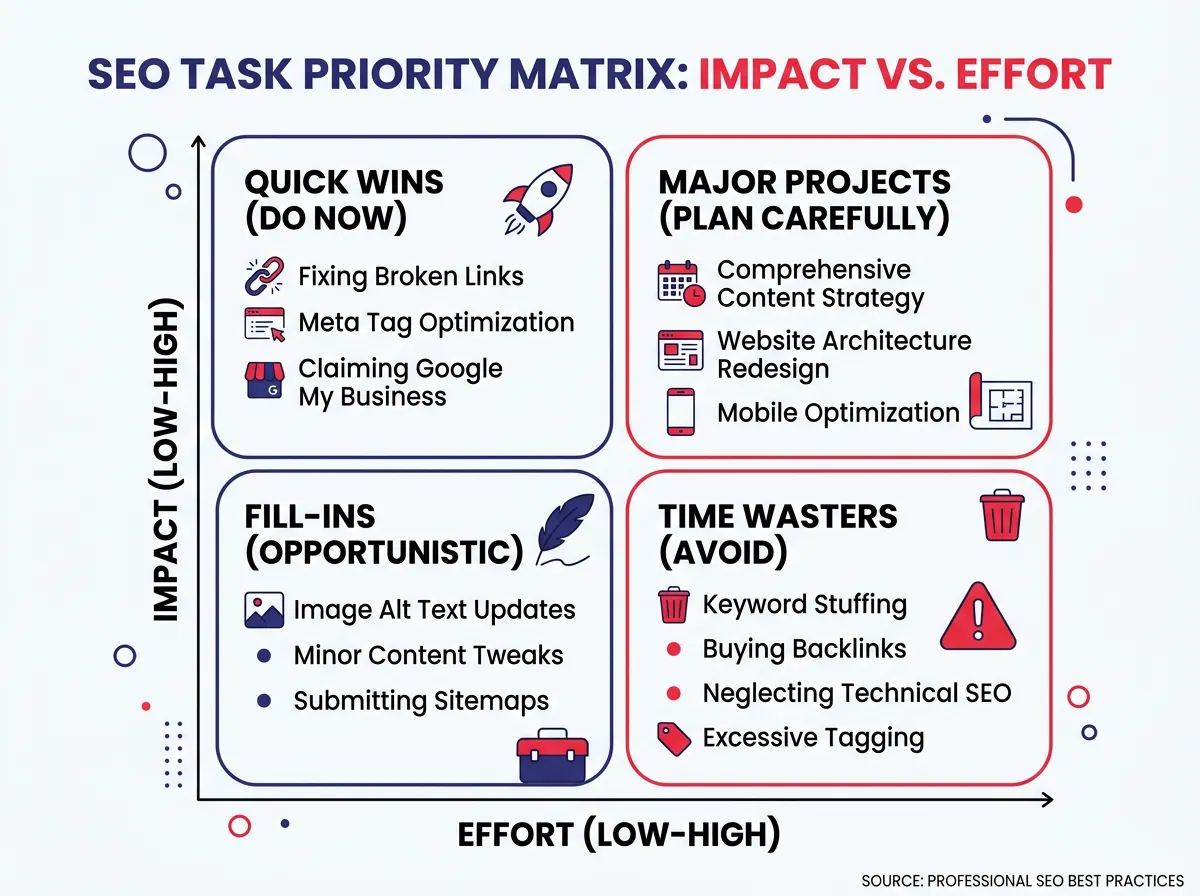
Where the outsized SEO results actually come from
Apply a Pareto lens to SEO and you’re looking for the 20% of work that drives 80% of outcomes. In practice, that comes down to a short list of high-leverage moves.
Defend your page-one rankings. These pages are already performing. A focused content refresh, a better title tag, and a few well-placed internal links can compound their results meaningfully.
Lift your mid-tier pages. Pages sitting in positions 11 to 30 are among the biggest untapped opportunities in any SEO program. They’re already indexed and partially trusted. Often a content upgrade and a targeted link push is all they need to break onto page one. A focused sprint here pays off disproportionately.
Build and expand topic clusters. Comprehensive coverage of a subject signals expertise and relevance. One strong pillar page can anchor and lift an entire cluster of supporting content, raising the authority of the whole group.
Fix true technical blockers. Crawlability failures, broken canonicals, indexation issues, and mobile usability problems genuinely limit your ability to compete. The key is separating what’s blocking your growth from what’s simply untidy.
Your SEO roadmap should reflect what matters to the business. Use Google Search Console, your analytics platform, and conversion data to rank work by revenue contribution and upside potential. The SEO audit tool is one input, not the strategy itself.
Reactive SEO that responds to every flag without a filter quietly erodes your team’s capacity. The sites winning in search are treating it as a proactive, business-aligned strategy rather than a maintenance checklist.
Your audit score going up while traffic stays flat is not a win. Traffic going up while a few minor issues stay unfixed, that’s exactly the trade-off worth making.