A page that ranks number one on Google may never show up in a single AI-generated answer. That gap isn’t a glitch. It’s a structural difference in how two separate systems evaluate the same content, and understanding it is the first step to building a strategy that actually works in both.
Most marketers assume that strong organic performance automatically carries over into AI search visibility. Research across 150,000 indexed pages says otherwise. Your top organic content and your top AI-cited content are probably not the same pages. SEO and GEO aren’t competing tactics so much as structural mirrors, each one rewarding a distinct set of on-page behaviors. Treating them as interchangeable is quietly costing brands visibility in both channels.
Why your best organic pages are invisible to AI search
The idea that solid SEO content will naturally get picked up by AI search tools is one of the most common and expensive misreads in content strategy right now. The data is pretty clear: organic success does not predict AI citation. In many cases, the content that performs best in Google is exactly what AI models pass over.
The data gap: when top organic pages get zero LLM traffic
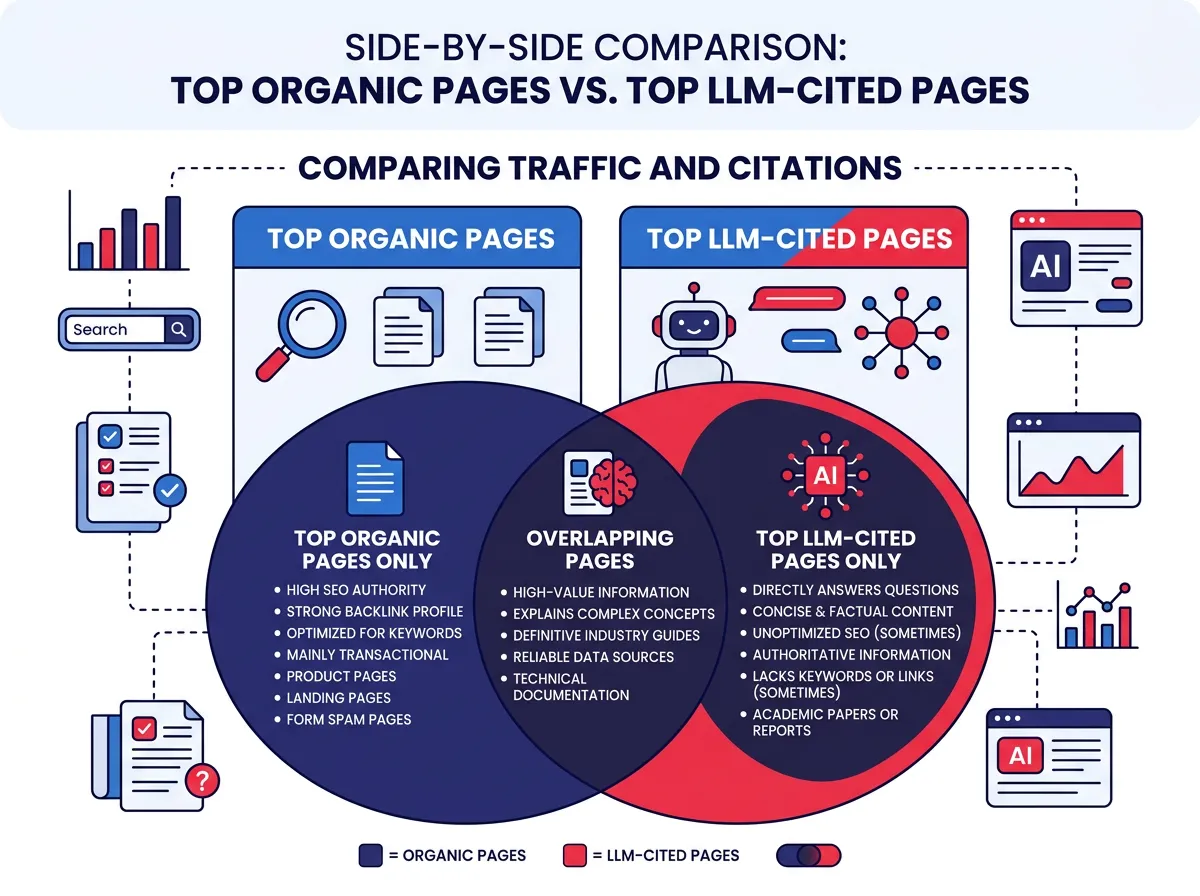
In a study covering 10 websites and 150,000 indexed pages, the top 10 organic pages captured 55% of all organic sessions. Those same pages captured only 29% of LLM sessions. The gap gets sharper when you look at individual pages: among the top 100 organic pages in the study, 49 had zero LLM traffic whatsoever.
That’s not a rounding error. Nearly half of the pages Google trusted most were completely invisible to AI platforms like ChatGPT, Claude, and Perplexity during the same period.
LLM traffic correlates with organic performance, but it’s not just organic performance with a different label. Two separate systems are reading the same content and reaching different conclusions about what deserves to surface.
What AI actually rewards: factual density over keyword density
The strongest predictor of LLM citation wasn’t domain authority or keyword optimization. It was content theme. Specifically, content built around original, proprietary, or verifiable data consistently outperformed generic educational content.
Trends and analysis posts attracted LLM citations 78% of the time. Data-based year-in-review posts came in at 61%. Educational how-to content sat at just 12%. That last number should worry most content teams, because how-to guides, listicles, and top-of-funnel FAQs make up the majority of most SEO content calendars.
The reason is pretty straightforward. AI models can produce generic educational content on their own. They don’t need to cite a source for it. But original data, proprietary research, and specific findings give a model something it can’t synthesize independently, which is exactly why it cites those sources.
GEO rewards content that fills a factual gap. SEO rewards content that matches search intent. Related, yes. The same objective? No.
The anatomy of a citable answer
Research across nearly 2 million sessions points to one structural element as the strongest predictor of ChatGPT citations: the answer capsule. An answer capsule is a concise, direct response to the core question of the page. It appears early, is written in clean prose, and avoids internal links or distracting formatting. It gives a model a clean, extractable unit to quote.
Pages that punched well above their organic weight on LLM traffic tended to answer one specific question with one specific piece of data, rather than explore a topic broadly. If you want AI search to cite your content, make that citation easy. Write the answer. Put it near the top. Let the rest of the page support it.
Building an authority-first content architecture for SEO and GEO
Diagnosing the problem is one thing. Fixing it means rethinking content architecture, entity management, and how success gets measured. The sites that performed best across both SEO and GEO in the study shared a few structural traits worth looking at closely.
Entity clarity: why inconsistent brand data gets you dropped by AI
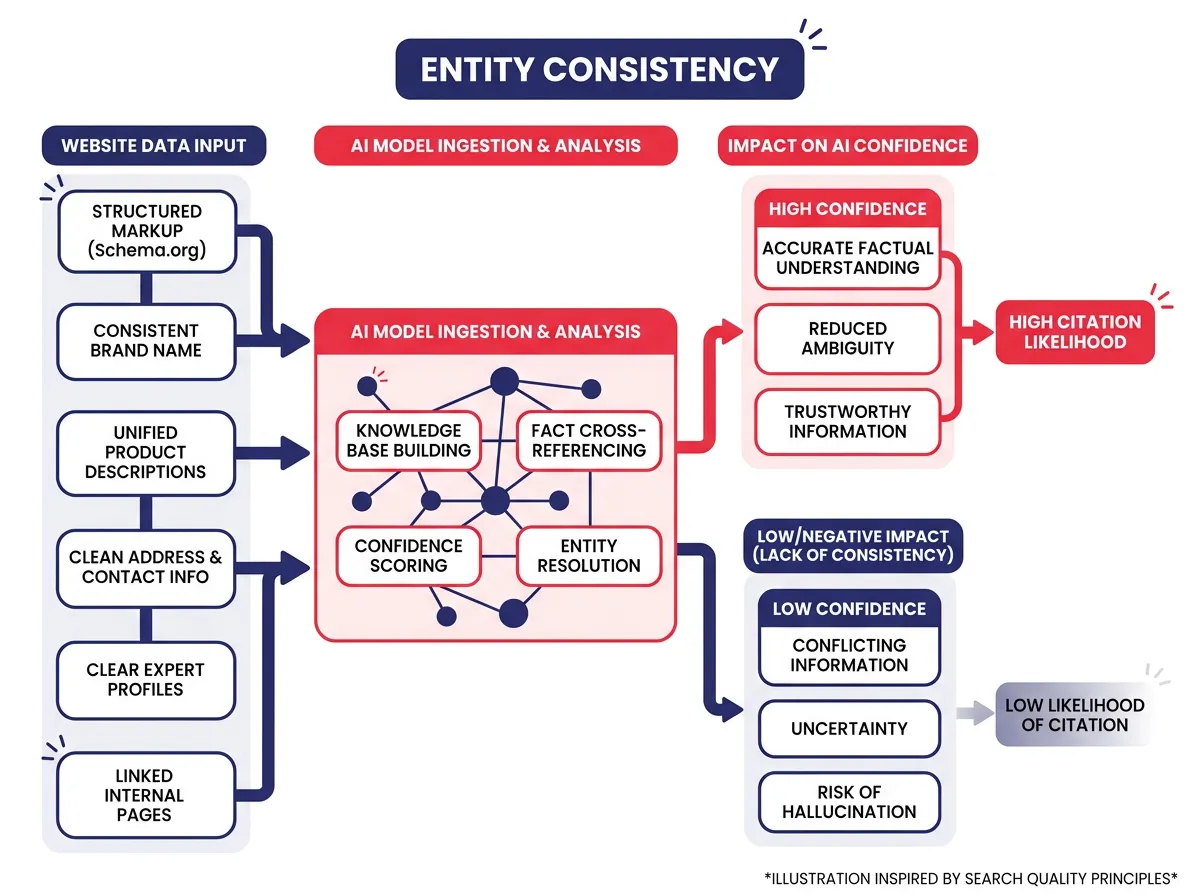
AI models build a picture of your brand from everything they can crawl. When that picture is inconsistent, whether conflicting product descriptions, varying contact information, or mismatched company details across pages, the model faces a reliability problem. Rather than risk surfacing inaccurate information, it drops the brand from generated answers entirely.
This is called entity ambiguity, and it’s one of the quieter GEO killers. Brands that invest in structured, consistent information across their entire site give AI models a clean signal. Brands that don’t get deprioritized, not because of anything a competitor did, but because of internal inconsistency that never mattered much in traditional SEO.
Audit your service pages, your about pages, and any page that describes what your company does. Make sure the language aligns. Make sure the facts match. Entity clarity is a foundational GEO requirement that most teams aren’t thinking about yet.
Technical foundations that satisfy both algorithms and AI models
One of the more interesting findings in the data involves service and product pages. Blog content generated the most LLM referrals by raw session count. But when measuring LLM sessions per 1,000 organic sessions, service and product pages outperformed every other page type at 29.4 LLM sessions per 1,000 organic sessions, compared to 23.4 for articles and just 14.0 for FAQ pages.
That relative outperformance makes sense. Service pages carry specific, factual, brand-owned information that a model can’t synthesize from general web knowledge. When someone asks an LLM a question that involves a specific solution or product category, a well-structured service page with proper schema markup becomes a reliable citation candidate.
Adding structured data markup to service and product pages is a high-leverage move for both SEO and GEO. It helps search engines parse your content, and it gives AI models cleaner signals about what your page is actually saying.
Shifting your KPIs from traffic counts to citation frequency
The rise of AI search has accelerated zero-click behavior, and that shift requires a new way of thinking about success. A zero-click AI citation (where a model surfaces your brand’s name or data in an answer without the user clicking through) shouldn’t be dismissed as a lost opportunity. It’s a high-intent brand impression delivered to someone who specifically asked for it.
Compare that to an accidental organic click that results in a three-second visit and a bounce. The AI citation wins on quality even without the click.
This reframe matters because it changes which metrics deserve attention. Branded search volume, direct traffic lift, and citation frequency in AI tools are the leading indicators of GEO performance. If your content strategy is still judged entirely by organic session counts, you’re measuring one channel while leaving the other completely unmanaged.
Track your organic and LLM-receiving pages separately. Look for pages that get LLM sessions with no organic clicks. In the study, those pages showed some of the highest engagement quality recorded, because those users arrived with a specific need, directed by an AI that already trusted the source.
The overall picture isn’t that GEO is replacing SEO. Two separate systems now evaluate your content against two separate sets of criteria. Optimizing for one no longer guarantees performance in the other. The brands that figure out how to satisfy both without diluting either will hold a real structural advantage as AI search keeps growing.