TL;DR
- Merchant Center for Agencies expanded worldwide from its original U.S. and Canada test markets, giving agency teams one access point for onboarding, account health, diagnostics and product performance across a whole client portfolio.
- The unified dashboard shows onboarding status for every client account, account health scores summarizing product data quality, and critical alerts for feed issues, policy violations and disapprovals.
- Portfolio-wide diagnostics can be filtered by market or region, campaign type and issue severity, and prioritize fixes by potential impact rather than volume, the example being an account with 50 minor attribute errors and two high-impact disapprovals.
- Store quality monitoring flags out-of-stock products across accounts, inventory health tracking identifies high-potential products getting low ad visibility, and promotions are now managed inside the platform.
- The platform does not yet replicate complex feed transformation, multi-channel distribution to Amazon or Meta, or rules-based automation, so the post suggests running it alongside existing third-party feed tools for a defined 60 to 90 days before consolidating.
Managing product feeds across dozens of client accounts used to mean juggling spreadsheets, third-party tools, and constant back-and-forth with clients just to track down a single disapproved product. Sound familiar? If you work at an agency handling Google Shopping campaigns for multiple brands, you already know how messy that can get.
Google just changed the game.
Merchant Center for Agencies has gone through a significant global rollout, expanding well beyond its original U.S. and Canada test markets. Agencies worldwide now have access to a centralized platform designed to manage product data across all client accounts from one place. No more logging in and out of individual accounts. No more piecing together performance snapshots from different dashboards. No more chasing down which client’s feed threw an error at 2 a.m.
This guide breaks down exactly what Merchant Center for Agencies does, which features are worth your attention right now, and how to think about weaving it into the workflows your team already uses. Whether you’re hearing about this for the first time or you’ve been watching the rollout since it started, here’s what you need to know.
- What Is Merchant Center for Agencies and What Does It Actually Do?
- Portfolio Diagnostics, Store Quality, and the Features That Actually Save Time
- How Agencies Should Think About Integrating Merchant Center Into Existing Workflows
What is Merchant Center for Agencies & What Does it Do?
Before getting into the specific features, let’s clear up what this platform actually is and why Google built it.
Merchant Center for Agencies is a dedicated version of Google’s Merchant Center platform, built specifically for agencies that manage product data for multiple clients. It gives agency teams a single access point to oversee onboarding, account health, diagnostics, and product performance across their entire client portfolio.
From feed repository to strategic performance tool
For years, Google Merchant Center was mostly seen as a backend necessity. You uploaded your product feeds, fixed errors when they popped up, and moved on. The platform wasn’t built with strategic insight in mind. It did the job, but it wasn’t designed to help agencies spot trends, prioritize fixes, or make smarter decisions at scale.
Google’s direction with Merchant Center for Agencies signals a real shift in thinking. The platform is being repositioned as a performance tool, not just a place to push feeds through. The data surfaced inside the agency dashboard is meant to drive optimization decisions, not just tick compliance checkboxes.
This matters because it changes how agencies should think about the role of product data management. Feed health was always important, but it used to sit in its own silo. Now, Google is connecting product data quality directly to campaign performance and surfacing that connection in a way that agency teams can act on without deep technical digging.
 ### A unified dashboard built for multi-client management
The centerpiece of Merchant Center for Agencies is the unified dashboard. At a glance, agency teams can see:
- Onboarding status for all client accounts, so you always know which accounts are fully set up and which still have gaps
- Account health scores that summarize each client’s overall product data quality
- Critical alerts that surface feed issues, policy violations, or disapprovals that need immediate attention
This is the feature that changes daily workflows most noticeably. Instead of logging into each client account individually to check on feed status, a team member opens one dashboard and immediately sees which accounts need attention and which are running clean.
The rollout of this unified view to agencies worldwide means that teams in Europe, Asia, Australia, and beyond now have access to the same infrastructure that U.S. and Canadian agencies have been using. That’s a real change for globally distributed agency teams managing clients across multiple markets.
Google’s move here also reflects something practical: as agencies scale, the cost of managing accounts one by one becomes a genuine bottleneck. The unified dashboard is built to remove that bottleneck, not just make things slightly more convenient.
Portfolio diagnostics, store quality, and the features that actually save time
The unified dashboard is the entry point, but the features that will have the biggest day-to-day impact go deeper. Here’s where Merchant Center for Agencies starts delivering real time savings.
Portfolio-wide diagnostics and issue prioritization
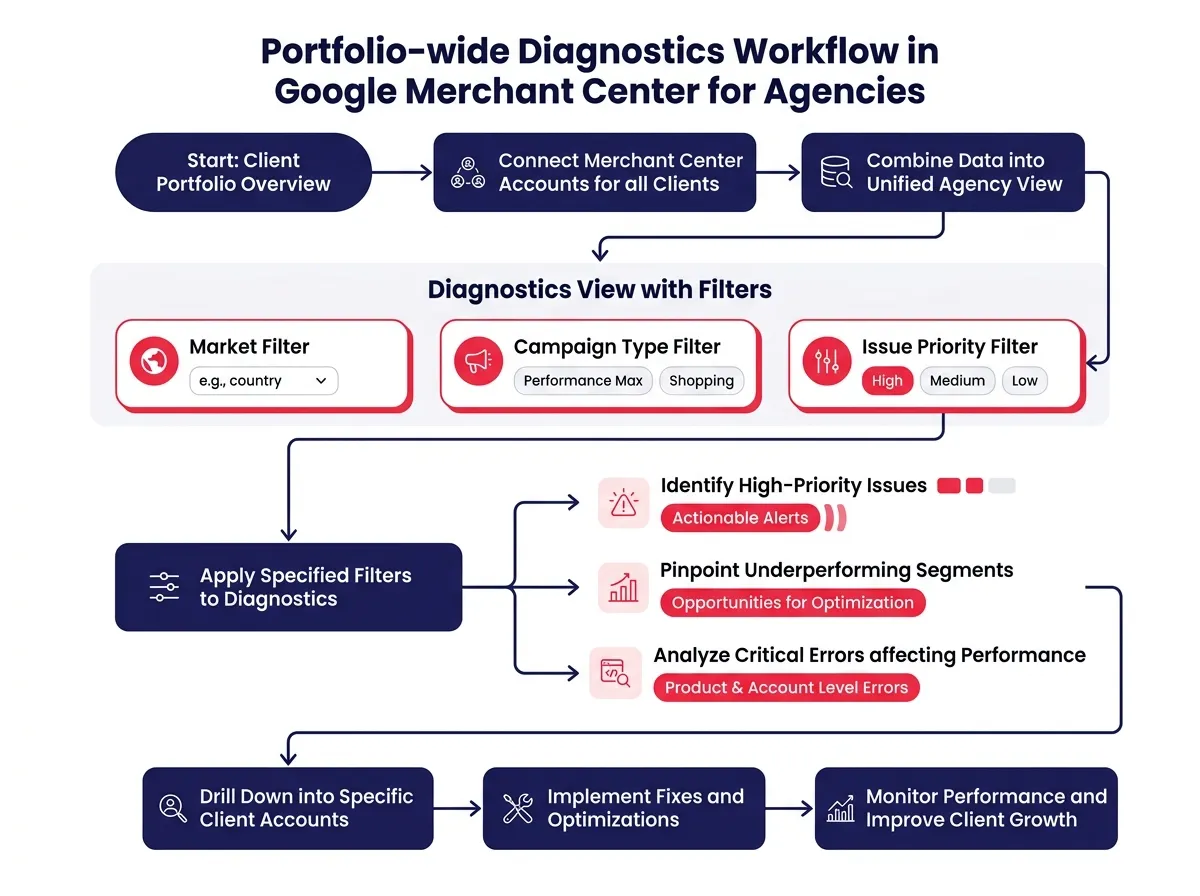
One of the more practical upgrades in Merchant Center for Agencies is portfolio-wide diagnostics. In the old world, auditing feed health across 30 client accounts meant going account by account, exporting data, and then piecing together a picture manually.
Portfolio-wide diagnostics change that by letting teams view issues across the entire client portfolio in a single view. You can filter by:
- Market or region, which is especially useful for agencies managing clients in multiple countries
- Campaign type, so you can isolate issues that affect Shopping campaigns specifically
- Issue severity, so you know what’s urgent versus what can wait
More importantly, the platform helps agencies prioritize fixes based on potential impact rather than just issue volume. That distinction matters more than it might seem. An account might have 50 minor attribute errors and two high-impact disapprovals. Without impact weighting, teams often end up chasing the small stuff while the revenue-affecting issues sit unaddressed.
This is a workflow change that compounds over time. When agency teams build a habit of weekly diagnostic reviews using the portfolio view, they start catching issues earlier and fixing them faster. For clients running high-volume Shopping campaigns, even a one or two day reduction in time-to-fix on product disapprovals can have a measurable effect on performance.
 ### Inventory health, store quality metrics, and promotions in one place
Beyond diagnostics, Merchant Center for Agencies brings store quality monitoring and inventory health tracking together in a way that was previously fragmented or unavailable at the portfolio level.
Store quality monitoring surfaces out-of-stock products and inventory gaps across all client accounts. For agencies managing retail clients, this is genuinely useful. Out-of-stock products that stay active in feeds waste ad spend and damage campaign efficiency. Having visibility into inventory gaps at the portfolio level means agency teams can flag issues to clients proactively, before they show up as performance drops.
Inventory health tracking goes a step further by helping agencies identify high-potential products that are getting low visibility in ad campaigns. These are products with strong attributes and good pricing that aren’t surfacing as often as they should. Tagging these products for prioritization inside campaign structures is a meaningful upgrade from what was possible before.
Promotions management is also now handled directly inside the platform. Previously, agencies often had to work across separate tools or rely on clients to submit promotions independently. Centralizing this inside Merchant Center for Agencies removes one more context switch from the agency workflow.
Here’s a quick summary of the key features and what problem each one solves:
| Feature | Problem It Solves |
|---|---|
| Unified dashboard | Eliminates logging in and out of individual accounts |
| Portfolio diagnostics | Surfaces and prioritizes feed issues across all clients at once |
| Store quality monitoring | Flags out-of-stock and inventory gaps before they hurt performance |
| Inventory health tracking | Identifies high-potential products with low ad visibility |
| Promotions management | Centralizes promotion setup without switching tools |
For agencies running large Shopping campaigns across multiple retail clients, the combination of these features represents a real shift in what’s possible from a single platform. The cumulative time savings from removing fragmented workflows add up quickly, especially for teams stretched thin across large account portfolios.
How agencies should think about integrating Merchant Center into existing workflows
Rolling out a new platform across an agency isn’t just a technical decision. It’s a workflow decision, a team training decision, and for some agencies, a tech stack decision. Here’s how to think through it practically.
Where Merchant Center fits alongside third-party feed management tools
The first question most agencies will ask is whether Merchant Center for Agencies replaces the third-party feed management tools they’re already using. The honest answer is: it depends on your setup.
For agencies that have been managing feeds primarily through Google’s native tools, this consolidation is fairly straightforward. The unified dashboard and portfolio diagnostics likely replace workflows that were previously being done through manual checks or cobbled-together reporting.
For agencies using established third-party feed management platforms, the picture is more nuanced. Many of those tools offer capabilities that Merchant Center for Agencies doesn’t fully replicate yet, including:
- Complex feed transformation logic for clients with messy or non-standard product data
- Multi-channel feed distribution for clients selling on Amazon, Meta, and other platforms simultaneously
- Advanced automation for rules-based feed optimization at scale
In these cases, Merchant Center for Agencies is likely to complement rather than replace existing tools. The smart move is to audit your current feed management workflow before assuming anything. Map out where each tool is doing work the other can’t, and identify the overlap zones where consolidation makes sense.
A practical starting point is to run both in parallel for a defined period, say 60 to 90 days, and track where your team is spending time, where issues are being caught first, and where the handoffs between tools create friction. That data will tell you more than any feature comparison list.
The agencies that will get the most out of Merchant Center for Agencies are the ones that approach it deliberately rather than reactively. Building clear internal processes around the platform, including regular diagnostic review cadences and a defined prioritization framework for product issues, creates the foundation for getting real value out of the tool as Google continues to develop it.
What to watch as Google continues developing the platform
The global rollout is a starting point, not the finished product. Google has a history of rolling out agency tools in phases, and Merchant Center for Agencies is following that pattern. Agencies that engage with it now will be better positioned as more advanced features come online.
Here are the open questions worth tracking:
Granular optimization controls: Right now, the platform surfaces issues and helps prioritize them. What’s less clear is how much control agencies will have over automated optimization recommendations versus manual overrides. As Google continues building out the platform, the balance between automation and agency control will be a defining feature.
Complex feed structures for larger retail clients: Agencies managing enterprise-level retail clients often deal with feeds that have thousands of variants, custom attributes, and market-specific rules. How Merchant Center for Agencies handles that level of complexity at scale is still being tested by teams in practice.
API access for automation: Many agencies have built internal automation tools around the Google Merchant Center API. Whether Merchant Center for Agencies offers expanded API access, or any dedicated agency-tier API endpoints, will matter a lot for teams that rely on programmatic workflows.
Performance insight integration: Google has been steadily connecting Merchant Center data with Google Ads performance signals. How deep that integration goes within the agency platform, and whether agencies will see campaign performance data alongside feed health data in the same view, will determine how useful the platform becomes for campaign-level decision making.
The agencies positioned to benefit most are those that don’t wait for the platform to be perfect before building processes around it. Start with the features that are live now, establish a rhythm for using them, and stay close to Google’s product updates as the rollout continues. The foundational value is already there, and the platform will keep getting more capable from here.