
TL;DR
- The post frames stalled technical SEO as a communication problem: executives and product managers think in quarterly targets, profit margins and resource costs, not Core Web Vitals scores, crawl budget or canonical tags.
- Its worked example: a site with 10,000 monthly organic visitors, a 3% conversion rate and a $15 average order value gains an extra $7,500 a month from a conservative 5% traffic increase.
- It cites research that a one-second delay in page load speed can cut conversions by up to 7%, and calls cost reduction, through less unnecessary crawl activity, cleaner redirect chains and removal of low-value pages, the most underused angle in technical SEO.
- Reporting should use a wide-to-narrow format covering who, what, where, why, when and how progress is measured, lead with organic revenue and conversion rate rather than counts like 3,400 crawl errors fixed, and revisit results against the original projection two to three months later.
Most technical SEO recommendations never get implemented. Not because they’re wrong. Not because they’re unimportant. But because the people holding the budget and the developer resources simply don’t see the value.
That’s a communication problem, not a technical one.
If your SEO fixes are stalling in a backlog, or your recommendations keep getting deprioritized in sprint planning, the issue is almost certainly how the work is being framed. Technical SEO projects stall when they sound like SEO problems. They move forward when they sound like business problems.
Knowing how to get buy-in for technical SEO work is one of the most underrated skills in the profession right now. The teams that consistently get their work shipped aren’t always the most technically advanced. They’re the ones who’ve figured out how to connect crawl budgets and canonical tags to revenue forecasts and company goals.
This guide walks through exactly how to do that.
- Why Technical SEO Recommendations Get Ignored (And How to Change That)
- 4 Practical Ways to Strengthen Buy-In for Technical SEO Projects
- How to Communicate Technical SEO Progress to Non-Technical Stakeholders
Why Technical SEO Recommendations Get Ignored (And How to Change That)
The Gap Between SEO Teams and Decision Makers
Here’s the honest truth: executives and product managers don’t think in terms of Core Web Vitals scores or index bloat. They think in terms of quarterly targets, profit margins, and resource costs.
When an SEO professional walks into a meeting and says “we need to fix our crawl budget and improve our canonical tag setup,” the person approving developer time hears noise. Not because they’re uninformed, but because the framing doesn’t connect to anything they’re accountable for.
This gap is the core reason so many technical SEO initiatives get shelved. The work is technically sound, but it hasn’t been translated into language that matters to the people who need to approve it.
What separates a great SEO professional from a good one is often the ability to manage stakeholders effectively. And stakeholder management comes down to one thing: perceived value. If the person signing off can’t see how the work benefits the business, it will always be lower priority than the project that can.
Non-SEOs are unlikely to understand why improving a website’s internal linking architecture matters on its own. But if you can show that fixing it is expected to increase organic revenue by a specific amount over the next 12 months, the conversation changes entirely.
Tying Technical Work to Revenue, Conversions, and Cost Reduction
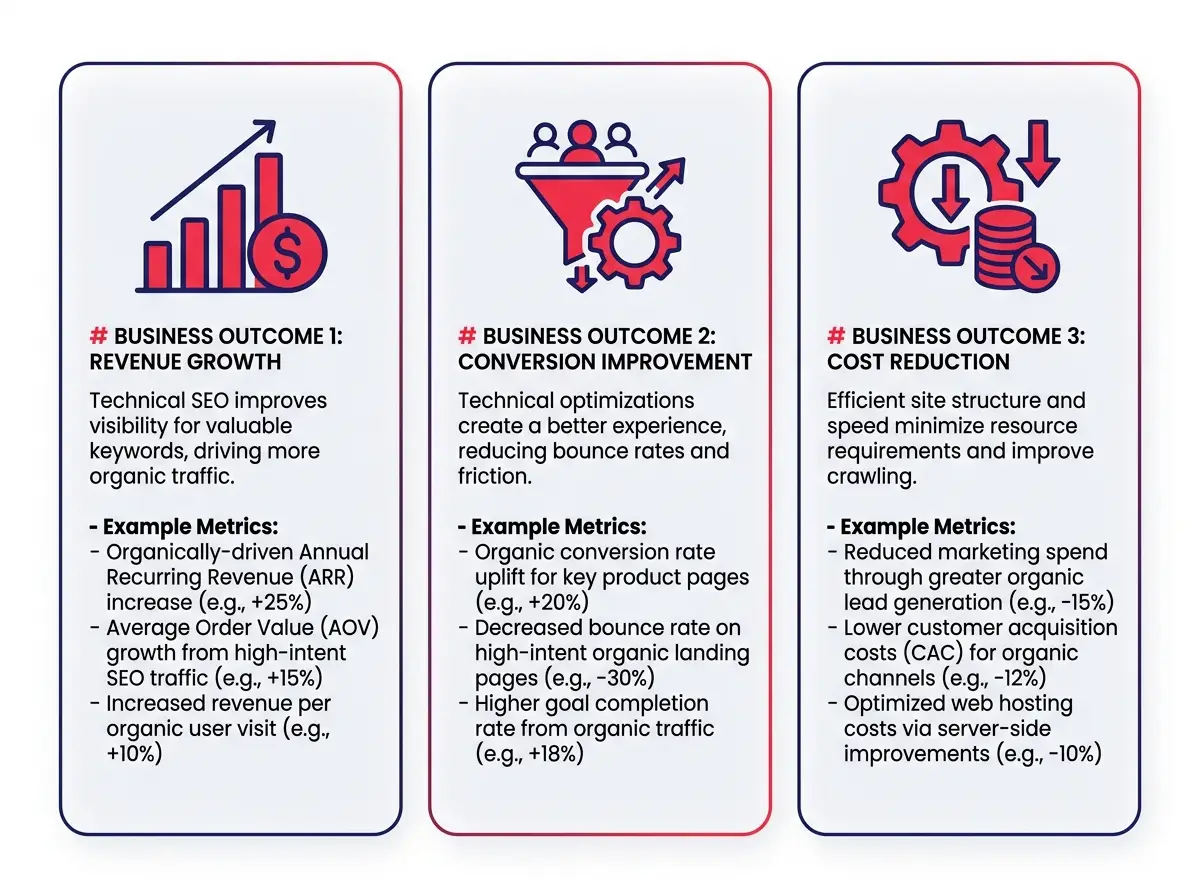
Every technical SEO initiative should map to at least one measurable business outcome. The three most universally understood are revenue growth, conversion improvement, and cost reduction.
Revenue is the clearest connection to make. If fixing a canonicalization issue is expected to reduce keyword cannibalization, improve rankings, and increase organic traffic, you can model what even a conservative 5% traffic increase would mean in dollars. For a site with 10,000 monthly organic visitors, a 3% conversion rate, and a $15 average order value, that’s an additional $7,500 per month. That number is far more compelling than “better search visibility.”
Conversion is another strong angle that gets overlooked. Research consistently shows that a one-second delay in page load speed can cut conversions by up to 7%. So instead of asking for developer time to improve Core Web Vitals scores, frame it as: “Every second we cut from load time could recover approximately 7% in conversion rate.” That’s a development investment with a clear expected return.
Cost reduction is the most underused angle in technical SEO. Many teams forget that every request to a website costs money. Hosting, infrastructure, and security expenses add up, especially on large sites with heavy bot traffic. Reducing unnecessary crawl activity, cleaning up redirect chains, and removing low-value pages can all reduce infrastructure overhead. That’s a real business case.
 ## 4 Practical Ways to Strengthen Buy-In for Technical SEO Projects
1. Quantify the Value Before You Start
Never go into a stakeholder conversation with “this is best practice” as your only justification. Best practice is not a business case. It doesn’t help anyone understand what’s at stake or why the work should jump the queue.
Before pitching any technical SEO project, do the math. Build a conservative model of what the expected outcome looks like in revenue, traffic, or conversion terms. Use your actual site data: current organic traffic, average conversion rate, average order value. Estimate a realistic traffic lift. Run the numbers across 12 months.
This approach shifts the entire tone of the conversation. You’re no longer asking for resources to do SEO work. You’re proposing a growth investment with a projected return.
Even if the impact takes several months to materialize, modeling expected gradual improvement over time gives stakeholders something concrete to evaluate. You’re not promising overnight results. You’re showing a reasonable, data-backed projection of how the work supports revenue growth.
This also applies to smaller projects. Reviewing page speed, auditing redirect chains, or cleaning up duplicate content might seem like housekeeping tasks. But if you can tie each one to a specific KPI, they stop looking like maintenance and start looking like strategic investments.
2. Connect Your Work to What Stakeholders Already Care About
One of the most effective ways to secure buy-in for technical SEO work is to make it sound like it was already part of the plan.
Most companies set annual goals around growth, expansion, profitability, or market share. Find out what those goals are, then frame your technical SEO work as a direct enabler of those goals.
Say the company wants to grow revenue from a specific region, and your team wants to audit hreflang tags. Don’t explain the technical mechanics of hreflang to engineering leadership. Connect the dots instead: the current hreflang setup is sending regional visitors to the wrong version of the site, which is reducing conversion rates in exactly the market the company is trying to grow. Fixing it should increase the number of regional visitors landing on the correct page, which improves conversions and directly supports the expansion goal.
That framing makes it much easier to secure developer resources, because now the work isn’t an SEO team request. It’s a business priority.
3. Breaking Down Technical SEO Work Using the Wide-to-Narrow Format
Clear communication is what keeps stakeholder support alive throughout a project, not just at the start. Using a structured format helps make sure the right information reaches the right people without overwhelming anyone.
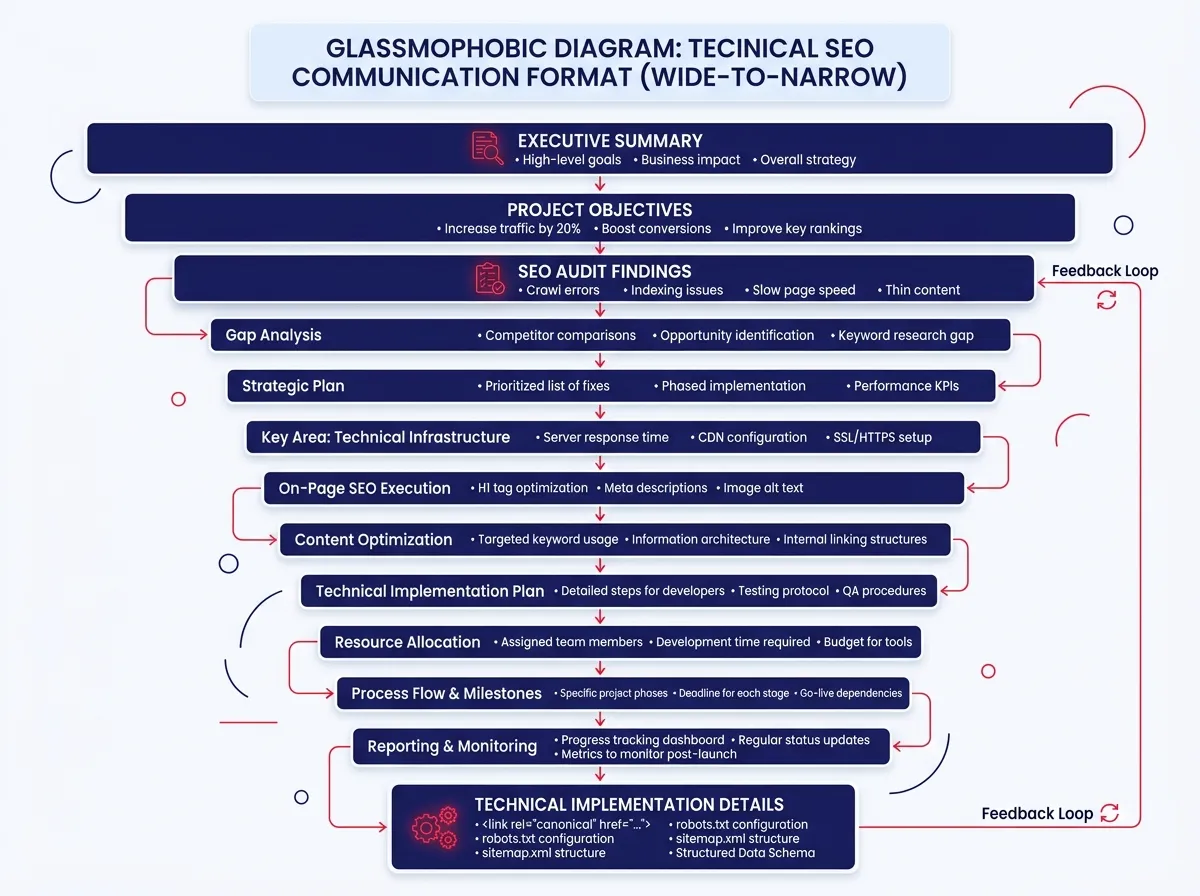
A useful approach is the wide-to-narrow format. Start with an executive-level summary that explains the business context, what you’re doing, and why it matters. Then, for those who want more detail, layer in the technical specifics. A C-suite reader can absorb the key points quickly, while a developer or SEO manager can continue reading for implementation details.
When communicating technical SEO projects, cover these core elements:
- Who is involved: the SEO team only, or does this require developer sprints?
- What is being done: explain it simply first, then add technical detail for those who need it
- Where it applies: focus on the products, regions, or business areas affected, not a list of every URL
- Why it matters: connect it clearly to a company goal or KPI that the stakeholder cares about
- When results are expected: give a realistic timeline and break the project into trackable milestones
- How progress will be measured: commit to specific metrics you will report against
Milestones matter a lot for long-running technical SEO projects. If a site architecture overhaul is going to take three months before rankings shift, stakeholders need checkpoints along the way to see that progress is happening. Breaking a project into phases (review, recommendations, tickets created, implementation, monitoring) gives stakeholders something to track before search engines even process the changes.
 ### 4. Reporting on Business Outcomes, Not Just SEO Metrics
How you report on technical SEO work over time is just as important as how you pitch it. Monthly reports that focus only on crawl errors fixed or Core Web Vitals improvements won’t hold stakeholder attention for long. Those metrics don’t connect to what decision-makers are accountable for.
Instead, lead every report with business metrics: organic revenue, incremental revenue from SEO, qualified organic traffic, and organic conversion rate. Then anchor your technical SEO updates to movement in those numbers.
So instead of reporting “we resolved 3,400 crawl errors this month,” try something like: “We resolved a crawl error issue that was causing Googlebot to spend a large portion of its crawl activity on low-value pages. In the weeks that followed, we saw a 12% improvement in crawl activity on our core product pages, which we expect to contribute to the organic traffic gains visible in this month’s report.”
This does two things. It gives stakeholders a clear picture of how the SEO team’s technical work connects to business results. And it builds a track record over time that makes future buy-in conversations much easier.
When you demonstrate consistently that your recommendations deliver measurable outcomes, stakeholders stop treating technical SEO as a low-priority maintenance task. They start treating it as a reliable business growth lever, which is exactly what it is.
Don’t skip the retrospective step either. After any significant Technical SEO implementation, revisit the results two to three months later. Compare actual outcomes to your original projections. Share those findings with stakeholders. When your models turn out to be accurate, or even conservative, that builds credibility that carries into every future project pitch.
And when something doesn’t work the way you expected? Share that too. Being transparent about what you learned and how you’ll adjust builds more trust than only reporting on wins.
The teams that consistently get technical SEO work done aren’t the ones with the biggest toolsets. They’re the ones who’ve made stakeholders feel like they’re investing in something worthwhile, and who keep proving them right.