
TL;DR
- Google I/O 2026 ran 19 to 20 May at Shoreline Amphitheatre in Mountain View, California, with Sundar Pichai leading the keynote.
- Gemini 3.5 Flash replaced Gemini 3.1 Flash as the Gemini app default; Google claimed four times the speed of competing frontier models and showed it beating GPT-5.5 and Claude Opus 4.7 on the MCP Atlas tool-use benchmark and leading on Finance Agent v2, MMMU-Pro and CharXiv.
- Gemini Omni is a world model family combining Veo, Nano Banana and Genie to generate physics-aware video from text, image, audio and video references; first release Gemini Omni Flash is rolling out to Google AI Plus, Pro and Ultra subscribers via the Gemini app and Google Flow.
- Gemini Spark is a persistent background agent running on dedicated virtual machines in Google Cloud that keeps working after the laptop closes, integrated with Gmail, Docs and Slides, while Search Agents bring the same continuous monitoring into Google Search.
- In the Antigravity 2.0 demo, multiple AI agents wrote, tested and audited a complete operating system from scratch, including scheduler, memory management and file system, patched missing keyboard and video drivers, then ran Doom on the result.
Google didn’t walk into I/O 2026 with a feature checklist. The whole event felt more like a thesis defense for a single idea: the best AI is the kind you stop noticing. Every announcement, whether it was about foundational models or redesigned operating systems, kept circling back to the same premise. AI should be doing things for you, not sitting around waiting to be asked.
The event ran May 19 through 20 at Shoreline Amphitheatre in Mountain View, California. Sundar Pichai led the keynote, and honestly, this might be the most cohesive product vision Google has put on stage in a long time. Past I/O events sometimes felt like a grab bag of unrelated demos. This one had a clear thread running through it: a genuine pivot toward agentic AI that takes action on your behalf rather than waiting passively for input.
Here’s a rundown of every major announcement worth understanding, starting with the AI models themselves and working outward to how they actually change the products people use every day.
- The AI Models Powering Everything: Gemini 3.5 Flash and Gemini Omni
- Gemini Spark and the Agentic Shift: When AI Stops Waiting and Starts Working
- Android, Search, and the Googlebook: How Google I/O 2026 Rewires the Everyday Experience
The AI Models Powering Everything: Gemini 3.5 Flash and Gemini Omni
Before any of the product announcements click into place, you need to know what’s actually running under the hood. Google I/O 2026 introduced two new AI models that power nearly everything else shown on stage. One is a faster, more capable language model built for everyday use. The other is a genuinely different kind of system.
Gemini 3.5 Flash: Four Times Faster and Sharper Than Its Predecessor
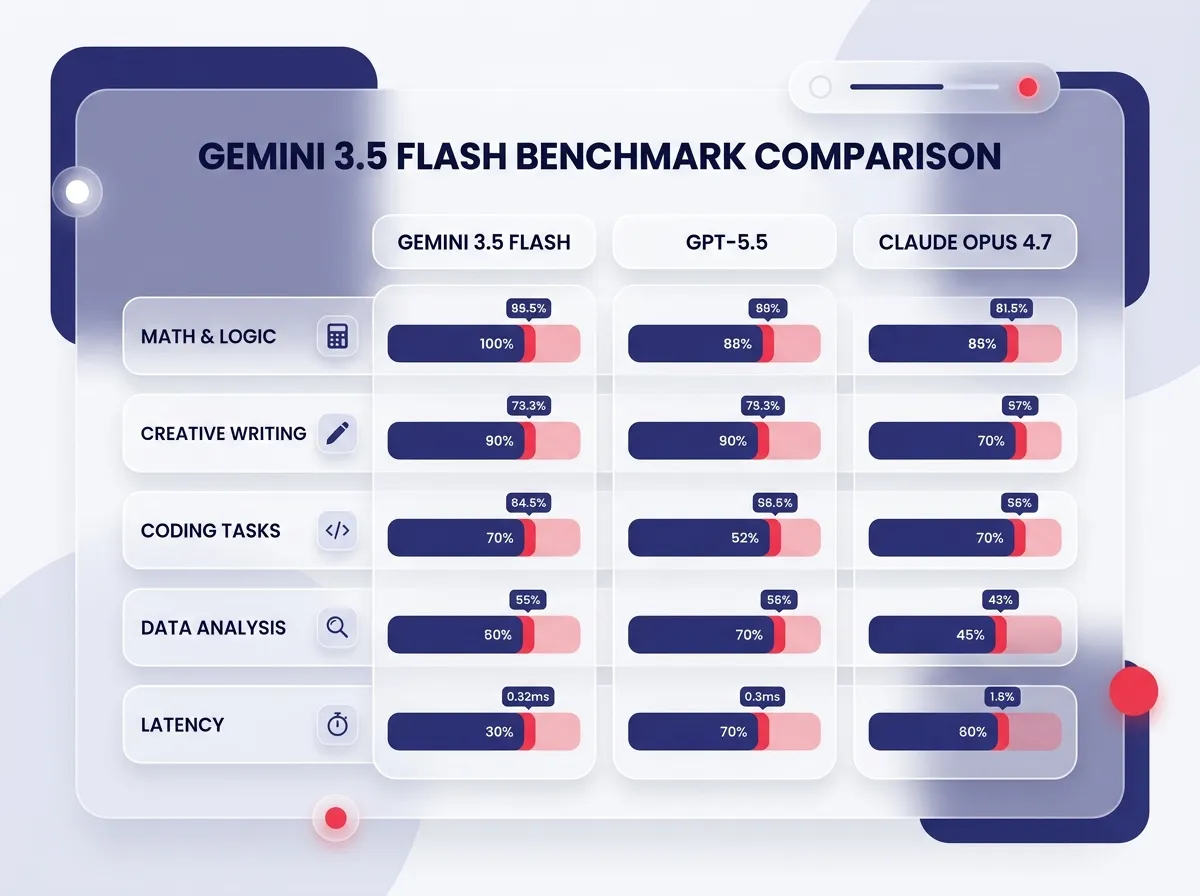
Gemini 3.5 Flash is now the default model inside the Gemini app, replacing Gemini 3.1 Flash. Google’s claim is that it’s four times faster than competing frontier AI models, and the benchmarks shown on stage did a reasonable job of backing that up.
On multi-step tool use, specifically the MCP Atlas benchmark, Gemini 3.5 Flash beats both GPT-5.5 and Claude Opus 4.7. It leads on Finance Agent v2 for financial analysis and outperforms both on visual comprehension benchmarks, including MMMU-Pro and CharXiv. It even beats the older Gemini 3.1 Pro on several coding and agentic tests, which means Google improved speed and raw capability in the same release. That doesn’t happen as often as you’d hope.
The speed improvement matters more than it might seem. In agentic workflows where a model is chaining multiple tasks together, a few seconds per step compounds quickly. Faster isn’t just nicer. It’s functionally different.
Gemini 3.5 Flash also powers the updated AI Mode in Google Search, the new Antigravity 2.0 coding assistant, and several other products announced at I/O 2026. It’s less a standalone product than the foundation everything else at this year’s show is built on.
 ### Gemini Omni: Google’s Leap Toward a True World Model
Gemini Omni is something different. Where Gemini 3.5 Flash is an evolution of a familiar format, Omni represents an architectural shift. Google DeepMind CEO Demis Hassabis described it on stage as a meaningful step toward artificial general intelligence. That phrase gets overused, but the technical specifics here give it more weight than usual.
Gemini Omni is a world model family that combines three existing Google tools: Veo for video generation, Nano Banana for lightweight on-device reasoning, and Genie for interactive environment generation. Together, they let Omni generate physics-aware video from combinations of text, images, audio, and video references at the same time. This isn’t better video generation in the usual sense. It’s a model that has some grasp of how things in the physical world actually behave.
Google says Omni has a stronger understanding of concepts like gravity, kinetic energy, and fluid dynamics. Generated content doesn’t just look visually plausible, it moves the way real things move. You can also edit generated videos using plain language prompts after the fact, which removes a significant friction point from creative work.
The first release under the Gemini Omni family, called Gemini Omni Flash, is rolling out now to Google AI Plus, Pro, and Ultra subscribers through the Gemini app and Google Flow. It’s also coming to YouTube Shorts and YouTube Create, which gives you a sense of how broadly Google plans to deploy this across its products.
Gemini Spark and the Agentic Shift: When AI Stops Waiting and Starts Working
One word kept surfacing throughout the I/O 2026 keynote: agentic. It sounds like conference jargon, but the idea it points to is genuinely worth paying attention to. Most AI tools right now are reactive. You open them, ask something, get an answer, and close them. Agentic AI works differently. It runs tasks on your behalf, in the background, without requiring you to manage it step by step.
Google made this concrete at I/O 2026 through two announcements: Gemini Spark and Antigravity 2.0.
Gemini Spark: Your Personal AI Agent That Keeps Running After You Close Your Laptop
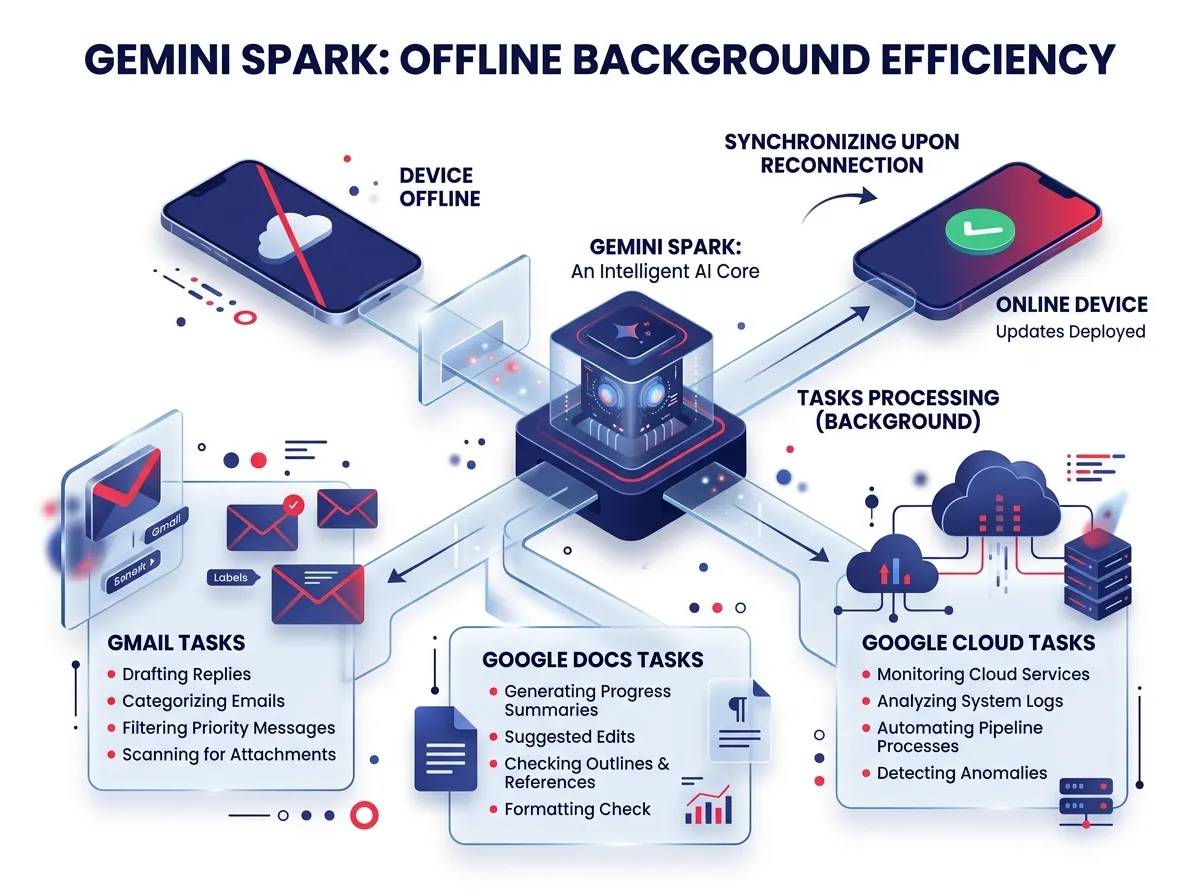
Gemini Spark is Google’s most direct attempt to show what a personal AI agent actually looks like in practice. It’s not a chatbot. It’s not a souped-up assistant. It’s a persistent background service running on dedicated virtual machines inside Google Cloud, which means it keeps working after you close your laptop or turn off your phone.
The practical implications are bigger than the description suggests. Today’s AI tools are session-based. When the app closes, the work stops. Spark breaks that model. You can set it up to scan monthly credit card statements for hidden subscriptions, compile school deadline summaries, monitor a job listing, or track a topic over time. When it finds something relevant, it surfaces it. You don’t have to ask again.
Spark is deeply integrated with Google Workspace (Gmail, Docs, and Slides), and the whole thing is framed around user direction and control. Google was deliberate on stage about positioning this as AI working under your supervision rather than acting on its own. That framing isn’t accidental. Fully autonomous AI systems have made a lot of people uneasy, and Google clearly knows it.
 ### Search Agents and Antigravity 2.0: Agentic AI for Everyday Users and Developers
Search Agents take the same background-monitoring idea and bring it to Google Search. Users can create agents that watch topics continuously, apartment listings in a specific neighborhood, price drops on a product, financial updates for a stock or sector. These aren’t saved searches. They’re active monitors that report back when something changes.
Google also showed that Search can now be used to build lightweight tools and dashboards for long-running projects. Planning a wedding, managing a move, tracking a slow-moving research topic: each of these can have a dedicated workspace inside Search now, rather than requiring a separate app to organize.
For developers, Antigravity 2.0 is the big one. Powered by Gemini 3.5 Flash and rebuilt as an agent-first workspace, it lets users run multiple AI agents simultaneously on a single project. The live demo on stage was more ambitious than anything Google has shown in a coding context before: AI agents wrote, tested, and audited a complete operating system from scratch, including the scheduler, memory management, and file system. When the demo surfaced missing keyboard and video drivers, Antigravity identified the gaps, patched the OS, and then ran Doom on the result. It’s a hard demo to be skeptical about in the moment, though obviously a controlled environment is a long way from production.
Android, Search, and the Googlebook: How Google I/O 2026 Rewires the Everyday Experience
Models and agents matter, but Google also used I/O 2026 to show how this AI shift lands in the products most people actually use. The changes to Android, Search, and hardware are where the philosophy gets tested against real behavior.
From OS to Intelligence System: Android Auto, Gemini on Wearables, and the Googlebook
Android is getting a significant rethink in 2026. Gemini is being embedded more deeply into the operating system rather than living as a separate app you open when needed. Android Auto is gaining new Gemini-powered capabilities, and wearables including smartwatches are getting on-device Gemini access that works without a constant connection to a phone.
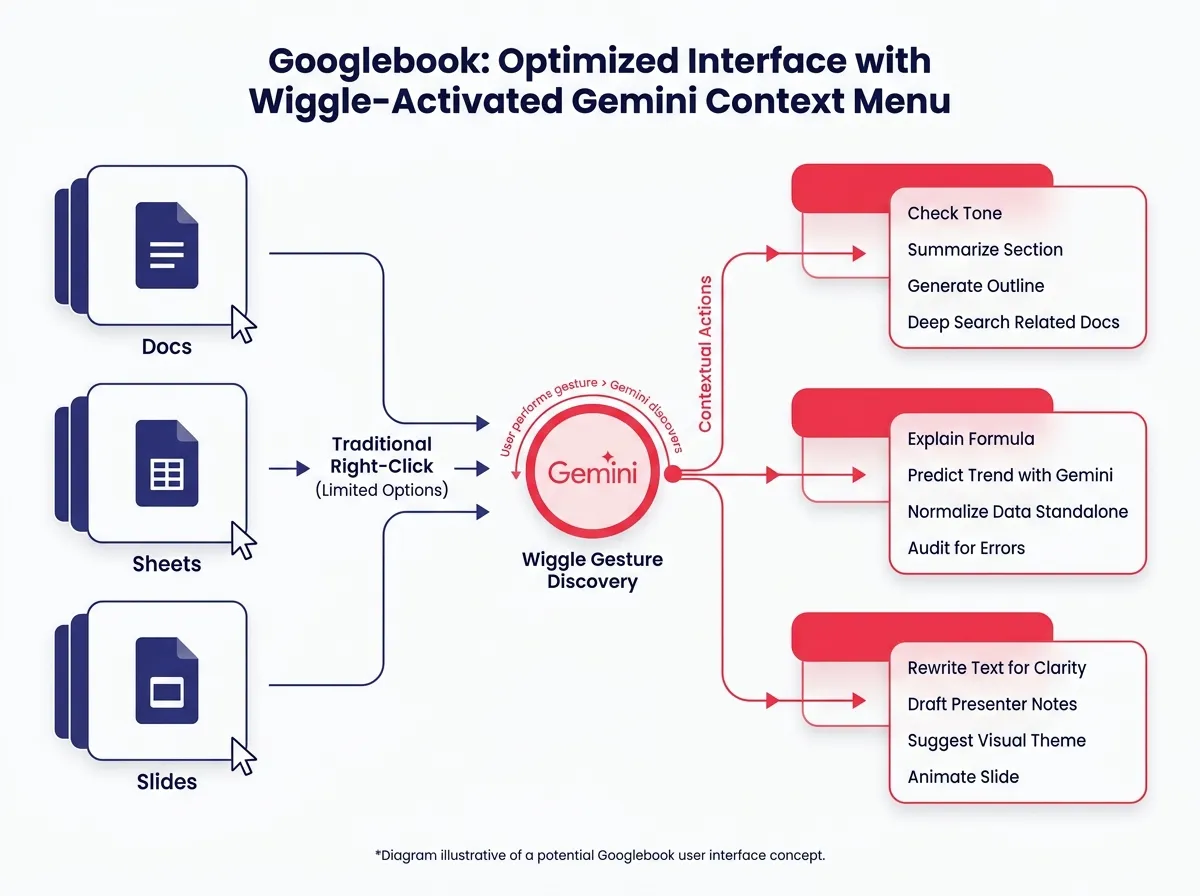
The hardware announcement that got the most attention was the Googlebook. This is Google’s laptop built around the Gemini era, and it replaces some Chrome OS conventions that have felt dated for a while. The most visible change is the removal of traditional right-click menus. Instead, wiggling two fingers on the trackpad activates a Gemini-powered context layer that suggests relevant actions based on what’s on screen. That sounds like a gimmick, and I was ready to write it off, but the demo showed it working naturally across different apps and workflows.
The Googlebook is also designed around cross-device integration rather than the web-first model Chrome OS has always prioritized. Android apps run natively, sync with phone and tablet state, and the whole experience assumes Gemini is always available as a layer on top of whatever you’re doing.
 ### Pause Point, Rambler, and Create My Widget: The Quiet Features That Signal a Mature Android
Not everything at I/O 2026 came with a dramatic demo. Some of the most telling announcements were smaller features that reveal a lot about where Google thinks Android needs to go.
Pause Point is a system-level tool that lets users schedule focus time and block distracting apps during set windows. What makes it interesting is who built it. Google has spent years profiting from the same notification loops and algorithmically driven feeds that Pause Point is designed to interrupt. Building a tool that works against that pattern is a real signal about where user sentiment has landed, whatever you think of the motivation.
Rambler is a writing assistant embedded in the Android keyboard that helps users organize and sharpen what they’re trying to say. It doesn’t replace writing with generated text. It works alongside you to bring scattered thoughts into clearer shape. That’s a subtler application of Gemini intelligence than most of what was shown on stage, and honestly, probably more useful for the way most people actually write on their phones.
Create My Widget lets users generate custom home screen widgets using plain language descriptions, with Gemini handling the layout and logic. It sounds minor, but it represents AI working at the interface layer to reduce friction rather than adding another app to manage.
Taken together, these smaller features point to something the bigger announcements can obscure: Google isn’t just bolting AI onto existing products. It’s rethinking how interfaces should behave when intelligence is always present. That’s genuinely harder than building a faster model, and Google I/O 2026 was the first year it felt like Google had a coherent answer to it. Whether the execution holds up outside a demo environment is a different question, and one worth revisiting once these features actually ship.