
TL;DR
- An AI SEO agent executes the work: it pulls the data it needs, decides the next step, checks its own output and returns for approval, where a chatbot only generates text and leaves the doing to you.
- Five workflows are named as the highest-return uses: keyword research and clustering, content optimization and scoring, technical SEO automation, internal linking at scale, and performance tracking across Search Console, an SEO platform and GA4.
- Three build routes are compared: chatbot plus MCP (Claude or ChatGPT with the Ahrefs MCP), third-party builders such as Gumloop and n8n, and purpose-built platforms such as Agent A with pre-built SEO skills.
- MCPs expose only a subset of each SEO tool's data, and an agent run locally stops when the laptop closes, which makes that route a poor fit for scheduled background jobs.
- Anthropic recommends one skill file per job rather than a single long prompt, to avoid context bloat; agents pointed at no authoritative source invent keyword volumes and competitor rankings, so the post routes them to SEO platform APIs or MCPs, Search Console and Bing Webmaster Tools.
Most marketing teams have tried AI at some point. Far fewer have actually put an AI SEO agent to work. There’s a real difference between typing a question into a chatbot and having software that pulls live search data, runs a full analysis, and drops a prioritized content brief into your inbox before your morning standup.
Asking ChatGPT for keyword ideas is one thing. Having an agent that automatically scans for competitor gap keywords every week, clusters them by topic, scores them against your thresholds, and delivers something you can act on immediately is something else entirely.
This article covers what AI SEO agents actually do, how they differ from the AI tools your team is probably already using, which platforms are worth a look, and how to build one that fits your workflow without turning it into a months-long project.
 ## Table of Contents
- What an AI SEO Agent Actually Does (and Why SEO Is the Perfect Fit)
- Three Platforms for Building an SEO AI Agent: A Side-by-Side Comparison
- How to Build Your Own SEO AI Agent: Practical Steps for Marketing Teams
What an AI SEO agent actually does (and why SEO is the perfect fit)
AI SEO agent vs. AI chatbot: the key distinction
An AI SEO agent does the SEO work rather than describing it. That single distinction matters more than it sounds.
A chatbot responds. It generates text based on what you ask. If you want help with keyword research, you bring the data, you decide what to do next, and you compile the output. The chatbot is a thinking aid. You’re still doing the work.
An AI SEO agent operates differently. You give it a task, point it at your data sources, and it works through the job on its own. It pulls what it needs, decides what to do next, checks its own output, and comes back when it’s done. You review and approve.
This isn’t a speed improvement so much as a different category of tool. One generates content on demand. The other completes workflows on its own, with human approval steps built in wherever your team wants them.
Five SEO workflows where agents deliver real ROI
AI SEO agents are most useful for work that is high-volume, sequential, and tied to live data. Five categories cover most of what marketing teams actually use them for.
1. Keyword research and clustering
Manual keyword research is slow. A well-configured agent connected to live SEO data takes a seed topic, pulls matching keywords, identifies long-tail variations and question formats, clusters by parent topic, scores by difficulty and traffic potential, and returns a prioritized brief with suggested titles. What takes hours manually runs in minutes.
2. Content optimization and scoring
Agents work in two directions here. They evaluate new content before it publishes and surface opportunities in your existing library. An agent running across your full content archive can find pages with declining traffic, compare them against current top-ranking pages for their target keywords, and produce a refresh list with specific gaps to address.
3. Technical SEO automation
Crawl errors, missing H1s, broken internal links, duplicate titles, slow load times. This work isn’t hard, but there’s too much of it to do consistently by hand. An agent connected to a site audit tool can run a crawl, compare it against the previous run, and post a digest of what actually needs attention this week rather than dumping 170 undifferentiated checks on your team.
4. Internal linking at scale
An agent can crawl a content library, map topical relationships between pages, identify where a new article should link out and where it should receive links from, generate anchor text suggestions, and flag over-optimized anchors. Run as part of a publishing workflow, every new article gets an internal linking brief before it goes live.
5. Performance tracking and reporting
Instead of pulling data from Search Console, your SEO platform, and GA4 manually, an agent pulls it together automatically. Monthly performance reports, traffic trend comparisons, content-level attribution, all delivered without someone spending a half-day compiling spreadsheets.
How sequential SEO tasks make agents especially effective
SEO is inherently sequential, which is exactly why agents handle it well. Keyword research feeds the content brief. Competitor gaps shape the outline. A technical audit tells you what to fix before you hit publish. Each step depends on the last.
That structure maps naturally to how agents are designed to operate. They plan a sequence of steps, execute them in order, and pass outputs from one stage into the next. The work is systematic, data-dependent, and repetitive enough that automating it frees your team for the decisions that actually require judgment.
Three platforms for building an SEO AI agent: a side-by-side comparison
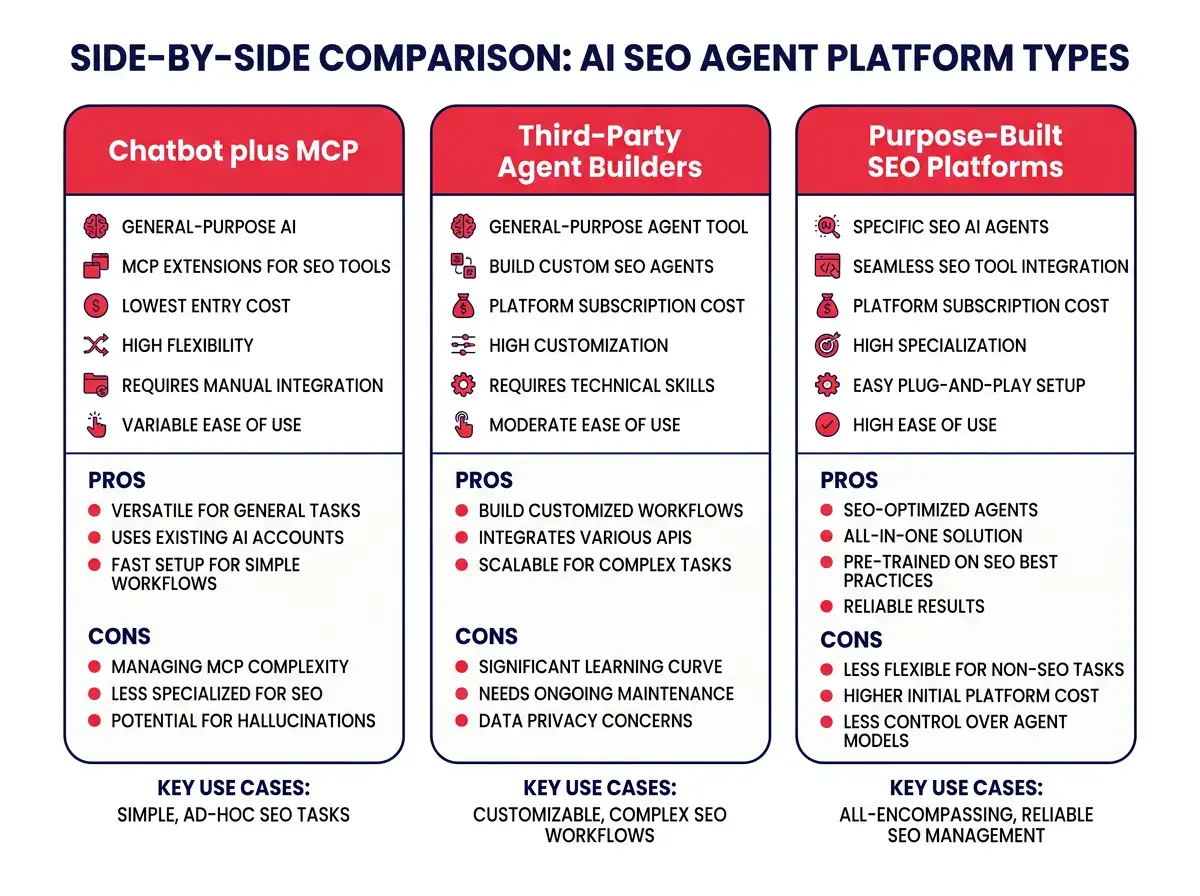 The “AI SEO agent” label is covering a lot of ground right now. It describes everything from a custom GPT someone configured on a weekend to a system that can crawl your site, open a pull request, verify its own fix, and notify your team in Slack. Three platform types cover most of what marketing teams are actually building.
| Platform Type | Best For | Key Advantage | Main Limitation | Example Tools |
|---|---|---|---|---|
| Chatbot + MCP | Teams who want to start cheap with tools they already use | Low marginal cost, flexible prompting | Runs locally, limited to what MCP exposes, no built-in SEO expertise | Claude + Ahrefs MCP, ChatGPT + Ahrefs MCP |
| Third-party agent builder | No-code teams who want visual workflow building | Drag-and-drop interface, broad integrations | Same data ceiling as chatbot + MCP, no SEO-specific logic | Gumloop, n8n |
| Purpose-built SEO agent platform | Teams doing SEO-specific work who need data depth | Full product data access, pre-built SEO skills | Less flexible, tied to one provider’s data and framework | Agent A |
Chatbot + MCP: the low-cost entry point
Connecting a chatbot your team already uses (ChatGPT, Claude, or Gemini) to live SEO data via an MCP (Model Context Protocol) is the most accessible way to start. If your SEO platform offers an MCP connector, setup takes minutes.
The agentic behavior kicks in when you give it a multi-step prompt. Something like: find every post that has lost more than 30% of its traffic this quarter, check which keywords each one ranked for, and draft refresh briefs for the top five. The chatbot plans the steps, calls the connectors, and returns an output.
The tradeoffs are real, though. The chatbot has no built-in opinion on what a good refresh brief looks like or how your team defines “declining.” That has to come from your prompts. MCPs also expose a subset of each SEO tool’s data, not everything available inside the product. And if you’re running the agent locally, closing your laptop means the agent stops, which makes it a poor fit for scheduled background jobs.
Third-party agent builders: visual workflows without code
Platforms like Gumloop and n8n sit in the middle. Instead of writing prompts or code, you connect nodes in a visual workflow editor. For teams that find the chatbot route too technical, this is a genuinely lower-friction option.
The tradeoff is that a nicer interface doesn’t mean deeper data access. These platforms mostly connect to tools via the same MCPs you’d use yourself, so the data ceiling is identical to the first option. There’s also no SEO expertise baked in. Whatever domain knowledge ends up in the agent, your team has to put it there.
Purpose-built SEO agent platforms: depth over flexibility
Purpose-built platforms like Agent A are designed for exactly this use case. The data access, integrations, and SEO logic are already wired in. You get full access to the SEO tool’s data rather than just what the API exposes, pre-built skill libraries for common SEO workflows, and connectors to tools your team is already using, like Notion, WordPress, Slack, and HubSpot.
The tradeoff is less flexibility. You’re working within someone else’s framework and you don’t have the same level of control that comes with building something from scratch. For most marketing teams doing SEO work, that tradeoff is worth it.
How to build your own SEO AI agent: practical steps for marketing teams
 ### Start with one workflow, not the entire pipeline
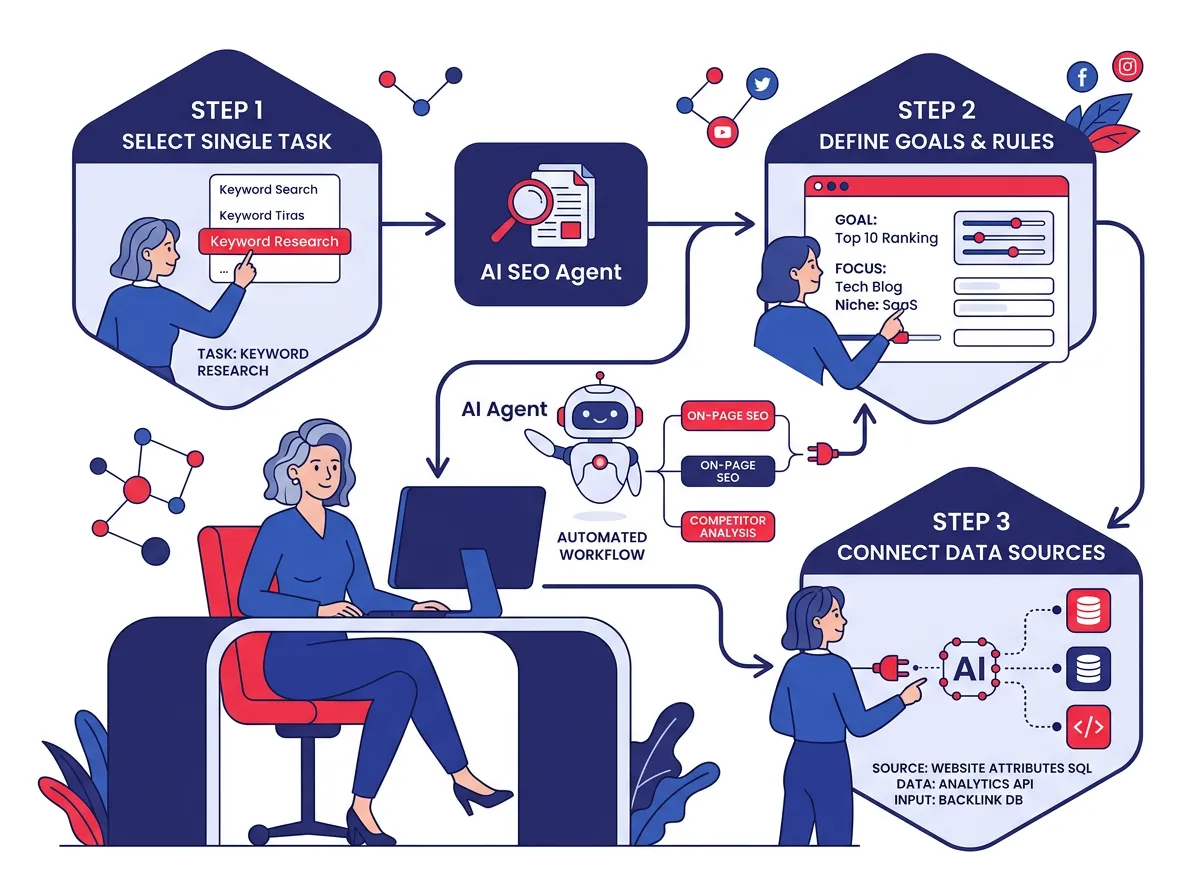
The most expensive mistake when building SEO agents is trying to automate everything at once: the full content pipeline, the technical audit, the reporting, all at the same time. It’s tempting because the use cases all seem obvious. But complex multi-part systems have more places to break, they’re harder to debug when something goes wrong, and they take longer to deliver any real value.
The smarter move is to pick one high-repetition workflow your team currently runs manually. Your monthly organic performance report. Your competitor gap analysis. Your internal linking process. Automate that first, get it working reliably, then build the next piece.
You get value faster. When something breaks, you know which stage broke it. And you build up hands-on knowledge about how your agent actually behaves, which makes the next build significantly easier.
When scoping your first workflow, look for these characteristics: it happens on a regular cadence (weekly or monthly), it follows the same steps every time, it pulls from specific data sources you can name, and the output has a predictable format. Those are the conditions where an AI SEO agent delivers the most immediate return.
Use skill files instead of one giant prompt
Anthropic recommends structuring agent instructions as separate skill files rather than a single long compound prompt. This approach prevents a common problem called context bloat, where the agent’s working memory gets so crowded with instructions that it starts losing track of what it’s supposed to do.
The structure is straightforward: one file per job. The keyword research skill is its own file. The content brief skill is its own file. The reporting skill is its own file. Each one is short, specific, and independently maintainable. Updating the keyword research skill doesn’t touch anything else.
Each skill file only loads when it’s relevant to the task at hand, which keeps the agent focused and makes the output more consistent. It also means you can iterate on individual workflows without risking the parts that are already working.
If you’re building in Claude, there are official skill-creator tools that walk you through the process. You describe what you want the skill to do, and the tool interviews you to understand the requirements, drafts the skill file, evaluates the output, and iterates with you until it’s right.
Connect to verified data and save what your agent learns
An agent is only as good as the data it’s working from. Without a clear directive on where to look, agents will fill gaps with whatever seems plausible. Invented keyword volumes, fabricated competitor rankings, made-up metrics. This isn’t a hypothetical failure mode. It happens, particularly with vague research prompts.
The fix is straightforward: point the agent at authoritative, structured sources. Your SEO platform’s API or MCP. Search Console. Bing Webmaster Tools. Give the agent access to the actual documentation for each source so it knows what parameters exist and how to query them correctly.
API and MCP connections beat scraping because the data comes back structured and verifiable. You can check it. The agent can check it. And when something looks off, you know where to look.
One practice worth building in early: save what your agent learns. After any significant build or run, ask the agent to summarize what it found and write the key insights to a memory file. For SEO work, these lessons accumulate fast, things like which keyword difficulty thresholds actually correlate with rankings on your site, which content formats perform best in your niche, and which technical issues your CMS keeps reintroducing after updates.
Future builds start from that documented baseline rather than from scratch. You also avoid having to re-explain your site’s history, quirks, and context every time you start a new session. Keep version backups too. Agents make it easy to build things and equally easy to break them. A backup system, whether local files or a GitHub repo, saves you a lot of time when something goes sideways.
The editorial judgment on what to publish, whether a strategic priority makes sense, whether the argument in a piece actually holds up, that stays with your team. The AI SEO agent handles the systematic, repeatable, data-heavy work so your team has more capacity for the decisions that actually require a human in the room.