TL;DR
- OpenAI moved ChatGPT ads from direct deals with its sales team to a self-serve ads manager open to mid-market brands and independent performance agencies, with account verification currently delayed by high signup volume.
- Ad formats grew from a headline, short description, single image and link into a larger image with customizable CTAs such as Shop Now, Book Now, Sign Up and Learn More, plus an ecommerce format pulling live pricing and customer reviews that stacks in portrait for carousel-style placements.
- Benji Shomair, OpenAI's VP of Monetization, said publicly that creative variation is one of the biggest drivers of ad success on the platform.
- Audience targeting including retargeting and lookalikes is in a gated rollout and outcome-based CPA or ROAS optimization is still in development with no public timeline, while conversion tracking, role-based account access, ad-level spend reporting and daily budget controls are already live.
- Users who opt out of ads get reduced access to features including image generation and slower research-heavy tasks, and still see contextual ads driven by the conversation topic; OpenAI blocks ads on health and political queries and does not share conversation content with advertisers.
For years, AI chat tools were sold as the clean, ad-free alternative to search engines. No sponsored results. No banners cluttering the sidebar. Just answers. That promise is now officially gone, and the shift has real consequences for every business professional who advertises online, competes for customer attention, or simply uses ChatGPT as part of their daily workflow.
OpenAI is actively building out a full-scale advertising ecosystem inside ChatGPT. What started as a quiet pilot with a handful of big brand partners has since grown into a self-serve platform open to mid-market businesses, performance agencies, and brands of all sizes. The pace of development has been aggressive, the strategic intent is obvious, and the ripple effects are already being felt across the broader digital advertising industry.
This article breaks down what ChatGPT ads actually look like right now for both users and advertisers, why OpenAI made this move in the first place, and what the emerging platform means for your marketing strategy going forward.
- How ChatGPT Ads Work Right Now: Formats, Targeting, and the Self-Serve Shift
- The User Side of ChatGPT Ads: Privacy Controls, Opt-Out Trade-Offs, and Data Guardrails
- Why OpenAI Launched Ads and What It Means for Competing in an AI-Driven Market
How ChatGPT Ads Work Right Now: Formats, Targeting, and the Self-Serve Shift
Before deciding whether to put budget into ChatGPT ads, you need an accurate picture of where the platform actually stands. Not where it might be in two years. Where it is today, and what it still can’t do.
From Simple Banners to Dynamic, Conversational Ad Units
When ChatGPT first introduced ads, the format was pretty bare-bones: a headline, a short description, a single image, and a link. Functional, but limited. That baseline has since been upgraded.
OpenAI is now testing a richer ad format that includes a larger image and an optional, customizable call-to-action button. Advertisers can choose from dynamic CTAs like “Shop Now,” “Book Now,” “Sign Up,” and “Learn More,” giving them a direct response element built right into the ad unit. That’s a meaningful shift, because it moves ChatGPT ads from pure awareness territory into performance marketing territory.
OpenAI has also introduced a dedicated e-commerce format that pulls in live shopping data, including pricing and customer reviews. This format can be displayed in portrait or landscape orientation, and the portrait layout is designed to stack multiple ads side by side, which opens the door to carousel-style placements. For e-commerce brands and retail advertisers, that’s a significant development.
Benji Shomair, OpenAI’s VP of Monetization, has publicly said that creative variation is one of the biggest drivers of ad success on the platform. That reasoning makes sense. ChatGPT is a high-intent, conversational environment. Someone researching running shoes is in a completely different headspace than someone planning a holiday trip, and the creative needs to match that context to perform.
The Self-Serve Ads Manager: Who Can Now Buy ChatGPT Ads
One of the biggest structural changes to the ChatGPT ads platform is the launch of a self-serve ads manager. Previously, running ads inside ChatGPT required a direct relationship with OpenAI’s sales team. That meant the platform was largely limited to bigger brands with established agency relationships and the budget to justify a direct negotiation.
The self-serve manager removes that barrier. Mid-market brands, independent performance agencies, and companies testing the waters on behalf of clients who aren’t ready to commit major spend can now access the platform without going through a sales rep. That dramatically increases the volume of advertisers on the platform and, by extension, the volume of data flowing through the system.
That data matters because it’s what allows OpenAI to learn which formats work in which contexts, and for which objectives. In that sense, the self-serve launch isn’t just a revenue move. It’s also a data acquisition strategy.
One catch worth flagging: account verification delays are common right now because of high signup volume. Ashley Fletcher, CMO at Adthena, noted publicly that his team has U.S. staff waiting to get accounts live and running into a message that reads: “We are reviewing your information. Due to a high volume of signups, verification may take some time.” If you’re planning to test the platform, build in some lead time for onboarding.
What Is Still Missing Before Serious Budgets Move In
Here’s the honest assessment most advertisers are working with right now: ChatGPT ads have real momentum, but the platform is still missing the features that unlock serious performance budgets.
Audience targeting, including retargeting existing customers, excluding them, and building lookalike audiences, is currently in a gated rollout. That alone limits how precisely brands can control who sees their ads.
More critically, outcome-based optimization is still in development with no public timeline. This is the ability to optimize campaigns against a cost-per-acquisition (CPA) or return on ad spend (ROAS) target rather than just impressions and clicks. Among advertisers who aren’t yet in the pilot, this is the single most commonly cited prerequisite for committing real budget. The feedback from the market is pretty consistent: brands want to optimize toward actual business outcomes like product sales and lead generation. Until they can do that inside ChatGPT ads, many will sit on the sideline.
What’s already live is not nothing. Conversion tracking, role-based account access, spend reporting at the ad level, daily budget controls, and the self-serve manager itself are all operational. The foundation is there. The performance engine is still being built.
The User Side of ChatGPT Ads: Privacy Controls, Opt-Out Trade-Offs, and Data Guardrails
For business professionals who use ChatGPT as a productivity tool every day, the arrival of ads raises a different set of questions. What does opting out actually cost you? How does ad targeting work when you’re in the middle of a sensitive work conversation? And what is OpenAI actually doing with your data?
Opting Out of Ads: What You Actually Give Up
Here’s something that often gets glossed over in coverage of ChatGPT ads: opting out is not free. Users who choose an ad-free experience face reduced access to certain platform features. That includes limits on image generation and slower access to research-heavy tasks.
This is a genuine trade-off, not a simple preference toggle. For business professionals who rely on ChatGPT for research, content creation, or image generation as part of their workflow, the opt-out decision has real productivity implications. It’s worth looking at what features you actually use before defaulting to the ad-free option, especially if you’re on a free or lower-tier plan.
Contextual Ads vs. Personalized Ads: A Critical Distinction
This is a distinction a lot of users miss, and it matters for how you think about sensitive work queries on the platform.
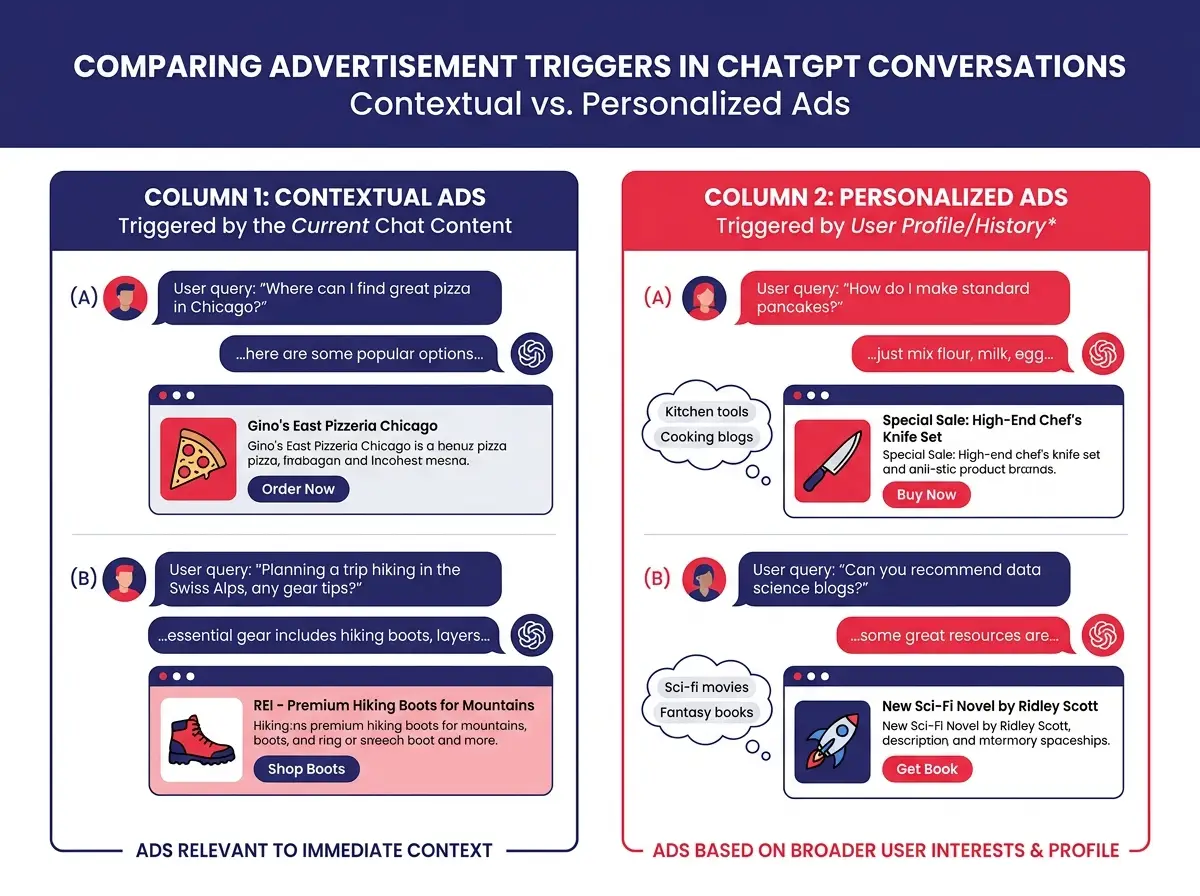
Even if you turn off ad personalization, you’ll still see ads inside ChatGPT. The difference is that those ads will be contextual rather than personalized. A contextual ad is triggered by the topic of your current conversation, not by your personal data or browsing history. If you’re talking about sourcing office equipment, you’ll likely see ads related to office equipment. That happens regardless of your personalization settings.
For most professional conversations, this is relatively low-stakes. But if you’re discussing a competitor’s products, researching sensitive business decisions, or exploring topics you’d prefer to keep private, it’s worth knowing that the conversation topic itself is influencing what ads appear. Contextual targeting means the content of your query is doing work even when your personal data is not.
What OpenAI Will Not Do With Your Conversation Data
OpenAI has put some clear guardrails in place worth understanding. The platform has committed to blocking ads on sensitive topics, including health-related queries and political discussions. That’s a meaningful baseline that many traditional ad networks don’t maintain.
On data sharing, OpenAI does not share conversation content with advertisers. Reporting is delivered in aggregate, non-identifying form. Advertisers can see how their campaigns perform, but they can’t access individual conversation data or user-level information tied back to specific people.
That approach puts ChatGPT ads closer to privacy-forward platforms than to behavioral ad networks built on cross-site tracking. For business professionals worried about their ChatGPT conversations being mined for advertiser insights, the current architecture offers some reassurance. That said, it’s reasonable to stay attentive as the platform scales. These commitments can evolve, and they’re worth keeping an eye on.
Why OpenAI Launched Ads and What It Means for Competing in an AI-Driven Market
Understanding why OpenAI built an ad business helps you understand where this is heading, and why your competitors are probably already paying attention.
The Capital Reality: Why Free AI Requires an Ad Business
Running large language models at scale costs an enormous amount of money. Server infrastructure, compute costs, research teams, safety testing, the financial demands are significant and ongoing. OpenAI’s ad business is not a side project. It’s core infrastructure funding.
The platform is reportedly targeting an IPO as early as September, with a confidential filing already expected. That context matters because it explains the urgency behind the pace of development. OpenAI needs advertising revenue to be a credible, growing line item on its financial statements. The self-serve launch, the new ad formats, the rapid addition of features like conversion tracking and budget controls, all of it is moving fast because the financial stakes demand it.
For businesses, that urgency means the platform will keep evolving quickly. Features that are missing today may be live within months. Advertisers who get familiar with the platform now will have a real head start over those who wait for it to fully mature.
The ‘Poaching’ Dynamic: Why Your Brand Might Appear in a Competitor’s Conversation
One of the most strategically interesting mechanics in AI advertising is what some marketers are calling the “poaching” dynamic. Here’s how it works: when a user asks ChatGPT to compare two competing software products, that conversation signals extremely high commercial intent. The user is actively evaluating options. They’re close to a decision. That’s an ideal moment for one brand to step in with an ad, even if the conversation started with a mention of a competitor.
This is arguably more precise than traditional search advertising in certain contexts. On a search engine, a brand might bid on a competitor’s keyword and hope for the best. Inside ChatGPT, the conversational context tells the platform much more about where the user is in their decision-making process. That makes AI ad placements particularly valuable for B2B brands competing for high-consideration purchases.
The implication for business professionals is pretty direct: your competitors may already be targeting your brand’s conversations. If you’re not running ChatGPT ads, you may be leaving that window open with no response on the other side.
How Gemini, Anthropic, and Perplexity Are Responding to the Ads-in-AI Question
OpenAI is not the only AI platform wrestling with how to monetize conversational interfaces, but the competitors are taking very different approaches.
Perplexity has experimented with sponsored follow-up questions, a format that feels more native to the research-style queries the platform handles. Google has integrated ads into Gemini’s AI Overviews, tying AI-generated answers directly to its existing search advertising infrastructure. Anthropic, which makes Claude, has so far held back from direct ad monetization, at least publicly.
The result is a fragmented AI advertising landscape where each platform requires its own strategy. What works in a Perplexity placement won’t automatically translate to a ChatGPT ads campaign, and neither will a Google Gemini approach. For marketing teams already stretched thin, this fragmentation adds real complexity to an already crowded planning cycle.
The businesses that navigate this most effectively will probably be the ones building flexible creative strategies now, learning what high-intent conversational environments actually demand from ad creative, and staying close to platform developments across all of these players as they unfold. ChatGPT ads as a topic are going to keep evolving, and staying current isn’t optional if advertising is a meaningful part of how you grow.