TL;DR
- SEO PR is earned media planned around a search outcome: one target URL, a story an editor will actually run, and a crawlable page that links back.
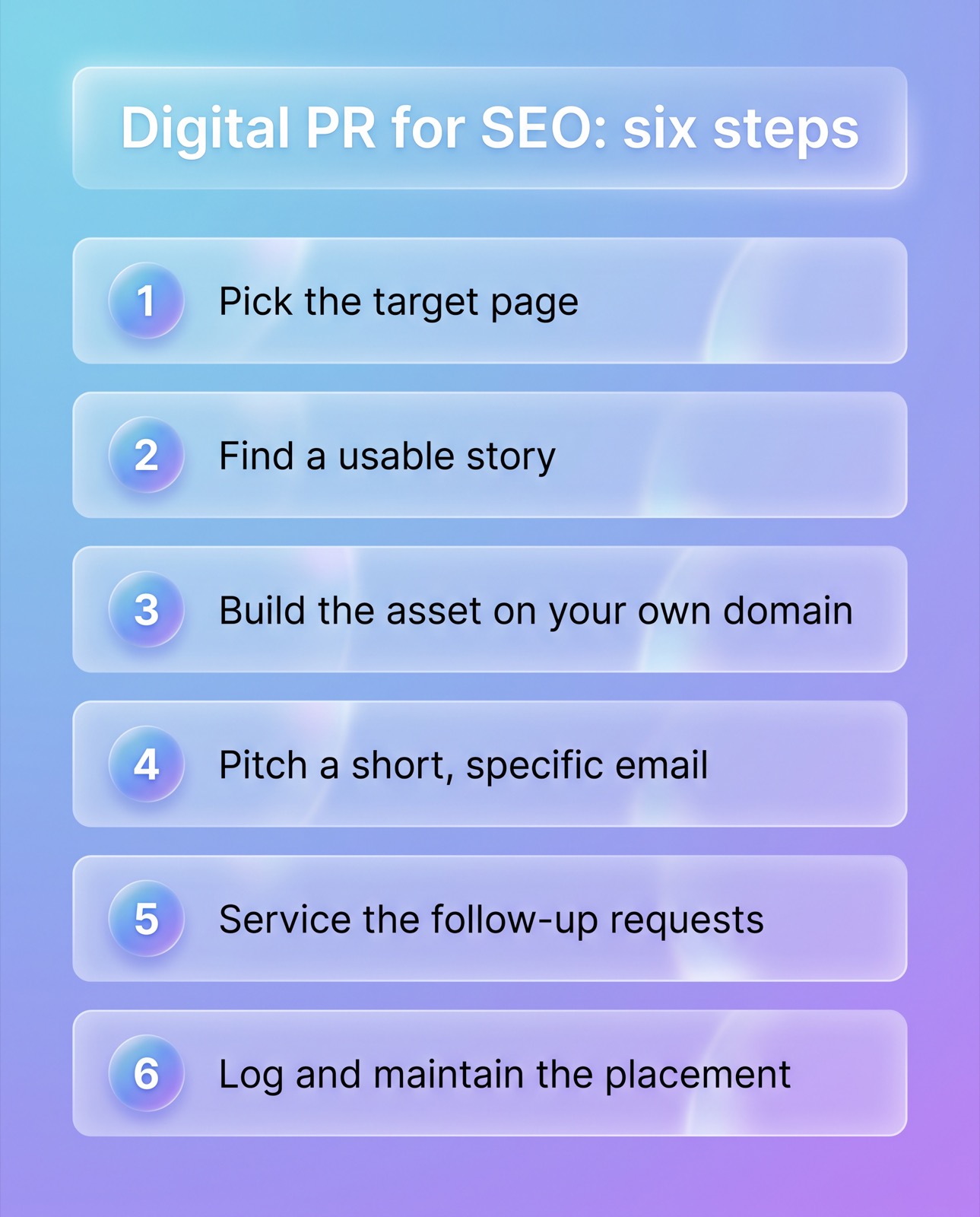
- Run it as six steps: pick the target page, find a usable story, build the asset on your own domain, pitch short and specific, service follow-ups, then log and maintain the placement.
- High PR backlinks quote Google's public toolbar PageRank score, which stopped updating in 2013 and was removed in 2016. Judge a link by the linking page instead: real editorial page, related topic, a site with its own readers.
- Paid wire distribution is bought for reach and discoverability. Its links are usually nofollowed and the text is syndicated, so do not expect ranking movement from it.
- There is no honest public benchmark for links per campaign or pickup rate. Track placements per pitch, referring domains before and after, referral sessions, and branded search in Search Console.
SEO PR is public relations work that is planned and measured around search outcomes: coverage on independent websites that carries a link or a brand mention back to a page you care about, published somewhere a crawler can actually reach. It aims at the same result link building aims at, but it gets there by giving an editor something worth publishing rather than asking a site owner for a favour.
If the phrase reads awkwardly, that is because it began life as a search query rather than a job title. The term seo pr is shorthand for the overlap between digital PR and search: the part of PR that produces crawlable, citable coverage, and the part of SEO that depends on other people deciding your site is worth referencing. Teams who do the work usually call it digital PR. This article treats SEO PR and digital PR for SEO as the same thing, because the person searching for one wants the other.
What is PR in SEO
PR in SEO is the earned half of your link profile. You do not place the link yourself. You give a journalist or editor a reason to publish something about you, and the link arrives attached to the coverage. Google's documentation describes links as one of the ways it discovers and understands pages, and Google's spam policies treat links bought or exchanged for ranking purposes as a violation. Those two facts together are the entire argument for PR as a search channel: the links Google is comfortable with are the ones you did not pay for directly.
Before planning anything, separate the three kinds of media. Owned media is your own site and channels, where you control the message and get no outside validation. Paid media is advertising and sponsored placement, where any link should carry rel="sponsored" or rel="nofollow" so it does not pass ranking signals. Earned media is coverage an editor chose to run. Only earned media produces the sort of link that search engines want to count, and the price of it is that you do not control the outcome.
A mention without a link still does work. Someone who reads about you and then types your brand into Google has created a branded search, which shows up in Search Console as a query and in analytics as a visitor who behaves nothing like a cold click. That is measurable. What is not honestly claimable is a specific ranking effect from an unlinked mention, so plan the campaign around the link and treat the brand lift as a second outcome you track separately.
PR SEO integration: two ends of one job
PR SEO integration works when the PR side knows which URL the campaign exists to help and the SEO side knows what an editor will actually run. Most of the friction between the two disciplines disappears once both are looking at the same short document: the pages that need authority, the topics those pages cover, and the date each campaign lands.
The SEO side can build that page list from its own data. Pages that convert well but sit on the second results page. Pages with far fewer referring domains than the pages outranking them. Commercial category pages that no one has ever linked to because nobody links to a product listing without a reason. Those are the campaign targets, and they should be decided before anyone writes a pitch.
The failure modes here are mechanical, and each one has a specific cost.
- The release points at the homepage. The homepage is usually the strongest page you have already. Point the link at the page you are trying to move, and give the journalist a reason why that page is the relevant destination.
- The campaign asset lives on a separate domain or an agency subdomain. Links earned there do very little for the site you actually sell from, and you cannot merge them later without a redirect you may not control.
- The asset is a PDF. Editors will still cover it, but the page that collects the links should be an HTML page you can update, link internally to, and keep in the sitemap.
- The campaign page is deleted during a site tidy-up six months later. Every link earned now resolves to a 404. If the page has to go, redirect it to the closest live equivalent instead of removing it.
- Nobody logs the coverage. A year on, no one can say which outlets ran the story, and the mentions published without a link are never reclaimed.
How to do digital PR for SEO
Digital PR for SEO runs as a repeatable sequence, not a one-off stunt. Six steps, in this order.
Pick the target page
Choose one URL per campaign before you write a word. One page keeps the pitch honest, because you have to explain to an editor why that page is worth sending a reader to. It also makes measurement possible: you have a before and an after for a single URL rather than a vague sense that the brand did well. If the campaign genuinely serves two pages, run two campaigns.
Find a usable story
A story is usable when it is new, specific, relevant to that outlet's readers, and provable. The material you own is usually more interesting than you think: aggregated and anonymised data from your own operations, a survey you actually commissioned and can describe the method of, informed commentary on a rule change that affects your industry, or original analysis of a public dataset that nobody has bothered to read properly. What does not work is a story about your company being pleased about something. A funding round or an award is news to you and to almost nobody else.
Build the asset on your own domain
Whatever the story points to has to exist as a page on the domain you want to strengthen. Give it a stable URL, a plain descriptive title, the data in HTML rather than only in a graphic, and a short method note so an editor can check your working. Put the images somewhere the newsroom can download them without asking. Add internal links from the asset to the commercial page it supports, because links arriving at the asset flow onward through your own site.
Pitch a short, specific email
The pitch is where most campaigns die. Put the fact in the subject line rather than a tease. First line: what is new. Second line: why this is for this writer, which requires having read something they wrote. Third: the link, plus an offer of the data, images and a named person available to comment. No attachments. Send it from a human address that receives replies. If there is an embargo, state the date and time clearly and honour it.
Build the media list by hand, one writer at a time, from the outlets that already publish this kind of story. A list bought in bulk produces bulk results.
Service the follow-up requests
When a journalist replies, the clock is short. Have the spokesperson briefed in advance and available. Have the raw numbers ready in a spreadsheet. Answer the awkward question directly rather than routing it through three approvals, because the story runs today whether your quote arrives or not. If the outlet asks for something exclusive, decide quickly what you can offer without breaking the wider plan.
Log and maintain the placement
Record every placement the week it appears: outlet, URL, date, whether there is a link, which page it points to, and the anchor text used. Check the links resolve. When a mention appears without a link, a short polite note to the writer asking whether they would consider adding the source is normal practice and sometimes works. Revisit the log twice a year, because pages get restructured and links break quietly.
SEO PR and traditional PR: the difference, and where they overlap
Traditional PR manages reputation across every channel, including ones that leave no trace online. SEO PR is the slice of that work where the output is a web page that a search engine can crawl, pointing at a URL that has a job to do. The skills overlap almost completely. The judgement about what makes a story, the relationships with writers, the ability to hold a line under a hostile question, all of that is the same craft. What SEO adds is a set of technical requirements about where the coverage lives and where it points.
The table below sets the two side by side on the parts that actually differ in day-to-day work.
| Aspect | Traditional PR | SEO PR |
|---|---|---|
| Definition of a win | Coverage in a title the client respects, in any medium | A crawlable page linking to a chosen URL, or a mention that lifts branded search |
| Target selection | Outlets that reach the audience, print and broadcast included | Online outlets whose articles stay published and are indexed |
| Where the story lands | Anywhere the audience is | An HTML page on your own domain, then the outlets that cite it |
| Reporting | Clip book, reach estimates, share of voice | Placement log with links checked, referring domains before and after, Search Console data for the target URL |
Where paid wire distribution fits
Be honest with yourself about wires. A paid press release sent over a distribution network is bought for reach and discoverability, not for link equity. Links inside syndicated releases are commonly nofollowed, and the same text appears on dozens of sites at once, which is duplicate content by definition. Treat a wire as a way to put a factual announcement in front of journalists, investors, partners and search users who look up your company name, and do not expect it to move rankings on its own.
That does not make it useless. An announcement that has to be on the record, reach a specific market, or appear in a language your team does not write is a reasonable use of a wire. If that is the job, plan the press release distribution around who needs to see the announcement, and for cross-border news treat an international press release as a reach exercise with a separate editorial pitch running alongside it. The links that matter will come from the journalists who pick the story up and write their own version.
High PR SEO backlinks: selling against a score that no longer exists
Anyone offering high PR SEO backlinks today is quoting a metric Google retired. PR in that phrase means PageRank, specifically the public toolbar PageRank score from zero to ten that Google displayed in its browser toolbar. Google stopped updating that public score in 2013 and removed it from the toolbar and its public endpoints in 2016. PageRank as an internal concept did not disappear, but the number a vendor could show you did. A seller quoting a PR value in 2026 is either reading a figure frozen more than a decade ago or quietly substituting something else.
The something else is usually a third-party authority score from an SEO tool. Those scores are vendor estimates calculated from that vendor's own crawl of the web using that vendor's own formula. They are useful for sorting a list of candidate sites into rough tiers. They are not Google data, they do not exist inside Google's systems, and no version of them is a threshold you should buy against. There is no honest number here to give you, which is why this article does not give one.
What to look at instead, when someone offers you a link:
- Is the linking page a real editorial page that a human reader would arrive at on purpose? Open it and read it. A page of unrelated outbound links with a paragraph of filler above them fails this immediately.
- Is the topic actually related to yours? A link from a page about your subject sits in relevant context and can send you a reader who wants what you sell.
- Does the site have an audience of its own? Check whether it has bylined writers, a publishing schedule, and social or newsletter distribution that exists independently of link sales.
- Would the link plausibly send a click? A link nobody would ever click is a link with a narrow purpose, and that purpose is visible to a spam classifier as well as to you.
- Will the page still be there in a year? Sites built to sell links get rebuilt or abandoned.
- Is money changing hands for the link itself? If so, Google's link spam policy applies, and the correct handling is rel="sponsored", which by design removes the ranking benefit you were paying for.
The uncomfortable summary: a link you can buy at a listed price is a link somebody else can buy too, and the marketplace that sold it to you has sold it to hundreds of others. Earned coverage is slower and less predictable, and it is the version that survives.
PR best practices for SEO
These are the habits that separate a PR programme that helps search from one that just produces clippings.
One campaign, one target page. Split attention and you can neither pitch it clearly nor measure it afterwards.
Keep the asset on the main domain. No microsites, no agency subdomains, no PDF-only releases.
Put the useful fact in the first paragraph. Editors rewrite from the top down and cut from the bottom up. If your number is in paragraph six it will not survive.
Make attribution easy and natural. Give the outlet a clean brand name, a named spokesperson with a real title, and a URL that obviously belongs in the story. Do not send anchor text requests. Asking a journalist to link a specific keyword phrase reads as manipulation and often costs you the link and the relationship.
Have something worth linking to before you pitch. Digital PR fails most often because the destination page is thin. The research asset, the calculator, the guide, the dataset, that page is the product of your content marketing work, and PR is the distribution for it.
Reclaim unlinked mentions, quietly. Set up a brand alert, and when your name appears without a link, ask once, politely, and let it go if the answer is no.
Protect the URLs you earned links to. Add the campaign pages to whatever list your development team checks before a migration, and never remove one without a redirect.
Localise rather than translate. For a second market, rewrite the pitch for what that market's editors cover, and point at the URL in that market's language. Sending a Thai outlet an English pitch that links to an English page wastes both.
What to measure, and which numbers to stop asking for
There is no honest public benchmark for how many links a campaign earns, what percentage of pitches get picked up, what a press release should cost, or how much a link moves a ranking. Those numbers vary by market, sector, story and the reputation of the person sending the email, and any figure quoted as an industry average is either from one agency's own book of clients or invented. Derive your own instead. After three or four campaigns you will have benchmarks that mean something because they came from your own account.
| What to measure | Where the number comes from | What it tells you |
|---|---|---|
| Placements per pitch sent | Your own outreach log, counted per campaign | Whether the story or the media list is the weak part |
| Referring domains to the target URL | A backlink tool, snapshot before the campaign and again 60 to 90 days after | The link outcome, remembering the count is one vendor's crawl and not Google's index |
| Referral sessions from each placement | Analytics, filtered to the referring domain | Whether the coverage reached readers or only reached a URL |
| Branded search impressions and clicks | Search Console, queries containing your brand, compared month over month | The effect of mentions that carried no link |
| Impressions and average position for the target URL | Search Console, page-level report for that single URL | Whether the page moved, without claiming the link alone caused it |
Two cautions on that last row. Rankings move for many reasons at once, including things you shipped the same week and updates you did not control, so read the trend rather than the day. And links are not instant. Pages have to be recrawled and the effect, where there is one, shows up gradually.
What SEO PR looks like in the Thai market
Thai coverage behaves differently from Western coverage in ways that change the plan. A large share of Thai media distribution happens inside Facebook and LINE, where a share can reach a very large audience and pass nothing to your site. A campaign can be a genuine hit in Thailand and produce few links, which is a reason to track branded search alongside referring domains rather than declaring the campaign a failure.
Thai online outlets also republish supplied releases close to verbatim, which produces many near-identical copies of your text across the web. That is reach, and it is duplicate content, and it is not a link-building result. Where you want links, pitch a writer with a story they can make their own.
Two technical points matter for Thai-language campaigns. Point the pitch at the Thai URL when the target audience reads Thai, because a link to your English page helps the wrong version of the page. And keep the Thai newsroom or resource section crawlable and internally linked rather than buried behind a JavaScript feed. Bilingual sites also need their hreflang annotations correct, or the earned link lands on a page search engines are unsure how to serve. Campaign planning for Thailand sits alongside the rest of your SEO Thailand work rather than beside it.
One more habit that pays off locally: keep a spokesperson who can answer in Thai. Thai business journalists work to the same deadlines as everyone else, and a quote that has to be translated and approved overnight often arrives after the article is published.
FAQ
Is SEO PR just link building with a nicer name?
No, although the two overlap and share a goal. Link building covers every method of acquiring links, including directories, digital partnerships, resource pages and outreach to site owners. SEO PR is specifically the earned-media route: a story, a media list, an editor's decision. The link is the byproduct of the coverage rather than the thing you asked for.
Do press releases actually help SEO?
A paid wire release rarely helps rankings directly, because the links are usually nofollowed and the text is syndicated to many sites at once. It does help discoverability, since the announcement becomes findable when someone searches your company name, and it puts a factual record in front of journalists who may then write their own version. The links that help come from those independent write-ups.
What are high PR backlinks, and should I buy them?
The PR in high PR backlinks refers to Google's public toolbar PageRank score, which Google stopped updating in 2013 and removed in 2016, so the metric being sold has not existed for years. Buying links also falls under Google's link spam policy regardless of what score is attached to them. Judge a potential link by the linking page itself: is it a real editorial page, on a related topic, on a site with its own readers.
How long does digital PR take to show up in search?
Longer than a campaign report cycle, and nobody can give you an honest fixed number. The link has to be published, crawled and processed, and the effect on a page competing for a commercial query usually appears as a gradual shift rather than a step change. Set the review point at least a quarter out and compare against the baseline you recorded before the campaign.
How many links should one campaign earn?
There is no reliable public benchmark, and any agency quoting one is describing its own past work rather than an industry standard. Measure your own placements per pitch across your first few campaigns and use that as the baseline. It is the only number that reflects your market, your sector and your stories.
Where to start
Start with one page that deserves more authority than it has, one story you can prove, and one honest measurement sheet. If you want the earned-link side of the programme planned and run alongside your existing search work, Relevant Audience offers link building as part of its SEO practice, and the team can help you decide which pages are worth a campaign in the first place.