TL;DR
- Seer Interactive tracked 53 brands, 5.47 million queries and 2.43 billion impressions from January 2025 to February 2026 and found organic CTR of 0.61% on AI Overview queries against 1.62% on queries without one.
- Trigger rates split sharply by intent: comparison queries 95.4%, question-format queries 85.9%, near-me queries 76.9%, commercial research 8-18%, transactional 5-14% and news queries around 15%.
- Pew Research found users clicked an organic result 8% of the time when an AI Overview appeared versus 15% without, and 26% ended the session; the zero-click rate hit 64.82% in 2026 and about 93% in Google AI Mode.
- Pages cited inside AI Overviews saw an average impression increase of 340%, Seer measured a 35% traffic lift for cited brands, and visitors arriving from an overview converted about 23% better than average organic visitors.
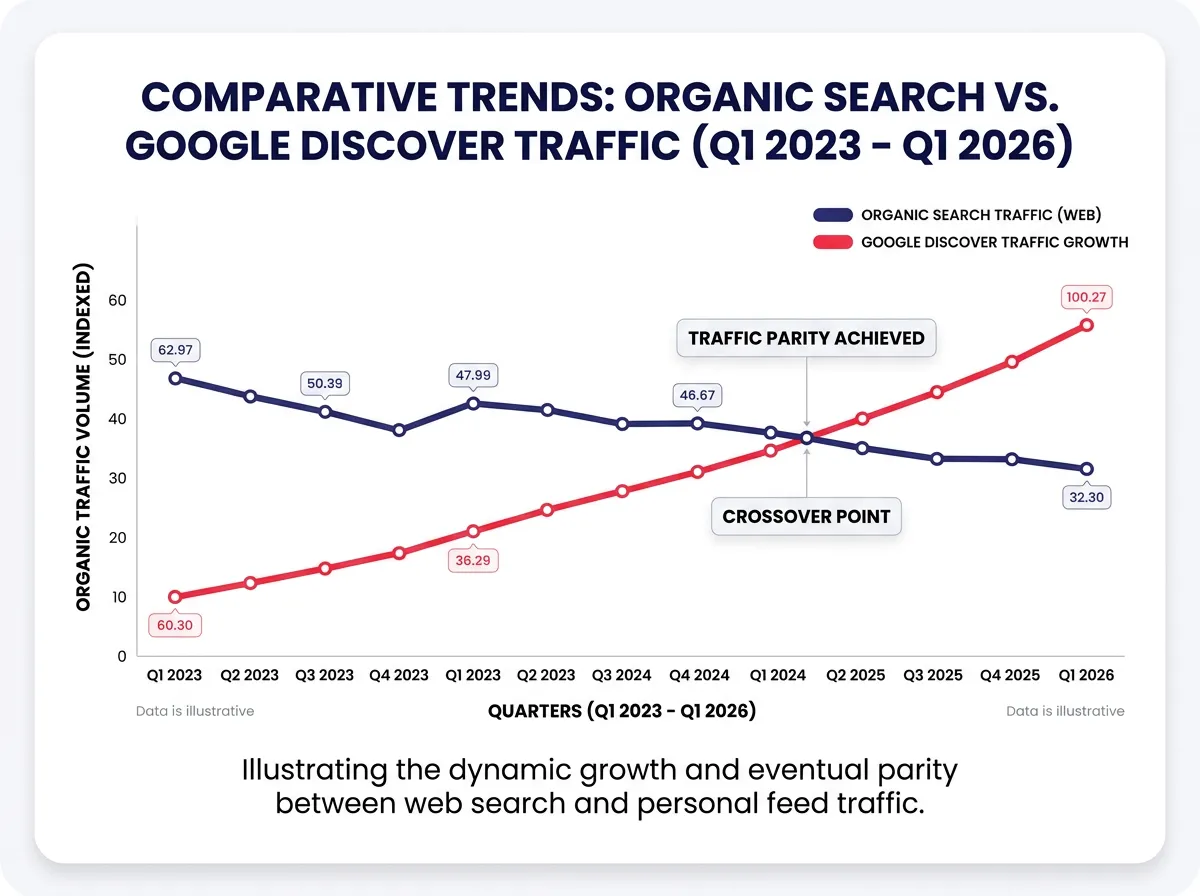
- Across Define Media Group's 64 publisher sites, breaking news traffic grew 103% from November 2024 to early 2026 and Google Discover traffic grew 30%, putting Discover level with web search for the first time.
Quick Summary: Google AI Overviews now appear on 48% of all search queries. When they do, organic click-through rates drop by an average of 58–61%. Informational and evergreen content bears the brunt. But brands cited inside AI Overviews earn 120% more clicks per impression than uncited competitors — meaning the new game is not just ranking, it is being quoted in the answer itself.
Organic search clicks have dropped 42% since Google AI Overviews expanded at scale — and marketing teams relying on evergreen content strategies are feeling it most. That number alone should stop any content team in its tracks. But beyond the headline stat, a more nuanced story is unfolding: while some channels are bleeding traffic, others are quietly growing fast. Understanding where the shifts are happening — and why — is what separates teams that adapt from those still waiting for traffic to bounce back.
Two things stand out clearly in the 2026 data. First, Google AI Overviews are fundamentally changing how traffic moves from search results to publisher sites. Second, channels like breaking news and Google Discover are picking up speed in ways that most marketing teams are not yet treating as priorities. This guide covers the full picture — the data, the mechanisms, and the specific actions that are working right now.
- How Google AI Overview Is Reshaping Organic Search Traffic
- AI Overview Prevalence: Which Queries Are Most at Risk
- The CTR Collapse: What 12 Studies Actually Show
- The Citation Advantage: Why Being in the Answer Beats Being Below It
- Breaking News and Google Discover: The Growth Channels Gaining Ground
- GEO and SEO Strategy Adjustments Marketing Teams Should Make Now
- Content Types and Query Segments That Still Earn Clicks
- How to Measure Performance in an AI Overview World
- FAQ: AI Overview Impact on Organic Search
How Google AI Overview Is Reshaping Organic Search Traffic
The scale of this shift is bigger than most teams have fully processed. Before AI Overviews rolled out broadly, organic search traffic across major publisher networks averaged around 1.7 billion clicks per quarter. Then came the drop — first 16% almost immediately after launch, and it kept falling from there. This is not a seasonal fluctuation, and it is not reversible by tweaking title tags. It is a structural change in what Google's search results page is designed to do.
Google's stated goal has shifted from sending users to the best source to answering users directly. AI Overviews are the primary mechanism for that shift. They synthesize information from multiple sources, present a clean answer above the fold, and give users everything they need without requiring a click to any individual site. For content teams that spent years building informational libraries designed to rank for high-volume queries, the economic model of that investment has changed fundamentally.
The 42% Drop: Breaking Down the Numbers
By Q4 2025, the cumulative decline in organic search clicks had reached 42% compared to pre-AI Overview baselines. To put that in context: nearly half of the organic search clicks that existed before AI Overviews are now gone. Seer Interactive's study of 53 brands, 5.47 million tracked queries, and 2.43 billion impressions spanning January 2025 through February 2026 found that organic CTR on AI Overview-present queries sat at 0.61% — compared to 1.62% on queries without an AI Overview. That is a 61% compression in click-through rate.
The Ahrefs analysis of 300,000 keywords confirmed a similar pattern: the top-ranking page's CTR fell by 58% when an AI Overview was present. Pew Research's panel-based study found that only 8% of users click through to organic results when an AI Overview appears, versus 15% when it does not. At scale, those numbers represent an enormous reallocation of attention from publisher content to Google's own AI-generated summaries.
Marketing teams that are still benchmarking against pre-2024 organic search baselines are measuring against a reality that no longer exists. The floor has shifted, and the trajectory is not reversing.
Why Evergreen Content Is Taking the Hardest Hit
Not all content types are equally affected. Evergreen and informational content — the kind built to rank for stable, high-volume queries — is absorbing the most damage. This makes sense when you understand how AI Overviews select their source material: they are especially effective at synthesizing well-established, stable information. If your content answers "what is content marketing" or "how does SEO work," there is a strong chance an AI Overview is sitting above your result and giving the user a complete answer before they ever see your link.
Health, science, how-to, and general explainer content are among the most displaced categories right now. Healthcare queries trigger AI Overviews 60.7% of the time. Home and garden queries: 50.4%. Transportation: 31.4%. For brands publishing in these verticals, the traffic impact is not marginal — it is structural. Agencies have reported client portfolio traffic declines of 30% to 70% for informational-heavy sites between late 2024 and early 2026. Major publishers have been hit hardest: HubSpot reportedly lost 70–80% of its organic traffic, Business Insider approximately 55%.
AI Overview Prevalence: Which Queries Are Most at Risk
Understanding which queries trigger AI Overviews is essential for any SEO or content team doing triage right now. The data is clear: query intent is the single strongest predictor of whether an AI Overview will appear, and therefore whether your organic result will have a meaningful click opportunity.
As of early 2026, AI Overviews appear on approximately 48% of all Google search queries — up from 34.5% in December 2025 and 31% in February 2025. The growth has been steep and consistent. But the aggregate number understates the risk for content teams, because the distribution is heavily skewed toward informational intent.
| Query Type | AI Overview Appearance Rate | CTR Impact |
|---|---|---|
| Comparison queries ("X vs Y") | 95.4% | Severe |
| Question-format queries ("how", "what", "why") | 85.9% | Severe |
| Informational queries (broad) | 36–91%* | High |
| "Near me" / local queries | 76.9% | Moderate–High |
| Commercial / research queries | 8–18% | Low–Moderate |
| Transactional queries | 5–14% | Low |
| News / breaking queries | ~15% | Low |
*Range reflects variation across studies; longer queries and W-questions sit at the higher end.
Query length also matters. Seven-word-or-longer queries trigger AI Overviews 46.4% of the time, while single-word queries see only 9.5% triggering. This means that the long-tail keyword strategy — long considered a safer, lower-competition path to traffic — is now precisely the territory where AI Overviews are most active. Teams need to reassess the risk profile of their long-tail keyword targeting accordingly.
The CTR Collapse: What 12 Studies Actually Show
The CTR decline from AI Overviews has been measured across a dozen separate studies, and while the exact numbers vary, the direction is unanimous: when an AI Overview appears, fewer users click organic results. The variation in reported numbers comes from differences in methodology, keyword samples, industry verticals, and time periods measured. Here is what the major studies found:
- Seer Interactive (Jan 2025–Feb 2026, 5.47M queries): Organic CTR dropped from 1.76% to 0.61% for AI Overview queries — a 61% decline. Paid CTR fell from 19.7% to 6.34%.
- Ahrefs (300,000 keywords): Top-ranking page CTR fell 58% when AI Overviews appeared.
- Pew Research (panel study): Users clicked organic results only 8% of the time when AI Overviews appeared, versus 15% without. 26% of users ended their search session entirely after seeing an AI Overview.
- Search Engine Journal field study: AI Overviews cut organic clicks by 38% on triggered queries.
- Composite average across 12 studies: 34% to 61% CTR reduction, depending on query type and vertical.
There is one important nuance in the 2026 data: organic CTR on AI Overview-present queries rebounded from 1.3% in December 2025 to 2.4% in February 2026. This does not mean the problem has resolved — it may simply reflect user adaptation, seasonal patterns, or Google's own adjustments to how often overviews appear. Non-AI-Overview queries also saw CTR growth over the same period (2.8% to 3.8%), suggesting the overall search landscape is evolving rather than simply stabilizing around AI Overview suppression.
Zero-click search behavior compounds the picture. The zero-click rate has climbed from 50% in 2019 to 64.82% in 2026. In Google's AI Mode — the fully conversational search interface — the zero-click rate reportedly reaches 93%. While AI Mode is not yet ubiquitous, its trajectory suggests the zero-click baseline will continue rising over the next 12–18 months.
The Citation Advantage: Why Being in the Answer Beats Being Below It
Here is the strategic pivot that changes the entire frame: while AI Overviews suppress clicks for uncited results, pages that get cited inside the AI Overview earn dramatically more traffic, not less. Being in the answer, rather than below it, is the new position-one equivalent.
The data on this is striking. Pages cited in AI Overviews receive 120% more organic clicks per impression than uncited pages on the same query. Seer Interactive found a 35% traffic lift for brands cited in overviews versus those that were not. Another analysis found that pages appearing in AI Overview citations see an average impression increase of 340% — because they are now being surfaced to users who searched queries those pages had never ranked for in traditional results.
This creates a bifurcated content economy. On one side: pages that rank in traditional results but are not cited in AI Overviews lose clicks as overviews absorb user attention. On the other side: pages that earn citation inside overviews gain visibility across a much wider query set, with higher-intent users clicking through. The users who do click through from an AI Overview have already read a summary and are seeking deeper information — they convert 23% better than average organic visitors, according to available data.
The implication is clear: GEO (Generative Engine Optimization) — structuring content so it earns citation inside AI responses — is now a direct revenue concern, not a theoretical future priority.
Breaking News and Google Discover: The Growth Channels Gaining Ground
The search traffic story does not end with AI Overview suppression. Two adjacent channels are showing strong growth precisely because they operate in territory where AI Overviews have less foothold — and most marketing teams have not yet prioritized either one.
Breaking News Traffic Grew 103%: What That Means for Content Teams
Across Define Media Group's portfolio of 64 publisher sites, breaking news traffic grew 103% from November 2024 through early 2026. That is not a marginal uptick — that is a channel that more than doubled in a little over a year.
The reason timely news content is outperforming evergreen content comes down to how AI Overviews behave with news queries. AI Overviews currently appear for only about 15% of news-related searches — nearly three times less often than in categories such as health and science. When someone searches for something that happened today, Google is still largely sending them to publisher sites rather than summarizing the answer in an AI panel. That click opportunity is real and growing.
The December 2025 Core Update appears to have accelerated this trend specifically for breaking news, with breaking news traffic in Discover increasing in a step-wise pattern after the update — suggesting that Google is actively rewarding time-sensitive, event-driven content in its ranking systems. For marketing teams at brands that publish content regularly, this signals that editorial calendars need to make room for timely, news-adjacent content that can capture Top Stories placement and search traffic before AI Overviews have a chance to absorb the query.
Google Discover Is Now Driving Traffic on Par With Web Search
Perhaps the most striking data point from the same publisher network: Google Discover traffic grew 30% over the same period and is now driving roughly equal traffic to traditional web search — for the first time in Define Media Group's history. Web Search's share of Google-surface traffic to news publishers has fallen from more than 50% to 27%, while Discover has taken up a growing share of the remaining traffic.
Google's February 2026 Discover-specific Core Update — the first dedicated Discover update Google has ever released — signals that Discover is being treated as a distinct algorithmic system, not just an extension of web search. In the United States, Brazil, and Mexico, 51% of the Discover feed now consists of AI Summaries, indicating rapid evolution of the channel's behavior.
Google Discover operates differently from search. Users are not entering queries — Google is proactively surfacing content based on interests, behavior, and engagement signals. That means content freshness, graphic design, strong headlines, and high engagement rates matter more than keyword density. SEO thinking alone will not get your content into Discover feeds at scale. Teams need a separate Discover optimization playbook: compelling visuals, sharp headlines that create curiosity gaps, and high dwell-time signals baked into the content itself.
GEO and SEO Strategy Adjustments Marketing Teams Should Make Now
The data points to a clear need for strategy realignment. This is not about abandoning SEO — it is about layering new thinking on top of it. Teams that treat their 2023 SEO playbook as sufficient are losing ground to competitors who have already adapted. Partnering with a team that offers dedicated AI SEO services can accelerate that shift.
Shifting From Evergreen-First to Real-Time Content Investment
Start with an seo audit specifically focused on AI Overview exposure. Which content categories in your current library are most exposed to AI Overview displacement? Informational guides, FAQ pages, definitional content, and how-to articles are all high-risk. Once you have mapped that exposure, the next step is rebalancing your editorial calendar to prioritize content that is timely, specific, and likely to surface in Top Stories carousels rather than getting absorbed into an AI summary.
This does not mean abandoning long-form content entirely. It means being strategic about which evergreen topics are worth investing in and ensuring timely content gets the resources it needs to compete. A practical framework: classify your content portfolio into four buckets — high-AIO-exposure/high-differentiation opportunity, high-AIO-exposure/low-differentiation (most vulnerable), low-AIO-exposure/high-intent (priority for traditional SEO), and authority-building content (written primarily to earn AI citations). Then allocate budget accordingly.
How GEO Thinking Should Inform Your Search and Discover Strategy
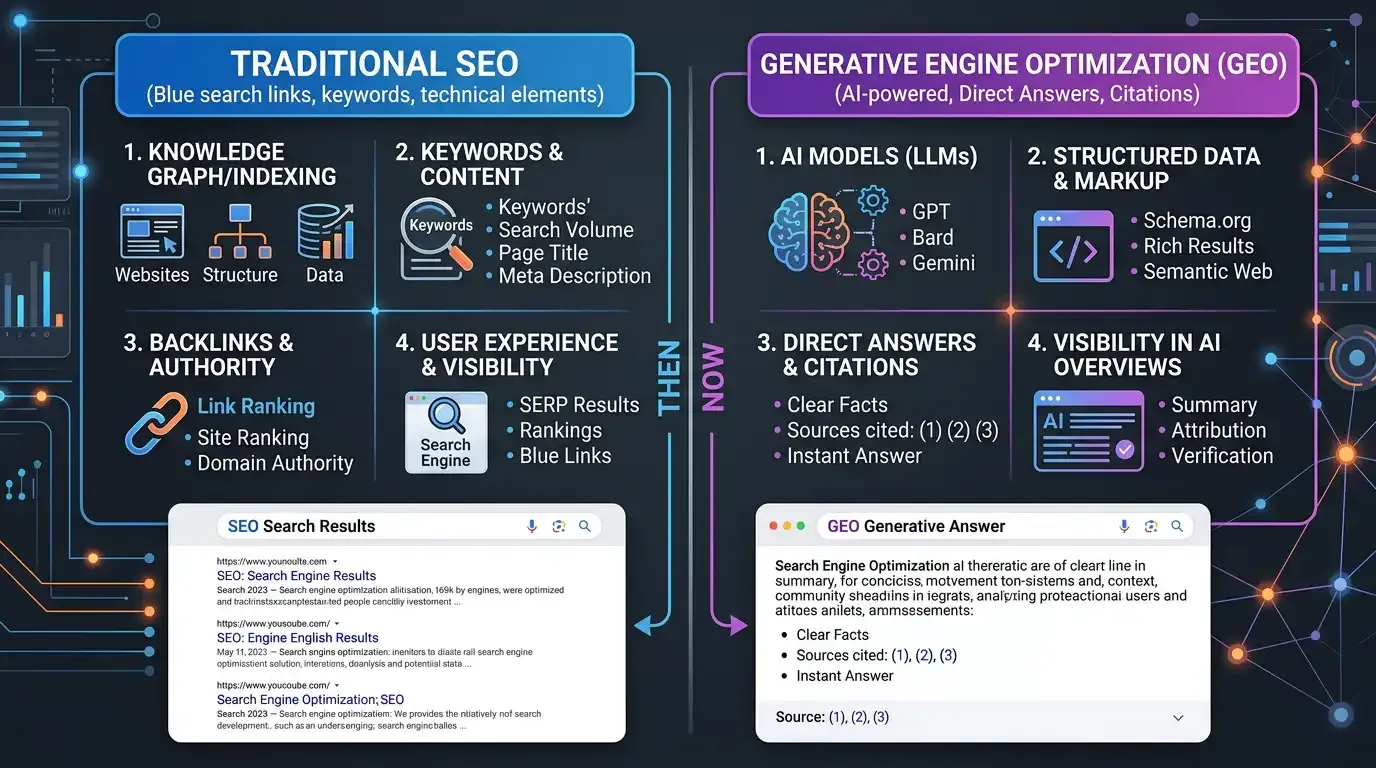
Generative Engine Optimization — GEO — is becoming as important as traditional SEO for teams that want their content to perform in an AI-first environment. GEO is about structuring content so it surfaces well within AI-generated responses and earns citation within AI panels, not just in blue link results. Where SEO wins a ranked link, GEO wins a sentence inside the answer. Those are different goals with different content requirements.
That means focusing on authority signals, source credibility, content freshness, and structured data. It also means writing in ways that are clear, citable, and factually specific — because AI systems favor content that is easy to extract and attribute. Google's own guidance confirms this: optimizing for generative AI features is fundamentally continuous with core SEO, because AI Overview retrieval is rooted in the same crawling, indexing, and quality systems that determine organic rankings.
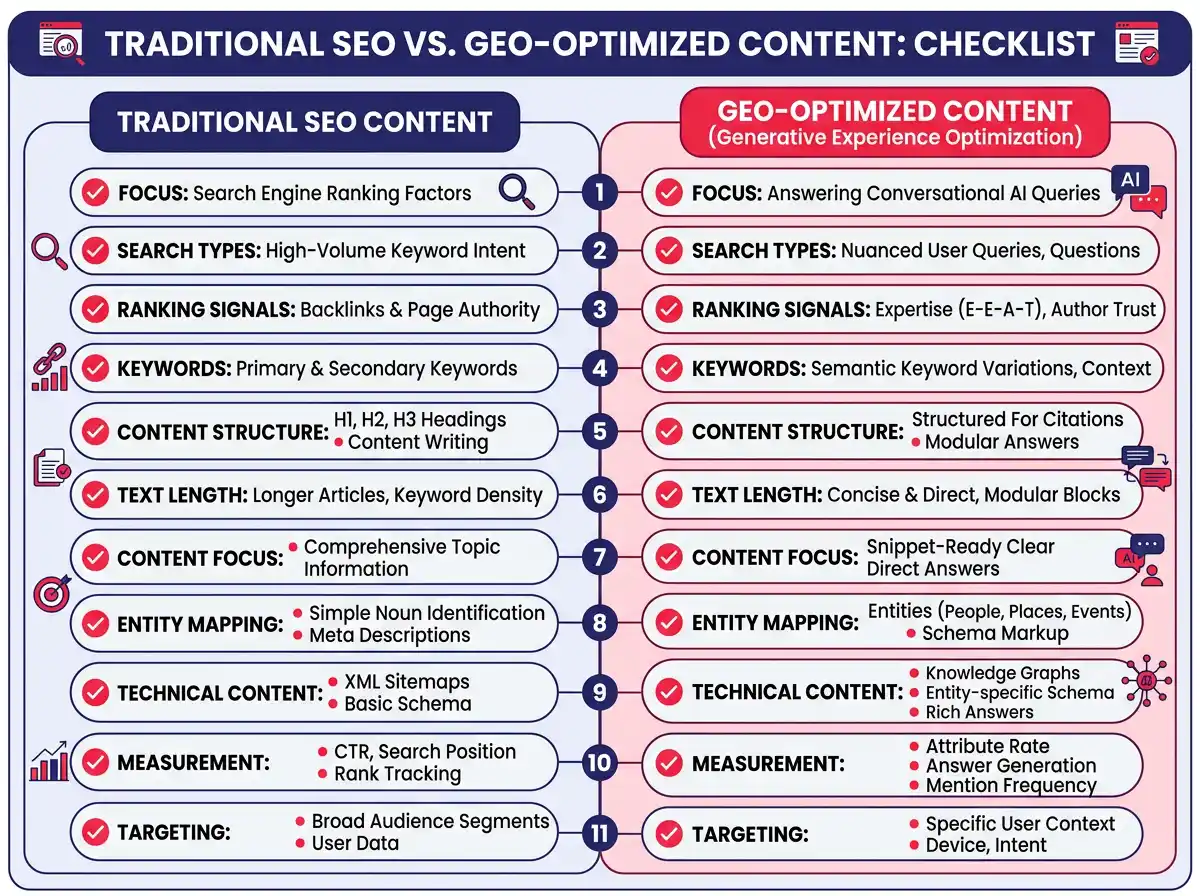
Teams that treat GEO and SEO as separate concerns are going to fall behind. The strongest content strategies right now are ones that optimize for both — ranking in traditional results while also being built in a way that earns visibility inside AI-generated answers and Discover feeds simultaneously.
Content Types and Query Segments That Still Earn Clicks
Not every type of content is equally exposed to AI Overview suppression. Understanding which categories still generate meaningful click-through is essential for deciding where to invest content resources in 2026.
The following content attributes are strongly associated with surviving — and sometimes thriving — in an AI Overview environment:
- Original data and proprietary research: AI systems cannot summarize what they cannot find elsewhere. A study, benchmark, or dataset that you own and publish is inherently un-synthesizable. It earns citation rather than displacement.
- Specific, opinionated perspectives: AI Overviews struggle to represent nuanced viewpoints, organizational stances, or expert opinions. Content that takes a clear position — and defends it with evidence — creates a reason to click through that a summary cannot replace.
- Decision-support content: Comparative analysis with specific tradeoffs, pricing breakdowns, and "which option is right for you" frameworks drive higher-intent users who need more than a summary. These users will click through even when a summary exists.
- Timely and newsworthy content: As established above, breaking news and news-adjacent topics see much lower AI Overview triggering rates. Being fast on relevant topics is a structural advantage right now.
- Local and near-me content: Despite 76.9% AI Overview appearance rates on near-me queries, local content with strong geographic specificity, review signals, and Google Business Profile integration maintains click value for users who need to take local action.
- Transactional content: Product pages, service pages, and conversion-focused landing pages see only 5–14% AI Overview triggering. Traditional SEO investment here remains sound.
| Content Type | AIO Risk Level | Recommended Action |
|---|---|---|
| Generic how-to / explainer | Very High | Consolidate, add original data, or deprioritize |
| Definition / "what is" content | Very High | Add unique perspective, expert quotes, or consolidate |
| Comparison / vs. content | High | Add tables, specific tradeoffs, and verdict with reasoning |
| Industry news / timely content | Low | Prioritize; invest in speed and Top Stories optimization |
| Original research / data studies | Low (citation upside) | Strong investment; earns citations and backlinks |
| Product / service pages | Very Low | Traditional SEO and CRO investment remains valid |
| Case studies / client outcomes | Low | Solid click-through; hard for AI to replicate specifics |
How to Measure Performance in an AI Overview World
One of the most significant practical challenges created by AI Overviews is that traditional performance metrics are now misleading. A page may see impressions go up while clicks go down — and conventional SEO dashboards will flag this as a rankings improvement despite worsening business outcomes. Teams need updated measurement frameworks to avoid misreading the data.
Here are the metrics that matter in 2026 and what to do with them:
- Track CTR by query segment, not sitewide. Sitewide average CTR is almost meaningless now because it blends queries with and without AI Overviews. Segment your Search Console data by query intent category (informational vs. transactional vs. navigational) and track CTR trends within each segment separately.
- Monitor AI Overview presence rate for priority keywords. Check your highest-traffic keyword clusters monthly to identify which ones have recently started triggering AI Overviews. An impression spike with a CTR crash is the key signal.
- Measure citation frequency separately from rankings. Use manual spot-checks or tools that track AI Overview sources to determine whether your content is being cited. Being cited at position 5 in an AI Overview may drive more traffic than ranking position 1 in traditional results without citation.
- Track clicks-per-impression by SERP type. Segment your impression and click data into three buckets: AI Overview-present queries, featured-snippet queries, and standard blue-link queries. Each bucket has different CTR baselines and requires different optimization strategies.
- Assess assisted business impact. Some users who see your content cited in an AI Overview will search for your brand directly, arrive via paid search, or convert through another channel. Brand search volume trends are a useful proxy for measuring AI Overview-driven awareness that does not show up as direct organic clicks.
The fundamental measurement shift: optimize for clicks-per-impression on high-value queries, not for impressions alone. Rankings matter less than whether those rankings are in a SERP context that still generates clicks.
FAQ: AI Overview Impact on Organic Search
How much has Google AI Overview hurt organic traffic?
Studies consistently show organic CTR drops of 34% to 61% for queries where an AI Overview appears. The most comprehensive study — Seer Interactive's analysis of 5.47 million queries — found a 61% CTR reduction. Overall organic search traffic across publisher networks is down approximately 42% from pre-AI Overview baselines as of Q4 2025. The impact varies significantly by content type: informational and evergreen content is hardest hit, while transactional and timely content is comparatively protected.
What types of queries trigger Google AI Overviews most often?
Comparison queries ("X vs Y") trigger AI Overviews 95.4% of the time. Question-format queries ("how does," "what is," "why does") trigger them 85.9% of the time. Broad informational queries fall in the 36–91% range depending on the study. By contrast, transactional queries (product searches, purchase intent) trigger AI Overviews only 5–14% of the time, making them comparatively safe for traditional SEO investment.
Can my content still get clicks if an AI Overview appears for that query?
Yes — especially if your content is cited inside the AI Overview. Pages cited within AI Overviews earn 120% more organic clicks per impression than uncited pages on the same query. Even uncited results can earn clicks from users who want depth beyond the summary. The users who do click through after seeing an AI Overview tend to be higher-intent and convert approximately 23% better than average organic visitors.
What is GEO, and how is it different from traditional SEO?
Generative Engine Optimization (GEO) is the practice of optimizing content to earn citation inside AI-generated answers, not just to rank as a blue link below them. Traditional SEO aims to win a ranked link; GEO aims to win a sentence inside the AI Overview answer. The content requirements are somewhat different — GEO favors clear, extractable definitions, original data, structured formatting, and strong E-E-A-T signals. In practice, GEO and SEO are complementary: you must rank to be cited, but ranking alone is no longer sufficient.
What type of content is most protected from AI Overview impact?
Content that is difficult for AI to synthesize or replace is most protected. This includes: original research and proprietary data, specific case studies with client outcomes, opinionated expert commentary, timely news content (AI Overviews appear on only ~15% of news queries), and transactional pages (product/service pages with purchase intent). Generic evergreen explainers and definition-style content are the most vulnerable.
Is Google Discover a viable traffic alternative to organic search?
Yes — and increasingly so. Google Discover traffic grew 30% from November 2024 through early 2026, and for the first time, Discover is now driving traffic on par with web search in publisher networks that track both. Discover operates on interest and behavior signals rather than query keywords, so optimizing for it requires a different approach: compelling visuals, high-dwell-time content, freshness signals, and sharp headlines that create engagement rather than just keyword matches. Google's February 2026 Discover-specific Core Update signals that Google is treating Discover as a distinct, increasingly important traffic channel.
Should I stop investing in evergreen content because of AI Overviews?
Not entirely — but you should invest differently. Evergreen content that contains original data, unique perspectives, or decision-support frameworks still earns clicks and AI citations. Generic evergreen content that restates common knowledge without adding unique value is the category to deprioritize. The practical guideline: before investing in any new evergreen article, ask whether your version will be meaningfully different from what an AI Overview could synthesize from existing sources. If the honest answer is no, redirect that resource to original research, timely content, or deeper service and case study pages.
How do I get my content cited in Google AI Overviews?
There is no direct submission or optimization trigger for AI Overview citation — Google's systems select sources based on the same quality and relevance signals that govern organic rankings. The most reliable citation factors are: strong E-E-A-T signals (demonstrable expertise, author credentials, cited sources), original data or proprietary insights, clear and extractable content structure (definitions early in sections, tables, lists), content freshness with regular updates, fast and mobile-optimized page performance, and genuine topical authority established through a consistent body of related content. Being cited inside an AI Overview is effectively a quality signal in itself — pages that earn it tend to see impressions rise across a broader set of related queries.