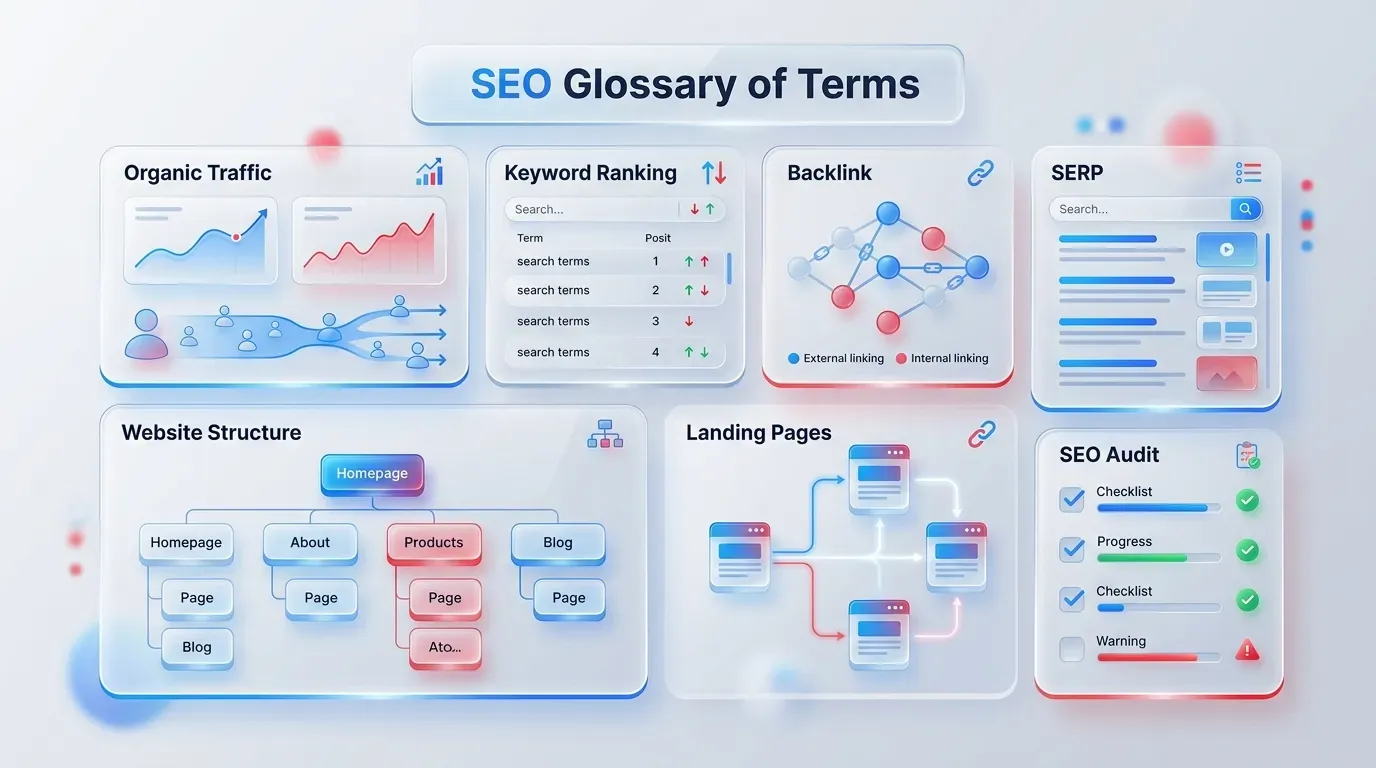
For anyone who has just entered the world of online marketing, or has just started learning about boosting website rankings through SEO, you've probably heard strange terms that people on your team or an SEO Agency keep throwing around. You're probably wondering what words like Crawl, Backlink, or Schema Markup mean, or what steps like Link Building or SEO Audit actually refer to.
But don't worry about not being able to keep up with the conversation. This article will gather and summarize the most commonly encountered SEO terms and explain them in simple language. By the time you finish reading, you'll be able to chat with your organization's marketing team or brief an external agency smoothly and confidently. Be sure to save this article so you can refer back to it whenever you forget a term.
- 1. Basic SEO Terms You Should Know
- 2. SEO Terms Related to Content and Keywords
- 3. Technical SEO Terms
- 4. SEO Terms Related to Building Trust and Link Networks
- 5. SEO Terms Related to Measurement
- 6. SEO Terms in the AI Era
- Elevate Your Digital Strategy with Relevant Audience
1. Basic SEO Terms You Should Know
Before diving into technical details, let's first build a foundation by understanding the terms that serve as the very first building blocks of ranking on the first page through SEO.
1.1 Keyword
A keyword is a "word or phrase" that people type into a search engine's search box when they want to know something, such as "cat cafe Sukhumvit" or "how to fix a leaking water pipe." This is both the core and starting point of all SEO work, because once we know what terms our customers or target audience like to type, we can create content or improve our website to specifically serve those searches.
1.2 Search Intent
Search Intent refers to "the real need behind why someone typed that keyword." For example, if someone types "iPhone 15 review," their intent is likely to gather information to help decide on a phone purchase. But if they type "buy iPhone 15 promotion," their intent is to look for the product and they're already ready to spend money. Understanding these different types of Search Intent is a critical factor that helps an SEO Specialist understand the goal and create content that best answers these intents.
1.3 SERP (Search Engine Results Page)
SERP is the results screen that appears immediately after you hit the search button on a search engine. This page gathers the top-ranking search result links together with ad links, maps, and videos. The ultimate goal for anyone doing SEO is to get their website to the very top position on the first SERP page, since that's the position most searchers click on.
1.4 Organic Traffic
Organic Traffic refers to "the number of people visiting a website naturally," not through any paid advertising channel on a search engine. This is a crucial metric in SEO, since this traffic comes from users who typed a keyword and chose our website from the SERP. This means these visitors clearly have an intent to buy a product or use a service related to that keyword (High Intent Traffic).
2. SEO Terms Related to Content and Keywords
Once you understand the basics, it's time to move into the equally important category of content creation and keywords.
2.1 Keyword Research
Keyword Research is the use of various tools to find out what people are searching for during any given period — which terms have high competition, which terms have low search volume but high purchase potential, and which terms are relevant to our website or business. This information is then analyzed to find the most suitable keywords for creating content and gaining an SEO advantage over competitors.
2.3 Search Volume
Search Volume is a number that indicates how many times, on average per month, a particular keyword is typed into a search engine. This helps us assess which keywords have high search volume and are worth targeting. However, keywords with high search volume tend to also have high competition. Choosing a keyword with moderate search volume but a stronger match to buyer intent may actually make it easier to rank and more effective at closing sales.
2.4 Focus Keyword
A Focus Keyword (or Main Keyword) is the central keyword used to identify what a particular page is about. It's a keyword that clearly conveys the main topic, has a broad meaning, and matches the primary Search Intent — for example, "acne treatment" or "car rental." These keywords can then be developed further into more specific Long-tail Keywords.
2.5 Long-tail Keyword
A Long-tail Keyword is a longer, highly specific keyword, usually consisting of a Focus Keyword extended with 3-4 or more additional words. For example, from the keyword "running shoes," it could be expanded into "women's running shoes for flat feet." Long-tail Keywords have significantly lower search volume than Focus Keywords, but people who search using these terms usually have very clear intent, giving us a better chance of closing a sale — and creating an opportunity to outperform competitors in SEO.
2.6 Meta Title & Meta Description
Meta Title is the text that serves as the "headline" of a web page, while Meta Description is a short description of that page. In terms of SEO, both Meta Title and Meta Description are pieces of information that appear in the SERP results. If these two elements are compelling and eye-catching, they'll help attract more people to decide to "click" through to our website.
2.7 Heading (H1, H2, H3...)
Headings are text titles that help organize content into categories and hierarchical order, such as the main heading (H1), subheadings (H2), and further sub-subheadings (H3 and beyond). Using headings properly doesn't just help readers find the information they need more easily — it also helps Google's crawlers understand the structure and grasp what content a page is focused on.
3. Technical SEO Terms
These technical terms might sound difficult to understand, but they're guaranteed to be useful when working with your development team.
3.1 Crawl
Imagine that Google has millions of tiny robot programs (called Crawlers or Bots). Crawling is the process where these robots move through web pages to read and gather information about what content each website contains. If a website's structure is too complex, these robots will have a hard time working properly, which can affect rankings.
3.2 Index
After the crawler bots finish gathering data, that information gets organized into an index — a process of collecting, analyzing, interpreting, and storing page data in a way that's appropriate for each keyword, so it can later be displayed in the SERP. If our website doesn't get indexed, it's as if Google simply cannot present our website's information at all, meaning customers won't be able to find our page in search results.
3.3 Schema Markup
Schema Markup is a type of backend data set that provides information to Google's crawlers about what each page on our website actually is — for example, whether a page is a product review, a product page, or an educational article. This helps crawlers better understand the context of each piece of content, which in turn helps improve rankings in the SERP.
3.4 XML Sitemap
An XML Sitemap is a backend data set that acts like a "website map," which we submit to Google to indicate how many pages our website has in total, how they're structured, and which pages are the most important. This allows crawler bots to explore and index our data more quickly and thoroughly.
4. SEO Terms Related to Building Trust and Link Networks
SEO doesn't only involve our own website — it also involves other websites across the internet.
4.1 Backlink
A Backlink is a link from an external website that points back to our website, whether it comes from a content reference, a mention, or from purchasing backlinks in a way that doesn't violate guidelines. The more backlinks we get from high-quality, relevant websites, the more Google will view our site as trustworthy and deserving of a higher ranking.
4.2 Link Building
Link Building is the process of acquiring quality backlinks through various strategies, such as creating engaging content that gets widely shared, doing public relations (PR) outreach with partner websites, or collaborating with business partners on guest articles that include backlinks. Link Building SEO is a challenging process, but one that significantly affects SERP rankings.
4.3 DA & PA (Domain Authority & Page Authority)
DA and PA are scores used to assess a website's level of trustworthiness, generated by external tools. While these aren't official scores from Google, they're still important data points that SEO specialists and marketing teams use as a standard for measuring how effective their Link Building efforts have been. The higher the DA and PA scores, the better the chances of achieving good SEO rankings. These break down as follows:
- DA (Domain Authority): the trustworthiness score of the entire domain
- PA (Page Authority): the trustworthiness score of a specific page
5. SEO Terms Related to Measurement
Beyond the various processes and steps involved in SEO, terms related to measurement are equally important.
5.1 CTR (Click-Through Rate)
CTR, or Click-Through Rate, is a ratio that shows how many searchers clicked through to a website compared to how many people saw it in the SERP. For example, a CTR of 2% means that out of 100 people who searched and saw our website on Google, only 2 people actually clicked through. A low CTR might mean that the Meta Title being used isn't compelling enough.
5.2 Bounce Rate
Bounce Rate refers to the proportion of people who click into our website and then immediately hit "close" or "back" without clicking to view any other pages. If a page has a high Bounce Rate, it could be a warning sign that the content doesn't match the Search Intent, or that there's a technical issue affecting the User Experience (UX).
5.3 SEO Audit
SEO Audit is the process of examining a website to find flaws — whether that's loading speed, link structure, metadata setup, and more — in order to find ways to plug any gaps and improve the website's overall performance.
6. SEO Terms in the AI Era
AI technology has transformed many industries, including SEO itself, prompting businesses and agencies to increasingly offer AI SEO services.
6.1 AI Search & Zero-click Search
In an era where more and more people are searching for information through AI (such as using ChatGPT or Google's AI features), AI Search tends to provide a complete, ready-made answer to what the user wants. This has led to a phenomenon called Zero-click Search — where users get a complete answer and therefore "don't need to click" into any website at all.
6.2 GEO (Generative Engine Optimization)
As consumer behavior shifts toward relying on AI, traditional SEO alone may no longer be enough. This has given rise to a new discipline called GEO, which is the process of optimizing information and websites so that AI chooses to reference our content and use it when generating answers for its users.
Although SEO terminology may seem complicated at first, once you gradually understand where these terms come from and what they mean, you'll see that it's really not beyond your ability to grasp. All it takes is a thorough understanding and correct application — and both the terminology and the practice of SEO will no longer feel like a challenge.
If you're looking for a marketing partner or team in Bangkok that can plan and measure SEO with precision to drive your website's ranking exactly as intended — while you focus fully on running your business — Relevant Audience is ready to be your SEO partner, with a team and comprehensive SEO services to match.
Elevate Your Digital Strategy with Relevant Audience
Relevant Audience is a full-service digital agency covering every dimension of online marketing, backed by a team of experts and modern technology, to ensure your business always stays ahead of the competition.
Our Services
- Paid Performance: Precise advertising campaigns across leading platforms (Google, Meta, TikTok, LINE)
- SEO & GEO: Boost your search rankings to the first page, making it easier for customers to find you
- Creative & Branding: Distinctive brand design and content that communicates effectively
- Web Development: Build and develop high-performance websites tailored to your business
- Growth Services: Additional services and solutions for businesses looking to grow
Contact us and request a quote today
- Phone: 02 038 5055
- E-mail: info@relevantaudience.com