Organic search clicks have dropped 42% since Google AI Overviews expanded — and marketing teams relying on evergreen content strategies are feeling it most. That number alone should stop any content team in its tracks. But beyond the headline stat, there is a more nuanced story unfolding: while some channels are bleeding traffic, others are quietly growing fast. Understanding where the shifts are happening — and why — is what separates teams that adapt from those still waiting for traffic to bounce back.
Two things stand out clearly in the data right now. First, Google AI Overviews are fundamentally changing how traffic moves from search results to publisher sites. Second, channels like breaking news and Google Discover are picking up speed in ways that most marketing teams are not yet treating as priorities.
How Google AI Overview Is Reshaping Organic Search Traffic
The scale of this shift is bigger than most teams have fully processed. Before AI Overviews rolled out broadly, organic search traffic across major publisher networks averaged around 1.7 billion clicks per quarter. Then came the drop — first 16% almost immediately after launch, and it kept falling from there.
The 42% Drop: Breaking Down the Numbers
By Q4 2025, that cumulative decline had reached 42%. To put that in context, nearly half of the organic search clicks that existed before AI Overviews are now gone. Google AI Overview panels are answering queries directly within the search results page, giving users what they need without ever requiring a click to an outside site. For publishers and brand content teams that built their traffic models on search volume forecasts from 2022 or 2023, the math simply does not add up anymore.
This is not a blip or a seasonal fluctuation. The trend line has been consistently downward since AI Overviews became a standard part of Google search results. Marketing teams that are still benchmarking against pre-2024 organic search baselines are measuring against a reality that no longer exists.
Why Evergreen Content Is Taking the Hardest Hit
Not all content types are equally affected. Evergreen and informational content — the kind built to rank for stable, high-volume queries — is absorbing the most damage. This makes sense when you think about how AI Overviews work: they are especially good at summarizing well-established information.
If your content answers “what is content marketing” or “how does SEO work,” there is a strong chance an AI Overview is sitting above your result and giving the user a complete answer before they ever see your link. These query types are exactly where AI-generated summaries perform best. Health, science, how-to, and general explainer content are among the most displaced categories right now.
Breaking News and Google Discover: The Growth Channels Gaining Ground
Here is where the data gets more encouraging. While traditional organic search is struggling, other traffic channels are showing real growth — and the numbers are significant enough to warrant a serious shift in how content teams allocate their time and budget.
Breaking News Traffic Grew 103%: What That Means for Content Teams
Across Define Media Group’s portfolio of 64 publisher sites, breaking news traffic grew 103% from November 2024 through early 2026. That is not a marginal uptick. That is a channel that more than doubled in a little over a year.
The reason timely news content is outperforming evergreen content comes down to how AI Overviews behave with news queries. AI Overviews currently appear for only about 15% of news-related searches. Compare that to the much higher appearance rates for informational and evergreen query types, and the gap is clear. When someone searches for something that happened today, Google is still largely sending them to publisher sites rather than summarizing the answer in an AI panel. That traffic opportunity is real and growing.
For marketing teams — especially those at brands that publish content regularly — this signals that editorial calendars need to make room for timely, news-adjacent content that can capture Top Stories placement and search traffic before AI Overviews have a chance to absorb the query.
Google Discover Is Now Driving Traffic on Par With Web Search
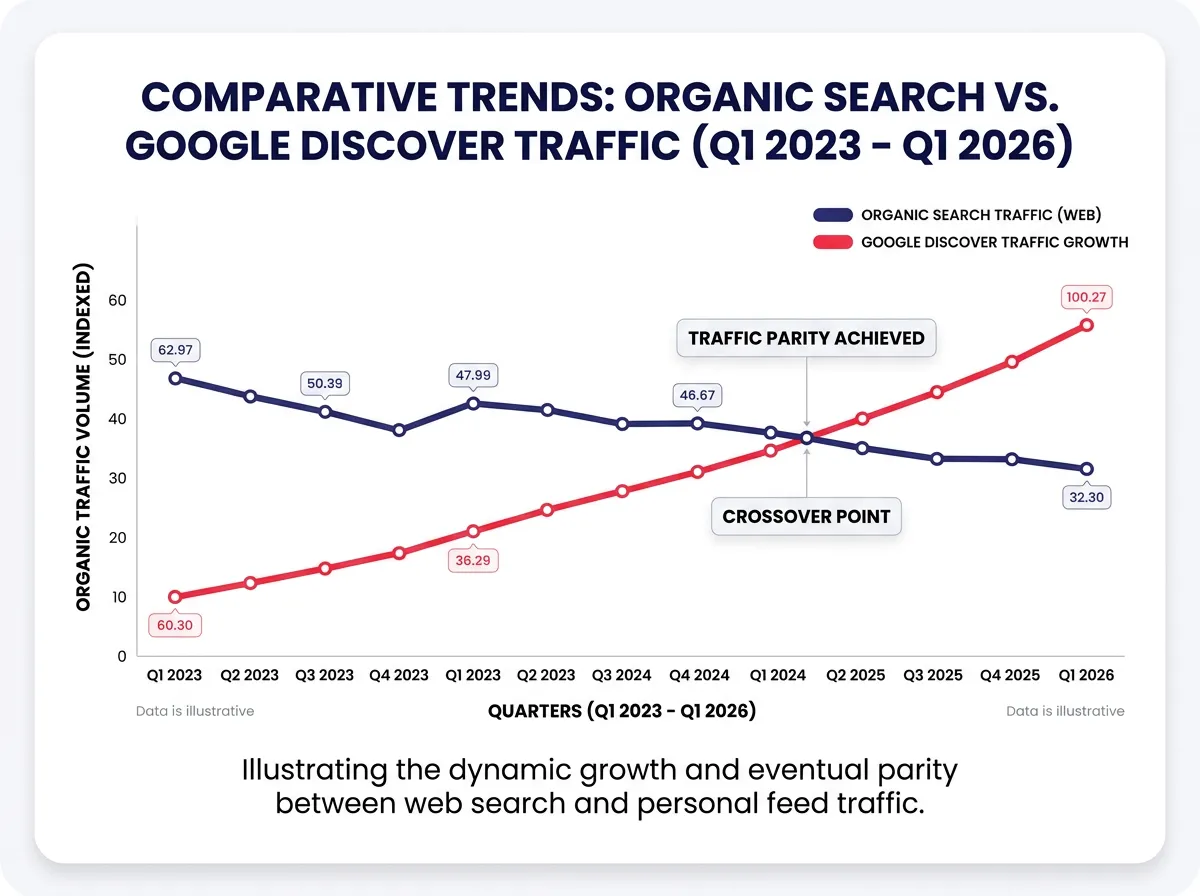
Perhaps the most striking data point from the same publisher network is this: Google Discover traffic grew 30% over the same period and is now driving roughly equal traffic to traditional web search. That is a massive shift in where users are consuming content, and most marketing teams are not set up to take full advantage of it.
Google Discover operates differently from search. Users are not entering queries — Google is proactively surfacing content based on interests, behavior, and engagement signals. That means content freshness, graphic design, strong headlines, and high engagement rates matter more than keyword density. SEO thinking alone will not get your content into Discover feeds at scale.
GEO and SEO Strategy Adjustments Marketing Teams Should Make Now
The data points to a clear need for strategy realignment. This is not about abandoning SEO — it is about layering new thinking on top of it.
Shifting From Evergreen-First to Real-Time Content Investment
Start with an seo audit. Which content categories in your current library are most exposed to AI Overview displacement? Informational guides, FAQ pages, definitional content, and how-to articles are all high-risk. Once you have mapped that exposure, the next step is rebalancing your editorial calendar to prioritize content that is timely, specific, and likely to surface in Top Stories carousels rather than getting absorbed into an AI summary.
This does not mean abandoning long-form content entirely. It means being more strategic about which evergreen topics are worth investing in and making sure timely content gets the resources it needs to compete.
How GEO Thinking Should Inform Your Search and Discover Strategy
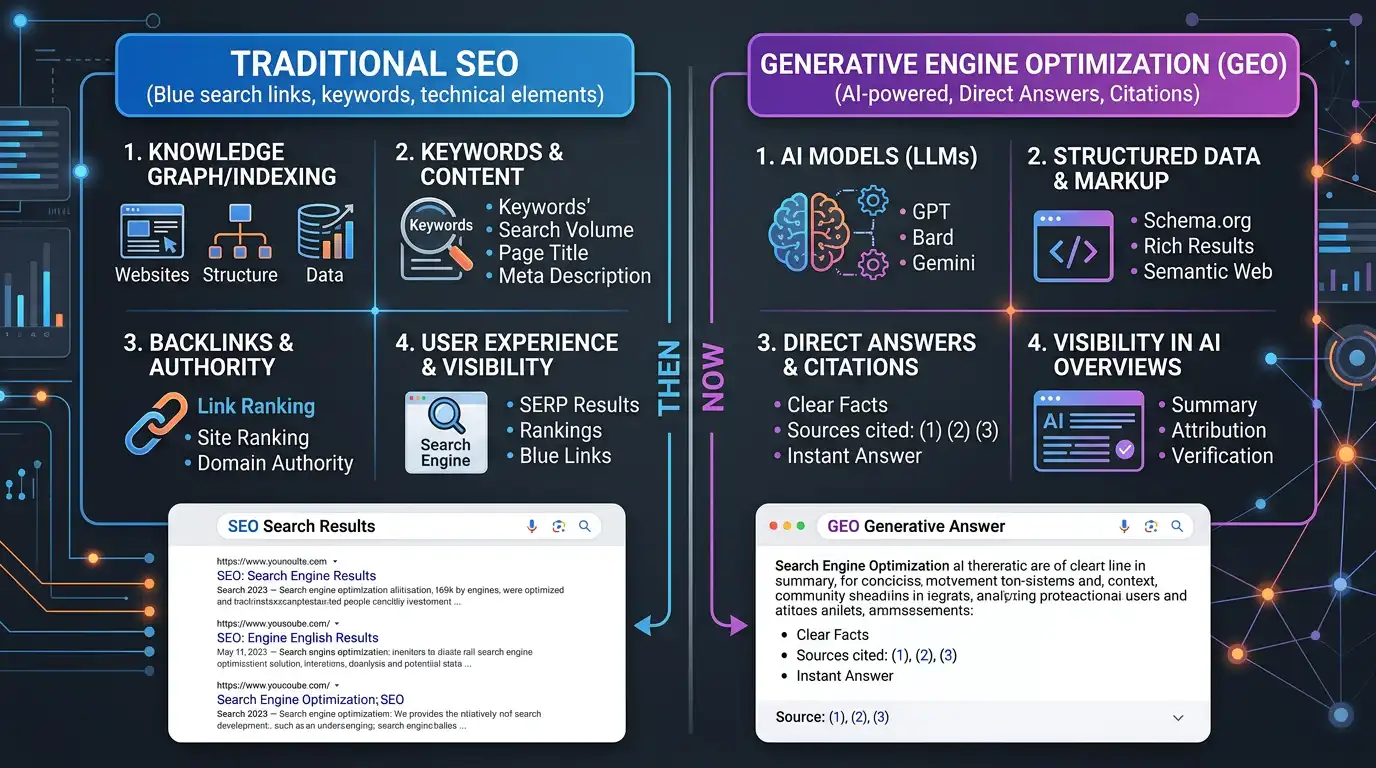
Generative Engine Optimization — GEO — is becoming as important as traditional SEO for teams that want their content to perform in an AI-first environment. GEO is about structuring content so it surfaces well within AI-generated responses and earns citation within AI panels, not just in blue link results.
That means focusing on authority signals, source credibility, content freshness, and structured data. It also means writing in ways that are clear, citable, and factually specific — because AI systems favor content that is easy to extract and attribute.
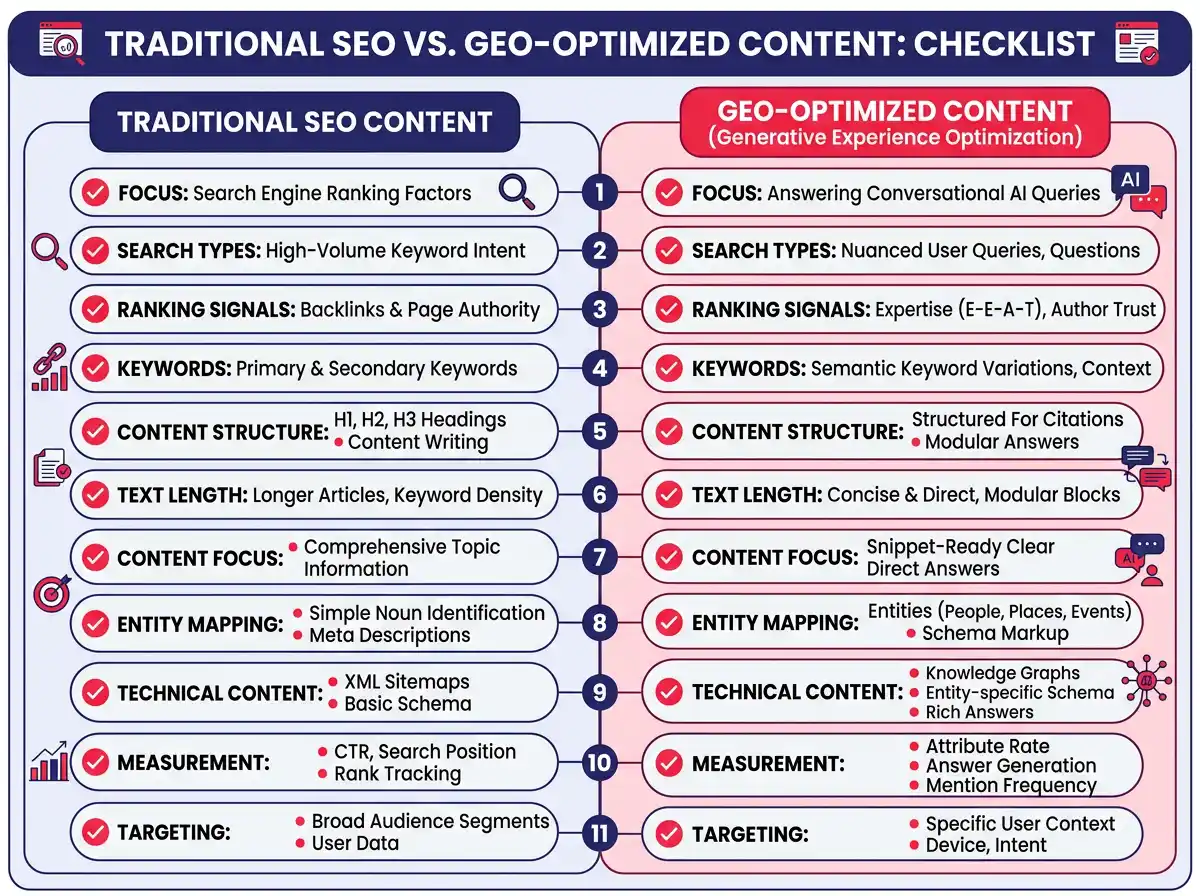
Teams that treat GEO and SEO as separate concerns are going to fall behind. The strongest content strategies right now are ones that optimize for both — ranking in traditional results while also being built in a way that earns visibility inside AI-generated answers and Discover feeds simultaneously.