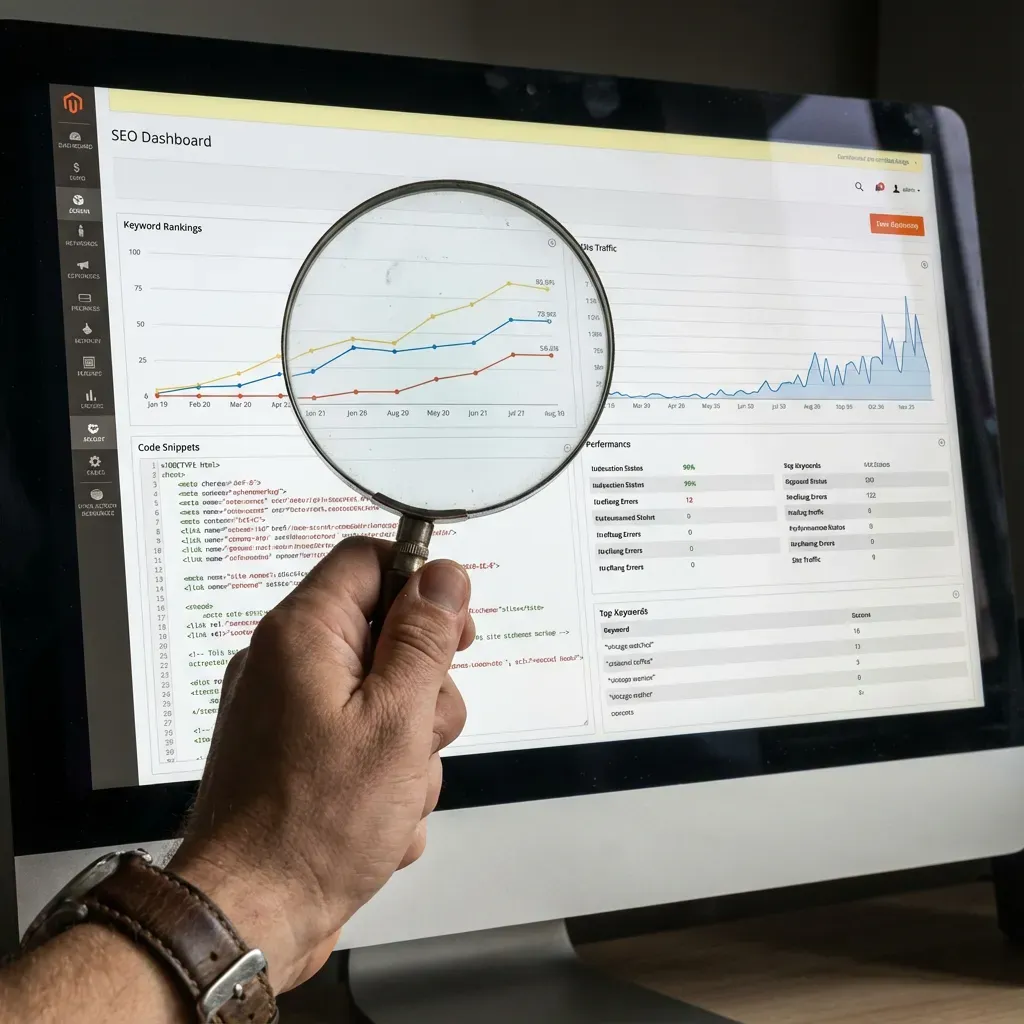
TL;DR
- Moving off the Luma theme to Hyva swaps RequireJS, KnockoutJS and jQuery for Alpine.js and Tailwind CSS, typically cutting product page LCP from 3-4 seconds to under 1.2 seconds, with Page Experience gains within 4-8 weeks.
- The targets given are INP under 200ms, LCP under 2.5 seconds and CLS under 0.1; well-optimized Magento stores average a 2.2 second load time and cloud-hosted enterprise stores around 2.7 seconds.
- Two native settings do most of the duplicate content work: enable canonical link meta tags for products and categories, and disable Use Categories Path for Product URLs so one product is not served at two URLs.
- Faceted navigation should be triaged by real search demand: index high-intent combinations such as brand plus product type, canonical sort parameters back to the base category, and block price ranges and /catalogsearch/ in robots.txt.
- Magento does not generate hreflang across Store Views natively, so it needs an extension or custom code, full locale codes such as en-us and en-gb, an x-default, and bidirectional references or Google ignores the whole cluster.
Quick Summary: Magento (Adobe Commerce) powers over 250,000 stores globally and facilitates $173 billion in annual GMV — yet most stores leave enormous organic traffic on the table. This guide covers every lever that matters in 2026: Core Web Vitals and the Hyva theme shift, crawl budget management, faceted navigation control, structured data for AI search, GEO/AEO optimization, international SEO with hreflang, and content strategy for topical authority. Follow the checklist at the end of each section to turn your Adobe Commerce store into an organic traffic machine.
Magento, known officially as Adobe Commerce, remains a powerhouse in ecommerce. While new platforms appear regularly, major brands and enterprise-level retailers continue to rely on Magento because of its unparalleled flexibility and robust catalog management capabilities. However, as we are firmly in 2026, the way we approach Ecommerce SEO for this platform has fundamentally shifted. It is no longer about keywords and backlinks alone. Successful Magento SEO today demands a sophisticated blend of technical infrastructure, entity optimization for AI-driven search, and a relentless focus on user experience signals that determine both ranking and click-through rate.
The stakes are high. Implementing rich snippets alone results in an average 20% higher click-through rate. Stores utilizing advanced SEO practices report a 25% increase in organic traffic on average. Yet poorly configured Magento installations routinely contain five to ten times more URLs in Google's index than they have actual products — a structural problem that drains crawl budget and dilutes ranking power across thousands of thin pages that should never be indexed at all.
This guide dives deep into every challenge and opportunity within the Adobe Commerce ecosystem, providing a clear roadmap to secure and grow organic visibility in 2026's AI-shaped search environment.
The Technical Foundation: Speed and Core Web Vitals
In 2026, site speed is not a tie-breaker — it is a fundamental threshold for indexation and competitive ranking. Magento has a reputation for being resource-intensive, and without the right server-side optimization, your Core Web Vitals will suffer. Google's page experience assessment — specifically Interaction to Next Paint (INP), Largest Contentful Paint (LCP), and Cumulative Layout Shift (CLS) — directly impacts how your store ranks against competitors who have optimized for these signals.
The current INP benchmarks you must target are:
| Metric | Good | Needs Improvement | Poor |
|---|---|---|---|
| INP (Interaction to Next Paint) | Under 200ms | 200–500ms | Over 500ms |
| LCP (Largest Contentful Paint) | Under 2.5s | 2.5–4s | Over 4s |
| CLS (Cumulative Layout Shift) | Under 0.1 | 0.1–0.25 | Over 0.25 |
The first step in addressing performance is your hosting environment. Shared hosting is never sufficient for a serious Magento build. You need a dedicated architecture running PHP 8.3 or newer with your database optimized on MySQL 8. However, the most significant speed gains come from caching layers. Varnish Cache is essential for Adobe Commerce — it acts as a reverse proxy, serving static content without touching the backend on every request. Redis should handle session storage and the object cache separately. If Varnish is not correctly configured, or if your full-page cache is constantly invalidated by a poorly coded extension, server response times climb rapidly.
Well-optimized Magento stores average a 2.2-second load time. Cloud-hosted enterprise stores typically land around 2.7 seconds. These numbers are achievable — but only with the right stack. HTTP/3 multiplexing reduces request latency on high-traffic category pages. A CDN distributes static assets globally so shoppers in any region get sub-50ms asset delivery.
Image optimization is another non-negotiable. Ecommerce sites are image-heavy by nature, and serving legacy JPG or PNG formats wastes significant bandwidth. Serving AVIF or WebP with proper lazy loading below the fold ensures the browser prioritizes the LCP element — usually the main product image on a PDP — above everything else. Adobe Commerce supports next-gen formats natively, but they require specific server modules to function.
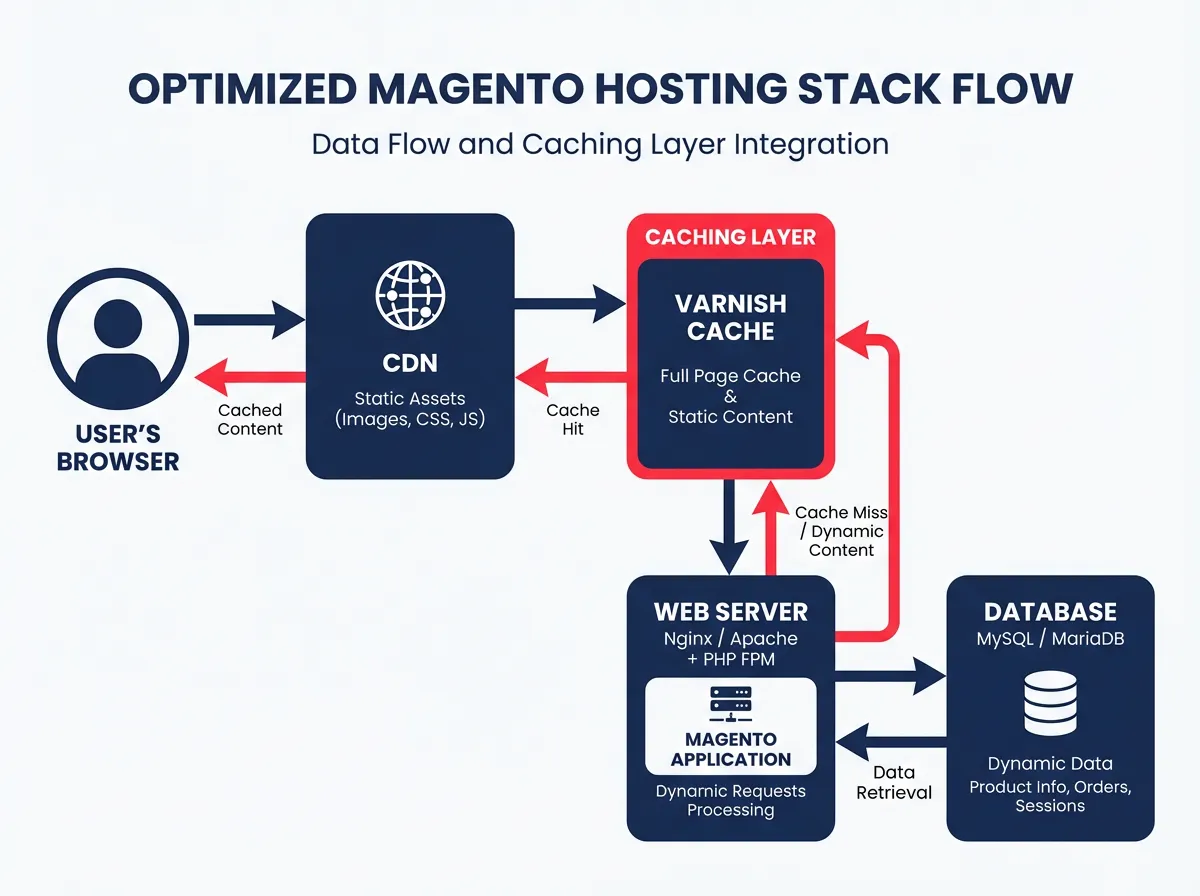
Hyvä Theme: The Single Biggest Performance Lever
If you are running Magento's legacy Luma theme in 2026, you are fighting an uphill battle against poor INP and LCP scores. Luma ships with substantial JavaScript bloat — RequireJS, KnockoutJS, and jQuery all loading on every page, even when the components they power are not used on that specific view. Product detail pages on Luma typically achieve LCP scores between 3 and 4 seconds. The same store migrated to Hyvä theme routinely drops that to under 1.2 seconds — a fundamental improvement that translates directly into ranking gains on competitive PDP queries.
Hyvä replaces Magento's legacy JavaScript framework with Alpine.js and Tailwind CSS, dramatically reducing the JavaScript payload. The result is a dramatically lighter frontend that passes Core Web Vitals assessments in testing environments. Stores that have completed the migration report significant improvements in Google Search Console's Page Experience report within 4–8 weeks of deployment.
If a full Hyvä migration is not immediately possible, interim steps include:
- Deferring all non-essential third-party scripts (chat widgets, analytics, retargeting pixels) until after the page is interactive
- Reducing the number of JavaScript bundles loaded on category and product pages
- Implementing critical CSS inline to eliminate render-blocking stylesheets
- Using HTTP/3 where your hosting supports it for parallel request handling
Headless architectures are another option for teams that want full control over frontend performance. A React or Next.js storefront connected to Adobe Commerce's GraphQL API gives developers complete authority over what scripts run and when. The trade-off is development complexity and the cost of maintaining two separate systems.
Mastering URL Structure and Rewrite Management
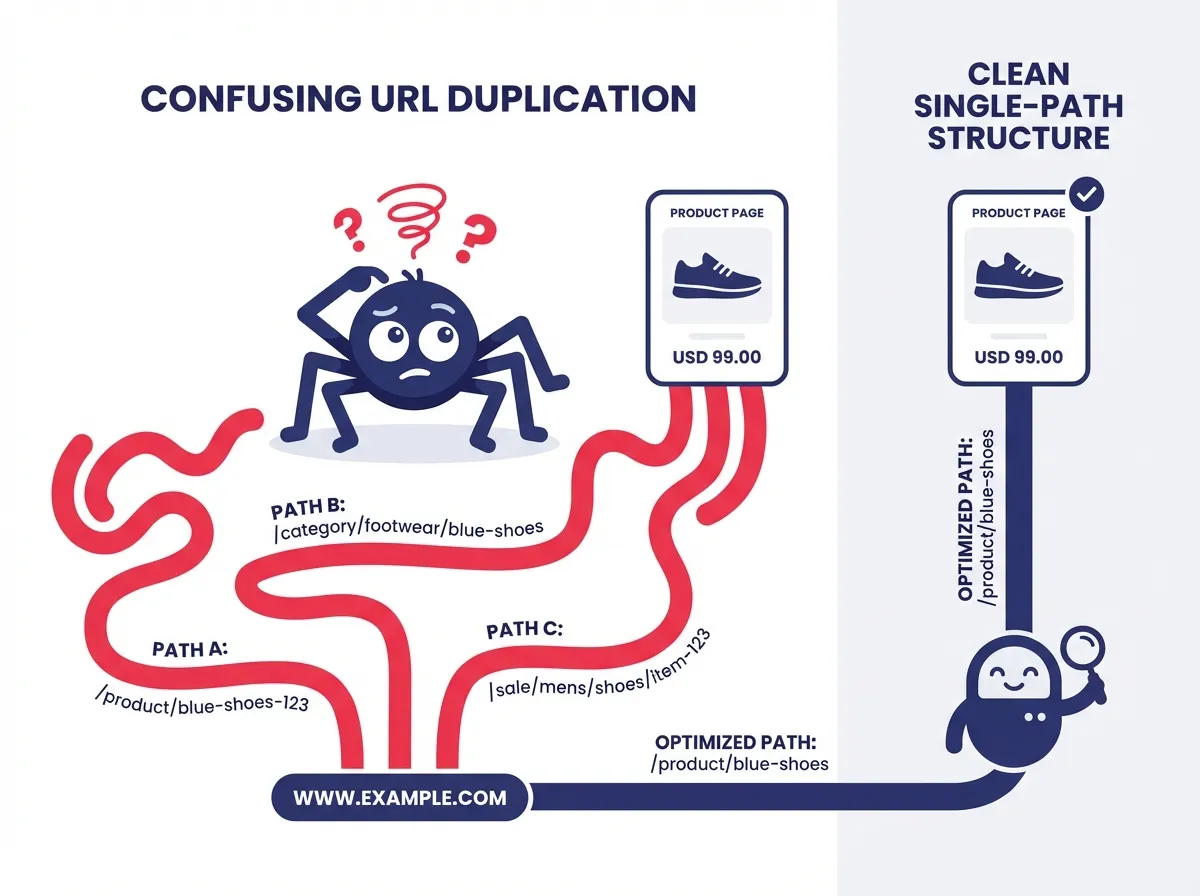
One of the most persistent issues in Magento SEO is how the platform handles URLs. By default, Magento can generate multiple URLs for the same product. You might have a URL that includes the category path and another that is simply the product name at the root level. For example, a single winter coat might be accessible at both domain.com/men/jackets/winter-coat and domain.com/winter-coat, serving identical content.
This creates a duplicate content problem at scale. While canonical tags are a safety net, relying on them entirely is inefficient — it forces search engine bots to crawl multiple versions of every page only to be told to ignore all but one. This wastes crawl budget, which is a finite resource, especially for stores with thousands of SKUs. The correct practice is to configure your store to use top-level product URLs and disable the "Use Categories Path for Product URLs" setting in the catalog configuration.
Changing URL structures on a live store requires careful planning. Every changed URL needs a 301 redirect to pass authority from the old structure to the new one. Magento's URL Rewrite table is powerful but becomes bloated over time. Databases with millions of rows in the url_rewrite table cause measurable performance degradation on every frontend page load. This is because Magento queries this table on every request to resolve the current URL.
Performing a regular SEO Audit on this table is mandatory maintenance. When you delete a product, Magento creates a redirect record. When you change a URL key, it creates another. Truncating and regenerating this table is common — but only do it with a full backup and a tested redirect verification script in place.
The Challenge of Faceted Navigation
For any ecommerce store, faceted navigation — filtering by size, color, price range, brand — is essential for user experience. For SEO, it is one of the most dangerous features in your Magento installation if not controlled correctly. Layered navigation generates unique URLs for every filter combination a user applies. With multiple attributes across a large catalog, this can mathematically result in millions of thin, low-value pages entering Google's index.
If Googlebot gets trapped in your faceted navigation, it wastes crawl resources on useless filter combinations instead of your core category and product pages. This is a structural dilution of crawl budget and link equity that tanks rankings across the board. The solution is a precise strategy using robots.txt directives, meta robots tags, and canonical tags applied at the attribute level.
The decision framework for 2026 is this: identify exactly which filter combinations have real search demand. Queries like "Red Nike Running Shoes Size 10" exist and deserve an indexable page. Queries like "Shoes priced between $51 and $54" do not. Apply this logic systematically:
- High-intent attribute combinations (brand + product type, color + product type): make indexable, include in sitemap
- Sort order parameters (price ASC/DESC, newest first): canonical back to the base category URL, never index
- Price range filters: disallow in
robots.txtor applynoindex, nofollowmeta tag - Internal search result pages (
/catalogsearch/): disallow inrobots.txtand applynoindex
AJAX-based filtering improves user experience but can hide links from crawlers if not implemented with a server-side fallback. Ensure your implementation renders filterable links in the HTML that bots can discover. Third-party layered navigation extensions — which most Magento stores use — often default to indexing everything. Check every extension setting with a fine-toothed comb.
Product Page Optimization for Entities and AI
Search engines now view products as entities with specific, verifiable attributes — not just keyword-matched documents. To rank well for commercial queries in 2026, you need to provide structured content and data that machines can parse with confidence.
Practical product page optimization for 2026 includes:
- Unique product descriptions: Manufacturer copy is duplicate content that no AI system will cite or surface. Write descriptions that include unique selling points, material specifications, intended use cases, and compatibility information. The "inverted pyramid" approach works well: place the most important and differentiating information in the first two sentences.
- Rich attribute data: Every relevant attribute (dimensions, weight, material, compatibility, warranty) should be present both in the visible product content and in the structured data markup.
- Out-of-stock strategy: Never delete a product page the moment it goes out of stock. That page has accrued historical authority and may still be receiving traffic. Keep it live, mark it clearly as out of stock, show related in-stock products prominently, and offer a notification signup. If the product is permanently discontinued, 301 redirect it to the most relevant equivalent product — not just the parent category.
- Review signals: Authentic customer reviews add E-E-A-T signals and provide the kind of experiential content that AI Overviews pull from when summarizing product suitability.
Handling configurable products and their simple variants correctly is also critical. Each simple product variant (a shirt in Small, Medium, Large) typically should not have its own independently indexable page. Consolidate visibility on the configurable parent product page. Ensure simple products either redirect to the parent or have a canonical pointing to it, unless a specific variant has genuinely high independent search demand.
Addressing Duplicate Content with Canonicals
Canonical tags are one of Adobe Commerce's most important native SEO features — and one of the most commonly misconfigured. Every page must carry a self-referencing canonical tag if it is the intended ranking version. For sorted or filtered category pages, the canonical should always point to the base category URL.
Enable canonical tags for both products and categories in Magento's native settings: Stores → Configuration → Catalog → Catalog → Search Engine Optimization. Check the boxes for "Use Canonical Link Meta Tag For Categories" and "Use Canonical Link Meta Tag For Products." This single configuration change, if not already enabled, can eliminate a significant volume of duplicate content signal issues.
Pagination is another canonical consideration. For paginated category pages, use rel="canonical" pointing to page 1 if the content is largely duplicated across pages, or implement proper self-referencing canonicals on each paginated URL depending on your content strategy. Google deprecated rel="prev/next" in 2019, so pagination handling now relies entirely on canonicals and crawl management.
The goal is to ensure Google never has to guess which version of a page to rank. Every signal — canonical, sitemap inclusion, internal link targets, and structured data URLs — should consistently point to the same definitive URL for each piece of content.
Structured Data and Schema for AI Search
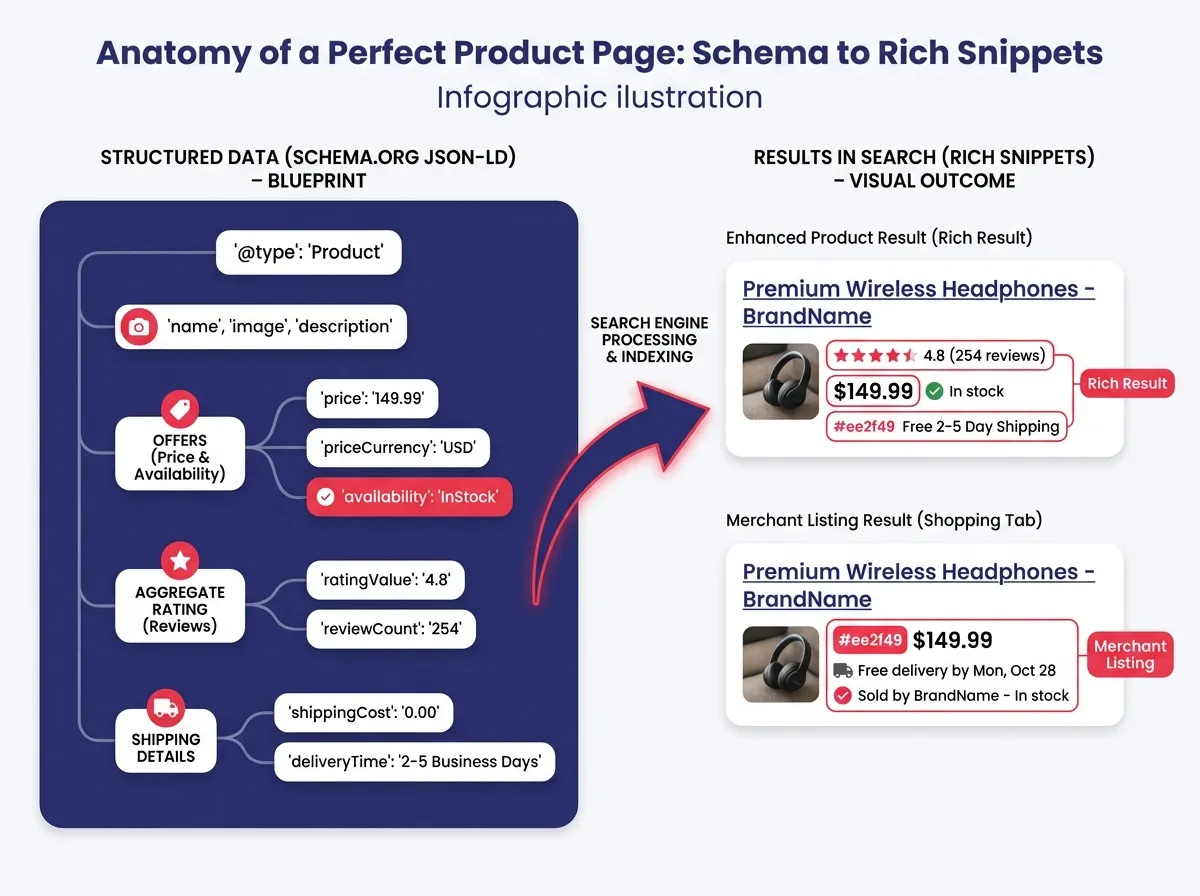
Adobe Commerce ships with basic Product and BreadcrumbList schema out of the box. In 2026, this is insufficient for competitive visibility, particularly in AI-generated search features. AI Overviews, Perplexity, and ChatGPT Search pull heavily from structured data when constructing answers. Stores with comprehensive, accurate schema coverage appear far more frequently in AI-generated responses.
The full schema stack a Magento store should implement in 2026:
| Schema Type | Where to Apply | Priority |
|---|---|---|
| Product | All product detail pages | Critical |
| BreadcrumbList | All category and product pages | Critical |
| Organization | Homepage and About page | High |
| Offer / AggregateOffer | Product pages with pricing | High |
| AggregateRating | Product pages with reviews | High |
| ShippingDetails | Product pages, checkout flow | High |
| FAQPage | Category pages, key landing pages | Medium |
| ImageObject | Product and category pages | Medium |
| SiteLinksSearchBox | Homepage (sitewide) | Medium |
Critically, your on-page Product schema must align with your Google Merchant Center feed. If your on-page markup shows a price that differs from what your feed reports, you risk losing eligibility for Google Shopping features. The gtin, mpn, brand, sku, and availability fields must be accurate and consistent across all data sources.
For FAQPage schema specifically: Adobe Commerce's Page Builder supports FAQ widget injection natively. On Magento Open Source, extensions like Mageworx FAQ allow adding structured Q&A arrays to category and product pages. Google's FAQ rich-result eligibility still applies to commerce pages, providing additional SERP real estate at no cost beyond the implementation effort.
Implementing rich snippets — star ratings, price ranges, availability — drives an average 20% higher click-through rate according to industry data. This is one of the highest-ROI SEO activities available for ecommerce stores and should be treated as a priority, not an optional enhancement.
GEO and AEO: Optimizing for AI Answer Engines
Generative Engine Optimization (GEO) and Answer Engine Optimization (AEO) represent the most significant strategic shift in Magento SEO for 2026. AI Overviews now appear on an estimated 13–15% of Google searches — a number that continues to grow. Perplexity, ChatGPT Search, and Google's AI Mode are actively pulling product and brand information from the open web, and ecommerce stores that are not structuring their content for machine extraction are being left out of these responses entirely.
GEO/AEO optimization for Magento stores focuses on:
- Inverted pyramid content structure: Place the direct, specific answer in the first sentence of every product description, category introduction, and blog post. AI models extract the most specific, definitive statements from text — not the narrative context that follows. "This 14-gauge stainless steel mixing bowl is dishwasher-safe, oven-safe to 500°F, and designed for professional-grade use" is far more extractable than "Our bowls are made with quality materials for a variety of kitchen tasks."
- Entity clarity: Use the exact brand names, model numbers, and category terms that people search for. AI engines match product entities to known knowledge graph entries. The more precisely your content maps to established entities, the more likely your store surfaces in AI-generated responses.
- Comprehensive structured data: As covered in the schema section above, broad schema coverage directly increases AI visibility. Every attribute you expose in JSON-LD is a signal an AI engine can consume without ambiguity.
- E-E-A-T signals: AI systems prioritize sourcing from pages that demonstrate Experience, Expertise, Authoritativeness, and Trustworthiness. Author bios on blog content, certifications and awards on brand pages, and genuine customer review content all strengthen your store's E-E-A-T profile.
The Role of Agentic Commerce Protocol (ACP)
Looking at the immediate horizon, we cannot ignore the rise of the Agentic Commerce Protocol (ACP). As discussed throughout late 2025 and into 2026, AI agents are beginning to perform shopping tasks on behalf of users. These agents do not browse visual websites — they consume structured data via APIs and protocols. A user telling their AI assistant to "order the best waterproof hiking boot under $200 with next-day delivery" triggers an agent that queries product data feeds, not a traditional web crawl.
Adobe Commerce is well-positioned for this shift due to its API-first architecture. However, enabling your store for agentic commerce requires more than standard SEO. Your product attributes must be clean, consistent, and exhaustive. Your pricing logic must be accessible via a standardized API. Your inventory and availability data must be real-time accurate.
Think of ACP readiness as the next layer of technical SEO. Just as we spent years optimizing HTML for crawlers, we must now optimize data structures for AI agents. Stores that expose well-structured product data via Adobe Commerce's GraphQL API — with complete attribute sets, accurate inventory signals, and clean categorization — are the ones that agentic systems will prefer and recommend.
Managing the Crawl Budget
For large Magento stores with tens of thousands of products, crawl budget management is not optional — it is a core SEO discipline. Googlebot allocates a finite number of crawl requests to your domain based on its authority, server response speed, and the historical quality of content it has found. If Googlebot spends that budget crawling low-value filter combinations, internal search results, and stale URL rewrites, it misses your new product launches and updated content.
Server log file analysis is the most accurate way to understand how bots are actually interacting with your Magento store. By parsing your access logs, you can see precisely which URLs Googlebot is requesting, how often, and in what sequence. Common findings include bots stuck in calendar widgets, session ID URLs appended to product pages, or infinite scroll pagination loops.
High-priority crawl budget actions for Magento:
- Disallow
/catalogsearch/inrobots.txtand applynoindexto all internal search results - Disallow session ID parameters (
?SID=,?PHPSESSID=) inrobots.txt - Remove irrelevant CMS pages from your XML sitemap (404 error pages, enable-cookies pages, success pages)
- Ensure your sitemap only contains canonical URLs — the exact versions you want indexed
- Use
noindexon account, cart, and checkout pages via Magento's native robots configuration - Monitor and clean the
url_rewritetable on a quarterly schedule
Use Google Search Console's URL Inspection tool and Crawl Stats report to validate your crawl budget improvements after implementing these changes. A clean crawl path should result in Googlebot spending more time on your high-value product and category pages — which means faster indexing of new content and fresher rankings.
International SEO and Store Views
One of Magento's strongest capabilities is handling multiple storefronts from a single backend using Store Views. This is ideal for international expansion — but international SEO requires precise implementation of hreflang tags to avoid creating duplicate content signals across language or region variants.
The hreflang attribute tells search engines which version of a page to serve to users based on their language and geographic location. In a Magento setup, each Store View typically maps to a language or region. The challenge is implementing hreflang correctly across all views and ensuring the bidirectional relationship is complete — every variant must reference every other variant, including itself.
Common international SEO mistakes on Magento stores:
| Mistake | Consequence | Fix |
|---|---|---|
Using en instead of en-us / en-gb |
Google cannot differentiate regional variants | Use full locale codes for all region-specific store views |
| Missing x-default hreflang | No fallback for unrecognized locales | Add x-default pointing to your primary store view |
| Hreflang not bidirectional | Google ignores the hreflang cluster | Every variant must reference all other variants |
| Conflicting currency in schema vs. Merchant Center | Merchant Center suspension risk | Ensure Store View currency matches schema and feed currency |
| Content not actually localized | Duplicate content penalty across regions | Translate and localize product and category content per Store View |
Currency and pricing consistency is especially important. If your schema markup shows a price in USD on the UK Store View because of a misconfiguration, you will confuse both users and search engines, and risk a Google Merchant Center suspension that removes your products from Shopping results entirely.
Building Topical Authority with Content
Technical excellence allows you to compete. Content makes you win. Magento stores that neglect their blog and Content Marketing strategy are treating the platform purely as a transactional engine — and missing the informational queries that drive awareness and category-level search demand.
To rank for broad informational queries and build topical authority, your store needs content that answers the questions your customers have before they are ready to buy. If you sell professional kitchen equipment, you need detailed guides on technique, maintenance, and equipment selection. If you sell automotive parts, installation guides and compatibility articles are essential. These informational pages:
- Rank for high-volume informational queries that product pages cannot target
- Build internal link equity flowing into your category and product pages
- Demonstrate E-E-A-T to both Google's systems and AI engines that evaluate source quality
- Capture users at the research phase, before they have chosen where to buy
A practical content hub structure for Magento stores: create pillar category guides ("The Complete Guide to [Category]") and connect them via internal links to sub-topic pages and ultimately to category and product pages. A blog post about "How to Choose a Mountain Bike for Beginners" should link naturally to your mountain bike category page. This passes authority from the informational content to the transactional destination.
Keep your blog at domain.com/blog/ rather than a subdomain (blog.domain.com). Subdirectories consolidate domain authority. A subdomain is treated as a separate site by Google, meaning all the authority your blog content accumulates benefits a different entity rather than your main ecommerce domain.
In 2026, AI systems are explicitly evaluating whether a brand is an expert in its niche. Shallow, thin content that covers a topic at a surface level will not earn AI citations or rank competitively for informational queries. Invest in depth, original research, and genuine utility.
Magento SEO Settings Configuration Checklist
The following navigation paths reflect Adobe Commerce's admin panel. Each item represents a native setting that should be verified on every Magento installation:
| Setting | Admin Path | Recommended Value |
|---|---|---|
| Canonical URLs for Products | Stores → Config → Catalog → Catalog → SEO | Enabled |
| Canonical URLs for Categories | Stores → Config → Catalog → Catalog → SEO | Enabled |
| Use Category Path in Product URLs | Stores → Config → Catalog → Catalog → SEO | Disabled |
| URL Rewrite (mod_rewrite) | Stores → Config → General → Web → SEO | Enabled |
| Full Page Cache | Stores → Config → Advanced → System → FPC | Varnish Cache |
| XML Sitemap — Include Images | Stores → Config → Catalog → XML Sitemap | All |
| Robots.txt — Disallow catalogsearch | Content → Design → Config → Edit Custom Instruction | Disallow: /catalogsearch/ |
| Product Fields Auto-Generation | Stores → Config → Catalog → Product Fields Auto-Generation | Custom template per product type |
| Search Engine Robots (Default) | Content → Design → Config → HTML Head | INDEX, FOLLOW for core pages; NOINDEX for account/cart/checkout |
Beyond native settings, the Magento extension ecosystem offers dedicated SEO tools that extend these capabilities significantly. Amasty SEO Toolkit, Magefan SEO, and MageWorx SEO Suite are among the most widely used. Evaluate extensions based on their granularity of control over indexation, redirect management, and structured data generation.
Frequently Asked Questions
Is Magento good for SEO?
Yes — Adobe Commerce is one of the most SEO-capable ecommerce platforms available, with native support for canonical URLs, XML sitemaps, robots.txt customization, URL rewrites, and structured data. However, a default Magento installation requires significant configuration to realize these capabilities. Without proper setup, common issues like duplicate product URLs, bloated faceted navigation, and slow page speed can neutralize any inherent platform advantage. Magento's strength is its granular control; its risk is that this control requires expertise to use correctly.
How do I fix duplicate content in Magento?
The primary tools for fixing duplicate content in Magento are canonical tags, URL rewrite configuration, and robots.txt directives. First, enable canonical URLs for both products and categories in Stores → Configuration → Catalog → Catalog → SEO. Second, disable "Use Categories Path for Product URLs" to prevent the same product from appearing at multiple URL paths. Third, apply noindex tags or robots.txt disallows to all faceted navigation filter combinations that do not have genuine search demand. For configurable products, ensure simple variants are not independently indexable unless a specific variant has proven independent search volume.
What is the best Magento SEO extension?
The answer depends on your specific needs. For comprehensive on-page SEO, meta templates, and structured data, Amasty SEO Toolkit and MageWorx SEO Suite are consistently rated highest in 2026. For advanced XML sitemap management and hreflang implementation across multiple Store Views, Magefan offers reliable tools. For layered navigation control, Mageworx SEO-Friendly URLs provides fine-grained control over which filter combinations are indexable. Always evaluate extensions against your version of Adobe Commerce and verify compatibility before installing in production.
How does Magento handle hreflang for international SEO?
Magento's native hreflang implementation depends on your extension setup. The core platform does not automatically generate hreflang tags across Store Views — this requires either a third-party extension or custom development. Each Store View must reference all other Store Views using the correct locale code (e.g., en-us, en-gb, de-de, th-th) in the hreflang attributes. The relationship must be bidirectional: if your UK Store View references your US Store View, your US Store View must also reference the UK Store View. A missing or unidirectional hreflang implementation causes Google to ignore the entire cluster.
How do I improve Magento site speed for Core Web Vitals?
The most impactful single change for Magento Core Web Vitals in 2026 is migrating from the Luma theme to Hyvä. Hyvä replaces the heavy RequireJS/KnockoutJS JavaScript framework with Alpine.js and Tailwind CSS, typically reducing product page LCP from 3–4 seconds to under 1.2 seconds. Beyond the theme, essential speed improvements include implementing Varnish Cache for full-page caching, using Redis for object and session caching, serving images in AVIF or WebP format with lazy loading, using a CDN for static asset delivery, running PHP 8.3 on modern infrastructure, and deferring all non-essential third-party scripts until after page interaction.
What is crawl budget and why does it matter for Magento?
Crawl budget is the number of pages Googlebot will crawl on your site within a given timeframe. For large Magento stores with thousands of products, faceted navigation can generate millions of unique URLs, spreading Googlebot's attention across countless low-value filter pages instead of your core product and category pages. This means new products may take weeks to be indexed and important pages may not be recrawled frequently enough to reflect price or availability updates. Control crawl budget by disallowing internal search results and filter parameters in robots.txt, applying noindex tags to low-value pages, and keeping your XML sitemap limited to only the URLs you want ranking.
How important is structured data for Magento SEO in 2026?
Structured data has moved from a nice-to-have enhancement to a critical ranking factor in 2026, particularly for ecommerce. Google uses Product schema to populate Shopping panels and AI Overviews. Rich snippet eligibility (star ratings, price, availability) drives an average 20% increase in click-through rate for Magento stores that implement it correctly. Beyond Google, AI search platforms like Perplexity and ChatGPT Search pull from structured data when generating product recommendations. Stores with comprehensive, accurate schema coverage — including Product, BreadcrumbList, Organization, FAQPage, and ShippingDetails — appear significantly more often in AI-generated answers than stores with basic or missing markup.
Should I use a headless architecture for Magento SEO?
Headless architecture — decoupling Magento's backend from a custom frontend built with React, Next.js, or similar — offers the greatest control over Core Web Vitals performance and frontend speed. For stores where performance is the primary bottleneck and a Hyvä migration is insufficient, headless is worth evaluating. However, headless introduces real complexity: you must ensure your frontend framework handles server-side rendering (SSR) correctly for SEO, since client-side-only rendering causes indexation problems. Googlebot can process JavaScript, but SSR remains the safer choice for ecommerce SEO. Headless is best suited for large enterprise stores with dedicated development teams rather than smaller operations where the maintenance overhead outweighs the performance benefits.