TL;DR
- The most rigorous study cited, covering 68,000 real queries, put the average organic CTR drop at 46.7% on queries with an AI Overview; overviews appeared on roughly 25% of Google searches, double the 13% of twelve months earlier.
- The diagnostic signature of AI Overview loss is stable or rising impressions with sharply falling clicks and CTR; if impressions fall alongside clicks, the post attributes it to a ranking drop or core update instead.
- Exposure by intent: informational queries trigger overviews around 90% of the time with CTR down 47% to 61%, commercial research 8-15%, transactional about 4% and navigational under 1%.
- Health, finance, legal, travel and B2B technology see CTR declines of 58% to 61% because overviews appear on 43-70% of their queries, and some health and medical sites lost 40-70% of organic traffic within a single year.
- Sites with comprehensive schema markup appeared in 47% more Perplexity AI responses than identical content without structured data, and schema is credited with recovering 45% or more of displaced traffic within 30 to 60 days.
- The Reality Check: Is AI Really to Blame?
- Step 1: Diagnosing the Impact with Google Search Console
- Step 2: Understanding the "Push Down" Effect
- Step 3: Identifying Vulnerable Content
- Step 4: The Strategy Pivot
- Step 5: GEO — Generative Engine Optimization
- Step 6: Schema Markup and Structured Data
- Step 7: Shifting Your Keyword Focus
- Step 8: The Brand Presence Play
- AI Overview Impact by Query Type: A Comparison
- The 90-Day Recovery Plan
- Navigating the Future
- Frequently Asked Questions
It is mid-2026 — over two years since Google launched AI Overviews in the United States in May 2024 — and the numbers tell a stark story. According to SparkToro, less than one third of Google searches now send a user to any external website. Zero-click searches hit 68% of all queries in early 2026. Publishers have recorded a 38% decline in Google referral traffic year-on-year. If you are staring at your analytics dashboard and seeing a downward trend, you are not alone, and you are not imagining it.
However, before you rewrite your entire content marketing strategy, you need to understand what is actually causing your specific traffic loss. AI Overviews are the most visible suspect, but they are not always the culprit — and even when they are, the fix is rarely a single action. This guide walks you through the exact diagnostic and recovery process, updated with the latest 2026 data and the emerging discipline of Generative Engine Optimization (GEO).
The Reality Check: Is AI Really to Blame?
Before tearing apart your content strategy, you must establish the facts. It is easy to look at a traffic dip and immediately blame AI Overviews. However, the picture is more nuanced than a simple cause-and-effect.
The most rigorous study to date — analysing 68,000 real queries — found that AI Overviews reduce organic click-through rates by an average of 46.7% relative to queries without them. That is significant. But across all searches, the impact is uneven. AI Overviews now appear for roughly 25% of all Google searches, having doubled from around 13% just twelve months ago. Critically, commercial and transactional queries only trigger an AI Overview about 4–8% of the time. If your site is primarily e-commerce or lead generation, you may be losing traffic for different reasons entirely.
So, if your traffic is down, AI Overviews might be a contributing factor, but they are rarely the sole reason. Before you overhaul your site, you must rule out these other common suspects:
- Core Algorithm Updates: Google updates its ranking systems frequently. A sudden drop often coincides with a core update that re-evaluated your site's quality or relevance.
- Technical Errors: Broken redirects, slow page load speeds that hurt Core Web Vitals, or accidental "noindex" tags can decimate traffic overnight.
- Seasonality: Comparing traffic in June 2026 to December 2025 may simply reflect a seasonal pattern that has nothing to do with rankings.
- Other SERP Features: Featured Snippets, Knowledge Panels, and "People Also Ask" boxes also absorb clicks. Losing a Featured Snippet typically hurts traffic more than an AI Overview appearing.
- Google AI Mode expansion: Distinct from AI Overviews, Google AI Mode (launched in 2025) generates 93% zero-click sessions among those who use it. Its user base is growing fast — the feature reached 1 billion monthly users by I/O 2026, though it still represents a small fraction of total search volume.
Performing a comprehensive SEO audit is vital. If you try to "fix" your site for AI Overviews when the real problem is a technical crawl error, you are wasting time and money.
Step 1: Diagnosing the Impact with Google Search Console
To confirm you are suffering from AI Overviews traffic loss, you need to get granular. You cannot look at site-wide traffic and draw conclusions. You have to look at specific keywords and specific pages.
The diagnostic signature of an AI Overview impact is simple: impressions remain stable or grow, while clicks and CTR decline sharply. If impressions are falling alongside clicks, you are more likely dealing with a ranking drop or a core update, not AI Overviews.
Checking Your Keywords
The first step is to see whether the keywords driving your traffic actually trigger an AI Overview. AI Overviews are now widespread, but they do not appear for every query.
- Manual Verification: Take your top 20 to 50 traffic-driving keywords. Open a private or incognito browser window and search for them. Note whether you see a large AI-generated summary at the top. Note that results can be personalised, so this gives a directional baseline rather than a definitive answer.
- Automated Tracking: For a larger keyword set, platforms like Semrush and Ahrefs track SERP features. You can input a keyword list and filter for "AI Overview" presence. This gives you the scale you need to understand what proportion of your traffic-driving terms are now dominated by AI summaries.
- PAA Mining: Use the "People Also Ask" boxes that appear alongside AI Overviews as a research asset. Tools like AlsoAsked.com let you export full PAA trees for your main keyword. Frame your H2 and H3 headings directly as these questions — that is exactly what AI Overviews extract.
If you find that your top traffic keywords now have substantial AI summaries dominating the page, you have established a strong correlation between AI Overviews and your traffic decline.
Timing Your Traffic Drop
Next, look at historical data. Pinpoint exactly when the traffic started to slide.
Open Google Analytics 4 or Google Search Console. Start the comparison from May 2024 — the date of the first major US rollout. Then look for these patterns:
- Sudden Drop: A cliff-edge decline on a specific week suggests it coincided with a known AI feature expansion or a core algorithm update. Cross-reference with Google's publicly confirmed update dates.
- Gradual Decline: A slow bleed of traffic over six to twelve months is more indicative of a shift in user behaviour or a gradual ranking erosion, rather than a sudden penalty. This pattern is common among informational sites that dominated pre-2024 but built their strategy around top-of-funnel definition content.
If your traffic was stable throughout 2024 and early 2025 but has dropped significantly in the past six months, look at whether Google recently expanded AI Overviews into your specific industry vertical. Health, finance, legal, travel, and B2B technology are experiencing the sharpest CTR declines — between 58% and 61% — because AI Overviews appear for 43–70% of queries in these sectors.
Step 2: Understanding the "Push Down" Effect
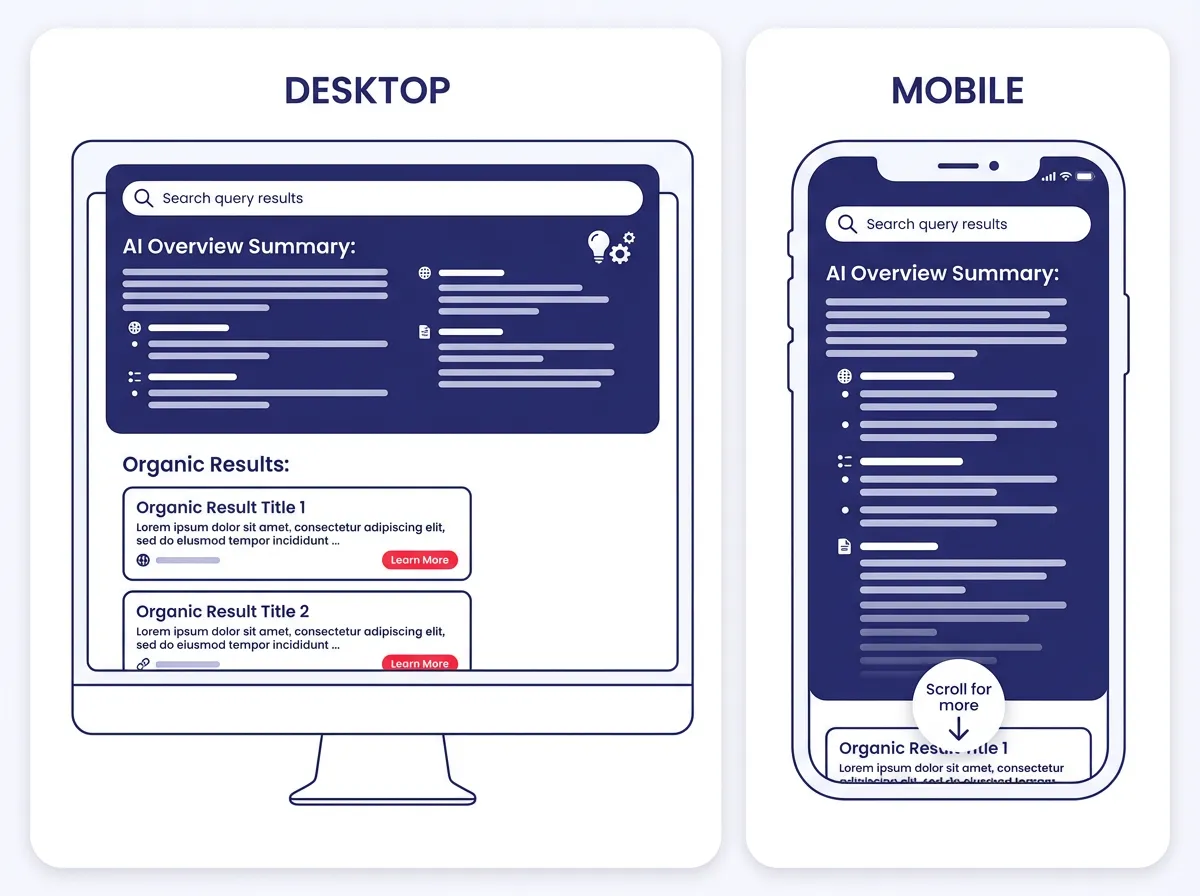
To fix the problem, you must understand the mechanics of the page. AI Overviews do not just add a box at the top of the results — they restructure the entire visual hierarchy of the SERP. A large AI summary, combined with the ads and shopping carousels that often sit above it, means that your number one organic ranking may now appear below the fold on both desktop and mobile.
This is the "Push Down" effect. Even if you hold the top organic position, you may be visually in the middle of the page on a desktop, or entirely off the first screen on a phone.
The Mobile vs. Desktop Dynamic
The impact is most severe on mobile. On a smartphone, an expanded AI Overview can consume the entire viewport. A user must actively scroll past the AI answer to see the first organic result.
Yet research reveals a counterintuitive pattern. Despite taking up more space, mobile searches have a lower zero-click rate (around 17%) compared to desktop searches (around 26%). Mobile users are more likely to scroll because they are often looking for a specific actionable outcome — a local business, a store location, a navigation destination — that the AI summary cannot deliver as efficiently as a traditional listing.
The implication for your strategy: monitor your device-segmented CTR in Google Search Console. If desktop CTR is collapsing but mobile CTR is holding, the SERP format is a factor and optimising for mobile-first scanning matters.
Step 3: Identifying Vulnerable Content
Not all content is equally vulnerable to AI Overviews traffic loss. We categorise queries into four main intent buckets — Informational, Commercial, Transactional, and Navigational — and the risk varies dramatically between them.
The Danger Zone: Informational Queries
The pages most at risk are those answering simple, factual questions. These are informational queries, and AI Overviews handle them with precision.
Examples include:
- "What is a catalytic converter?"
- "How many ounces in a cup?"
- "History of the Roman Empire."
- "Who is the CEO of Tesla?"
For these searches, an AI summary synthesises an answer from multiple sources and presents it cleanly. The user gets their answer immediately and has no incentive to click deeper. If your site relies heavily on basic definition pages or simple Q&A content, you are likely seeing the most severe traffic dips here. AI Overviews appear for up to 90% of clearly informational queries.
Health content is particularly vulnerable. At the start of 2026, some health and medical information sites had lost 40–70% of their organic traffic within a single year — primarily because their most-visited pages answered questions that AI now handles better and faster than a static article can.
The Safe Zone: Commercial and Transactional Queries
On the flip side, AI Overviews are far less intrusive when a user wants to research a product in depth or complete a purchase.
Examples include:
- "Best running shoes for flat feet 2026."
- "Buy iPhone Pro Max."
- "Salesforce pricing tiers."
The user is not looking for a definition — they are looking for options, prices, reviews, and the ability to purchase. An AI summary can mention products, but it cannot replicate the experience of browsing a site optimised for ecommerce SEO or reading a detailed human-written review with photos and personal anecdotes. E-commerce queries see AI Overviews appear only around 4% of the time, making them largely protected.
Step 4: The Strategy Pivot
You have diagnosed the problem and identified affected pages. Now it is time to act. You cannot force Google to remove the AI Overview, but you can change how you play the game. There are two core strategic approaches, and most sites should run both simultaneously.
Strategy A: Optimize for Citations (The "If You Can't Beat Them, Join Them" Approach)
For high-volume informational queries where an AI Overview is inevitable, your goal shifts from "getting the click" to "getting the citation." AI Overviews contain links. They cite their sources. Research from 2026 shows that brands cited in AI Overviews earn 35% more organic clicks and 91% more paid ad clicks than competitors who are not cited, for the same queries. Being listed as a source in that overview is genuinely valuable — it builds authority and drives indirect brand awareness even when the user does not click through immediately.
To increase your chances of being cited:
- Lead with the Direct Answer: Immediately following a heading like "What is X?", provide a concise, self-contained definition in the first two to four sentences. Google's AI extracts passages, not entire pages. Every section should open with an answer to the implied question in that heading.
- Structure is Non-Negotiable: Use clear, logical headings (H2s and H3s) framed as questions where possible. Mirror the "People Also Ask" questions you find for your target keyword.
- Boost E-E-A-T Signals: Named, credentialled authors, cited data, and up-to-date publication dates all signal trustworthiness. AI systems increasingly weight author credentials; anonymous "content team" bylines are a disadvantage. Cite your statistics and link to authoritative data sources.
- Keep Content Fresh: AI models favour content that appears current. Updating the publication date alone is insufficient — you must update the actual information with the latest data, examples, and statistics.
Strategy B: Optimize for the Click (The "Value Add" Approach)
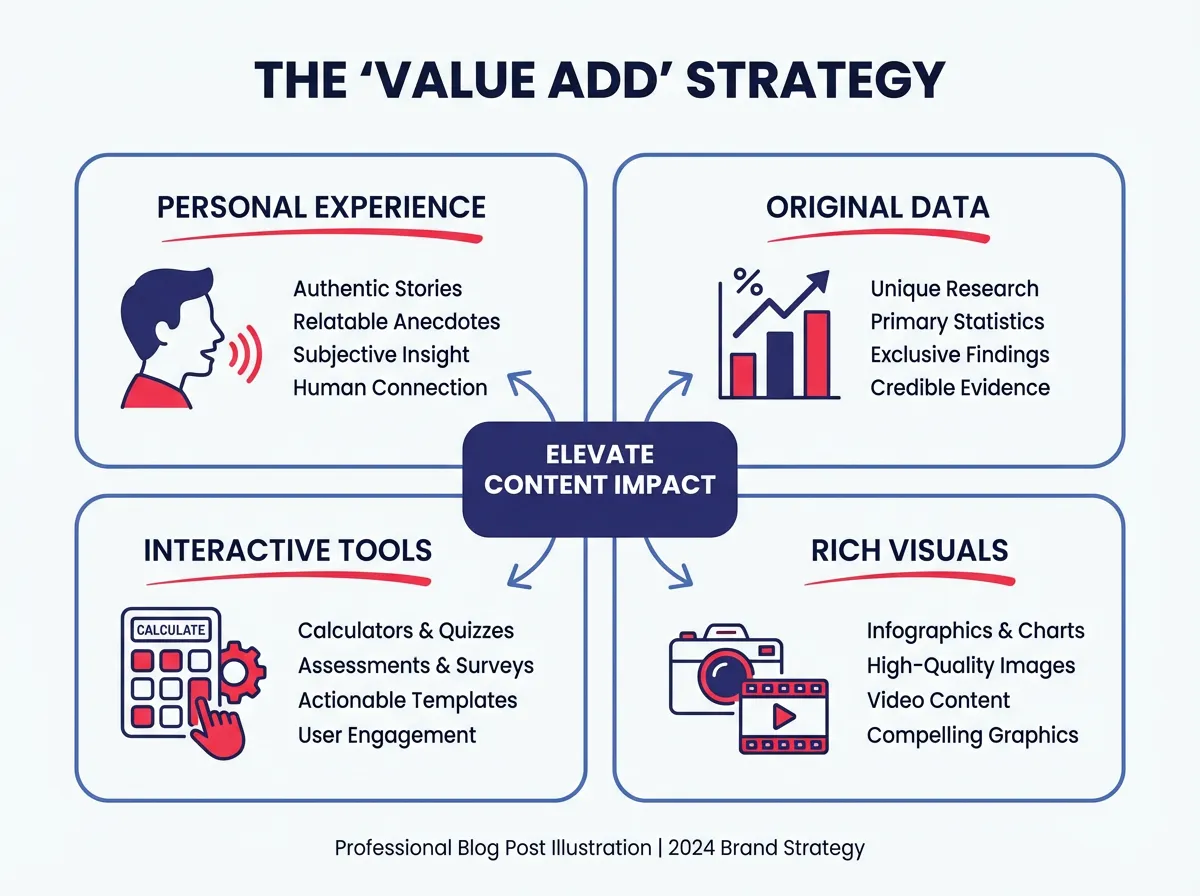
For queries where you want to fight for the click, you must offer something the AI cannot. If the AI gives a summary, you must give the deep dive. Ask yourself: What can I provide that a two-sentence AI answer cannot replicate?
- First-Hand Experience: Use personal stories ("I tested this product for 30 days…"). AI cannot experience things. Google's E-E-A-T framework specifically rewards "Experience" — meaning lived, real-world perspective.
- Unique Data and Original Research: Publish surveys, proprietary benchmarks, or analysis that cannot be found elsewhere. Original data is the most citation-worthy and click-worthy content you can produce.
- Tools and Interactivity: Calculators, quizzes, interactive maps, and downloadable templates. An AI can explain the BMI formula, but it cannot provide a live calculator where you input your numbers and get an instant result.
- Rich Visuals: High-quality original photos, diagrams, infographics, and video walkthroughs give users a reason to visit your actual page rather than read the AI's text-based summary.
Step 5: GEO — Generative Engine Optimization
If traditional SEO is the practice of ranking in Google's ten blue links, Generative Engine Optimization (GEO) is the practice of becoming the source that AI systems cite when they generate answers. GEO is the most important new discipline in search marketing in 2026, and it extends beyond Google AI Overviews to include ChatGPT Search, Perplexity, Gemini, and any other AI model that retrieves live web content. Our AI SEO services are built around exactly this discipline.
GEO differs from traditional SEO in a fundamental way: instead of optimising for ranking position signals like backlinks and keyword density, you are optimising for citation worthiness — the signals that make an AI retrieval model say "this passage is authoritative and relevant enough to include in my generated answer."
The key GEO principles to implement immediately:
- Entity Clarity: Be explicit about who you are, what you do, and who you serve. Name your company, your authors, your location, and your specialisations clearly in your content and your schema markup. AI systems build "knowledge graphs" from explicit entity information; vague "we help businesses grow" copy is invisible to them.
- Third-Party Validation: GEO rewards external corroboration. Get your brand mentioned in industry publications, news sites, and credible directories. When multiple high-authority sources confirm a fact about your brand or endorse your expertise, AI models weight you more heavily as a citation candidate.
- Passage-Level Optimisation: AI retrieval systems evaluate individual passages, not entire pages. Each section of your content should be able to stand alone as a complete, authoritative answer. If you have a section that is 400 words of preamble and context with the actual answer buried at the end, the AI will skip it.
- Content Freshness Signals: Update your most important pages regularly — not just the date stamp but the actual information, statistics, and examples. AI systems that use real-time retrieval (like Perplexity and Google AI Overviews) reward recency.
- Cross-Platform AI Presence: Track where your brand appears across AI platforms, not just Google. Tools now exist to monitor how often your brand is cited in ChatGPT, Perplexity, and Gemini responses. This "AI share of voice" metric is becoming as important as traditional organic ranking position.
Step 6: Schema Markup and Structured Data
Schema markup has moved from "nice to have" to a core technical requirement for surviving the AI search era. Structured data gives AI systems explicit, machine-readable context about your content — what type of content it is, who wrote it, what entities it discusses, and what questions it answers. Without schema, AI models must infer all of this from your prose, and they will often get it wrong or simply skip your page in favour of a better-structured competitor.
Data from 2026 shows that sites with comprehensive schema markup appeared in 47% more Perplexity AI responses than competitors publishing identical content without structured data. For Google AI Overviews specifically, schema implementation has been shown to recover 45% or more of traffic lost to AI Overview displacement, with results typically visible within 30–60 days of implementation.
The schema types that matter most for AI citation optimisation:
- Article / BlogPosting: Signals content type, authorship, publication date, and modification date. Essential for any editorial or informational content.
- FAQPage: Directly maps your question-and-answer sections into a format AI systems can extract and cite with precision. This is arguably the highest-value schema type for AI Overview citation.
- HowTo: For step-by-step instructional content, HowTo schema makes each step machine-readable and highly citable.
- Person / Organization: Establishes author identity and organisational credibility — directly supporting E-E-A-T signals that AI models use to evaluate source trustworthiness.
- Product / Review / AggregateRating: For commercial pages, these schemas protect you from AI Overview displacement by signalling purchase-intent content that AI typically does not summarise.
A full technical schema implementation guide is beyond the scope of this article, but if you need hands-on help, our team at Relevant Audience provides technical SEO audits that include schema architecture planning tailored to your specific site and industry.
Step 7: Shifting Your Keyword Focus
If a specific set of keywords has become a "zero-click wasteland" due to AI Overviews, it may be time to cut your losses strategically. There is no point in spending content production resources fighting for a keyword that generates 10,000 impressions but only 60 clicks — especially if those clicks will decline further as AI Overviews become more prevalent.
The Bottom-Funnel Pivot
Reallocate your content budget toward the bottom of the funnel. These are the commercial and transactional keywords we discussed in Step 3.
Instead of writing another article on "What is CRM software?" — which AI answers perfectly — write "CRM software comparison for dental clinics with 5–20 staff." This is specific, high-intent, and requires a human perspective and industry knowledge to answer convincingly. AI cannot produce a genuinely useful comparison for that level of niche specificity without citing a source that has actually done the research.
Use keyword research tools to identify long-tail queries in your niche. These specific, multi-word queries are often too nuanced for a generic AI summary to address satisfactorily. They have lower search volume, but conversion rates are significantly higher — and they are far less likely to trigger an AI Overview in the first place.
Additional keyword categories that remain resilient to AI Overview displacement in 2026:
- Opinion-based queries: "Is X worth it?", "Best X for Y in [specific context]" — these require genuine subjective evaluation that AI hedges on.
- Local and hyper-specific queries: "SEO agency Bangkok", "best contractor Chiang Mai" — local intent queries see AI Overviews rarely and users need to click to find actual businesses.
- Comparison queries with complexity: "X vs Y vs Z for [specific use case]" — detailed multi-option comparisons where a table-driven deep dive adds more value than a summary.
- Community and experience queries: "Reddit best X", "forum recommendations Y" — users are explicitly seeking human opinions, not AI synthesis.
Step 8: The Brand Presence Play
We need to redefine what "success" looks like in 2026. For years, success was measured in sessions and pageviews. In the AI search era, we need to value Brand Visibility alongside traffic volume.
Even if a user does not click your link, seeing your brand name cited in an AI Overview has measurable value. It is the "Billboard Effect" applied to search — a form of brand recall reinforcement that is real but harder to track in GA4.
Imagine a user searching "best cybersecurity practices for small businesses." The AI Overview generates five bullet points and cites your company as the source for points two and four. The user reads and leaves without clicking. But three weeks later, when that user evaluates cybersecurity vendors in a team meeting, your brand name is familiar. They search for you directly. That branded search does not show up in your organic traffic report as an AI Overview conversion — but it is one.
Therefore, for your core brand topics — the service areas or expertise categories you want to be known for — you should actively fight to be cited in AI Overviews, even if the direct click-through rate appears low. Being absent from AI-generated answers on your core topics means your competitors occupy that mental real estate instead.
Track branded search volume in Google Search Console as a secondary KPI alongside organic clicks. A growing branded search trend in the context of declining informational traffic often signals that your AI citation strategy is working.
AI Overview Impact by Query Type: A Comparison
| Query Type | AI Overview Frequency | Avg. CTR Impact | Industry Examples | Recommended Strategy |
|---|---|---|---|---|
| Informational | ~90% | −47% to −61% | Health, Finance, Legal, Tech | Optimise for citation (GEO) |
| Commercial Research | ~8–15% | −10% to −25% | SaaS, Insurance, Travel | Add unique data, comparison tables |
| Transactional | ~4% | −5% or less | E-commerce, Local Services | Strengthen product/local SEO |
| Navigational | <1% | Minimal | Brand searches, login pages | Build brand awareness campaigns |
| Local / Near Me | ~5% | −5% or less | Restaurants, Clinics, Contractors | Optimise Google Business Profile |
The 90-Day Recovery Plan
You have the knowledge; now you need a concrete plan. Here is a three-month roadmap to adapt to AI Overviews traffic loss, ordered by impact priority.
Month 1: Audit and Diagnose
- Week 1: Pull your Search Console performance data from May 2024 to present. Filter by page, sort by impressions, and identify the exact pages that have lost the most clicks. Look for the AI Overview signature: stable or growing impressions alongside falling CTR.
- Week 2: Run your top 50 traffic-driving keywords through an SEO platform (Semrush or Ahrefs) to confirm which ones now trigger AI Overviews. Cross-reference with PAA questions on those SERPs using AlsoAsked.com.
- Week 3: Categorise every affected page by query intent — informational, commercial, transactional, or navigational. This categorisation drives every strategic decision in Month 2.
- Week 4: Run a technical health check. Confirm that your traffic issues are not actually caused by a crawl error, indexing problem, or Core Web Vitals regression. A full SEO audit at this stage prevents you from misdiagnosing an AI problem when the actual issue is technical.
Month 2: Optimize and Restructure
- Week 1–2: Take your top 10 at-risk informational pages. Restructure the opening of each section to lead with a direct 2–4 sentence answer. Rewrite H2 and H3 headings as questions mirroring PAA data. Implement FAQPage schema on all of them. Ensure each page has a named author with a visible bio and credentials.
- Week 3–4: Take your top 10 commercial pages. Add one human-specific element to each: a video walkthrough, a comparison table built from your own testing, a personal case study, or a proprietary data point. Make these pages un-summarisable — something the AI cannot adequately replace.
Month 3: Expand and Pivot
- Week 1–2: Conduct new keyword research targeting opinion-based, comparison, and bottom-funnel queries in your niche. Look specifically for terms that AI Overviews do not appear on — these represent protected traffic opportunities. Prioritise local or hyper-specific angles where your geographic or industry knowledge is an advantage.
- Week 3–4: Publish 2–4 new pieces of content targeting these resilient keywords. Set up AI citation monitoring using available tools to begin tracking how often your brand appears in AI-generated answers across Google, ChatGPT, and Perplexity. Review your branded search trend in Search Console — this is your leading indicator that the strategy is working.
Key Takeaway: The brands winning in 2026 are not fighting AI Overviews — they are feeding them. Structure your content so that AI systems quote you, build E-E-A-T signals so that AI systems trust you, and invest in interactive and original-data content that users have to click through to actually use. Do all three simultaneously and you will recover lost traffic while building a more durable, citation-based authority than you had before.
Navigating the Future
The search landscape has changed fundamentally, and it will continue to change. Less than one third of Google searches now result in a click to any external website. That is an extraordinary shift from the environment that existed even three years ago. But the internet did not die when Featured Snippets were introduced, it did not die when the mobile-first index rewrote SEO best practices, and it will not die now.
The winners in this environment share a common trait: they stopped measuring the wrong things. Traffic volume is a vanity metric if it is driven by informational content that has a near-zero conversion rate. The AI Overview era is forcing a productive reckoning with that reality. Fewer visitors who are more qualified and more engaged — visitors who clicked because they needed something only your page could provide — are worth more than vast numbers of one-second bounces from definition queries.
Focus on building a brand that people search for by name. Focus on producing the original research, the detailed comparisons, and the experience-driven content that software cannot replicate. Focus on earning citations in AI answers so that even when users do not click today, they remember your name tomorrow. And invest in the technical infrastructure — schema, E-E-A-T, passage-level optimisation — that makes your content legible and citable across the full landscape of AI search tools that your audience is increasingly relying on.
If you want a team to help you build this strategy and execute it for your specific industry, our content marketing and SEO services are designed for exactly this environment.
Frequently Asked Questions
How do I know if AI Overviews are specifically causing my traffic drop?
The diagnostic signature is: impressions hold steady or increase in Google Search Console while clicks and CTR fall sharply. If both impressions and clicks are dropping together, the problem is more likely a ranking loss from an algorithm update, not AI Overviews. Confirm by manually searching your top keywords in a private browser and checking whether a large AI summary appears at the top of the results.
Can I opt out of having my content appear in Google AI Overviews?
Yes. You can use the nosnippet or max-snippet: 0 meta robots directive to prevent Google from using your content in snippets, which includes AI Overviews. However, this is generally not advisable because being cited in an AI Overview — even without a direct click — builds brand awareness and drives indirect traffic through branded searches. Opting out removes that benefit entirely.
What types of content are most protected from AI Overview traffic loss?
Transactional, commercial, and local-intent content is the most protected. E-commerce product pages, service landing pages with pricing, local business pages, original research reports, interactive tools, and detailed comparison guides with personal testing data are all highly resilient. AI Overviews appear on fewer than 5–8% of these query types. Informational "definition" and "how does X work" pages carry the highest risk.
What is Generative Engine Optimization (GEO) and how is it different from SEO?
Traditional SEO optimises content to rank in Google's list of blue links by building backlinks, keyword relevance, and technical authority. GEO optimises content to be cited by AI-generated answers — in Google AI Overviews, ChatGPT, Perplexity, and Gemini — by improving entity clarity, structured data, passage-level answer quality, and author credentiousness. In 2026, you need both: SEO to rank and GEO to be cited.
How important is schema markup for recovering AI Overview traffic?
Extremely important. Research in 2026 shows that sites with comprehensive schema markup appear in 47% more AI-generated responses than competitors with identical content but no structured data. FAQPage schema is particularly high-value because it maps your Q&A content directly into a format that AI extraction systems can use with precision. Schema implementation typically shows measurable results within 30–60 days.
How long does it take to recover traffic after implementing these strategies?
Expect a 60–120 day recovery window for most sites. Schema changes and content restructuring for AI citation tend to show results the fastest — sometimes within 30 days. New content targeting bottom-funnel and long-tail keywords takes longer to rank and gain traction, typically 60–90 days for meaningful traffic. Brand visibility improvements via AI citation are harder to measure but accumulate over time through branded search growth.
Should I diversify away from Google search traffic entirely?
Diversification is wise and should be part of any long-term strategy, but abandoning SEO entirely would be a mistake. Google still processes billions of searches daily and remains the largest single referral traffic source for most websites. The correct response is to expand your traffic channels — email marketing, social, video, paid search, AI platform optimisation — while simultaneously adapting your organic search strategy for the AI era, rather than treating them as either/or choices.
What metrics should I track to measure recovery from AI Overviews traffic loss?
Track five metrics in parallel: (1) organic clicks and CTR per page in Search Console, (2) branded search volume growth as a proxy for AI citation awareness, (3) conversion rate from organic traffic — fewer but more qualified visitors should convert better, (4) AI citation frequency using monitoring tools across Google, ChatGPT, and Perplexity, and (5) revenue or leads from organic, not just traffic volume. If conversions hold or grow while traffic dips, you are in better shape than raw traffic numbers suggest.

![[How to] How to Analyze Competitor Keywords in 5 Advanced Steps](/_next/image/?url=%2F_next%2Fstatic%2Fmedia%2FCustomer%20Service%20Process%20Automation-1.3vk-sxqhjaxw4.webp&w=3840&q=75)