If your traffic cratered in late June and you've been refreshing Google Search Console every ten minutes, you're not imagining things. But you might be pinning the blame on the wrong date. This isn't one update. It's the last stage of a three-part enforcement rollout that started weeks earlier, and most people are only looking at the ending.
Everyone's treating the June 2026 Google update like a single, isolated event. It wasn't. The rules that got your site penalized were written weeks before the drop ever showed up in your reports. June is the cleanup crew, not the lawmaker. If you actually want to understand what happened, you need to rewind to mid-May, not just stare at your June 24-26 numbers.
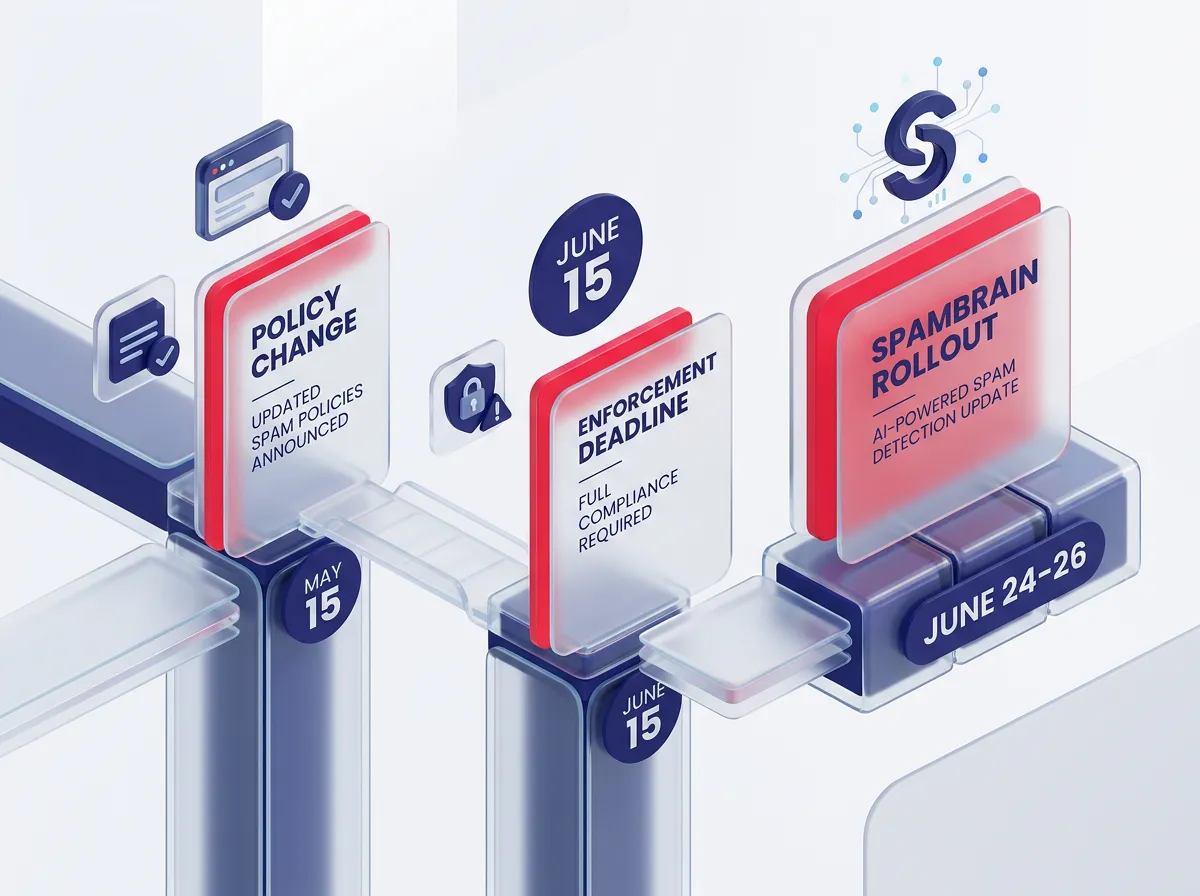
Here's the short version: Google changed its policy on AI-answer manipulation on May 15. It set an enforcement deadline for certain UX patterns on June 15. Then, on June 24-26, its spam system swept through and applied both sets of rules at scale. Your traffic drop is step three in a sequence, not a random punishment out of nowhere.
- The Three-Part Enforcement Timeline: May 15, June 15, and the June 24-26 Spam Update
- Diagnosing the Damage: GSC Checks, Mount AI, and Realistic Recovery
The Three-Part Enforcement Timeline: May 15, June 15, and the June 24-26 Spam Update
This timeline isn't trivia. It changes what you should actually be fixing. Look only at June 24-26 and you'll spend weeks patching symptoms that aren't the real cause.
May 15: The Policy Change on AI-Answer Manipulation
On May 15, Google quietly updated its guidance on what counts as gaming AI Overviews and AI-driven citations. No press release, no big announcement. Just a change buried in documentation that most people never read until it costs them.
The behavior it targeted is pretty specific: pages built to get quoted by AI systems rather than to actually answer someone's question. Think answer-shaped text stuffed in for citation bait, structured data that promises more than the page delivers, and the same claim rewritten forty different ways across forty different pages just to improve the odds of getting picked up.
Google has a name for part of this: recommendation poisoning. That's when a site tries to steer AI-generated recommendations through repetition and structural tricks instead of earning them through actual authority or accuracy. If your content marketing strategy leaned on this kind of AI-answer bait, May 15 is the day the rules changed under you, whether you noticed or not.
June 15: The Back-Button and UX-Spam Deadline
A month later, Google drew a hard line on something related but different: UX patterns designed to trap people instead of serve them. The classic example is the back-button trap, where a page reloads content, redirects you somewhere else, or blocks the browser's back function just to fake more time-on-page or squeeze out extra pageviews.
June 15 wasn't when these tactics suddenly became against the rules. It was the deadline Google gave sites to fix them before enforcement started. If you got a warning, or should have known better from existing guidance, you had roughly a month to clean house. Most site owners never saw that warning, because they weren't looking for one.
June 24-26: SpamBrain's Mechanical Cleanup
This is the part everybody felt. Between June 24 and June 26, Google's SpamBrain system ran a global, multi-language enforcement pass based on the two rule changes above. SpamBrain doesn't write policy, it just executes it, algorithmically, at scale, with no human looking at your individual pages first.
That's the key thing for diagnosis. The drop you're seeing in your dashboard on those dates isn't a new judgment call. It's the mechanical execution of a decision Google already made weeks before. SpamBrain flagged the AI-manipulation and UX-spam patterns, then applied ranking suppression across every affected site at once, in every language it supports.
So if your site got hit, whatever "offense" happened, it happened before June even started. The update just made it visible.
Diagnosing the Damage: GSC Checks, Mount AI, and Realistic Recovery
Once the timeline makes sense, the next question is whether you actually got hit, and how badly. This part doesn't require guessing.
Use Search Console to Isolate the June 24-26 Window
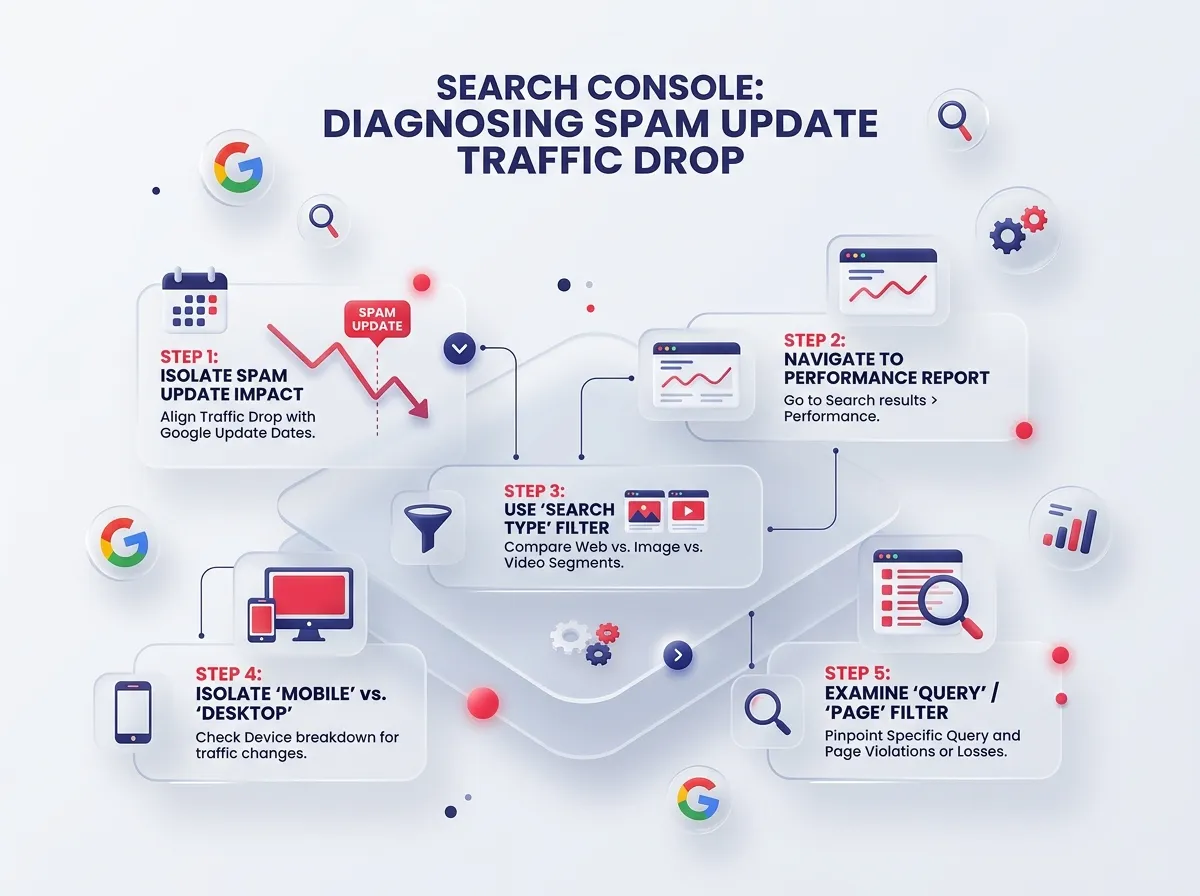
Open SEO audit Search Console and compare June 24-26 directly against the two weeks before it. Don't just eyeball the main traffic chart. Break it down by:
- Date range, comparing that exact window against your usual baseline
- Country, since SpamBrain went global but hit some regions harder than others
- Page type or URL pattern, to see if the drop clusters around specific templates, like AI-generated hub pages or thin comparison content
A sitewide, sudden drop hitting almost every page type at once looks like a spam action, not normal core-update noise. Core updates tend to create slow, uneven movement across content categories over days or weeks. SpamBrain enforcement usually looks like falling off a cliff, not sliding down a slope.
Check your Manual Actions report while you're at it, ideally as part of a broader SEO audit. Most sites caught in this rollout won't see anything listed there, because this is algorithmic suppression, not a human-reviewed penalty. That empty report doesn't mean you're fine. It just means the path back looks different.
The Mount AI Warning: When Scaling Content Becomes a Liability
There's a pattern showing up across a lot of affected sites that deserves its own name: Mount AI. It's what happens when a site scales up AI-generated content fast, hundreds or thousands of pages in a short window, then gets hit with a sudden, total crash instead of a slow bleed.
Normal content-quality problems tend to erode traffic gradually over months. Mount AI sites don't. They look totally fine right up until enforcement hits, then the bottom falls out overnight. The