
TL;DR
- Google's spam policies name exchanging money, goods or services for links, or for posts that contain links, as link spam when it is done for ranking purposes.
- Paid links are allowed only when the link carries rel="sponsored" or rel="nofollow"; Google's Qualify your outbound links page says sponsored is the preferred value for ads and paid placements.
- Google detects violations with automated systems and, as needed, human review that can lead to a manual action; violating sites may rank lower or drop out of results.
- Guest posts, advertorials and press releases with optimized anchor text that pass ranking credit are named as link spam, so the label on a paid link does not make it safe.
- If links were bought in the past, check the Manual actions report, audit the links, ask for removal or rel="sponsored", and keep disavow for manual actions or links that cannot be removed.
Buying backlinks to boost rankings is link spam under Google's own policy. The document Spam policies for Google web search lists exchanging money for links, or for posts that contain links, as a violation when it is done for ranking purposes. The only compliant option is to add rel="sponsored" or rel="nofollow", which tells Google the link should not pass ranking credit.
Link-selling offers usually lead with a high DR or DA number, a price per post and the words "permanent dofollow". This article is a risk explainer only. It contains no list of sellers and no advice on how to buy links without getting caught, because according to Google's documentation there is no way to buy links for ranking purposes that does not break the policy. Every policy statement here comes from two Google Search Central pages, Spam policies for Google web search and Qualify your outbound links to Google, both accessed on 27 November 2026.
Why link offers keep arriving, and what to ask before you reply
Links from other websites are still one of the signals Google uses to understand which pages are trustworthy, so demand for links never goes away. Sellers often lead with easy numbers such as "DR 50+" or "tens of thousands of visitors". These numbers come from third-party SEO tools, not from Google, and they can be inflated by pointing large volumes of links at the seller's own sites.
Before you answer any offer, ask one question first: does this link exist because someone wants to cite us, or because money changed hands? If money changed hands, Google's policy is clear that the link must carry rel="sponsored" or rel="nofollow", and once it does, the link no longer has the ranking effect the seller is advertising. An offer that promises a ranking-boosting dofollow link in return for payment is therefore an offer to break the policy outright.
How Google treats bought links
The definition of link spam in Google's policy
The Spam policies for Google web search page defines link spam as creating links to or from a site primarily for the purpose of manipulating search rankings. The first example the document gives is buying or selling links for ranking purposes, which includes the following cases.
- Exchanging money for links, or for posts that contain links
- Exchanging goods or services for links
- Sending someone a product in exchange for them writing about it and including a link
Beyond direct buying and selling, the document lists other patterns that count as link spam: excessive link exchanges or partner pages built purely for cross-linking; using automated programs or services to create links; requiring a link as part of a contract or terms of service without letting the content owner qualify the outbound link; text ads or text links that do not block ranking credit; advertorials or native advertising where payment is received for articles that include links that pass ranking credit; links with optimized anchor text in articles, guest posts, or press releases distributed on other sites; low-quality directory or bookmark site links; keyword-rich, hidden or low-quality links embedded in widgets distributed across various sites; widely distributed links in the footers or templates of various sites; forum comments with optimized links in the post or signature; and creating low-value content primarily to manipulate linking and ranking signals.
Notice that this list does not care what the service is called. Labels such as guest post, review article, PR or sponsored content do not make a link any safer. What Google looks at is whether something was given in return for the link, and whether the link passes ranking credit.
rel="sponsored" is the correct route when you pay
The same document says Google understands that buying and selling links is a normal part of the economy of the web, for advertising and sponsorship purposes, and that it is not a violation of its policies as long as those links are qualified with a rel="nofollow" or rel="sponsored" attribute value on the link tag.
The Qualify your outbound links to Google page expands on this as follows.
- rel="sponsored" is for links that are advertisements or paid placements, commonly called paid links. The page notes that nofollow was previously recommended for these links and is still an acceptable way to flag them, but sponsored is preferred.
- rel="ugc" is recommended for links inside user-generated content, such as comments and forum posts. Site owners may remove it for members who have consistently made high-quality contributions over time.
- rel="nofollow" is for cases where the other values do not apply and the site owner would rather Google not associate the site with, or crawl, the linked page from that site.
- Several values can be combined, separated by a space or a comma, for example rel="ugc nofollow".
The page also says links marked with these attributes will generally not be followed, although the linked pages may still be found through other means, such as sitemaps or links from other sites. In practice this means that if you pay for an article and do it the compliant way, with rel="sponsored", the link is worth something for brand visibility and for the visitors who click it, but it is not meant to pass ranking credit, and ranking credit is what link sellers are selling. RA has already published a separate article on link attributes and how to use each one in day-to-day work, so this article does not repeat that material.
How Google detects and handles violations
The Spam policies for Google web search page states that Google detects policy-violating practices both through automated systems and, as needed, through human review that can result in a manual action. Sites that violate the policies may rank lower in results or not appear in results at all. The document also says its policies cover common spam practices, but Google may act against any type of spam practice it detects.
For a site owner this means two kinds of outcome. In the first, automated systems act on the links or the site, and nothing appears in the Manual actions report, because that report lists only actions taken after human review. In the second, a human reviewer issues a manual action, which the site owner sees in the Manual actions report in Search Console, and which has to be fixed before a reconsideration request is filed. Both carry a cost. The first wastes the budget. The second wastes the budget, the time spent cleaning up, and the traffic lost while the problem is being fixed.
Six common link-selling patterns and their warning signs
Link offers can arrive by email, through Facebook groups, on freelance platforms, or from sites that publish a price list for "article placement". The table below groups six patterns, with signals you can check yourself and a risk level relative to Google's link spam policy. The risk level is a comparative judgement based on the wording of the policy, not a figure published by Google.
| Pattern | Signals you can check | Risk level |
|---|---|---|
| PBN (private blog network) | Several thin sites with scattered topics; some run on expired domains that used to belong to other sites | Very high: link spam, and possibly expired domain abuse |
| Guest post farm | A "write for us" page with prices, an outbound link in every article, no real readers | High: guest posts with optimized anchors are named in the policy |
| Sitewide footer or sidebar links | The same link appears on every page and has nothing to do with the site's content | High: links in footers or templates distributed across sites are named in the policy |
| Web 2.0 and low-quality directories | Free blogs built only to hold links; directories that accept any site | Medium to high: low-quality directory and bookmark links are named in the policy |
| Hacked sites with injected links | Hidden links in old pages on agency or abandoned sites | Very high: hacked content and link spam at the same time |
| Sponsored article without rel | The article is labelled as advertising or has a published price, but the link is dofollow | High: advertorials that pass ranking credit are named in the policy |
How PBNs work, and why Google treats them as a violation, is covered in RA's existing article on what a PBN is. As for hacked sites, the Spam policies for Google web search page defines hacked content as any content placed on a site without permission because of vulnerabilities in the site's security, and notes that hackers may add hidden links or hidden text. Anyone who buys links from this kind of seller is directly benefiting from a break-in on someone else's website. On expired domains, the document defines expired domain abuse as buying an expired domain name and repurposing it primarily to manipulate search rankings with content that provides little to no value to users.
How to check whether a site is a link farm
Even if you never buy links, marketing teams are sometimes asked to assess sites that invite them to publish articles, collaborate on content or swap promotion. Use this list to screen out sites that look like link-selling operations before spending more time on the conversation.
- Real traffic compared with DR: a site with a high DR but almost no search traffic, or a traffic graph in steady decline, can be a site that has pumped links into itself to sell them. Look at the trend and at the queries the site actually ranks for, not at a single number.
- Outbound link ratio: if almost every article links out to unrelated business sites, using exact-match keyword anchors, that is the profile of a site that exists to sell links.
- Random topics: one site carries articles on casinos, beauty clinics, accounting services and travel side by side, with no editor and no clear content direction.
- A "write for us" page with prices: putting a price on an article with a dofollow link is selling links for ranking purposes under Google's definition.
- No real author or contact details: no author names, no about page, and contact information that is only a form and a free email address.
- Broken domain history: a domain that used to belong to a company or public body and then one day turned into an article aggregator may be an expired domain that was bought and reused.
- Thai content that reads like machine translation: stiff sentences, repeated spelling mistakes and long articles that answer nothing can be a sign of content produced to hold links.
For a detailed guide to choosing a link provider, RA's existing article on selecting a backlink service covers that topic. This article stays focused on the risk signals under Google's policy.
Buying backlinks compared with digital PR
The safer alternative to buying links is to give media outlets and other sites their own reason to cite the brand, which is the core of digital PR. The table compares the two approaches on the dimensions a business owner should care about.
| Dimension | Buying backlinks | Digital PR |
|---|---|---|
| Risk under Google's policy | High: if the link passes ranking credit, it fits the link spam definition | Low: links come from editorial decisions, with no payment for the link |
| Link lifespan | Uncertain: link-selling sites can be shut down or delete articles at any time | Usually long, for as long as the news article stays online |
| Brand mentions | Usually just a link inside an article nobody reads | The brand name appears in a news or analysis context, sometimes even without a link |
| Referral traffic | Close to none, because the site has no real audience | A real chance of interested readers clicking through |
| Brand credibility | Risk of being associated with low-quality sites | Reputation gained from being cited by outlets people recognise |
The honest downside of digital PR is that you cannot control the outcome fully. The outlet decides whether to write about you and whether to link, and the process takes longer than transferring money and getting a link straight away. RA has already published separate articles on how digital PR differs from traditional PR and on how SEO PR earns links worth having. The next section is only a short summary of the steps for the Thai market.
A six-step digital PR playbook for the Thai market
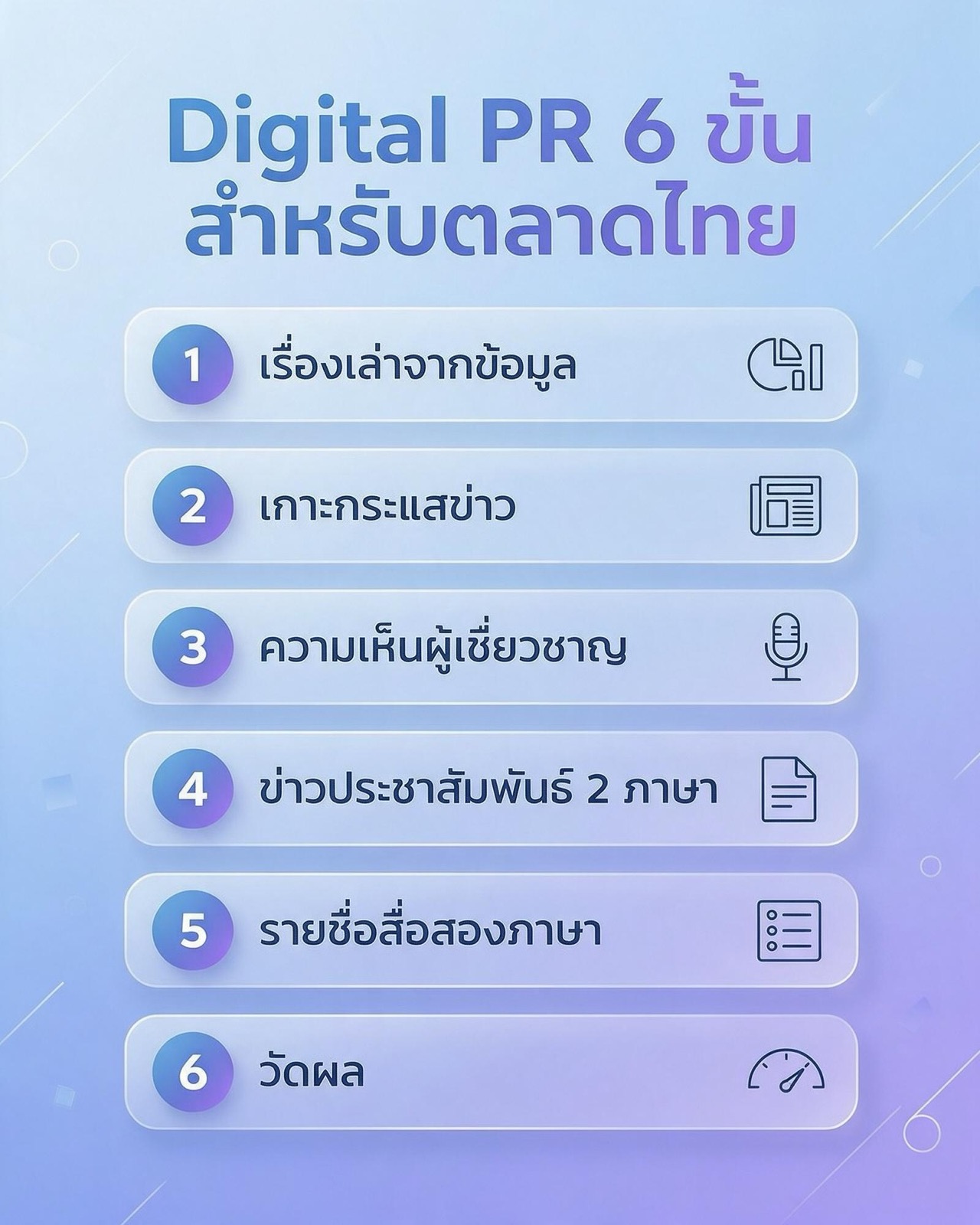
1. Data-led stories
Journalists want stories with new data. Data the brand already holds, such as search trends in its own product category, anonymised usage statistics, or a survey run with a proper method, can be turned into a story an outlet wants to use. The key is that the data must be real, verifiable, and published with a clear explanation of how it was collected. A survey with too small a sample or leading questions puts both the brand's credibility and its relationship with journalists at risk.
2. Newsjacking
Newsjacking means offering a view or data point connected to a story that is already in the news, such as a change in law, a platform policy update or an industry event. What matters is speed and relevance. Attaching the brand name to the end of a story adds nothing; the brand needs a genuinely new point, and it should stay away from sensitive news such as disasters or loss of life.
3. Expert commentary
Thai journalists and reporters at English-language outlets in Bangkok need sources who can explain complex topics clearly. Prepare executives or in-house specialists to comment on subjects they genuinely know, with a short bio, a photo and a list of topics they can speak on, and send these to newsrooms in advance. When a story in that area breaks, journalists will know whom to call.
4. Bilingual press releases
The Thai market has both Thai-language and English-language media, so a press release written in one language cuts out the other group of outlets. The Thai and English versions should each be written for their own readers rather than translated word for word. Remember too that under Google's policy, links with optimized anchor text in press releases distributed on other sites count as link spam. A release sent through a press release distribution service should therefore aim at reach and at being picked up by journalists, not at being a place to put links. For brands that need to reach media outside Thailand, there is an international press release service.
5. A bilingual media list
A good media list is not a long list of email addresses. It is a list of journalists and editors who actually cover the category, grouped by media type: Thai-language business media, English-language media in Bangkok, trade publications, and online outlets with niche readerships. Read each journalist's recent work before getting in touch, and pitch stories that match what they already write about.
6. Measurement
Measure what actually happened: the number of outlets that published, the links gained and the attributes on those links, brand mentions even without a link, the traffic from each outlet in Google Analytics, and changes in branded queries in Search Console. Good measurement tells you which kinds of story work with which groups of media, and that feeds the plan for the next round.
If you have already bought links, what to do
Some websites have bought links in the past, sometimes without the owner knowing, because a previous SEO provider handled it. These are the steps to take.
- Open the Manual actions report in Search Console first. If there is a manual action related to links, it will show up there. If there is none, there has been no penalty from human review, but that does not mean those links have any value.
- Run a backlink audit. Collect the list of links from Search Console and from SEO tools, and separate links that were paid for or exchanged from links that occurred naturally. A full SEO audit usually includes this step.
- Ask for removal or for rel="sponsored". Where you can still reach the site owner, getting the link marked as sponsored brings it into line with the policy.
- Use disavow only when needed. The disavow tool fits cases where there is a manual action, or where there are many paid links that cannot be removed. Disavowing without a reason can remove good links too. How to write the file, and when not to use it, is already explained in RA's article on what disavow is.
- Stop buying more, and move the budget to work that gives people a reason to link, such as content built on your own data, or digital PR.
If you have received a manual action, fix the problem completely before filing a reconsideration request, and explain what you did.
The Thai market: what site owners should know
Link selling can be disguised as ordinary marketing, such as "review articles", "online PR" or "monthly SEO packages" where part of the work is placing links on network sites. A few general observations follow.
- Some news and lifestyle sites accept paid articles. That is fine if the content is labelled as advertising and the links carry rel="sponsored". The problem is offers that guarantee the link will be dofollow.
- Businesses that sell to foreign customers in Thailand, or market both in Thailand and abroad, have an extra digital PR option in English-language media in Bangkok.
- A good SEO plan for the Thai market starts with strong content and site structure. External links have more effect when the destination page is valuable enough for people to want to cite it.
FAQ about buying backlinks
If I buy a sponsored post and it carries rel="sponsored", does it still help?
It helps with brand visibility and traffic, but not with rankings, because the Qualify your outbound links to Google page says links marked with these attributes will generally not be followed. Paying for a sponsored post should therefore be judged on readership and audience fit, not on DR.
Do PBNs still work?
PBNs break Google's policy, because they create links to manipulate rankings, which is the definition of link spam, and if they run on expired domains they may also count as expired domain abuse. Short-term results some people see do not make them safe, because Google detects violations through both automated systems and human review.
When is disavow necessary?
Disavow is necessary when there is a manual action related to links, or when you know there are many paid or exchanged links that cannot be removed. For an ordinary site with some odd links that appeared naturally, disavow is usually unnecessary, and disavowing the wrong links can remove good ones too.
Do press releases earn dofollow links?
Links in press releases sent through distribution services should not be used for ranking purposes, because Google's policy names links with optimized anchor text in press releases distributed on other sites as link spam. The value of a press release lies in journalists picking it up and writing their own story, and a link that comes from a journalist's article is an editorial link.
How long does digital PR take?
Digital PR has no fixed timeline, because the outlet decides whether and when to publish, and the media list, relationships with journalists and data-backed stories all have to be built. A first campaign can land quickly if the news timing is right, but nobody can guarantee a number of links. If a provider guarantees a fixed number of media links, ask how those links are obtained.
Summary
The short answer to whether you should buy backlinks is no, if the goal is rankings. Google's policy counts it as link spam, and if you make it compliant by adding rel="sponsored", the link is no longer meant to pass ranking credit anyway. Money spent on buying links goes further when it funds content built on real data and digital PR work that makes outlets want to cite the brand on their own.
If you want a team that works within Google's policies to plan how to earn links from relevant media and websites, see RA's white-hat link building service, which starts by auditing the site's existing links before planning next steps.