
TL;DR
- Maximum CPL = gross profit per deal x close rate x share of profit you will spend on acquisition; monthly budget = (target deals / close rate) x target CPL.
- Google Search suits demand that already exists; Meta and TikTok create demand; LinkedIn fits B2B with a known decision-maker title; LINE fits Thai buyers who chat first.
- Diagnose low lead volume in order: tracking, impressions, CTR, form completion, lead quality, then sales response time, before adding budget.
- Under Thailand's PDPA, fully in force since 1 June 2022, lead forms should state the purpose of data collection and link a privacy policy.
Paid lead gen that works starts with two decisions: pick the channel where your customers are already searching or comparing, then set your budget backwards from the highest cost per lead (CPL) your business can actually afford. Get those two right at the start and most low-lead problems can be fixed by checking one point at a time in order, instead of guessing with more budget.
This article does not go back over the definition or the funnel structure of lead generation, which most readers already know. It goes straight to three practical jobs: choosing between Google, Meta, LinkedIn and TikTok (plus LINE), calculating a budget with a CPL formula and a worked example, and diagnosing a campaign that brings in fewer leads than it should.
What needs to be in place before you run ads for leads
Before talking about channels or money, four pieces need to be ready. If any one of them is missing, every platform you try will give you numbers you cannot read.
1. An offer worth filling in a form for
People hand over a phone number or email only when they get something back straight away: a quotation, a free assessment, a sample, a site visit, or a document they can actually use. A plain "contact us" offer usually brings the fewest leads, because the user cannot tell what they will get. Ask yourself what you would be trading your details for if you were the customer. If you cannot answer in one sentence, the offer is not clear enough yet.
2. Where the lead lands: a platform form or a landing page
Every major platform has its own form that users can fill in without leaving the app. The upside is that they are easy to complete, and some fields are pre-filled from the user's profile. The downside is that the same ease brings in more people who are not serious. A landing page on your own website gives you room to explain the offer, show reviews and filter out the wrong people before they submit, but fewer people will get to the end. There is no answer that is always right. Businesses selling high-value items that need several conversations usually benefit from a detailed page on the website, while services people decide on quickly tend to do well with platform forms.
3. Measurement that tells you where each lead came from
At minimum you need conversion tracking that fires every time someone submits a form successfully, broken down by campaign, with UTM parameters on every ad link. If all you can measure is "more people called this month," you will never know which channel deserves more budget. Test the setup by submitting a real form before the campaign goes live, then check that the conversion shows up both in the ad platform and in GA4.
4. A follow-up process once the lead arrives
A lead nobody calls back is money already spent for nothing. The sales team needs to agree on who takes leads from which channel, how many hours they have to respond, and where the result gets recorded (a CRM, a Google Sheet or LINE OA all work, as long as there is one place). That record of outcomes is what lets you calculate your close rate, which is the key input to the budget in the next section.
Choosing the right ad channel for your business
The question to ask before choosing a platform is whether your customers search for what you sell, or need to be shown it before they become interested. If people are already searching, channels that answer searches bring in leads that are closer to buying. If the market does not yet know it has the need, you need channels that create demand, and you have to accept that those leads will need longer nurturing.
Google Ads: catch people who are looking for an answer
Search Ads work from search queries. Someone typing "home solar installation price" or "SME accounting service" is telling you directly what they want. The limitation is that lead volume is capped by how many people search. You can raise the budget, but if the market only has so many searches, the extra money mostly pushes up click prices instead of bringing in more leads. For deeper setup topics such as match types and negative keywords, see our Google Ads service page.
The thing to watch on Google is queries that look related but carry a different intent, for example ones containing "free", "jobs" or "how to do it yourself", which pull in clicks that will never become customers. Review the search terms report every week during the first months.
Meta (Facebook and Instagram): create demand and reach a large audience
Meta suits products or services people can understand from an image or video, with a customer base broad enough for the system to find people likely to fill in a form. Campaigns with the Leads objective support both instant forms and sending people to a website. The system learns from the people who actually submit, so the closer the signal you send back is to a real customer, the more accurately it finds similar people. If all you send back is "someone filled in the form," the system goes looking for people who like filling in forms, which is not the same thing as people who buy.
Instagram runs on the same ad system as Facebook, but user behaviour differs. Vertical creative that looks natural in the feed usually fits Instagram better. Campaign setup details for each platform are on our Facebook Ads service and Instagram ads service pages.
LinkedIn: when the buyer's job title matters more than their interests
LinkedIn suits B2B sellers who know exactly who the decision maker is, such as a procurement manager at a factory or an HR director at a mid-sized company. The platform lets you target by job title, industry and company size, and its Lead Gen Forms pull information from the member's profile to pre-fill the form. The trade-off is a narrow audience, so expect cost per click to be higher than on other channels. Whether it is worth it depends on deal value, not click price. If one deal is worth hundreds of thousands or millions of baht, a CPL that looks expensive may still be well within what you can accept, and the formula in the next section helps answer that question.
TikTok: reach people who have never heard of you with short video
TikTok has a campaign objective for lead generation with in-app forms. Its strength is reaching people who have never heard of the brand, using videos that look more like normal content than ads. It suits consumer products, education, beauty, or services that can be explained in a few seconds. The thing to watch is that viewers are in entertainment mode, not buying mode. Leads from TikTok therefore usually need faster follow-up and a warmer message, and videos need replacing more often than on other channels because they wear out quickly.
LINE: for customers who prefer to chat first
LINE Ads can send people to add your LINE OA as a friend or to a web page, and once customers are in your LINE OA you can follow up with messages. The catch is that an "add friend" is not yet a lead until the customer sends a message or shares details, so the two numbers need to be counted separately. See how to plan these campaigns on our LINE Ads service page.
Comparison of ad channels for finding leads
| Channel | Best suited to | What to watch |
|---|---|---|
| Google Search | Services or products people already search for, when you need leads ready to buy | Volume is capped by search demand; queries with the wrong intent |
| Meta (Facebook/Instagram) | Products that can be explained visually, broad customer base | Instant forms are easy to fill in and can bring low-quality leads without screening questions |
| B2B where you know the decision maker's job title, high-value deals | Narrow audience, cost per click can be high, must be justified by deal value | |
| TikTok | Products or services that can be explained quickly in short video | Viewers are in entertainment mode; creative wears out fast |
| LINE | Businesses whose customers like to chat before deciding | Adding a friend is not a lead; measure chats separately |
Most businesses do not need to start every channel at once. A safer approach is to pick the one channel that best matches how your customers behave as the main channel, add one more as a test, and decide based on the numbers once there is enough data.
Lead generation tools worth having in your stack
Tools do not create leads by themselves, but they tell you what works and stop leads from getting lost along the way. A minimum set that works in practice looks like this:
- Each platform's own forms (Meta instant forms, LinkedIn Lead Gen Forms, TikTok's forms and the lead form asset in Google Ads), used when you want the fewest possible steps.
- A landing page that loads fast on mobile, with a short form and LINE or call buttons that work with one tap.
- Google Tag Manager and GA4 to record form submissions, call clicks and LINE clicks as separate conversions.
- Sending data back to the platforms, for example enhanced conversions for leads in Google Ads or Meta's Conversions API, so the system knows which leads became real customers.
- A CRM or lead log that the sales team actually uses. It can be CRM software or a well-structured spreadsheet, as long as it has columns for source, contact date and outcome.
A common mistake is leaving leads from platform forms sitting inside the ad system with nobody downloading them, because the form was never connected to a CRM or an email alert. Set up the connection or instant notifications from day one.
The cost of lead generation: budgeting ads with a CPL formula
There is no single figure for what lead gen costs that applies to every business, because it depends on competition in your industry, how narrow the audience is, how demanding the form is, and the season. The method that works is to calculate from your own business numbers and set a CPL ceiling before the campaign starts.
The basic formula: what CPL is and how to calculate it
CPL (cost per lead) is total ad spend divided by the number of leads in the same period.
CPL = ad spend ÷ number of leads
That number only tells you what you paid per name. The more important question is what CPL still leaves the business profitable, and that has to be worked out backwards from the sales side.
Calculating the maximum CPL your business can accept
You need three numbers: gross profit per deal, the close rate from lead to customer, and the share of gross profit you are willing to spend on acquiring a customer.
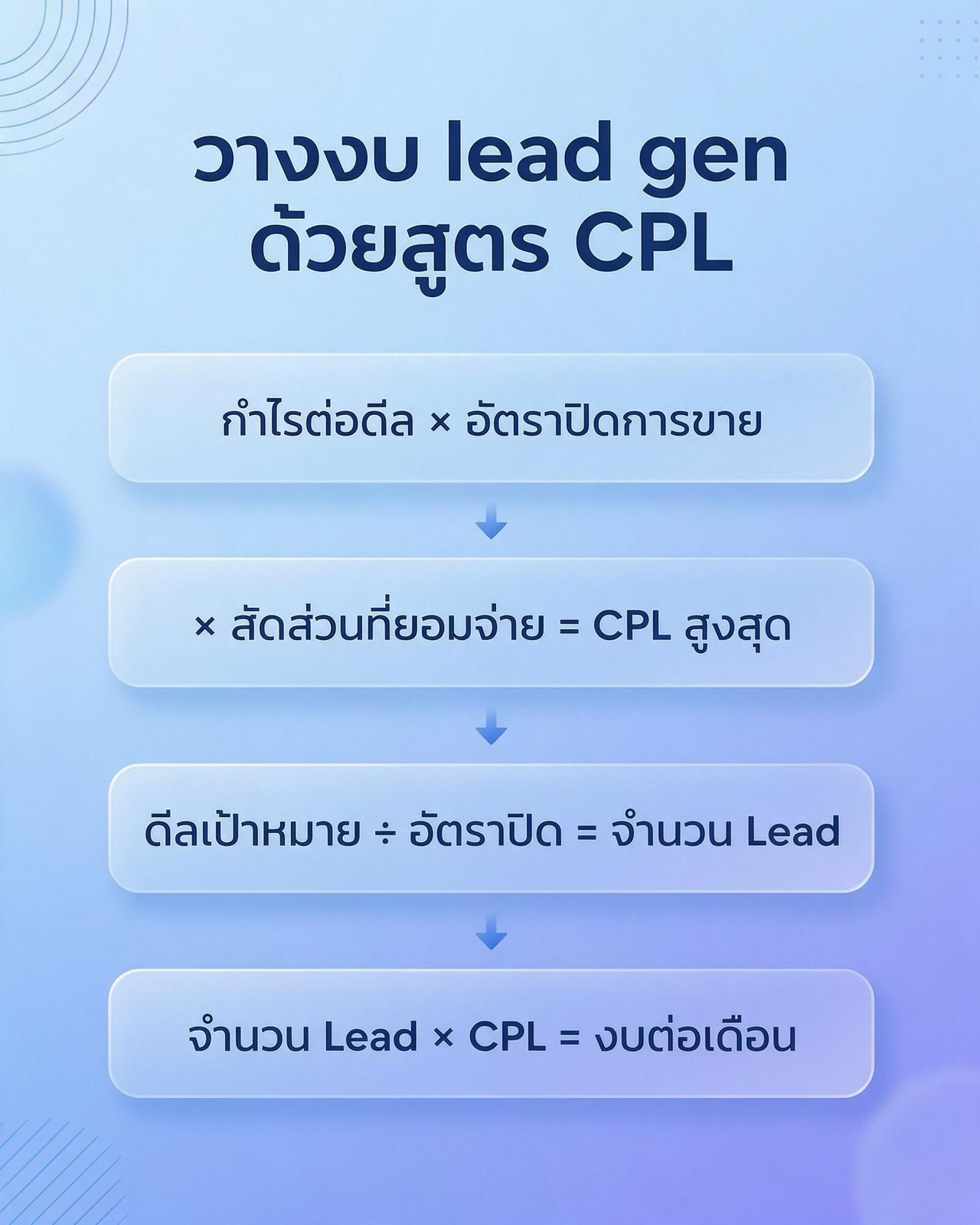
Maximum CPL = gross profit per deal × close rate × share you are willing to spend on acquisition
If you do not have close rate data yet, use what you have from existing channels, for example how many of the customers who contacted you on their own in the past six months actually bought. If you have nothing at all, start with a cautious assumption and adjust it once you have real data, one to two months after launch.
Calculating a monthly budget from a sales target
Once you have the maximum CPL, work backwards from the number of deals you want.
Leads needed = target number of deals ÷ close rate
Monthly ad budget = leads needed × target CPL
Worked example (illustrative numbers only)
Suppose an office-building cleaning company has the following figures. Every number in this example is made up for illustration and is not a market average.
- Gross profit per contract: 20,000 baht
- Close rate from leads: 10% (one customer for every 10 leads)
- Willing to spend 30% of gross profit on acquiring a customer
- Target: 8 contracts per month
Maximum CPL = 20,000 × 0.10 × 0.30 = 600 baht
Leads needed = 8 ÷ 0.10 = 80 leads per month
Monthly ad budget = 80 × 600 = 48,000 baht
This figure is a ceiling, not a target you must spend in full. If the campaign achieves a CPL of 450 baht, the same budget brings in more leads, or you can cut the budget. On the other hand, if the real CPL settles at 900 baht after the learning period, you have three options: adjust the campaign to bring CPL down, raise the close rate by following up leads better, or accept that this channel does not pay for this offer.
Notice that the close rate feeds straight into the maximum CPL. If the sales team improves follow-up so the close rate rises from 10% to 15%, the maximum CPL in this example moves from 600 to 900 baht. In other words, improving the sales side sometimes helps more than tuning the ads.
How to split the budget during testing
Most ad systems need a certain number of conversions before they can learn. If the daily budget is so low that a campaign gets only one or two leads a week, the system will take a very long time to stabilise. What works is concentrating the budget in a small number of campaigns at first instead of spreading it across many small ones, and setting the test period in advance, for example four to six weeks. Then decide on CPL and lead quality together, not on the numbers from the first three days.
A simple rule of thumb: the daily budget should be large enough to produce several leads a week at your target CPL. If the budget you have cannot reach that level, cut the number of channels or campaigns until it does. That is better than splitting a small amount across many places and having none of them gather enough data to decide.
What pushes cost per lead up or down
- Auction competition. Industries with high deal values, such as real estate, finance or legal services, have advertisers prepared to pay a lot per click.
- Audience narrowness. The more you restrict location or criteria, the fewer people the system has to choose from.
- Form difficulty. Longer forms reduce the number of leads but often raise their quality.
- Season. In periods when every brand is advertising at once, such as the end of the year, ad prices tend to rise.
- Creative freshness. When people have seen an ad too many times, CTR drops and cost per result goes up with it.
Why lead generation matters to a business, seen through the numbers
Once you have a measurable CPL and close rate, finding new customers stops being a matter of luck and becomes something you can plan. You can answer how much budget you need if you want five more customers next quarter, and how many salespeople you need to handle the leads. The same data helps management decide whether to invest more in marketing or in the sales team, a question that cannot be answered at all without numbers.
Fixing low lead generation: check one step at a time
When a campaign brings in few leads, the first thing many people do is raise the budget, which usually makes leads more expensive without fixing the cause. A better approach is to work through the user's path in order, because a problem early in the path makes every number after it wrong.
Step 1: Is tracking still working?
Before changing anything, fill in the form yourself once and check whether the conversion is recorded. Sometimes leads have not really dropped; the tag broke after someone edited the website, or the thank-you page URL changed. Compare the number of leads in the ad platform with the number the sales team actually received. If the two are far apart, the problem is measurement, not the campaign.
Step 2: Are the ads being shown enough?
Look at impressions and impression share in Google. If you are losing share because of budget, the daily budget is too low. If you are losing it because of rank, ad quality or bids are too low. On social channels, check whether the audience is so narrow the system cannot find people, and whether the campaign is stuck in the learning phase because it gets too few results.
Step 3: Do people click once they see the ad?
If impressions are high but CTR is low, the problem is the message or the offer. Try changing the first line to talk about the customer's problem instead of the company name, add a clear offer such as "free site assessment within 48 hours", and test at least two or three new creatives at the same time.
Step 4: Do people who click go on to fill in the form?
If clicks are high but submissions are low, look at the landing page and the form. Open the page on your own phone and time how long it takes to load. Check whether the offer on the page matches what the ad promised, and whether the form asks for more than it needs. Fields such as budget or company name can often be dropped from the first step and asked on the call back. Also add a LINE chat option for people who do not want to fill in a form.
Step 5: Are the leads any good?
Sometimes the problem is not too few leads but too few usable ones: wrong phone numbers, people who did not mean to submit, or people outside your service area. The fix is to add one or two screening questions, choose a form type that favours intent over volume, and send data back to the platform about which leads became customers so the system finds more people like them.
Step 6: Is the sales team calling back fast enough?
Leads who are contacted late often no longer remember what they filled in, or have already spoken to a competitor. Set a clear response-time target, turn on instant notifications for new leads, and track whether the team meets the target. This problem does not reduce the number of leads, but it reduces how many of the leads you have already paid for become customers, and the end result is a lower CPL you can afford.
Lead gen in the Thai market: what differs from overseas guides
A few points are specific to running lead gen in Thailand.
- Chat comes before forms. If customers ask through LINE or Messenger before giving a phone number, a chat with real content should count as a type of lead and be measured separately from forms.
- Form language. Forms translated directly from English often read stiffly and cause confusion. Write the questions, button labels and error messages in short, easy Thai.
- PDPA. Thailand's Personal Data Protection Act has been fully in force since 1 June 2022. Lead forms should state the purpose of collecting data and link to a privacy policy, and you should check the details with your own business's legal adviser.
- Mobile first. Always test landing pages and forms on a real phone first, not on a desktop screen.
- Call backs. The sales team should ask for the preferred channel in the form itself.
FAQ about running ads for lead gen
Which channel should I start lead gen on first?
Start with the channel that matches how customers already look for you. If people search for your service on Google, start with Search Ads. If the product needs to be seen before people get interested, start with Meta or TikTok. If you sell B2B and know the decision maker's job title, consider LinkedIn. Add a second channel once the first has enough data to judge.
What counts as a good CPL?
A good CPL is one below the ceiling calculated from your own profit per deal, not a market-wide figure. Use the formula gross profit per deal × close rate × share you are willing to spend, then compare it with the campaign's actual CPL. Two businesses in the same industry can accept very different CPLs because their profit and close rates differ.
Platform forms or a landing page: which is better?
Platform forms give you more leads, while landing pages usually give you more committed ones. The best approach is to test both with the same offer and compare the cost per closed customer rather than CPL alone.
Why do I get lots of leads but cannot close sales?
Two likely causes are a form so easy that people submit without real intent, or a sales team that calls back too slowly. Add screening questions, send closed-deal data back to the platform, and measure the sales team's response time alongside it.
Next steps
If you already know your profit per deal and close rate, put them into the formulas above to find the CPL ceiling and monthly budget for your business. If you want a team to plan channels, set up measurement and keep campaigns under that ceiling, see the details of Relevant Audience's lead gen service.