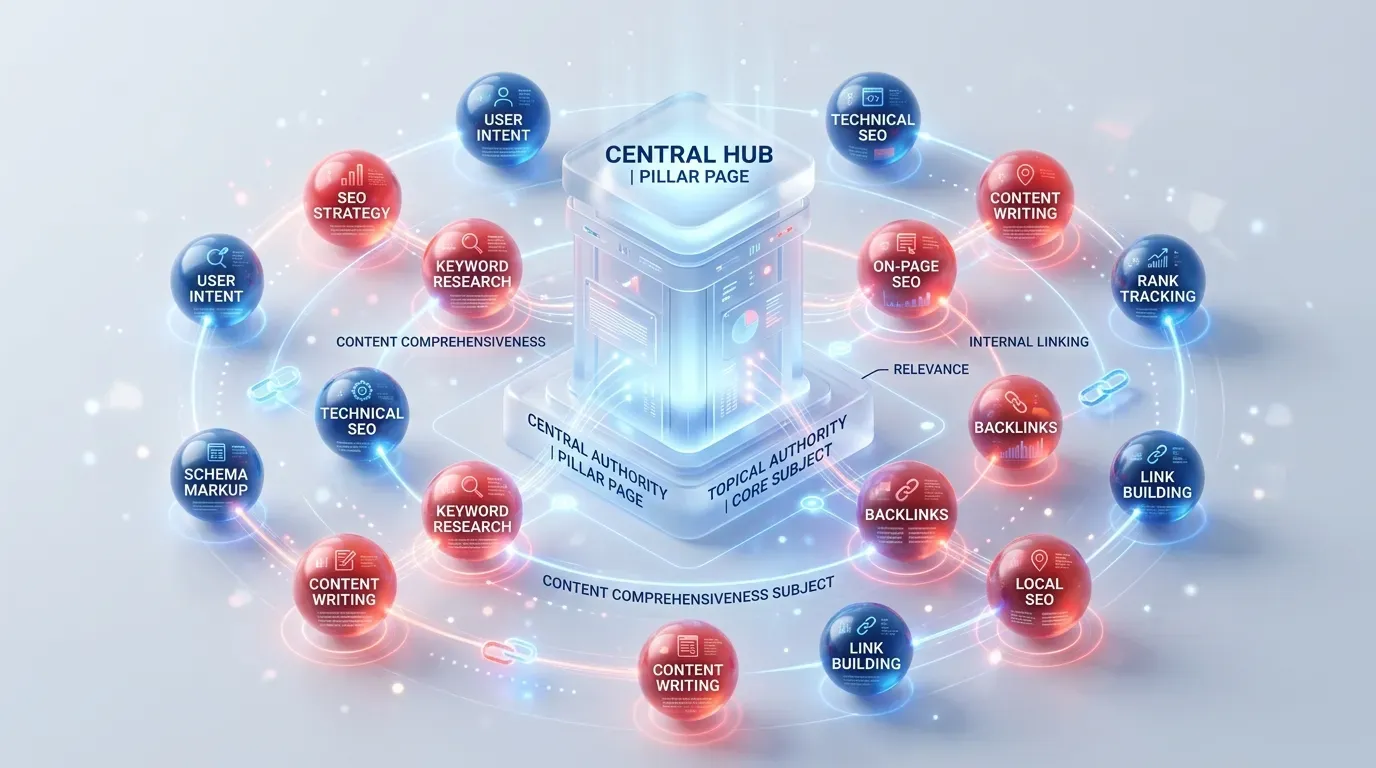
Have you ever wondered why some websites manage to dominate search engine results pages (SERPs) for nearly every related keyword, while others put in tremendous effort writing quality articles yet still can't climb the rankings? The reason behind this isn't just about the number of backlinks or domain age alone—it comes down to something called Topical Authority, or subject matter expertise, which is one of the key factors that both Google and AI Search technology use to evaluate rankings.
This article will explore the importance of Topical Authority in depth—from its definition and significance in SEO to strategies for building credibility—to help elevate your website's search rankings and establish authority within your industry.
- What is Topical Authority?
- What is a Topic Cluster? Why It's Important for Building Credibility
- How to Build Topical Authority for Sustainable Growth
- Pitfalls to Avoid When Planning Your Topical Authority Strategy
- Measuring Topical Authority
- Elevate Your Digital Strategy with Relevant Audience
What is Topical Authority?
Topical Authority refers to when a website is evaluated and ranked by search engines as a source with deep expertise, high credibility, and comprehensive coverage of a specific topic. This includes a network of articles and content that thoroughly explains the subject matter—not just surface-level writing—to the point where search engine algorithms and AI Search systems trust that the website is credible, genuinely knowledgeable, and among the best resources for searchers.
To illustrate this more clearly, let's compare how search engines work to how humans naturally think. If we have a specific health issue, we'd naturally choose to trust and consult a specialist doctor with proven experience treating that condition, rather than someone who just read a single medical article. The same principle applies to websites. When algorithms crawl your site and find that your content structure comprehensively covers every dimension of a topic, your website earns trust and naturally gets pushed higher in the rankings.
Why Topical Authority Matters for SEO and AI Search
Since Google's goal as a search engine is to deliver the most accurate, safe, and trustworthy information to users, when a website meets these conditions, related pages on that topic have a greater chance of ranking higher simultaneously. This differs from traditional SEO approaches of the past, which often relied on ranking for just a single keyword.
Furthermore, with the rise of AI Search technology and Generative AI tools like ChatGPT or Google AI Overview—which are increasingly answering user queries directly instead of relying on traditional search results pages—Topical Authority has become even more critical. These systems must select sources to reference when summarizing answers for users. Websites with systematically interconnected content get referenced far more often than those with scattered, disconnected information. This is why SEO for ChatGPT or AI SEO fundamentally requires building Topical Authority—making your website genuinely knowledgeable on a subject, not just optimized to match keywords.
What is a Topic Cluster? Why It's Important for Building Credibility
Effectively building Topical Authority requires "systematically organizing your content structure," known as a Topic Cluster, which consists of three key components:
1. Pillar Page
The main content page that serves as a central hub, comprehensively explaining the broader topic.
2. Cluster Content
Supporting pages that dive deep into specific aspects and details of that broader topic.
3. Internal Linking
Connecting pages through internal links (Link Building for SEO), where every supporting page naturally links back to the main pillar page, distributing SEO ranking power across all pages.
For example, if the main topic is SEO, the Pillar page might be an overview article explaining what SEO is and its key components. Supporting pages would then branch out into topics like SEO Audit, On-page SEO, Technical SEO, Link Building, or Local SEO—each diving deep into its specific subject while always linking back to the Pillar page.
This content architecture sends "positive signals" to search engines that this website presents deeply interconnected information throughout its entire system—not just surface-level content. It also elevates the User Experience (UX), allowing users to easily find comprehensive, related information all within a single website.
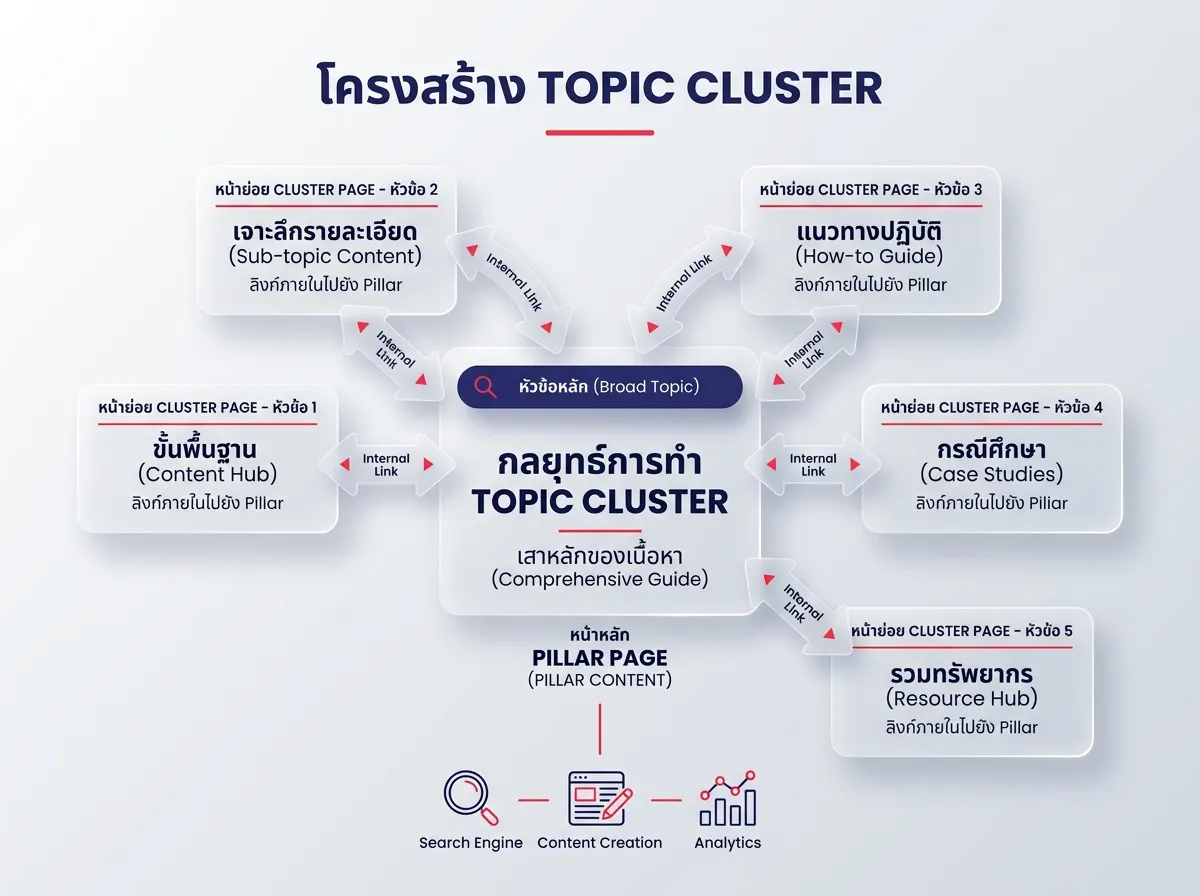
Additionally, systematically connecting internal links relates directly to the principles of Link Building SEO. While Link Building typically focuses on links from external websites, properly structuring Internal Links also plays a crucial role in distributing credibility across different pages within your own website. A Pillar page that receives links from numerous supporting pages becomes stronger, while supporting pages themselves gain credibility passed down from the Pillar page as well.
How Are Pillar Pages Different from Supporting Pages?
Many people wonder whether Pillar pages and supporting pages should be written the same way. The answer is "No"—both serve distinctly different roles. The table below summarizes these differences clearly:
| Component | Pillar Page | Supporting Page |
|---|---|---|
| Goal | Provide a comprehensive overview of the entire main topic | Deep dive into one specific sub-topic |
| Content Length | Medium to very long, covering multiple aspects | Short to medium, focused on answering specific questions |
| Target Keywords | Broad keywords with high search volume | Specific niche keywords or long-tail questions |
| Linking Strategy | Links out to every supporting page in the cluster | Links back to the Pillar page and related supporting pages |
| Updates | Updated when new supporting pages are added | Updated when specific information changes |
The Pillar page functions like a comprehensive table of contents, guiding readers to the supporting pages that match their needs. Supporting pages, meanwhile, answer specific questions as thoroughly as possible. When both work together, a website achieves both breadth and depth on a topic—exactly the signal Google looks for to identify a site that comprehensively covers a subject.
How to Build Topical Authority for Sustainable Growth
Building effective Topical Authority that satisfies algorithms long-term requires careful planning—starting from SEO Audit and systematically creating content that addresses search demand. This process can be broken down into four simple steps:
-
Define Your Core Topic - Start by selecting a topic that aligns with your business goals and your organization's or website's area of expertise. Avoid creating content that's too broad, and instead focus on deep, specialized knowledge within your specific industry, allowing you to branch out content based on depth.
-
Analyze Search Intent (Keyword & Search Intent) - Conduct Keyword Research to gather keywords related to questions, concerns, and sub-topics connected to your core content. Use these findings as a content outline to create articles and rank for those specific keywords.
-
Design Your Content Map (Content Mapping) - Organize your research into a content map, establishing the Pillar Page as the central hub while gradually creating supporting content to address various sub-topics. Structure internal links so they connect naturally throughout your content ecosystem.
-
Keep Content Updated Regularly - To prevent credibility loss from outdated information, regularly review and update older articles to ensure content remains relevant to current circumstances, maintaining long-term trust.
Pitfalls to Avoid When Planning Your Topical Authority Strategy
While many businesses understand the concept of Topical Authority, implementing it without careful planning can lead to mistakes that actually damage a website's credibility. Here are key pitfalls businesses should watch out for:
-
Focusing on breadth while sacrificing depth: Producing large volumes of content without deep expertise on any particular subject confuses search engine algorithms, making it difficult for them to identify exactly what your website specializes in.
-
Prioritizing quantity over quality: Rushing to produce large amounts of content while neglecting accuracy and value undermines credibility and rankings, just as much as lacking depth does.
-
Disconnected link structure and page architecture: Creating a Pillar Page without supporting content to back it up—or having numerous supporting pages that never link back to the main page—prevents ranking power from being properly distributed, affecting SEO performance across the entire site.
-
Neglecting to update older content: Focusing exclusively on creating new content while allowing older articles to contain outdated or inaccurate information damages both credibility and brand image in the eyes of consumers.
Measuring Topical Authority
Results from building Topical Authority don't happen overnight—they're the cumulative outcome of continuous content improvement and creation. Success can be evaluated using these key metrics:
-
Cluster Rankings - Your website begins ranking systematically across a whole cluster of related keywords, not just for one isolated keyword.
-
Topic-Specific Traffic Growth - Organic Traffic flows consistently into pages within a specific Topic Cluster, showing clear and sustained growth patterns.
-
Thought Leadership Signals - Once your content structure becomes sufficiently strong, your website starts getting referenced as an answer source in SEO for ChatGPT and various AI Search platforms—a clear signal that your brand and website are recognized as genuine experts on that subject.
Should You Choose an SEO Agency to Manage Your Topical Authority?
Building a comprehensive content system that aligns with search algorithms requires strategic vision, advanced analytical tools, and sustained effort over time. For organizations with sufficient in-house talent and resources, developing content architecture independently can be an appealing option. On the other hand, working with an SEO agency (SEO Agency in Thailand) may prove more cost-effective and faster than building an entire marketing team from scratch.
Having an expert SEO Specialist team manage your project helps ensure your business can precisely define content scope, design both internal and external linking structures, and refine your website's technical foundation. This integrated approach ensures each piece of content works together cohesively, transforming standalone, disconnected articles into a valuable digital asset that continues driving business success well into the future.
Elevate Your Digital Strategy with Relevant Audience
Relevant Audience is a full-service digital agency covering every dimension of online marketing, backed by a team of experts and cutting-edge technology—ensuring your business always stays ahead of the competition.
Our Services
-
Paid Performance: Precision-targeted advertising across leading platforms (Google, Meta, TikTok, LINE)
-
SEO & GEO: Boost your search rankings to the first page, making it easier for customers to find you
-
Creative & Branding: Distinctive brand design and content that resonates with your audience
-
Web Development: Build and develop high-performance websites tailored to your business needs
-
Growth Services: Additional services and solutions for businesses ready to scale
Contact us and request a quote today
-
Phone: 02 038 5055
-
E-mail: info@relevantaudience.com