
TL;DR
- Google's "Tips to improve your local ranking on Google" page says there is no way to request or pay for a better local ranking, so a guaranteed Map Pack date is a red flag.
- Google's guidelines say unnecessary information in a business name could result in suspension, virtual offices are not eligible, and each location gets only one page.
- Google Maps policy removes paid or incentivised reviews and bars merchants from selectively soliciting positive reviews or setting staff review quotas.
- A suspended profile goes through Google's appeals tool with documents whose name and address match, such as business registration or utility bills; an appeal can be submitted only once.
- Business Profile Performance data mixes organic and Google Ads activity, counts a viewer once a day, and the searches metric can take up to 5 days after the month starts.
The short answer: local SEO services worth paying for cover six areas of work: optimising your Google Business Profile, a web page for each branch, a name, address and phone number (NAP) that match everywhere, review management that follows Google's policies, links from local sources, and measurement the business owner can open and check directly. When you choose a provider, look at three things before anything else: whether they work within Google's rules, how transparent their reporting is, and who holds ownership of the profile.
This guide is for storefront owners and for marketing managers at multi-branch businesses, such as hotels, clinics, restaurants and retailers, who are comparing proposals from several providers. The rules quoted here come from Google's own help pages, "Guidelines for representing your business on Google" and "Tips to improve your local ranking on Google", last checked on 13 November 2026. Google's rules change, so reread those pages before you sign a contract.
Why the shop closest to the customer does not always reach the Map Pack first
Google's "Tips to improve your local ranking on Google" page says local results are mainly based on relevance, distance and popularity, and then explains the third factor under the heading prominence. In Google's words, relevance is how well a Business Profile matches what someone is searching for. Distance is how far each business is from the person searching, and if the searcher does not share their location, Google uses what it knows about where they are. Prominence is how well-known a business is, which draws on information such as how many websites link to the business and how many reviews it has.
The sentence worth remembering from the same page is that there is no way to request or pay for a better local ranking on Google. A provider who guarantees first place on Google Maps by a set date is selling something Google says cannot be bought. This guide focuses on the next question: how to choose and work with a provider so the work actually moves those factors.
What a provider can influence is relevance and prominence. Distance is the real location of your shop, and nobody can move it for you. That filters proposals quickly. If a plan only promises "more visibility across a wider radius" without saying how it will raise relevance or prominence, the plan has no substance yet.
The scope of work you should see in a local SEO proposal
A good proposal splits the work into clear categories and says what evidence each category will hand you to check. Use the table below to compare several proposals line by line.
| Work area | What the provider should do | Evidence to ask for |
|---|---|---|
| Google Business Profile | Correct the name, categories, address, hours, photos and business description so they follow Google's guidelines | A before-and-after list of changes, with the rule behind each one |
| Branch pages | Build or improve one web page per branch, with address, phone, hours and location-specific content | The URL of each page and the link to it from that branch's profile |
| Citations and NAP | Check that name, address and phone match across the directories and platforms customers actually use | A sheet of sources with a fixed or not-yet-fixed status |
| Review management | Set up a way to ask real customers for reviews without incentives, and reply to every review | The review link or QR code, reply templates, and the reply rate |
| Local links | Earn links from associations, partners, local media and events the business genuinely takes part in | A list of links won, with the source pages |
| Measurement | Add UTM tags to the profile's website link, set up GA4 reporting and track geo-grid rankings | Access to the raw data, not only a summary file |
Google's guidelines say to use as few categories as possible to describe your overall core business, to pick the most specific ones, and to choose categories that complete the statement "This business IS a" rather than "this business HAS a". Google's own example is a motel with a swimming pool: the right category is "Motel", not "Hotel" or "Swimming Pool". In another example, a restaurant inside a hotel takes the "Restaurant" category on its own profile, while the hotel keeps "Hotel".
Branch pages help relevance because Google says it can also detect category information from your website and from mentions of your business across the web. A good branch page carries information no other page has: how to get there from the nearest train station, parking, the languages staff speak, and services available only at that branch. If the site already has technical problems, such as branch pages that are not indexed, start with a full SEO audit first. Otherwise nobody will see the content you add.
Links from local sources support prominence, since Google names the number of websites linking to a business as one of the inputs. This is a different job from buying links in bulk. A valuable link is one with a real reason to exist, such as the business sponsoring a community event or belonging to a professional association. For this work at full scale, see the link building service.
A 10-point scorecard for choosing a local SEO provider
Use this table while you talk to each provider. Ask the question in the middle column, then compare the answer with the right-hand column. A simple scoring method: 2 points when the answer matches and comes with evidence, 1 point when it matches without evidence, and 0 when the provider cannot answer or avoids the question. The 20-point total is only a comparison tool, not an industry standard.
| Point | Question to ask | Answer you want to hear |
|---|---|---|
| 1. Profile ownership | Who will be the primary owner of the Google Business Profile? | Your business holds primary ownership. The provider gets manager access only. |
| 2. Google's rules | How will you set the business name on the profile? | The real-world name on the storefront sign, with no keywords or taglines added. |
| 3. Getting reviews | How will you increase the number of reviews? | Ask every real customer the same way, with no discounts or gifts in exchange. |
| 4. Multi-branch experience | How will you handle names and categories across branches? | One name for every branch in the country, one category where the service is the same. |
| 5. Report transparency | Can we see the raw data? | Yes, through direct access to the profile's Performance data and GA4. |
| 6. KPIs | How will you measure success? | Calls, direction requests, website clicks and geo-grid rankings, not views alone. |
| 7. Thai and English content | Who writes the branch pages in both languages? | A writer for each language, not machine translation alone. |
| 8. Branch pages | Will each branch get its own page? | Yes, with branch-specific information, not just a swapped district name. |
| 9. Handling a suspension | What happens if the profile is suspended? | An appeal through Google's tool with documents, and no new profile. |
| 10. Handover at the end | What do we get back when the contract ends? | Every access right, the report data and the citation sheet stay with the business. |
Point 1 matters most and belongs in the contract. Google's guidelines page notes that if you assume ownership of a Business Profile, the previous owner first needs to add you as an owner and transfer ownership to you. So if the provider keeps primary ownership, on the day you end the contract you depend on their cooperation to get your own profile back. You can prevent that risk from day one by keeping primary ownership in the business and adding the provider as a secondary user, scoped to the work.
Points 2 and 3 screen out risky providers fastest. If the answer is "keywords in the shop name rank faster" or "we have a team that helps with reviews", stop the conversation there. The reasons are in the next section.
Red flags that get a Google Business Profile suspended
Google's "Guidelines for representing your business on Google" opens with three requirements for keeping a profile from being suspended: avoid prohibited content and behavior, reflect your business accurately, and comply with the product guidelines on that page. The practices below run directly against those rules. If a provider proposes any of them, treat it as a warning sign.
- Stuffing keywords or extra details into the business name. Google says including unnecessary information in your business name isn't permitted and could result in the suspension of your Business Profile. The guidelines list marketing taglines, store codes, hours, phone numbers, URLs, service or product information and location information among the things a name must not include.
- Using a virtual office. If a business rents a physical mailing address but does not operate out of that location, Google says the location isn't eligible for a Business Profile. P.O. boxes and mailboxes at remote locations aren't acceptable either.
- Listing a co-working desk with nobody there. Google only allows an office at a co-working space that has clear signage, receives customers during business hours and is staffed during business hours by the business's own staff.
- Creating duplicate listings. Google says not to create more than one page for each location, whether in a single account or multiple accounts, and that there should only be one profile per business.
- Buying reviews or trading incentives for them. Google Maps' prohibited and restricted content policy says reviews or ratings that have been paid for, directly or in kind, are fake engagement and will be removed. It also bars merchants from offering payment, discounts or free goods or services in exchange for posting a review, or for revising or removing a negative one.
- Asking only happy customers for reviews. The same policy bars merchants from discouraging negative reviews or selectively soliciting positive ones, and from asking staff to collect a set number of reviews.
- Using numbers or links that redirect elsewhere. Google bars phone numbers or URLs that redirect or refer users to landing pages or phone numbers other than those of the actual business, including pages created on social media sites, and the phone number must be under the direct control of the business.
- A provider asking to be primary owner instead of you. This is not itself a suspension rule, but it costs you control. If the profile is ever suspended, the person who can appeal is the one signed in to the Google Account linked to the profile.
The consequences, in Google's own wording, come in several levels. The guidelines page says following the rules helps you avoid common problems, including changes to your information or, in some cases, removal of your business information from Google. The end of the page says Google reserves the right to suspend access to Business Profiles or other Google services for individuals or businesses that violate these guidelines, and may work with law enforcement where the violation is unlawful. The "Fix suspended or disabled profiles" page adds that when an account is restricted, the Business Profiles it manages are suspended and it cannot create or claim other profiles. So if your profile is managed from a provider's account and that account is restricted, your profile is suspended along with the rest.
Google's guidelines allow no links of any type in the business description, and bar descriptions that focus on special promotions, prices or sales. One example Google gives of content that is not allowed is "Everything on sale, -50%". The field is meant for the services and products you offer and the mission and history of the business.
If your listing is suspended, what steps does Google set out?
The "Fix suspended or disabled profiles" page says Google may suspend or disable profiles that don't follow its guidelines, and that you can submit an appeal if you believe the profile should be reinstated. The order to follow is:
- Bring the profile in line with every guideline before you appeal, for example by removing keywords from the name and changing the address to the place where you actually operate.
- Prepare evidence. Google's examples are official business registration, a business license, tax certificates and utility bills such as electricity, phone, water and internet, with a business name and address that match the profile.
- Submit through the Google Business Profile appeals tool while signed in to the account linked to the profile. The tool shows the date of the decision, the reason, and the policy that was violated.
- Do not create a new Business Profile for the same business. Google marks this as important.
- Submit everything at once. Google says appeals can only be submitted once, so attach all documents the first time.
If you manage more than 10 Business Profiles, the appeals tool asks whether you are requesting bulk reinstatement for 10 or more suspended locations, and you attach a spreadsheet of the Business Profile ID for each location along with supporting documents. Tip: keep a document file for each branch before anything goes wrong, so the evidence is ready if you ever need it.
The KPIs a local SEO report should show
A report that only shows views is not enough to make decisions with. What an owner needs to know is whether more people are calling, travelling to the shop or visiting the website from the profile. This table sums up the KPIs to ask for in every monthly report and what to watch out for when you read the numbers.
| KPI | Data source | What to watch when reading it |
|---|---|---|
| Geo-grid ranking | A rank tracker that checks from many points around the shop | Rankings change with the searcher's location, so read it as a map, not a single number |
| Calls | Google Business Profile Performance | Counts clicks on the profile's call button, and only works once a phone number is added |
| Directions | Google Business Profile Performance | Google changed the count to account for multiple taps, cancellations and spam |
| Website clicks and GA4 | Profile Performance, plus GA4 through a UTM-tagged link | Follow through in GA4 to see whether visitors reach the booking or contact page |
| Review velocity and reply rate | The profile's reviews tab | Look for consistency. A sudden spike is a pattern Google's policy names as rating manipulation |
Some details from the "Understand your Business Profile performance & insights" page are worth knowing before you read any report. First, performance data is available only for verified profiles. Second, it includes views, searches and actions from both organic results and Google Ads, so if you ran more ads that month, the extra views and calls may not all come from SEO work. Third, the searches metric updates at the start of each month and can take up to 5 days to show. Fourth, views count unique visitors, and a person is counted only once a day. A good report states the date range clearly and separates months with advertising.
Review velocity is the rate at which new reviews arrive each month. It should grow with the number of real customers, not jump in a single week. Google Maps' policy says content showing unusual volumes or patterns of reviews that indicate an effort to manipulate a place's rating is not allowed and will be removed. As for replies, aim to answer every review, because Google's help pages recommend replying to show customers that you value their feedback.
Multi-branch businesses: the structure to set up from day one
For a multi-branch business, the basic structure is one branch, one Google Business Profile, one web page and one phone number that reaches that branch. Google's guidelines say to use a local phone number instead of a central call center helpline whenever possible, and that the website linked from the profile should represent that individual location.
Names and categories across a chain. Every branch within the same country must use the same name, and every branch that offers the same service must share the same category. There are two exceptions: sub-brands or different types of operation, such as retail and wholesale, and branches that consistently use a different name on their storefront, website or stationery. A name like "Brand X Siam branch near BTS" breaks the rule, because it adds location information to the name.
Hotels. Google's guidelines say indoor lodging such as hotels and motels shouldn't provide hours, and that a restaurant, cafe or bar inside a hotel should have its own profile with a different name from the hotel.
Clinics and hospitals. Doctors and dentists count as individual practitioners under Google's guidelines. They can have their own profile when they work in a public-facing role and can be contacted directly at the verified location during stated hours. Where several practitioners work at one location, the organization should have its own profile separate from theirs, and each practitioner's profile should use only the practitioner's name. One practitioner shouldn't have multiple profiles to cover different specializations. Hospital departments that operate as distinct, public-facing entities can have their own profiles, with a name and category different from the main organization.
Restaurants. For hours, use the times when diners can sit down and eat in. If that is not possible, use takeout hours. Menu URLs can't be direct links to third-party ordering or delivery services, and third parties that manage profiles for clients must notify the business owner and have their consent before submitting a menu URL. A delivery-only brand operating out of a shared kitchen must hide its address and add service areas instead.
Retail. At the time of checking, showing in-store products on the profile is available only in the US, Canada, the UK and Ireland, so retailers in Thailand cannot use it yet. If a proposal sells this feature to a Thai business, ask how they intend to deliver it. Retailers that also sell online should plan branch pages alongside SEO for the main website, so that branch pages and product pages do not compete for the same keywords.
Roadmap: local SEO in 90 days
A 90-day plan does not mean you will reach the Map Pack on day 90. Google gives no timeframe and says plainly that rankings cannot be bought. The plan exists to split the work into stages you can check, so you know what should be finished each month.
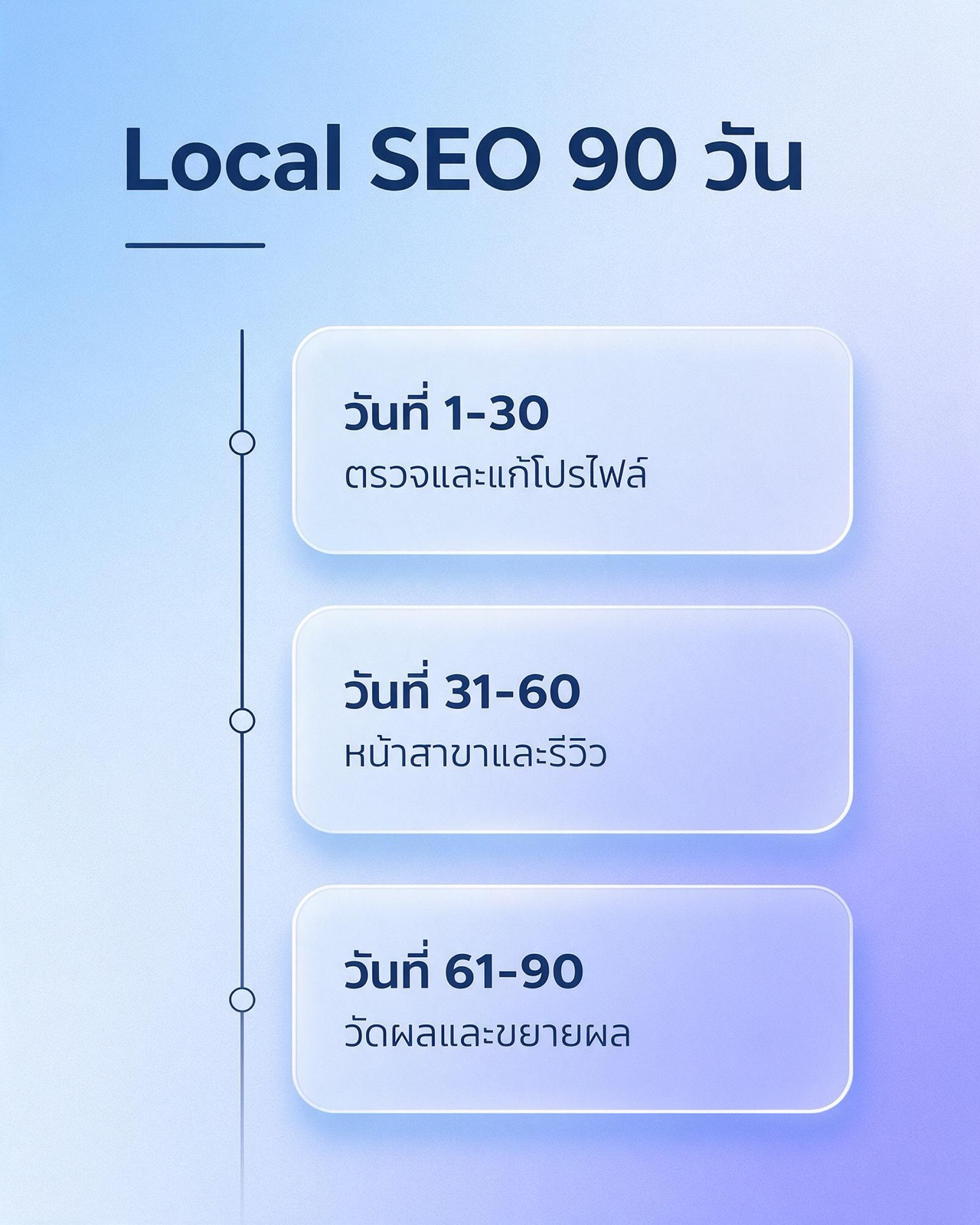
Days 1-30: audit and fix the profiles. Check every branch profile against Google's guidelines, item by item: name, address, categories, hours, phone and website link. Find and resolve duplicate listings, verify any branch that is not yet verified, check user access so the business is primary owner, add UTM tags to the website link, and record a baseline for every KPI.
Days 31-60: branch pages and reviews. Build or improve branch pages in both Thai and English. Start asking for reviews with the link or QR code Google lets you create. Write guidance for replying to positive and negative reviews, correct NAP in the main data sources, and add real photos of each branch.
Days 61-90: measure and scale. Compare KPIs with the baseline, separate out the effect of advertising, and use the geo-grid map to see which branch is still weak in which zone. Start local link work, then roll out what worked at the pilot branches to the rest.
How much can you do yourself, and when should you hire?
A single-location business whose owner has time can do most of this alone. Google provides full guides on verification, editing information, replying to reviews and adding photos. The jobs an owner does better than any outsider are asking customers for reviews at the counter and taking real photos of the shop.
The point to consider hiring is when you have several branches, when a profile has been suspended before, when the website has technical problems, or when you need pages in two languages. Those jobs take knowledge of the rules, time and measurement tools. Google's "Understand how Google sources & uses info in Business Profiles & local search results" page says profile information is compiled from publicly available web content, licensed data from third parties, users who contribute information including business owners, and Google's own interactions with the place. The same page says Google makes profile information available to third-party sites and apps through APIs such as Google Maps Platform, so accurate, consistent information travels beyond Google Maps. If you also want your business to be cited in answers from AI tools, see the Generative Engine Optimization approach.
Local SEO in Thailand: what needs different thinking
The first issue is bilingual names. Google's guidelines do not allow repeating the same business name in multiple scripts or languages in the name field, even if it appears that way on the storefront sign. Google's example is a brand name repeated in Japanese script. The right approach is to pick the one name customers know best, then use bilingual web pages so people searching in Thai and in English can both find you.
The second is addresses, which in Thailand may include a soi, a moo or a building name. Google lets you pin your location directly on the map when the address has no street number or the system cannot find it. It allows cross-streets and landmarks only in regions where the official street address doesn't pinpoint the location accurately. Suite or floor numbers go in the second address line.
The third is businesses that serve customers on site, such as air-conditioning technicians, plumbers or cleaning services without a storefront. Google allows one service-area profile, with the address hidden from customers and a service area that generally shouldn't extend farther than about 2 hours of driving time from where the business is based.
Frequently asked questions (FAQ)
How long does it take to reach the Map Pack?
Nobody can give a fixed date, because Google's ranking tips page gives no timeframe and says there is no way to pay for a better local ranking. What you can check is whether each stage of the 90-day plan is finished, and whether KPIs such as calls, direction requests and geo-grid rankings move from the baseline.
Can a business without a storefront do local SEO?
Yes. A business that travels to customers can have one service-area profile, with the address hidden and a service area set. If it has several bases with separate staff and separate service areas, it can have one profile per base. A virtual office is not eligible. An office in a co-working space qualifies only if it has clear signage, receives customers and is staffed by your own staff during business hours.
What should I do if my listing is suspended?
Fix the profile so it meets the guidelines first, then appeal through the Google Business Profile appeals tool with documents whose name and address match the profile, such as business registration or utility bills. Do not create a new profile for the same business, and attach all evidence in one go, because Google says an appeal can only be submitted once.
How should I reply to a negative review?
Reply to every review politely: thank the customer, state the facts briefly and offer a way to continue the conversation, without revealing the customer's personal information. Google reviews replies before they are posted, which usually takes up to 10 minutes but can take up to 30 days, and customers can still change their review after reading your reply. What you must never do is offer a discount or gift in exchange for editing or removing a review.
Do I need a website?
It is not required, but it is worth having. Google's guidelines ask for either a phone number that connects to your individual location or a website that represents it, and Google says it can detect category information from your website. Prominence also draws on how many websites link to your business. A branch page therefore supports relevance and gives you a destination you can measure in GA4.
Summary
A good local SEO provider follows every one of Google's guidelines, leaves profile ownership with the business, reports on calls, direction requests and website clicks, and works to a staged plan you can check. Use the 10-point scorecard and the red-flag list in this guide to compare proposals before you decide. If you would like a team to review your profiles and plan the work for your business, see Relevant Audience's local SEO page.