
TL;DR
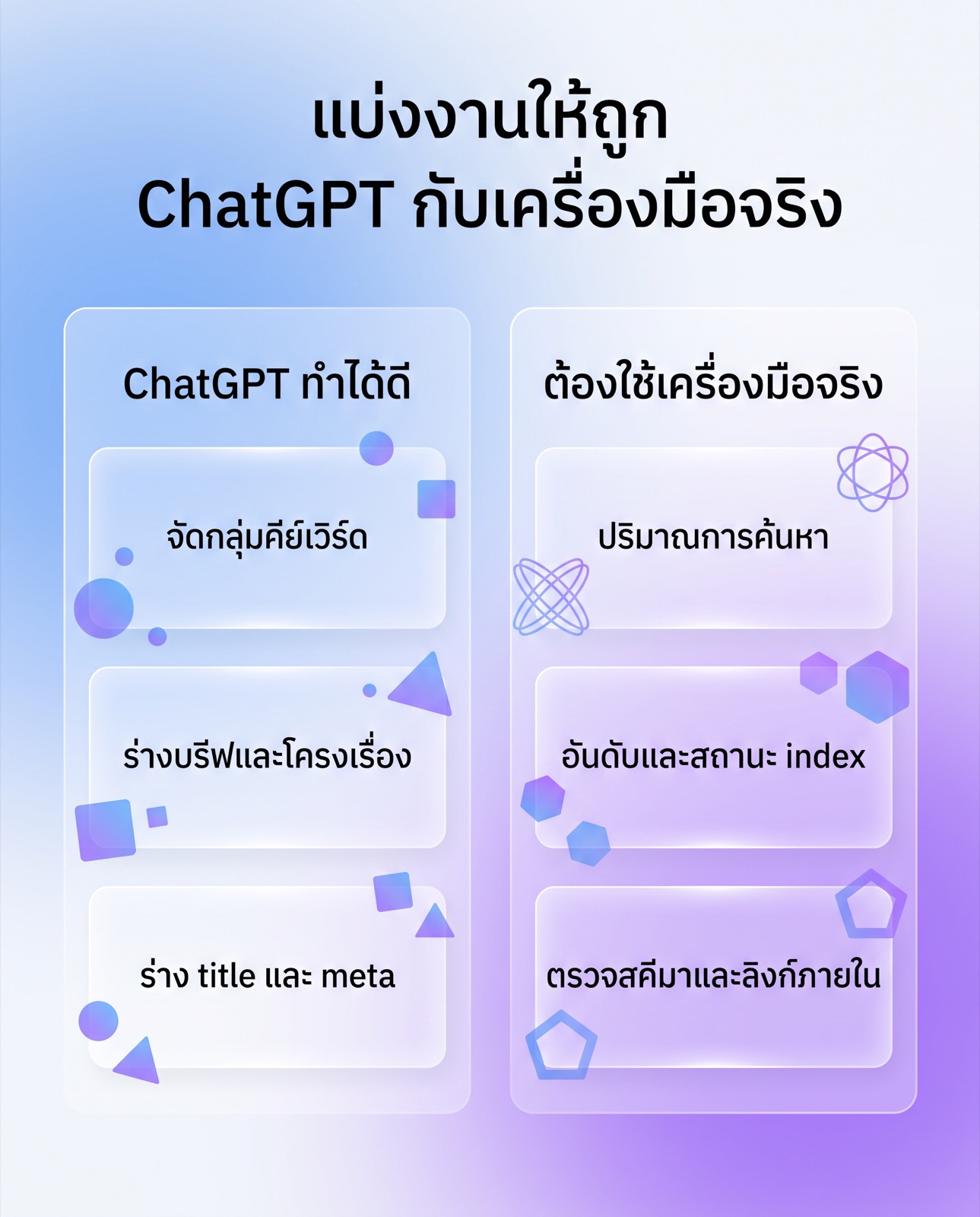
- ChatGPT is reliable for clustering keywords, labelling search intent, writing briefs, drafting titles, meta descriptions and JSON-LD, and proposing internal links from a URL list you supply.
- It has no search volume, no knowledge of your rankings or index status, and no way to verify a fact about your own site, so every number has to come from a real tool.
- The working order is: export real data from Google Search Console first, let the model group and label it, let it draft, then verify with a keyword tool, a crawler and Google's rich results test.
- Google's stated position is that it values helpful, high quality content regardless of how it was produced, so neither a guaranteed ranking nor a guaranteed penalty for AI drafts is a supportable claim.
- For Thai sites, tell the model to merge differently spelled forms of the same need into one cluster, and have a Thai speaker check register and word segmentation before publishing.
ChatGPT helps with SEO in the parts of the job that involve drafting, grouping and turning raw exports into something readable: clustering keywords from a Google Search Console export, labelling the intent behind hundreds of queries at a time, writing briefs for writers, drafting title tags and meta descriptions inside a character limit, drafting JSON-LD, and proposing internal link pairs from a URL list you supply. What it cannot do is measure. ChatGPT has no real search volume, does not know your current rankings, does not know which pages are indexed, and has no way to confirm that anything it writes about your site is true.
The safest arrangement is to split the roles from the start. ChatGPT drafts and classifies, a real SEO tool measures, and a person checks before anything is published. Reverse that order and you end up with a keyword file that looks tidy but contains words nobody searches, and an article that reads smoothly with numbers inside it that do not exist.
One paragraph of scope-setting before going further. This article is about using ChatGPT to do SEO work. It is not about getting your brand quoted inside ChatGPT answers. Those are two different jobs with different methods and different measurement. The first is about cutting the time your team spends on production work. The second is about being chosen to answer someone's question, which belongs to GEO and has its own playbook. Everything below stays with the first one.
How far AI can help with SEO
Split SEO into three piles and the boundary becomes obvious. The first pile is measurement: search volume, keyword positions, clicks and impressions, index status, referring domains, page speed. The second pile is decisions: which page to build first, whether to merge two overlapping pages or keep them apart, which keyword group to abandon. The third pile is production: briefs, drafts, metadata, schema, table formatting, translation, spreadsheet formulas.
AI handles the third pile well. It handles part of the second pile when you feed it real data to read. It handles none of the first pile. Those numbers have to come from tools connected to real data: Google Search Console for your own clicks and average positions, Google Analytics for what happens after the click, a keyword tool for search volume, a crawler for site structure.
The most expensive mistake teams make when they start using AI is asking a language model for a first-pile number and believing the answer. A language model is trained to produce plausible sentences, not to refuse when it does not know. So you get search volumes that look reasonable, cost-per-click figures with convincing decimals, and sources that were never published. Put those in a client deck and the damage is not the wrong number, it is the credibility of the whole report.
Where ChatGPT improves SEO work
The best return on time comes from work that is high in volume, repetitive in shape, and easy for a person to check. A concrete example: say you pull 1,200 rows of query data out of Google Search Console. Grouping those by hand takes half a day. Ask a model to group them by topic and by intent first, then review only the groups that look odd, and the same job takes under an hour. Every result is checkable because the source data is yours.
The second reliable win is turning one piece of content into several formats without drift. You have a long article and you need three meta description variants, a summary line for a category page, a three-line teaser for the homepage, and five FAQ questions for schema. All of that is reshaping information that already exists rather than creating new facts, so the risk of invention is low.
The third is reading things people do not want to read: server logs, exports with too many columns, URL lists thousands of rows long where you are hunting for a repeating pattern. Ask the model what patterns it sees, then verify those observations against the real data. That turns a needle-in-a-haystack search into hypothesis confirmation, which is much faster.
What ChatGPT can actually do for SEO
These are the jobs worth handing over, all of which leave room for a person to check the output.
- Keyword clustering. Take a raw query list from your own file and group it into topics, with a suggestion of whether each group needs one page or several.
- Search intent classification. Tag each query as informational, comparative, transactional or navigational. This is unmanageable by hand past a few hundred rows.
- Content briefs. Turn a keyword group into a heading structure, the questions the piece has to answer, and a list of things the writer must not claim.
- Title tags and meta descriptions. Several versions inside a set length, each labelled with the angle it takes.
- JSON-LD drafting. Schema for the page type you name, ready for you to test in Google's rich results test.
- Internal link mapping. Give it a URL list with each page's topic and it proposes which page should link to which, with anchor text.
- Reading exports. Search Console files or server logs, summarised into patterns worth investigating.
- Regex and spreadsheet formulas. For filtering queries, stripping brand terms, or bucketing URLs by folder.
- Translation and localisation into Thai. Keeping technical terms intact and proposing the words Thai users actually type instead of a literal translation.
- First-draft outlines. So a writer has something to argue with instead of a blank page.
Notice that every item starts from data you supply. None of them ask the model to go and find information. That is the line worth holding. If you supplied nothing and it answered with a number, the number is a guess.
How to use ChatGPT for SEO, step by step
The workflow that holds up has four steps, and the last one is the step most people skip.
Step one: gather real data before you open the chat
Open Google Search Console, go to the performance report, set the date range to the last three to six months, open the queries tab and export. Do the same for the pages tab. If you have a keyword tool, export search volumes into a second file. What you are doing is moving the truth out of the tools and into the conversation, so the model works from data instead of from memory.
If the file is too large to paste whole, cut it down to the columns that matter first, usually query, clicks, impressions and average position. Sort by impressions descending and drop the rows with almost no impressions, because those rows carry too little signal to decide anything with anyway.
Step two: let the model group and label
This step converts a long list into a structure. Do not ask for writing yet. Ask only for grouping, intent labels, and a note on which groups overlap with pages you already have. A good output here is a table with columns for group, member queries, intent and owning page, not a descriptive paragraph.
Step three: let the model draft
Once the structure exists, ask for briefs, titles, metadata, outlines and schema. The important part is putting constraints into every instruction: maximum length, no numbers that are not in the data provided, product names spelled the way the company spells them. The tighter the constraint, the less rewriting afterwards.
Step four: verify with real tools
Everything from step three is a draft. Search volume gets checked in a keyword tool. Rankings get checked in a rank tracker or against average position in Search Console. Schema goes through Google's rich results test. Internal links get confirmed by a crawler that sees them rendered on the page. Every factual claim about your products gets read by someone at the company. If you want a picture of what is structurally wrong with the site before you start producing content, finishing an SEO audit first is cheaper, because good content on a broken structure still does not get indexed.
chatgpt seo prompts you can paste today
Prompts that work share a shape: state the role, state the attached data, state what you want, state the output format, state what is forbidden. Copy any of the following and paste your own data underneath it.
Prompt 1: cluster keywords from a Search Console export
You are an SEO planner. Below is a real query list from Google Search Console with columns for query, clicks, impressions and average position. Group every query into topic clusters, putting queries that express the same need in the same cluster even when they are spelled differently or mix languages. Answer as a three-column table: cluster name, member queries separated by commas, and total impressions for the cluster. Sort by total impressions descending. Do not add queries that are not in the list. Do not estimate search volume. [paste your data here]
A good result has clusters you can name in plain language, roughly one cluster per ten source rows, and cluster impression totals that add up close to the total in your file. If the sum is far off, the model skipped rows or invented numbers. Run it again and repeat that it must not calculate on its own.
Prompt 2: classify search intent in bulk
Label each query below with exactly one of four values: informational, comparative, transactional, navigational. Reply as a two-column table with query and label. If you are unsure about a query, write unsure rather than guessing. Do not explain your reasoning. Do not change the query text. [paste query list]
The instruction not to guess matters more than it looks. Plenty of queries are genuinely ambiguous, especially ones where a product name and a place name overlap. Fifty rows marked unsure is a better outcome than a thousand rows labelled confidently and wrongly.
Prompt 3: write a brief from a keyword cluster
Write a brief for one article. The keyword cluster is [paste a cluster from prompt 1]. The reader is [describe, for example an online shop owner in Thailand doing SEO themselves for the first time]. The brief must contain h2 and h3 headings that cover every query in the cluster, at least five questions the article has to answer, a list of data the writer must go and source, and a list of things not to claim because they cannot be verified. Do not put any statistics or figures into the brief yourself.
That last line is the whole trick. It shifts the model from filling in convincing-looking numbers to marking where a number is needed and leaving a person to find it.
Prompt 4: draft title tags and meta descriptions
Below is the content of one page. Write five title tag options and five meta description options for it. The primary keyword is [state it]. Keep each title under 60 characters and each meta description under 155 characters, counting spaces. Under each option, add one line describing the angle it takes. Do not promise anything the page content does not cover. [paste page content]
Always recount the lengths yourself. Models count characters unreliably, and it gets worse with Thai text where vowels and tone marks stack. The fastest check is pasting the output into a spreadsheet and running a length formula.
Prompt 5: draft JSON-LD for an FAQ page
Build FAQPage JSON-LD from the questions and answers below. Use only text that appears on the page. Do not add new questions. Do not shorten an answer in a way that changes its meaning. Reply with a single code block ready to paste into the page. [paste questions and answers]
Run the output through Google's rich results test every time, because schema with one misspelled field name fails as a whole, and the testing tool tells you exactly where.
Prompt 6: map internal links
Below is a list of URLs with the main topic of each page on the same website. Propose internal links: which page should link to which, with anchor text that reads naturally inside a sentence. Reply as a three-column table: source page, destination page, anchor text. Propose no more than three links per source page. Use only URLs that appear in this list. [paste URL list]
The restriction to URLs in the list prevents the most common failure of this job, which is a model inventing plausible URLs that you paste straight into production as broken links.
Prompt 7: write regex for report filtering
Write a regular expression for the filter in Google Search Console that excludes queries containing our brand name. The brand name and its common misspellings are [list them]. Explain what each part of the expression does, then give five example queries it matches and five it does not.
The examples are a tiny test set you can verify by eye in ten seconds before applying the expression to real data.
Prompt 8: convert English keywords into what Thai users type
Below are English keywords for our products. For each one, propose three forms a user in Thailand would plausibly type: a full Thai translation, a transliteration, and a mixed Thai-English form. Reply as a four-column table. Do not state search volumes, because we will check those in a keyword tool ourselves. [paste keywords]
This is the highest-value prompt for a Thai site, because the literal translation is usually not the phrase people type, transliterations come in several spellings, and a keyword tool will tell you immediately which form has real demand. The model's job is to generate the candidates. The tool's job is to delete the ones nobody searches.
Pairing ChatGPT with your SEO tools
Do not look for one tool that does everything. Think of it as a line that hands work along. At the front are the tools holding real data: Google Search Console, which knows which queries earn your impressions; Google Analytics, which knows what people do after the click; a keyword tool, which knows search volume; a rank tracker, which knows daily positions; a crawler, which knows which page links to which. In the middle sits the language model, taking that data and organising and drafting from it. At the end sits a spreadsheet or Looker Studio, presenting the result to the team.
The handoff from front to middle happens in one of two ways. The first is copy-paste or file attachment, which is slower but keeps you in control of exactly what leaves your systems. The second is a script or plugin pulling data automatically, which is faster but requires settling data-access questions first. For a small team the first is enough and safer. For a report you rebuild every week, the second pays off once the report structure has stopped changing.
The table below sets out, for each job, what the model is responsible for and which tool has to confirm the result. Use it as a pre-publish checklist.
| Job | What ChatGPT can do | What a real tool must confirm |
|---|---|---|
| Keyword research | Expand terms, cluster them, tag intent, propose Thai variants | Search volume and competition from a keyword tool |
| Briefs and drafts | Heading structure, questions to answer, a first draft to edit | Product and pricing facts, checked by someone at the company |
| Titles and meta descriptions | Multiple versions inside a stated length | Actual click-through rate in the Search Console performance report |
| JSON-LD structured data | Schema drafted for the page type | Google's rich results test |
| Internal links | Page pairs and anchors from the URL list you supplied | A crawler confirming the links render and the targets are not 404 |
If your team is putting this in place as a process rather than trying it occasionally, starting from an SEO plan that names who checks what at which step helps more than collecting better prompts. The real bottleneck is almost always the checking step, not the drafting step.
The limits of using ChatGPT for SEO
The following limits are not temporary gaps waiting for the next version. They follow from how a language model works, which is predicting the next piece of text from patterns it has seen rather than querying a database and reporting the result.
No real search volume. Any volume figure a model gives you is inferred from text patterns, not read from a query database. Ask twice and the number may change, which is the clearest sign it was never read from anywhere.
No knowledge of your rankings. Positions change daily and vary by device, location and the searcher's history. A model cannot know the current value. Even a chat model with browsing gets one version of one result page from one place at one moment.
It invents sources and statistics convincingly. A model can produce a report title, a publication year and a percentage that all look real with no original behind any of them. There is exactly one defence: if you are going to cite a figure, open the source and read it yourself first.
It produces full pages of keywords nobody searches. A phrase that is grammatically well formed is not evidence anyone types it. A model's keyword list is a hypothesis, not a plan, until it has been through a tool with real demand data.
Its knowledge has a cutoff. Training data stops at some point. Things that change often, such as the name of a report inside a tool, where a button sits, or a guideline announced recently, can be answered wrongly without the model knowing it is wrong.
It cannot verify facts about your own site. Ask which of your pages load slowly or which have duplicate content and the answer comes from linguistic probability, not from inspecting your site. Those answers have to come from a crawler.
Thai word segmentation trips it up. Thai does not put spaces between words, so counting length and finding word boundaries is harder than in English. A meta description the model says fits may not, and a break in the wrong place can change the meaning.
The question of whether AI-written content ranks deserves care. Google's stated position is that it values helpful, high quality content and does not judge by how the content was produced. So claiming that AI content is guaranteed to rank, or guaranteed to be penalised, both go beyond what has actually been stated. What you can control is accuracy, completeness, and having a named person check the work before it goes live.
What changes in the Thai market
Work on Thai-language data needs more checking than the English equivalent. The first reason is how queries are typed. Thai users routinely mix Thai and English inside a single query, sometimes transliterating, sometimes typing a brand in English and continuing in Thai. When you ask a model to cluster queries, state explicitly that differently spelled terms meaning the same thing belong in the same cluster, or you will get clusters fragmented past the point of usefulness.
The second reason is register. Thai translated directly from English reads as translated: sentences too long, connectives too frequent, ideas ordered the English way. The fix is to have the model draft and a Thai speaker rewrite, rather than asking the model to polish its own output. Repeated polishing passes usually produce longer text rather than more natural text.
The third reason is where Thai users go after the search. A large share start a chat rather than filling in a form, so content should make starting a conversation easy, and measurement has to count chat contacts as conversions. Otherwise the report will suggest the content produced nothing while the results are landing in a channel nobody counted.
The fourth reason is benchmarks. There is no reliable public figure for a good cost-per-click in the Thai market, or a good click-through rate at position one. Those vary widely by industry and by query. Anyone quoting a single national benchmark is going beyond the available data. What works instead is pulling your own account's six to twelve month averages as a baseline and measuring change against that. The tools that give you that baseline are your own Google Search Console and Google Analytics, not a language model. Teams building an AI SEO process should settle the baseline before they start, because without one there is no way to tell whether adding AI improved results or only made the work faster.
FAQ
Can ChatGPT replace SEO tools?
No, because ChatGPT has no search volume, ranking or index-status data for your site. It can replace only the drafting and organising work applied to data you supply. In practice it replaces the hours you spent clustering queries by hand and writing first drafts, not any tool subscription.
Does content written with ChatGPT rank?
There is no fixed answer, because Google's stated position is that it values helpful, high quality content and does not judge by production method. What you can control is making the content accurate, making it answer the question, and having a person check it before publishing. An unreviewed AI draft published as-is usually has an accuracy problem before it has a ranking problem.
What kind of prompt works better?
A prompt with your real data attached beats a long, elegantly written prompt every time. The priority order is attached data first, a clearly specified output format second, and prohibitions third. Adding praise or motivational phrasing does less for output quality than saying do not invent numbers.
Is it safe to paste company data in?
Treat anything you paste as data sent to an outside provider, and check your organisation's policy first. Do not paste customer personal data, card details, passwords or API keys into a conversation. Most SEO files are queries and URLs, which carry no personal data anyway, so delete the columns you do not need before attaching.
How well does it handle Thai?
Well enough for clustering and drafting, but a Thai speaker has to check register and word segmentation every time. The frequent failures are miscounted text length, wording that is too formal or simply not what people type, and business terms translated literally into phrases nobody uses.
Where to start
Pick the one job you repeat every month that eats the most time. For most teams that is clustering queries from a Search Console export. Run prompts 1 and 2 against your own data, time how long it used to take and how long it takes now, then expand to the next job once the checking step has settled. Adding ten prompts in the first month usually ends with nobody checking any of the output.
If you want help sequencing the work, setting the review criteria, and connecting model output to your real measurement tools, look at the ChatGPT SEO service from Relevant Audience and tell us which step you are stuck on.