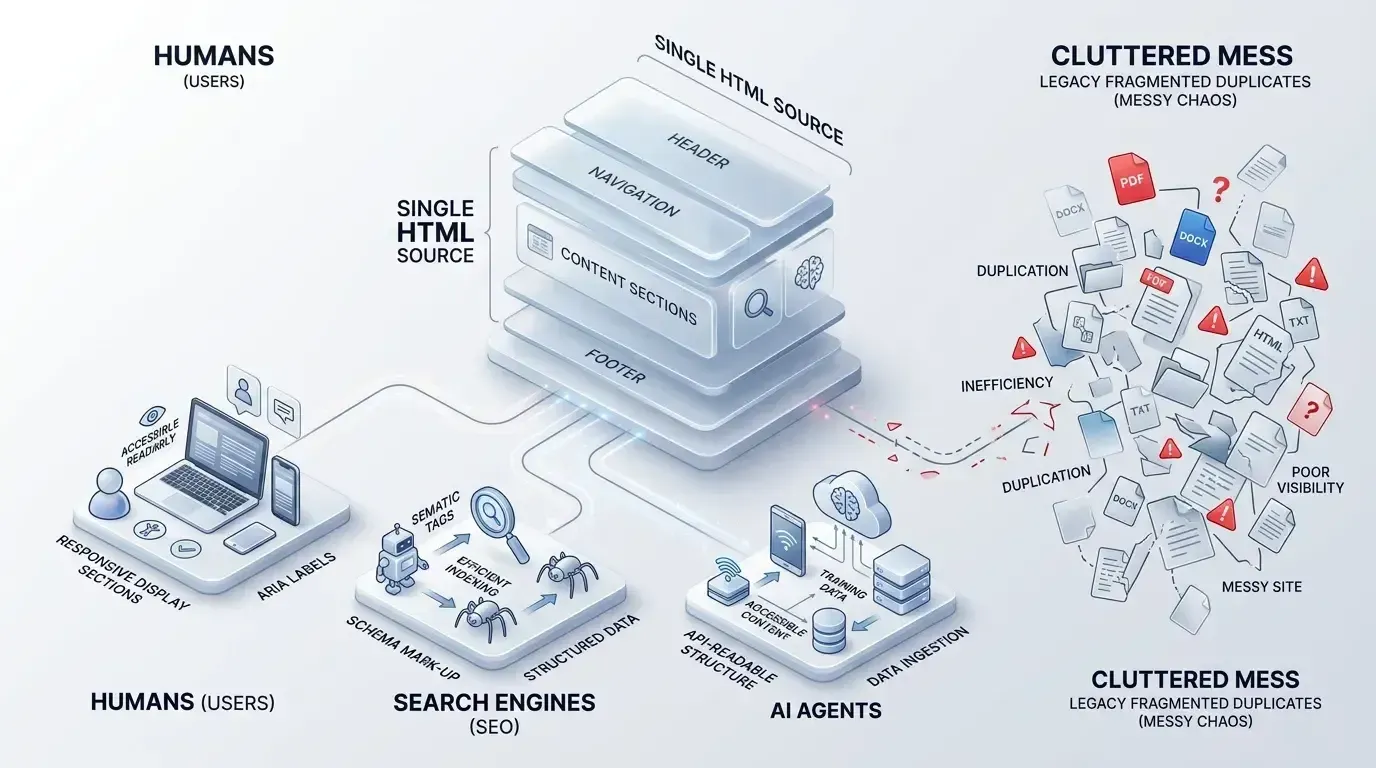
TL;DR
- A GEO audit checks four areas in order: technical access for AI crawlers, passages that can be quoted on their own, consistent facts across other sites, and whether your brand is cited for a fixed prompt set.
- robots.txt tokens are separate per crawler: GPTBot (OpenAI training), OAI-SearchBot (ChatGPT search), PerplexityBot, ClaudeBot and Google-Extended (Gemini use only), so blocking one never blocks another.
- Google says AI Overviews and AI Mode follow normal Googlebot rules, need the page indexed and snippet-eligible, and respect nosnippet and max-snippet; Google-Extended does not affect them.
- A free GEO audit is possible with Search Console, Bing Webmaster Tools, Screaming Frog's free 500-URL crawl, server logs and manual prompt checks in ChatGPT, Perplexity, Gemini and Copilot.
- The report should carry eight parts: decision summary, scope and method, technical, content by page, authority, citation baseline with raw answers, prioritised action plan and re-check plan.
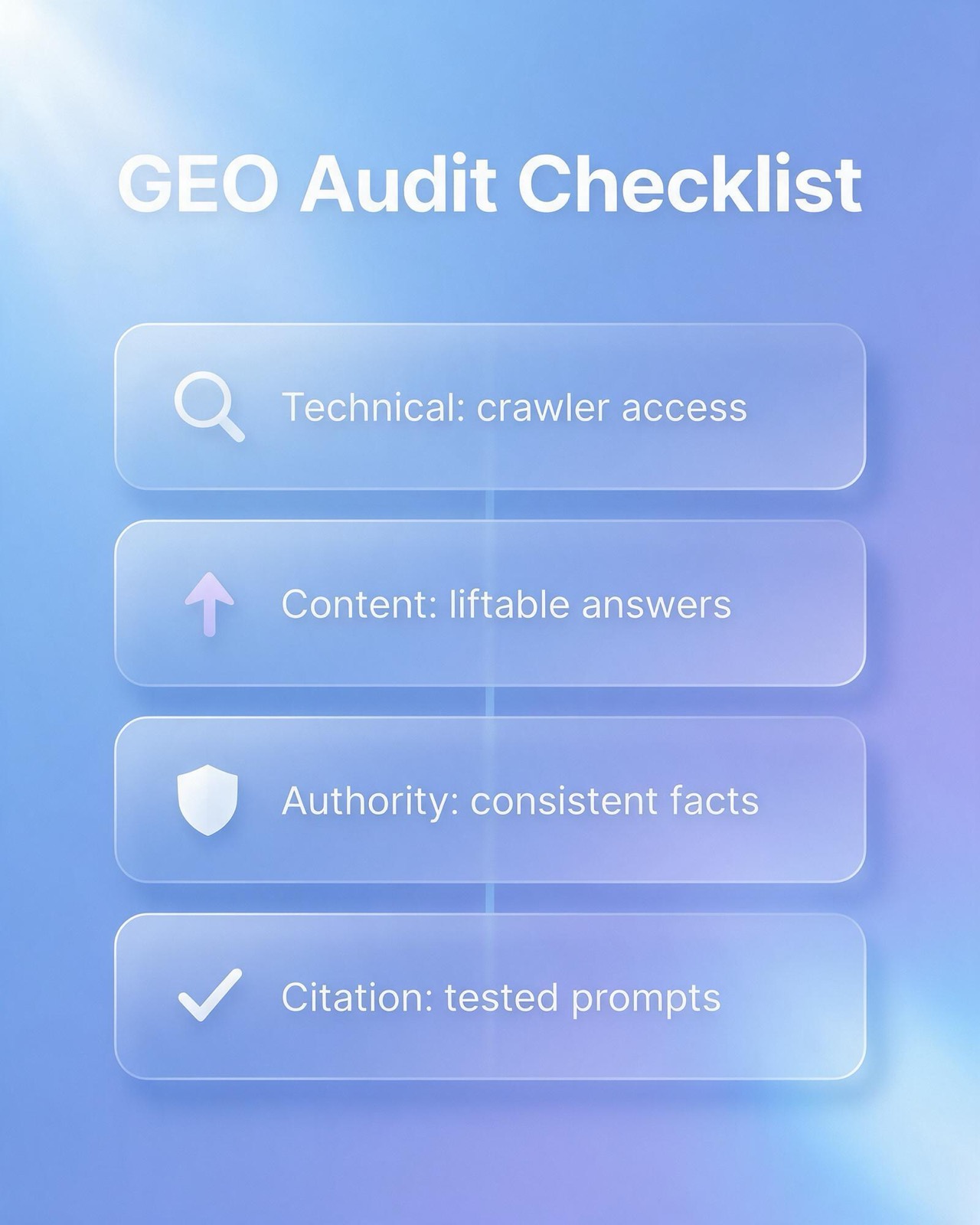
A GEO audit is a structured review of whether AI answer engines such as ChatGPT, Perplexity, Gemini, Microsoft Copilot and Google's AI Overviews can reach your pages, understand them, trust them and use them when they answer questions in your category. It ends with a prioritised list of fixes, grouped into four areas: technical access, content that can be quoted, authority signals from other sites, and evidence of whether you are actually being cited today.
This guide covers what a GEO audit includes, a checklist for each of the four areas, how to run a GEO content audit on your highest-volume queries, which tools help and which free options are enough to start, and what a usable GEO audit report should contain. It does not cover how to track GEO results month after month (that is a measurement job with its own methods), and it does not cover using AI agents to run the audit for you. Both are separate topics.
What is a GEO audit, and why does it matter
GEO stands for generative engine optimization: the work of getting your content used inside AI-generated answers, either as a named source with a link or as a brand mentioned in the answer text. A GEO audit is the diagnostic step before that work. It answers a narrow question: if an AI system went looking for an answer that your business should be part of, what would stop it from using your page?
The question matters because AI answers fail differently from ordinary search results. In a classic results page, a weak page still appears somewhere in the list, and you can see its position. In an AI answer, the model either uses your content or it does not. A page can rank well in Google and still be absent from AI answers, for example because its key facts are buried in a long paragraph that does not make sense out of context, or because an AI crawler is blocked in robots.txt by a rule nobody remembers adding.
The audit is the first stage of GEO work, and it is the part you can do yourself, with or without outside help.
How a GEO audit differs from an SEO audit
A traditional SEO audit checks whether search engines can crawl and index your site, whether pages target the right queries, and whether links and technical health support rankings. A GEO audit keeps most of that foundation, because AI systems that ground their answers in web results still depend on pages being crawlable and indexed. Google, for example, states that to be eligible as a supporting link in AI Overviews or AI Mode, a page must be indexed and eligible to show a snippet in Google Search. There is no separate submission process.
What a GEO audit adds is three layers an SEO audit usually skips:
- AI-specific crawler access. AI companies run their own crawlers with their own robots.txt user-agent tokens, and blocking one does not block the others.
- Passage-level quality. AI systems lift short passages, not whole pages. The audit checks whether a single paragraph still answers the question correctly when it is read alone.
- Answer presence. Instead of rank positions, the audit records whether your brand or URL appears in real AI answers for a defined set of prompts.
What a GEO audit is not
A GEO audit is a point-in-time diagnosis. It sets a baseline and produces a fix list. Ongoing measurement, such as prompt tracking over months, attribution in analytics and reporting on citation trends, is a different job; if that is what you need, the companion article on how to measure GEO covers it in detail. Keeping the two apart matters in practice: an audit that tries to be a dashboard tends to produce lots of numbers and too few fixes.
GEO audit checklist: technical, content, authority and citation
The checklist below splits the audit into four areas. Run them in this order, because each one depends on the one before it. A page that AI crawlers cannot fetch will not be cited however good the writing is, and good writing will not help much if every other source on the web contradicts your facts.
1. Technical: can AI systems reach and read the page?
Start with robots.txt, because it is the most common silent blocker. Check the rules for each AI user-agent separately. The main tokens to look for are:
- GPTBot: OpenAI's crawler for collecting training data.
- OAI-SearchBot: OpenAI's crawler for surfacing pages in ChatGPT search results. Blocking GPTBot does not block OAI-SearchBot, and the reverse is also true.
- ChatGPT-User: used when a ChatGPT user's request causes a page to be fetched.
- PerplexityBot: Perplexity's crawler for indexing pages for its answers.
- ClaudeBot: Anthropic's crawler.
- Google-Extended: a robots.txt token, not a separate crawler. It controls whether content Google crawls may be used for Gemini model training and grounding. It does not affect inclusion in Google Search, and Google states that AI Overviews follow normal Googlebot rules, not Google-Extended.
The decision about which of these to allow is a business decision, not a technical default. Some publishers block training crawlers while allowing search crawlers, so their content can be cited in answers without being used for model training. The audit's job is to record what the current rules actually do and flag any rule that contradicts the stated goal. A common finding is a blanket Disallow: / for an unknown bot list copied from a template years ago.
Next, check the layers above robots.txt:
- Firewall and CDN bot rules. Some CDN and security services offer one-click settings that block AI crawlers. If one of these is switched on, robots.txt is irrelevant, because the request never reaches your server. Check the CDN dashboard, not just the file.
- Server logs. Look for requests from the user-agents above and their response codes. A run of 403 or 429 responses to an AI crawler means it is being refused or rate-limited.
- Rendering. Do not assume an AI crawler executes JavaScript the way Googlebot does. Open the raw HTML (view source, not the inspector) and check that the main text, headings and key facts are present without scripts running. Content that only appears after client-side rendering is a risk.
- Snippet controls. In Google, nosnippet, data-nosnippet and max-snippet limit how text can be shown, and they apply to AI Overviews and AI Mode as well. A nosnippet tag added for another reason can quietly remove a page from AI features.
- Indexing basics. Canonicals pointing to the right URL, no stray noindex, an XML sitemap that lists the pages you want used, and submission to both Google Search Console and Bing Webmaster Tools. Bing matters here because Microsoft Copilot grounds its answers in Bing's index.
- Structured data. Organization, Article, Product, FAQPage or LocalBusiness markup, where relevant, validated and matching the visible content. Structured data does not guarantee a citation, but it removes ambiguity about who you are and what the page is.
Some sites also publish an llms.txt file. Treat it as optional. It is a community proposal, and the major AI search providers have not documented it as an input they rely on, so it should never be a priority fix ahead of crawler access or rendering.
2. Content: can a passage be lifted and still be right?
AI answer engines retrieve and quote passages. The content part of the audit checks each priority page for whether its most important answers survive being pulled out of context. Questions to ask of each page:
- Does the first paragraph answer the main question in one or two sentences, using the same words a user would use in a prompt?
- Does each section open with its answer, then explain? Sections that build slowly toward a conclusion are hard to quote.
- Are pronouns resolved? A passage that starts "It also supports this" is useless on its own. The quoted passage needs to name the product, the place or the rule.
- Are facts specific and checkable: names, dates, versions, limits, prices you actually publish? Vague claims give a model nothing to cite.
- Are comparisons and steps in lists or tables, where they are easy to extract?
- Is the page dated, and is the date honest? Updating the date without updating the content creates a mismatch that a careful reader, human or not, can detect.
- Does the page cover the follow-up questions a person asks next, or does it stop at the first answer?
The content check also looks across pages. If three pages on your site give three different answers to the same question, for example three different minimum order quantities, any one of them may be quoted, and the result will be inconsistent. Consolidating overlapping pages is often a higher-value GEO fix than writing new ones.
3. Authority: do other sources agree with you?
AI systems that cross-check sources tend to prefer facts that appear consistently across several places. The authority part of the audit looks outside your site:
- Entity consistency. Your business name, address, phone, founding year, service list and leadership should match across your site, your Google Business Profile, LinkedIn, industry directories and any Wikipedia or Wikidata entries. Conflicts here are one of the easiest problems to find and fix.
- Third-party coverage. List where your brand is discussed by others: trade press, review sites, comparison articles, forums, marketplaces. Note where coverage is missing for the topics you want to be cited for.
- Author signals. Pages that make expert claims should show who wrote them and why that person is qualified, with an author page that links to their other work.
- Review platforms. For local and consumer businesses, the content of reviews, not just the star rating, is text that can feed into answers about your business.
Authority work is slow to change, so the audit's role is mostly to map the gaps and fix the inconsistencies you control directly.
4. Citation: are you being used today, and for which prompts?
The last area is the evidence check. Build a prompt set from the questions your customers actually ask, then run it in each AI engine that matters to your market and record three things per answer: whether your brand is mentioned, whether one of your URLs is cited, and which other sources are cited instead.
The "which other sources" column is the most useful one for the audit. If the same comparison site, directory or forum thread is cited again and again for your category, that tells you where the engines are getting their information, and it points to either a content gap on your site or an authority gap off it. For the methods to repeat this check on a schedule and turn it into a trend line, use the dedicated measurement approach rather than expanding the audit.
The table below summarises the four areas, what each one checks, and where you look to check it.
| Audit area | What you check | Where you check it |
|---|---|---|
| Technical | AI crawler access, rendering without JavaScript, snippet controls, indexing in Google and Bing | robots.txt, CDN or firewall bot settings, server logs, raw HTML, Search Console, Bing Webmaster Tools |
| Content | Answer-first openings, self-contained passages, specific facts, lists and tables, consistency across pages | Priority pages, read section by section as if each paragraph stood alone |
| Authority | Matching business facts across the web, third-party coverage, author pages, reviews | Google Business Profile, directories, LinkedIn, trade press, review platforms |
| Citation | Brand mentions, cited URLs and the competing sources cited in your place | A fixed prompt set run in ChatGPT, Perplexity, Gemini, Copilot and Google AI features |
How to run a GEO content audit for high-volume search queries
You cannot audit every page in the same depth. A GEO content audit for high-volume search queries focuses effort where the demand is: the questions many people ask, and where an AI answer is likely to replace a click. Here is a workable sequence.
- Pull the query list. Export queries from Google Search Console for the last few months and sort by impressions. Impressions are a better starting point than clicks, because a query with high impressions and a low click-through rate may already be answered on the results page.
- Keep the question-shaped queries. Filter for queries that start with or contain who, what, how, why, which, best, vs, cost or compare. These are the queries most likely to trigger AI answers. Group close variants into one topic.
- Map each topic to one page. Note which URL currently gets the impressions. If two or more URLs split the impressions for the same topic, flag it: that split usually means neither page is the clear answer.
- Turn each topic into prompts. Rewrite the query as two or three natural questions a person would type into a chat assistant. Prompts are longer and more specific than search queries, so add the context a real buyer would give, such as location, budget range or company size.
- Run the prompts and record the answer. For each prompt, note whether your page is cited, what the answer says, and which sources are cited. Check whether the answer is correct about your business.
- Score the page against the content checklist. Use the content questions above. Write the specific fix: "move the price range from paragraph six to the opening," not "improve clarity."
- Prioritise by demand and effort. Fixes on high-impression topics where you are absent from AI answers and the page needs only restructuring come first. New pages and authority work come later.
An illustrative example, with made-up numbers to show the method: a Bangkok property developer finds that the query "condo maintenance fee per square metre" brings in 4,000 impressions a month across two URLs, a news post and a pricing page. In ChatGPT and Perplexity, the answer cites a property portal and a forum thread, not the developer. The pricing page lists its fee in a table at the bottom without the unit, and the news post mentions an old figure. The fix list has three lines: consolidate into the pricing page, state the fee and its unit in the first paragraph with the date it applies from, and redirect or update the news post so the old figure stops circulating.
GEO audit tool options
No single GEO audit tool covers all four areas. Most audits combine a crawler for the technical layer, a visibility tool for the citation layer and manual review for content and authority. The categories that exist today:
- Site crawlers. Tools such as Screaming Frog SEO Spider, Sitebulb, or the site-audit modules in Ahrefs and Semrush can check robots.txt, status codes, canonicals, structured data and rendered versus raw HTML across a whole site. They do the technical part at scale.
- AI visibility trackers. A newer category runs prompt sets in AI engines and reports brand mentions and citations. Examples include Ahrefs Brand Radar, Semrush's AI visibility features, Similarweb's AI search tools, Profound, Peec AI and Otterly.AI. They differ in which engines they cover, how prompts are chosen and whether results are sampled or run on demand.
- Log analysis. Log file analysers, or a CDN's own bot analytics, show which AI crawlers actually request your pages and what responses they get. This is the only direct evidence of crawler behaviour.
- Validation tools. Google's Rich Results Test and the Schema Markup Validator check structured data. Search Console's URL Inspection shows how Google sees a specific page.
Pricing for these tools changes often and depends on plan, prompt volume and the number of engines tracked, so check each vendor's current pricing page rather than relying on a figure in any article. When comparing visibility tools, ask three questions: which engines and countries are covered, whether you can supply your own prompts, and whether you can see the full answer text and cited sources, not just a score. A single visibility score is hard to act on; the raw answers are what tell you what to fix.
Free GEO audit: what you can do without paid software
A free GEO audit is entirely possible for a small or medium site. It takes more time, but nothing in the four-area checklist strictly requires a paid tool. A free toolkit looks like this:
- robots.txt and raw HTML. Read your robots.txt directly in the browser and check each AI user-agent. Use view-source on priority pages to confirm the content is in the HTML.
- Google Search Console. Free query and page data for the high-volume content audit, plus URL Inspection for indexing status.
- Bing Webmaster Tools. Free indexing data for the search index behind Copilot, plus its own site scan.
- Screaming Frog SEO Spider, free version. Crawls up to 500 URLs, which covers the priority pages of most small sites.
- Rich Results Test and Schema Markup Validator. Free structured data checks.
- Server or hosting logs. Most hosting panels let you download raw access logs. Search them for the AI user-agent names.
- Manual prompt checks. Run your prompt set in the free tiers of ChatGPT, Perplexity, Gemini and Copilot and record results in a spreadsheet. Use a logged-out or fresh session where possible so personal history does not shape the answers.
Be careful with tools marketed as a "free GEO audit" that ask only for a URL and return a score in seconds. Some are useful quick checks of robots.txt and structured data. Others are lead-capture forms with a generic report. Before trusting a score, check whether the tool tells you exactly which crawler rules, pages and prompts it looked at. If it cannot, the score is not evidence of anything.
Paid tools earn their cost when you need many prompts across several engines and countries on a schedule, or when your site has thousands of pages. For a first baseline on a focused set of priority pages, the free route is enough.
GEO audit report: what it should contain
A GEO audit report is only as good as the decisions it makes possible. It should be short enough that someone reads the whole first section, and specific enough that a developer or writer can act on each line without asking what it means. A practical structure:
- Summary for decision makers. One page: the three to five problems with the biggest effect, what each one costs if left alone, and what fixing it involves. No scores without explanation.
- Scope and method. Which pages were audited, which AI engines and countries were checked, the prompt list used, the dates the checks were run and any limits, such as engines that could not be tested.
- Technical findings. The robots.txt and CDN rules per AI crawler, with a plain statement of what each rule does today; rendering problems; snippet controls; indexing issues in Google and Bing.
- Content findings by page. For each priority page: the topic, the current state of its opening and key passages, and the specific rewrite or consolidation needed.
- Authority findings. A list of inconsistent business facts and where each one appears, plus gaps in third-party coverage for priority topics.
- Citation baseline. For each prompt: mentioned or not, cited or not, and the sources cited instead. Keep the raw answers in an appendix, because AI answers change and the report should show what was true on the day.
- Prioritised action plan. Each fix with an owner, an effort estimate (small, medium, large) and the expected area of effect. Separate quick fixes, such as a robots.txt rule, from long projects, such as building third-party coverage.
- Re-check plan. When to rerun the citation baseline and how results will be tracked afterwards, linking to whatever measurement method you use.
Agencies that deliver audits under their own brand often need the same structure in a format they can present to their own clients. A white-label marketing service for agencies can supply that, but the structure of the report does not change with the logo on it.
Common GEO audit mistakes
- Checking only GPTBot. Allowing or blocking one OpenAI crawler says nothing about OAI-SearchBot, PerplexityBot or the others. Each token needs its own check.
- Ignoring the CDN. A clean robots.txt means nothing if a bot-management setting refuses the request before it reaches the server.
- Testing prompts once. AI answers vary between runs and between sessions. A single run per prompt can make you look present or absent by chance. Run each prompt more than once and note the variation.
- Auditing the home page only. AI answers usually cite the page that answers a specific question: a pricing page, a guide or a product page. The audit should follow the queries, not the site menu.
- Writing vague fixes. "Improve E-E-A-T" is not a fix. "Add an author box with the engineer's qualifications to the three installation guides" is.
- Treating structured data or llms.txt as the main lever. Both can help clarity. Neither replaces crawler access and a clear answer on the page.
GEO audits for Thai-language sites and the Thai market
Sites serving Thailand need a few extra checks. First, test prompts in both Thai and English, because buyers in Thailand use both, and the cited sources often differ between the two languages. A brand can be cited in English answers and absent from Thai ones, or the reverse.
Second, check the Thai pages on their own. If the Thai version is a thin translation, loaded by JavaScript, or missing hreflang links to its English counterpart, AI systems may have no usable Thai passage to quote. Thai text also has no spaces between words, so make sure key facts such as prices, units, dates and product names are written clearly and consistently rather than split across images or decorative layouts.
Third, the authority layer in Thailand runs through local sources: Thai-language news sites, marketplace listings, Pantip threads, LINE Official Account profiles and Google Business Profiles. When the audit lists which sources are cited in place of you, these local platforms often appear, and they show where your business facts need to be correct and current.
For businesses that want to be recommended by ChatGPT specifically, the same checklist applies, with extra attention to OAI-SearchBot access and Bing indexing; the ChatGPT SEO service page covers that focus.
GEO audit FAQ
How long does a GEO audit take?
A focused GEO audit of 20 to 50 priority pages and a prompt set of a few dozen questions usually takes from several days to a few weeks, depending on how many AI engines and languages are covered. The technical checks are fast; the content review and the citation baseline take most of the time, because they involve reading pages and answers closely.
How often should you run a GEO audit?
A full GEO audit makes sense once or twice a year, or after a major site change such as a redesign, CMS migration or new CDN setup. Between audits, a lighter monthly check of robots.txt, CDN bot rules and your prompt set catches the problems that appear without warning.
Can a GEO audit guarantee citations in ChatGPT or Google AI Overviews?
No, a GEO audit cannot guarantee citations, because no AI provider publishes a guaranteed path to being cited. What the audit can do is remove the barriers you control, such as blocked crawlers, unreadable pages and conflicting facts, and show you where the gaps are relative to the sources being cited now.
Is a GEO audit the same as an AI SEO audit?
The terms overlap and are often used for the same work. "AI SEO" sometimes also means using AI tools to do SEO tasks, which is a different thing; the AI-powered SEO page explains that side. A GEO audit is specifically about visibility inside AI-generated answers.
Do I need a GEO audit if my SEO is already strong?
Yes, it is still worth running, because strong rankings do not confirm AI crawler access, passage-level clarity or answer presence. A short GEO audit on a site with good SEO is usually quick, and it often finds one or two specific blockers that rankings would never reveal.
If you would like a second pair of eyes on any part of this checklist, Relevant Audience's GEO service starts with exactly this kind of audit and turns the findings into a working plan for your site.