TL;DR
- AI marketing splits into six jobs: generative content, predictive analytics, chatbots, personalization, programmatic media buying, and AI SEO and GEO. Each needs different data and a different metric.
- Start with one repeating task you can time, write down what good looks like, keep a human fact check, and only expand once the first task is stable.
- This article quotes no uplift figures for any brand, because the widely circulated ones have no source, no control group and no time window. Judge a case study by those six questions instead.
- Thai drafts need more human editing than English ones, Thai customer service runs through chat rather than email, and Thai sentiment and keyword tooling is thinner, so plan the workload differently.
- Pick tools by the job they do, not by price or brand, and check with whoever owns data compliance before connecting customer data to anything new.
AI marketing is the use of artificial intelligence inside marketing work that used to be done by hand or took a long time: drafting content, analysing customer data, answering chat messages, recommending products to individual users, buying media, and shaping web content so it gets picked up by AI-driven search. What you get back most clearly is speed and volume. What AI still cannot do for you is decide which message is correct for your brand, or which data set is trustworthy enough to act on.
This article runs from the definition through the benefits, the six main application types, a start-up sequence you can actually follow, tools grouped by the job they do, how to read global brand cases without being fooled by numbers, and what to watch out for with personal data and the work that still needs people. One note up front: this article quotes no result figures for any brand, because the numbers passed around in marketing writing usually have no source, no control group and no time window attached. Setting your team a target from a number like that is setting a target from thin air.
What AI marketing actually is
AI marketing is the use of systems that learn from data to do or assist marketing work, instead of following fixed rules written out one by one. The word AI here covers two groups of things that work quite differently. The first group generates something new: it writes text, makes images, summarises documents. The second group predicts or classifies: it guesses which customers are likely to buy again, or sorts your customer base into groups that behave alike.
That line matters when you buy tools. Generative models work immediately with almost none of your own data. Predictive models are useless without your business history fed into them. Plenty of companies buy a prediction system and never use it, for one reason: their purchase history is scattered across several places and cannot be joined up.
It is also worth knowing that the word AI is used loosely on software sales pages. Some features labelled AI are ranking by a score somebody defined in advance. That is not bad, but it means you should not pay learning-system prices for an ordinary formula. The easiest check is to ask the vendor what data the model learns from, how often it updates, and whether the output would change at all if you fed it none of your own data.
Finally, AI marketing is not a new department you need to create. It is a layer of tooling inside work you already do. If the underlying process is broken, for example nobody knows what your best customers look like, adding AI only gets you the wrong answer faster.
What AI marketing is good for
The benefits of AI marketing come down to four things: less time spent on drafting and repetitive work, more test versions for the same cost, reading volumes of data a person cannot get through, and answering customers outside office hours. All four are measurable in daily work. You do not have to wait for a revenue result to know whether it is paying off.
The first is time. The work AI helps with most has a clear structure and plenty of examples: drafting email subject lines, condensing a long article into captions, turning product specs into ad copy, writing catalogue descriptions for a store with a thousand items. That work used to eat a content team's week, even though the real value sits in choosing and checking, not typing.
The second is the number of versions. When drafting gets cheap, you can test ten headlines instead of two. The catch is traffic. With low volume, more versions means each one collects too little data to conclude anything, and two versions give you a more trustworthy answer.
The third is reading data. Grouping and prediction systems can read the behaviour of tens of thousands of customers in minutes and point out who is likely to drift away and who is likely to buy more. What they cannot tell you is why. The reason still comes from talking to real customers or to your sales team.
The fourth is response time. A customer who messages at ten at night and hears nothing until morning often goes elsewhere. Automated responses close that gap, as long as the system knows when to hand over to a person.
The benefit people mention least is what it does to collaboration. When a first draft appears quickly, team discussion shifts from arguing in the abstract to fixing something concrete, which finishes much faster.
The six main types of AI marketing
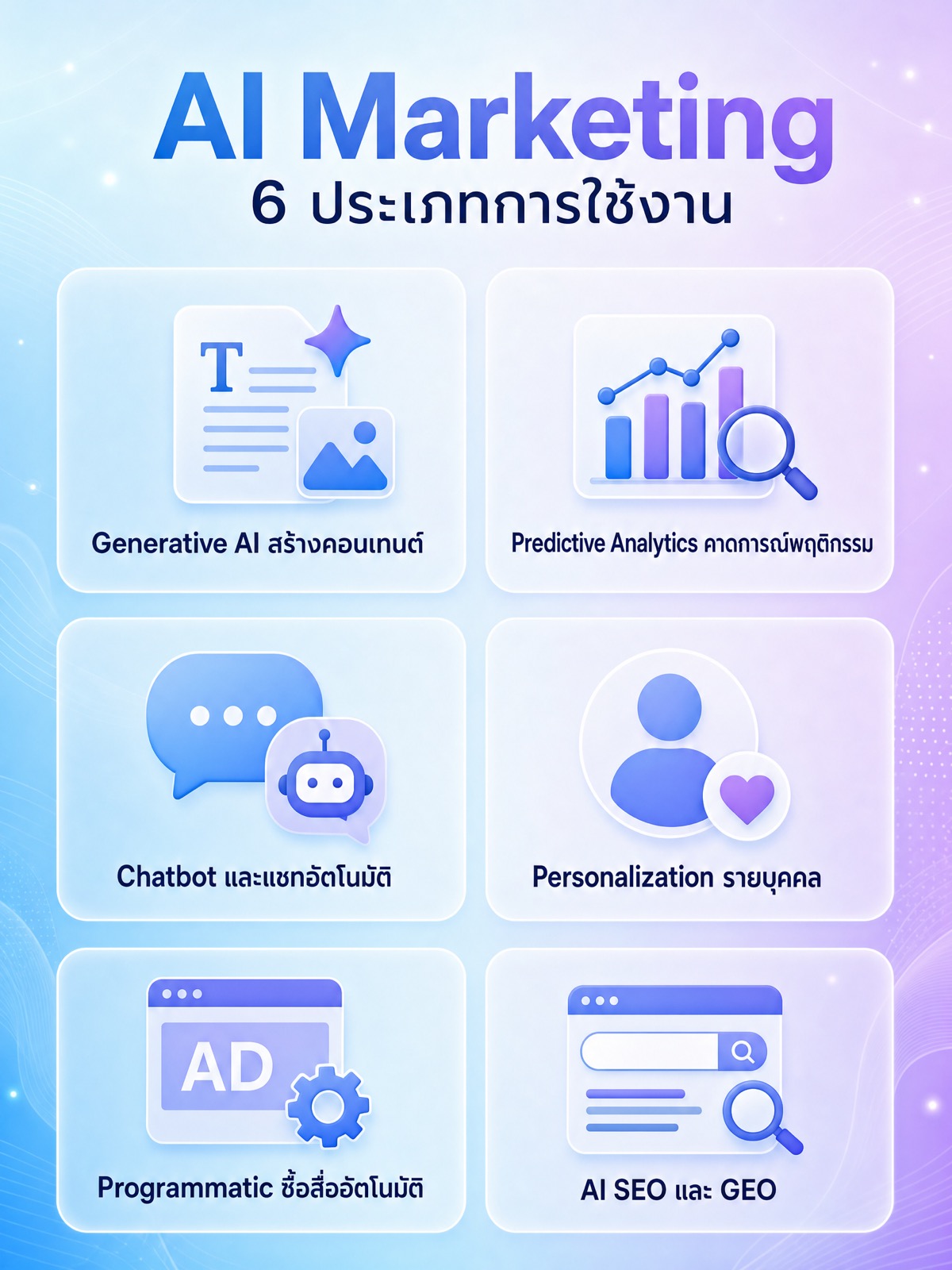
In practice AI marketing splits into six types according to the job it does: generative AI for content, predictive analytics for behaviour, chatbots and automated chat, personalization of content and offers, programmatic media buying, and AI SEO and GEO. Each type uses a different data set and is measured differently. Knowing which one you are doing keeps you from picking the wrong tool and the wrong metric.
1. Generative AI for content
Generative AI for content means using language and image models to draft copy, artwork, video scripts and article outlines. It works best on volume with a repeating shape: several ad copy versions for testing, or product descriptions for an online store with a thousand items. What still needs a person is the facts about the product, the price, the conditions and the brand's voice. A model does not know when your promotion expires, and it will confidently guess if you do not tell it.
2. Predictive analytics for behaviour
Predictive analytics for behaviour means using historical data to forecast what happens next: which customers are likely to stop buying, which products will sell next month, which lead the sales team should call first. These systems need reasonably clean history. If your transactions live in a separate Excel file per month, the first job is not buying a model, it is getting the data into one place.
3. Chatbots and automated chat
Chatbots and automated chat means letting a system take the first round of customer questions, answer the ones that repeat every day, and hand over to a person when the matter is complex or involves money. In Thailand the main channel for this is chat inside the app customers already use, not only a web chat box. Good design starts by collecting the thirty questions your admins answer most often and limiting the bot to that set, rather than letting it answer everything.
4. Personalization of content and offers
Personalization of content and offers means changing what each user sees based on that person's behaviour and history. The everyday examples are the recommended product rows in a shopping app, the ordering of the home screen in a streaming service, and the email that brings back the item you left behind. The condition is enough behavioural volume. A store with a few hundred visitors a day and a few dozen products usually gets more out of better categorisation than out of a recommendation system.
5. Programmatic media buying
Programmatic media buying means letting a system bid for and choose ad placements in real time against the goals you set, instead of buying media as a package in advance. The system learns from the conversion signals you send back, which means the quality of your measurement setup matters more than manual bid tweaks. If the conversion signal is wrong, the system will diligently learn the wrong thing. The service side of this is covered on the marketing process automation page, including connecting systems and setting automation rules.
6. AI SEO and GEO
AI SEO and GEO means getting your content picked up in answers from search engines and AI assistants, not only ranking in ten blue links. The work is making each passage answer one question completely on its own, giving it material that can be quoted such as tables, steps and common questions, and making sure the page can be reached and understood by the systems that collect it. The approach is described on the AI SEO page.
How to use AI marketing, step by step
The way to use AI marketing without it falling apart is to start with a single task whose time you can measure, not with buying a platform. The sequence below is designed for a small team to complete within a month without a data team of its own.
- Pick one repeating task you can time. Twenty captions a week, or the repeat questions in chat. Write down how long it takes per item today. That number is your baseline, and nobody has it for you.
- Write down what good looks like. Length, tone, banned words, information that must appear every time. This document becomes the instruction you feed the model and the checklist people review against.
- Feed it three to five real examples you were happy with, so the model can see the shape you want. This works better than describing it with long adjectives.
- Let the model draft and always have a person edit. Record how heavily each piece had to be edited. If more than half needs rewriting, your instruction is not good enough yet, which is not the same as the model being useless.
- Check facts separately from checking style. Prices, specs, conditions, promotion end dates: somebody has to compare each one against the source. Models invent these convincingly.
- Measure after two to four weeks. Compare time per item against your baseline, and check whether quality dropped by looking at the downstream metric, such as click rate or reply rate.
- Only then expand to a second task. Opening six workflows at once in month one is the surest way to make sure none of them improves.
The three mistakes that come up most often: no baseline, so nobody can say whether anything improved; publishing model drafts with no fact check; and putting identifiable customer data into public tools without asking whoever owns data handling first. The last two cost more than people expect, because they are much harder to fix afterwards than to prevent at the start.
AI marketing tools, grouped by the job they do
Choose AI marketing tools by the job you need done, not by the name you have heard most. The table below compares categories of tool, not prices or plans, because pricing and features change often enough that any figure printed in an article expires before you use it. Check current terms with the provider directly.
| Tool category | What it can actually do | Limits to know about |
|---|---|---|
| Generative models for text and images, such as language assistants and image generators | Draft content, summarise documents, convert formats, adjust tone, produce first-pass artwork | Knows nothing about your internal information unless you supply it, and invents facts confidently. Every piece needs a human check. |
| Analytics and prediction tools, such as web analytics products and data warehouses | Group customers, predict churn, rank leads, show the path before purchase | Needs centralised, clean history. If the data is scattered, the predictions mean nothing. |
| Chat platforms and automated reply systems | Take the first round of questions, answer repeats, collect basic details, hand over to an admin | The question scope and handover rules must be explicit, or it will answer wrongly on things where being wrong is expensive. |
| Recommendation and personalization systems on a site or app | Order products and content per user, send email based on what someone left behind | Needs enough traffic and enough products. Small sites usually gain more from better categorisation. |
| Programmatic buying platforms and automated bidding inside ad platforms | Bid and allocate budget against goals in real time, expand targeting from available signals | Output quality depends on conversion measurement being correct. A wrong signal teaches the system the wrong lesson. |
The sixth category is AI SEO and GEO tooling, which checks whether your content is being cited in AI assistant answers and helps structure content so systems can read it. This category is new and the measurement methods are not settled, so treat it as a way to watch direction rather than as a number for a board report. If you want content structured to be quotable from the start, the approach is on the content marketing page.
Four questions worth asking before buying any tool: where will our data be stored and will it be used to train models, how do we get our data out if we stop using it, who on the team will actually run this, and how much time does the current process waste per month without it. The last one usually gets skipped, and it is the only one that tells you whether the purchase pays.
Which brands use AI in marketing, and how to read a case study
Which brands use AI in marketing? Effectively every large brand with a lot of users on its own app or site. But this article quotes no result figures for any brand, because the popular numbers passed around in marketing writing cannot be traced to a source, do not state how they were measured, and are often copied until they no longer mean what the original said. Looking at the mechanism is more useful, along with learning to read the cases you find elsewhere.
The mechanisms that can be described plainly: a streaming service such as Netflix organises its experience around algorithmic recommendation of what to watch next, so no two users see the same home screen. Large retailers and marketplaces routinely run product recommendation and per-user page ordering on their own apps and sites. Several consumer goods brands have publicly said they use generative tools in campaign creative. All of that describes how the mechanism works. None of it certifies how well it performed.
When you read a case study with attractive numbers, ask these six questions before believing it.
- Was there a control group? Without a group that did not get the change, a rise could come from seasonality, a promotion or a price change.
- What was the time window? Comparing a festival month against an ordinary one produces a lovely number without anyone doing anything.
- How is the metric defined? An increase in engagement might mean clicks, views or time spent, which are not the same thing.
- What else changed at the same time? If the site, the ad budget and the AI all changed together, nobody can separate the cause.
- Who published the number? A figure from a tool vendor carries different incentives than one a brand reports in its own official filings.
- How big was the base? A hundred percent increase off a tiny base has almost no business meaning.
If a case cannot answer those six, use it as inspiration about mechanism, but do not turn it into a numeric target for your team. The only baseline you can set targets from is your own business data, measured against last month and the same period last year.
Personal data and the work that still needs people
Two things need care with AI marketing: how personal data is used, and letting unreviewed output reach the public. Thailand has a personal data protection law in force, so using customer data for personalization, or feeding it into an external tool, creates obligations around consent and the purpose the data was collected for. This article is not legal advice and will not conclude on anyone's behalf. Take the questions below to whoever owns compliance in your organisation, or to your own legal adviser.
- What purpose was this data collected for, and does the new use fall inside that purpose?
- Where does the tool store data, and is it used to train the provider's models?
- Do we actually need to send identifiable data, or would data with identifiers stripped be enough?
- If a customer asks for deletion, can we do it everywhere the data has travelled?
- Who approves connecting customer data to a new tool?
The second area is the work that still needs people: deciding where the brand stands, checking facts, handling an unhappy customer, and writing anything that needs specific context, such as culturally sensitive material or subjects with legal exposure. For that group the cost of a mistake outweighs the time saved by a wide margin. Deciding in advance which categories may never ship unreviewed output saves a lot of arguing later.
What is different in the Thai market
Using AI marketing in Thailand differs from what English-language articles describe in three ways that affect daily work. The first is language quality. General language models handle English better than Thai when it comes to politeness levels, sentence-final particles and brand voice. The consequence is that Thai drafts need more human editing time than English drafts. Teams that plan for equal time savings in both languages tend to set the wrong deadlines.
The second is the customer service channel. Thai customers contact brands through chat in the app they already use far more than by email, which changes what a chatbot is for. Chat conversations are short and informal, often carry an image or a payment slip, and customers expect a fast reply. A system designed around email tickets often does not fit that behaviour, and the measurement differs too: the numbers to watch are the share of conversations resolved without handover, and first response time outside office hours.
The third is Thai-language data tooling. Sentiment analysis and keyword research tools for Thai have fewer options than their English equivalents, and Thai word segmentation, in a script with no spaces between words, can distort results. In practice, do not trust a single Thai sentiment score on its own. Sample and read the actual messages alongside it, and when doing keyword work, check the words Thai people really type, including common misspellings.
One more thing to plan for is transliteration. Thai writes brand names and technical terms several ways, both transliterated and in English. Fixing the standard forms in your brand guidance makes tool output considerably more stable.
How to measure whether AI marketing is worth it
The measurement that works is against your own baseline, not against benchmark figures quoted in articles, because no reliable public benchmark exists for this in the Thai market. There are four sets of numbers worth collecting.
- Time per item. Time the same task before and after. This arrives fastest and is the hardest to argue with.
- Edit ratio. Estimate how much of each draft has to be rewritten before use. If that ratio does not fall after several rounds of improving the instruction, the task may not suit a model.
- Downstream quality. Watch the existing metric for that work, such as click rate, email open rate or reply rate, to confirm the speed did not come at the cost of worse results.
- Share resolved by the system. For chat, look at what percentage of conversations end without handover, and whether the customers who do get handed over now wait longer.
Collect all four for at least four weeks before deciding to expand or stop, and write down what else changed during that period, such as ad budget, seasonality or a site change. Without that note, in three months nobody will remember what moved the number.
Frequently asked questions about AI marketing
Is AI marketing suitable for small businesses?
Yes, if you start with content drafting and answering repeat questions, which need no large history. The data-hungry uses, such as prediction and per-user recommendation, are usually not worth it for a business with low traffic or few orders, because the model has too few examples to learn from. Small businesses generally gain more from better product categorisation and clearer page copy.
Will AI replace marketers?
No, in the sense that AI can draft and process data but cannot decide where a brand stands or carry responsibility for the outcome. What changes is the mix of time: typing and data gathering shrink, while reviewing, deciding and talking to customers take up a larger share. The skills that gain value are framing the task clearly and reviewing work well.
Does using AI to write content hurt SEO rankings?
What affects rankings is the quality and accuracy of the content, not the tool used to type it. Content that answers the question directly, contains information that can be verified, and does not duplicate other pages on your own site can rank whoever wrote it. The common failure is producing many near-identical pages that compete with each other, and publishing wrong facts because nobody checked.
How much data do I need before personalization makes sense?
There is no published minimum to rely on, and anyone quoting an exact figure has not looked at your data. The simple check is whether each group you want to separate has enough people to show a difference within a month. If a group has a few dozen people a month, splitting messaging for it cannot be measured. Start with two broad groups, such as returning customers and new visitors, then get finer.
Which tool should I start with?
Start with the tool that matches whatever eats the most of your team's time right now. If time goes into drafting content, start with a generative model. If it goes into answering the same chat questions every day, start with automated replies. If it goes into building reports and merging files, start by getting the data into one place. That order matters more than the brand of tool.
Summary and next step
AI marketing pays off on repetitive work and on work that requires reading large amounts of data, and pays off less when the task calls for judgement about where the brand stands or accuracy that cannot be wrong. The safe way to start is one task, a timed baseline, a human check at every point where facts matter, and expansion only after that. As for the result figures you see in other articles, treat them as illustrations of a mechanism, not as targets for your team.
If you want an outside view on which task to start with in your own context, the team can look at your content structure and automation setup. Service details are on the AI SEO and marketing process automation pages.