
TL;DR
- Chat apps reach Thai buyers faster than email, but the tolerance is lower: an off target send gets the account blocked permanently, and no admin panel undoes it.
- A chat business account identifies a user by an id scoped to that account, not an email or phone, so matching to purchase history needs a key collected on purpose.
- Official account plans charge per message beyond a monthly quota, which makes send everyone every week cost twice: in fees and in blocks.
- Track blocks after a send, reachable friends, first response time, click rate per send and sales started in chat. Cumulative friends supports no decision.
- Thailand's PDPA took full effect on 1 June 2022, so set a retention period and keep sensitive documents out of the conversation.
Modern CRM in Thailand has to move into chat, because the channel customers actually open and reply to has already moved to LINE. A system that stores names, phone numbers and purchase history in a table but cannot reach the customer where the customer is turns into a notebook you read after the fact, not a system that produces the next sale.
This article covers what CRM means in day to day selling, the three Thai customer behaviours that changed and left older systems short, what a system running on LINE OA actually does, how to connect it to the CRM a company already owns, the five numbers worth checking every month, and the limits worth knowing before paying for anything.
What CRM means in day to day selling
CRM is the process of collecting customer information and putting it back to work so the next contact matches what the customer already did. It is not the name of one piece of software. If the business knows which model this person asked about, when they last bought, and what went wrong for them, and the next staff member who talks to them can pull that up in seconds, the CRM is working. A contact list nobody opens during a conversation is a cost that returns nothing.
When assessing a system, split it into three layers and look at them one at a time. The first is the database: who is who, what they bought, what is outstanding. The second is the messaging channel: how you reach them and whether they actually open it. The third is the team process: who answers within how many minutes, who an unfinished case goes to, and how anyone knows a case is stuck.
Many Thai businesses invest heavily in the first layer and leave the other two to chance. The result is a tidy database with no route out to the customer. The data sits in one system, the conversation sits in another, and nobody can say what stage yesterday's enquiry is at.
Three Thai customer behaviours that changed
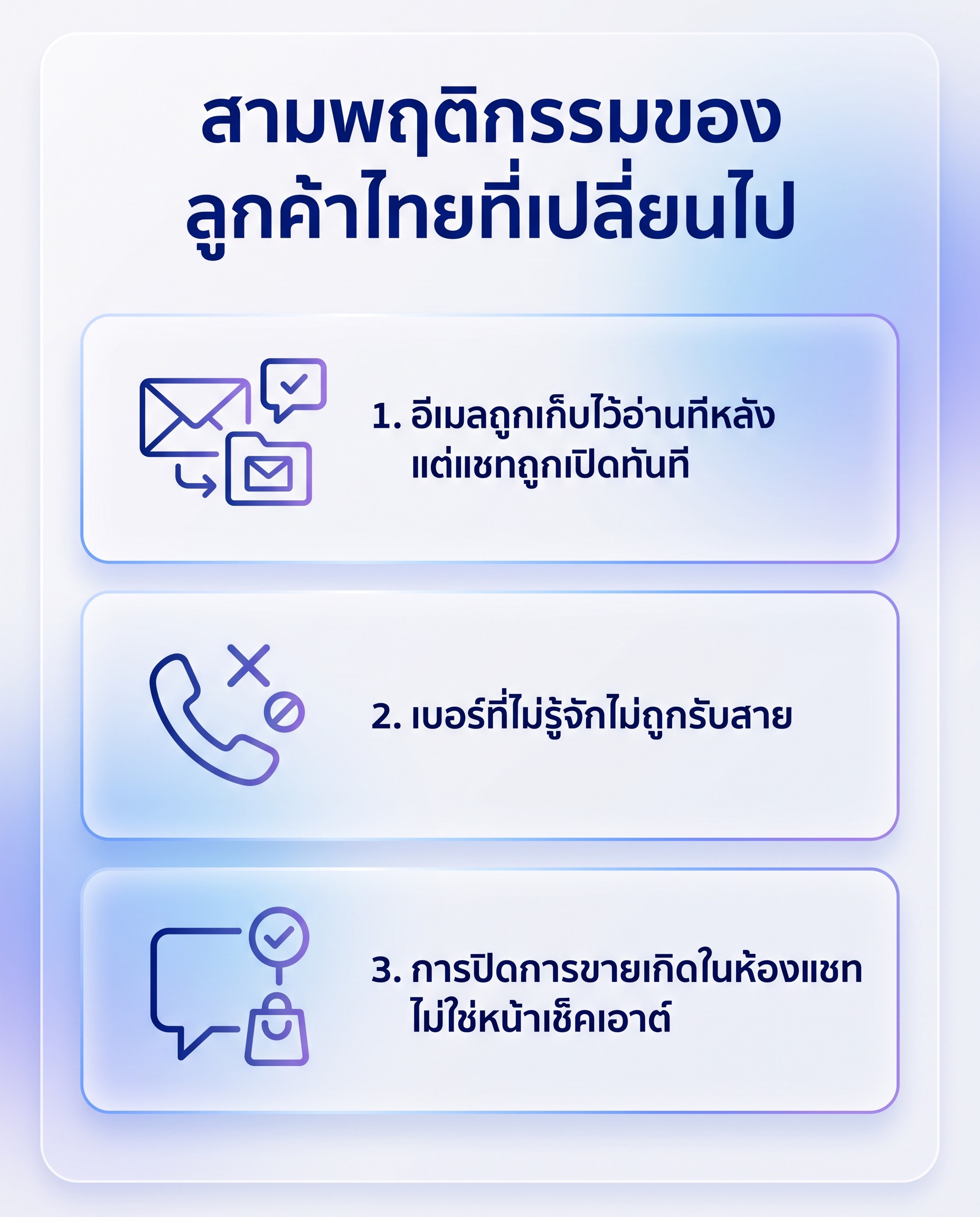
What pushed CRM to move is not new technology but a change in how buyers take in messages. The three below hit selling most directly, and each one changes the design in a different way.
One: email gets saved for later, chat gets opened now
Email still has a place in the Thai market, and that place is receipts, documents and anything that needs a record. It is not where a sales conversation starts. Ordinary inboxes push promotions into their own tab, and people open that tab when they are already hunting for a discount, not because something new arrived. A chat message lands on the lock screen the moment it is sent.
The catch is that this cuts both ways. Chat reaches people faster, which means tolerance is lower too. An email that misses gets scrolled past. A chat message that misses gets the account blocked, and a block on a chat app is permanent until the person changes their mind on their own. No button in any admin panel brings them back. Frequency is something to design, not something to set once and forget.
Two: unknown numbers do not get answered
Calling back someone who left a phone number has become much weaker, because many people in Thailand run call screening apps and deliberately ignore numbers they do not recognise. After years of scam call coverage, an unscheduled call reads as a risk before it reads as an opportunity.
The design consequence is direct. A chat message sits there to be read when the person is ready, and does not force them to stop what they are doing the way a ringing phone does. A sales team still measured on outbound calls per day is measuring an activity the recipient decided to refuse in advance. Calls still work in one case: when the time was agreed in chat first and the recipient knows whose number it is.
Three: the sale closes in the chat window, not at checkout
Many Thai customers look at a product on a website or on social, then message before deciding. The repeat questions are always the same: is it in stock, which day does it arrive, can the price come down, where do I send the transfer slip. All of those answers happen in the chat window, and so does the order.
What follows is that the real sales record ends up in an inbox rather than in the store system. Website reports will show that this group looked and left without buying, when in fact they bought through another route. A business reading only its website numbers will keep undervaluing the channel that closes the sale, and will often cut budget from what is making the money.
Why older systems fall short in the Thai market
The contact spreadsheet
A spreadsheet is a fair starting point at a few dozen customers. Trouble starts when two people edit the same file, duplicates arrive unnoticed, old history gets typed over, and there is no record of who changed what. Worse, a spreadsheet cannot message anyone by itself, so every contact needs a human to copy names out by hand, and that is exactly where the two copies of the truth start to disagree.
An international CRM with no connection to chat
International CRM products are built on the assumption that a customer is identified by one email address. That assumption only half holds in a market that runs on chat, because a business account on a chat app sees the user as an identifier scoped to that one business account, not as an email and not as a phone number. The display name is often a nickname or a cartoon. Matching that person to purchase history in the back office needs a key you collected on purpose, such as an order number or a phone number the customer typed in, rather than a guess based on the name.
A per message cost the old system never had to consider
Email marketing logic says send to everyone because the cost per message is close to zero. That logic does not transfer to a chat app, where official account plans charge by messages sent, with a monthly quota and a per message charge beyond it. Blasting the whole base every week costs twice: once in message fees, and again in the extra people who block, which is damage you cannot buy back.
What a CRM running on LINE OA actually covers
Turning an official account into a customer system needs nothing exotic, but the parts have to connect into one line rather than sit as separate switched on features.
- A greeting message when someone adds the account, set in LINE Official Account Manager under response settings. That first message should say what the account is good for and ask for one piece of information, not run a five question survey.
- A rich menu, the image menu pinned under the text field, which does the job of a website home page. The buttons worth having are the ones answering the three or four most repeated questions, and they can change per group of users.
- Tags, the labels admins attach during a conversation: which model they asked about, which province they are in, whether they have bought. Tags are only worth anything with a naming standard everyone follows, otherwise you get thirty labels meaning the same thing.
- Behaviour based audiences, built from people who clicked a link in a previous send or who saw that message. These beat guessing by age and gender, because they are evidence of what someone actually cared about.
- Segmented sends instead of sending to everyone. A message to the whole base should be reserved for things everyone genuinely needs to know. A promotion on one model belongs to the people who asked about that model.
- Automated replies with a route to a human. Opening hours, store location and parcel status can all be answered automatically, but there has to be a way for the user to ask for a person at any point, and a person on duty to pick it up.
- Post purchase follow up, such as checking in after delivery on a schedule that suits the product, or a reminder when a consumable is due for replacement. This is the part that produces repeat orders, and the part most businesses leave empty.
What turns that list into a system is not the number of features. It is that tags from the chat window flow into the audience for the next send, and the result of that send flows back into tags again. Break the loop and each feature works alone and cannot be measured together.
How to connect chat to the CRM the company already runs
Organisations that already paid for a back office system do not need to throw it away. Four decisions matter, and they should be made before wiring anything up rather than halfway through.
- Pick the primary source of data. If purchase history lives in the accounting or point of sale system, that is the source, and the chat side is a contact channel plus a conversation store. Two systems both claiming to be the truth is behind almost every case of conflicting records.
- Define the key that matches identities. What works in practice is one confirmation from the customer through a form opened inside the chat, or an order number given in the first conversation, with that link stored permanently. Never use the display name as a key, since users change it whenever they like and duplicates are common.
- Send only meaningful events. The central system should receive things like added the account, requested a quote, closed the sale, or reported a problem, rather than every raw line of chat. Syncing whole conversations into the back office creates a security burden without improving any decision.
- Test with one real account before rolling out to the team. Walk the path from adding the account, asking a question, being handed to an admin, through to closing the sale, and check the data appears everywhere it should. It takes under half a day and saves a lot of rework.
For businesses already sending email, connecting the two channels does not mean choosing one. Receipts, confirmations and long form content still suit email marketing better, while anything that needs an answer within minutes belongs in chat. Splitting the work by the nature of the content is what keeps damage to both channels lowest.
If the customer path includes filling a form or booking a slot, a page that opens inside the chat app such as a LINE Mini App beats sending the user out to a browser, because they stay in the same conversation and can carry on immediately. Account setup, rich menus and basic response handling sit inside LINE Official Account management.
Five numbers that show whether the system works
The number to watch is not total friends, since that count grows through giveaways from people with no interest in the brand. All five below come from standard reporting.
| Metric | Where to find it | The signal to act on |
|---|---|---|
| Blocks after a send | Official account insights, friends statistics | Blocks jumping only on certain sends means that content did not match the people who received it |
| Friends you can actually reach | Same page, separate from cumulative friends | Friends rising while reachable friends stays flat means you are paying for people who block right after taking the giveaway |
| First response time | Chat tool reporting or the connected system | A median above ten minutes during working hours means cases are going to whoever replied first |
| Click rate on sends | Per send message reporting | Low clicks on high volume means paying message fees to reach the wrong group |
| Sales that started in chat | Chat tags matched to order numbers in the back office | Being unable to measure this at all means there is no identity key, and every judgement about the channel is wrong |
Note that cumulative friends is not on the list. It reports well to management but supports no decision, because it says nothing about how many people still accept messages from the brand.
Common mistakes and what each one costs
- Messaging everyone every week. The cost is extra message fees plus permanent blocks. Blocked users drop out of the reachable count but stay in cumulative friends, so the report looks better than reality.
- Letting everyone invent their own tags. The cost is that audiences built from tags are unusable and someone has to reread conversations by hand, which is far more expensive than agreeing a naming standard on day one.
- Turning on automation with no exit to a human. The cost is customers with an off script question who go quiet, leaving no trace that the case was lost.
- Sending the same coupon to people who just bought. The cost is a discount paid against a sale that was happening anyway, plus the reaction of whoever paid full price yesterday. Excluding recent buyers from a send is a one time job that keeps paying.
- Nobody covering outside office hours. The cost is the questions arriving late at night or over long holidays, which is one of the periods when people browse most. The cheapest fix is an automatic message stating plainly what time an answer will come, rather than silence.
What this means for businesses in Thailand
Most small and mid sized Thai businesses run with two or three admins handling several jobs at once. A system designed for a fifteen person sales team usually ends up used at a tenth of its capability. The sensible move is to start with whatever removes repeated work immediately: a rich menu answering the top questions, a greeting message that sorts intent, and a small tag standard everyone uses the same way.
Thai itself makes automated replies harder. Written Thai has no spaces between words, the same word gets typed several ways, people switch polite endings, use abbreviations and slang, and often send a sticker or a photo instead of text. A system matching exact strings misses a large share of questions. The design that holds up puts buttons first and typing second, not the other way round.
Buying cycles here also tie tightly to festivals and long holidays. Songkran, new year and the mid year sale periods change both the volume of incoming messages and how fast customers expect an answer. Staffing to those cycles pays better than adding features. Marketing aimed at people who showed interest and did not buy should be planned alongside a remarketing plan on the ad platforms, so two teams do not hit the same person in the same week.
Limits worth knowing before deciding
A chat based system does not fix everything. First, it cannot see anything from before the user added the account. What they browsed on the website does not follow them in. Connecting the two sides means planning that collection deliberately from the start.
Second, users can block at any time and owe no explanation, so the reachable base can shrink faster than an email list. Third, cost is tied to message volume, so a communication plan designed in the email world goes over budget the moment it moves to chat. Fourth, an inbox is not a store for sensitive data. National ID numbers, photographs of documents and health information do not belong in a conversation. Move them into a system with access control, and set a retention period in line with Thailand's Personal Data Protection Act, which took full effect on 1 June 2022.
Last, none of this replaces a person who knows the products. Tools let informed people work faster with fewer slips, but if the answer going out is still wrong, sending it faster only makes it wrong sooner.
Frequently asked questions
The business already has an official account. What has to change for it to count as a customer system?
Three things have to be added: a tag standard everyone uses the same way, segmented sending instead of sending to everyone, and a key that matches the chat user to purchase history in the back office. Those three give an account that used to broadcast announcements a memory of individual customers. Everything else can come later.
Which businesses should not invest in this yet?
Businesses getting fewer than ten enquiries a week, still answering them with one person, and selling nothing that gets repurchased should stay on basic tools. The main cost is not the software fee but the team time needed to configure it and keep the data clean, and that only pays off once the repeated work is large enough.
Is email still needed once chat is running?
Yes, because the two channels do different jobs. Email suits receipts, documents, long content and contact in a work context, while chat suits anything needing a fast answer and the close itself. Choosing the channel by the nature of the content lowers how often the recipient is hit in either place, which is the single biggest driver of the block rate.
How do you measure the return on this?
Measure the gap in repeat purchase rate and average order value between a group that receives follow up and a holdout group that receives nothing. That is more honest than counting all sales that came through chat, since part of that would have happened anyway. Holding back roughly a tenth of the base is workable without much revenue impact.
How long can chat data be kept?
Set a retention period matching the purpose you told the customer about, then delete or de identify once it passes. Thai data protection law requires keeping only what the purpose needs, and gives the data subject the right to request access or deletion. A system built properly can find and remove one person's data without opening conversations one by one.
If the work of setting a tag standard, designing the menu, wiring data into the back office and running the send schedule needs a team, the LINE CRM service from Relevant Audience covers it from the structure through to monthly reporting.