
TL;DR
- Follower count is a number that can be bought, which makes it the weakest signal for choosing a creator. Recent post reach, audience location and the character of the comments tell you far more.
- Thailand has no reliable published rate card and no meaningful average engagement rate, so price a deal backwards from your own gross margin and conversion rate instead of hunting for a market price.
- The nano, micro, macro and mega tiers are a real convention, but the follower bands behind them differ between agencies, platforms and tools, so always ask whose definition is being used.
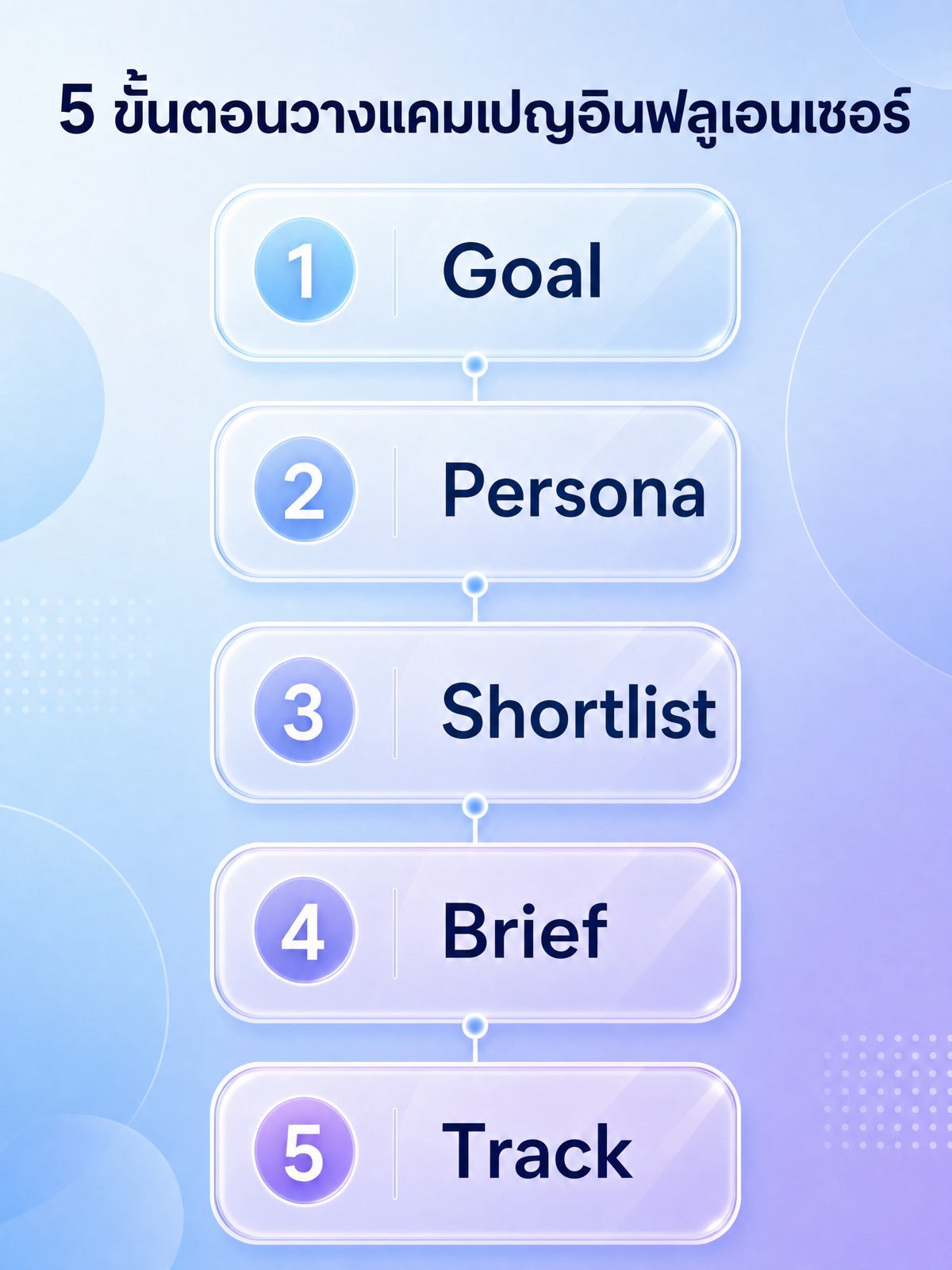
- Run the five steps in order: one measurable goal, a persona specific enough to rule people out, a shortlist filtered on data, a brief separating fixed facts from free creative, and tracking built before the first video goes live.
- Disclose paid posts with the established hashtag and the platform's own paid partnership tool, and confirm the rules for tightly regulated categories such as supplements, cosmetics, medical and financial products with a qualified adviser.
Influencer marketing in Thailand is the practice of paying or partnering with creators who have an audience on Thai social platforms, letting them describe your product in their own voice, and measuring the result against sales, leads or brand search rather than view counts. This guide is not another definition piece. It answers the harder question: how to run a creator campaign here so that you pick the right people, brief them properly, measure honestly, and get the paid disclosure right.
It follows the order a marketing team decides in: why budget keeps moving toward creators, the terminology, then tiers, pricing without a rate card, platform selection, a five step process, measurement and disclosure.
Why marketing budget keeps moving toward creators
The clearest explanation has nothing to do with market size numbers and everything to do with where buying decisions now happen. Discovery moved out of the search box and into the feed and the livestream. Many shoppers meet a product in a short video they were not looking for, watch someone use it, then tap through to the profile or straight into a chat. That path leaves little room for a banner and a lot of room for one person to talk about a product properly.
The second reason is the cost of bought reach. Every platform sells ad inventory through an auction, so as more brands compete for the same audience, the price moves with them. Paying a creator buys reach and content in one transaction, because the video you get back can be reused as ad creative afterwards. That is why experienced buyers negotiate usage rights before the work starts.
The third reason is a trust gap. Viewers know an advertisement is what a brand chose to say. A video from a creator they follow arrives with context attached: what that person reviewed before, what they said was not worth buying, and a comment section where anyone can ask an awkward question. The credibility comes from having evidence to check the claim against, not from creators being better presenters.
The last reason is structural: the purchase now closes very close to the content. Marketplaces such as Shopee and Lazada, along with in app shop features and live commerce, have shortened the path from seeing a video to paying so far that it sometimes never leaves the app. When checkout sits that close to discovery, the people making the content become a sales channel.
Influencer, KOL and KOC, kept short
Thai marketers use these three words almost interchangeably. If you want a distinction that is useful, draw it at the base of the influence rather than the follower count, because the base tells you what the content should look like. Work that explains how a product functions suits a base of expertise. Work that makes ordinary buyers feel that people like them use this suits a base of real usage. An expert style brief handed to a lifestyle creator usually produces a video the audience instantly recognises as a script being read.
- Influencer: the base is the relationship with an audience and taste that audience wants to follow. Suits awareness and brand image work.
- KOL, or key opinion leader: the base is expertise or professional standing. Suits work that must explain and reassure.
- KOC, or key opinion consumer: the base is lived experience, reviewing as one consumer to another. Suits high volume review work that builds social proof.
If you want the definitional treatment in more depth, the influencer and KOL marketing service page covers it. This guide moves on to the decisions a planner has to make.
Tiers by follower size, and what actually differs
The industry splits creators into four tiers: nano, micro, macro and mega. The convention is real and useful because it lets you talk to agencies and platforms without explaining yourself. What you need to know up front is that the follower bands behind those labels have no central standard. Agencies, platforms and tools draw the lines in different places, so where micro begins can only be answered once you say whose definition you are using.
What genuinely differs between tiers is not the follower number. It is the typical reach pattern, how the working relationship functions, what the brand is really buying, and where the risk sits. The table below sets those out so you can match a tier to an objective, and it is not a pricing table.
| Tier | Typical reach pattern and working relationship | What the brand is really buying, and what to negotiate |
|---|---|---|
| Nano | A small audience, often people who know the creator personally. You deal with them directly and hear back quickly, but the process is informal. | The feeling of a recommendation from someone nearby, and volume across many posts. Negotiate deadlines and a minimum quality standard, because neither is a given. |
| Micro | An audience clustered around a specific interest such as food, parenting, gaming or a technical niche. Usually self managed, with a process and their own rates. | Topical relevance and content that still sounds like a person speaking. Negotiate usage rights and an exclusivity window against competitors. |
| Macro | A broad audience across interests. Usually represented by a manager or an agency, with staged approvals and a long queue. | Substantial reach in a short window and production you can hold to a standard. Negotiate revision rounds, the publication date, and access to insight data. |
| Mega | A mass audience, often a public figure. Work goes through representatives under a formal contract. | Endorsement by reputation and broad conversation. Negotiate the scope of image usage, the length of the commitment, and what happens if a public issue arises. |
One observation holds across all four tiers. The broader the audience, the more diluted its relevance to your product, and the narrower it is, the higher the management cost per piece relative to the reach delivered, which is why many campaigns mix tiers. Worth saying plainly too: follower count is a number you can buy, which makes it the weakest signal in the selection process. What tells you more is the actual reach of recent posts, the share of the audience in Thailand, and whether comments are questions about the product or the same emoji repeated.
How to price a deal when there is no central rate card
Thailand has no reliable, publicly published rate card for influencer fees. Figures that circulate usually come from surveys that do not state their method, or from samples too narrow to carry across categories. The same is true of average engagement rates, which vary so much by platform, category and calculation method that a single average carries almost no information. Stop hunting for a market price and calculate a ceiling from your own numbers instead.
The method works backwards from margin. If you know the gross profit on one sale and roughly what share of traffic from comparable channels converts, you can estimate how many sales a deal must produce to break even, then compare that against the reach the creator achieved on recent posts. The number is not the correct price. It is the most you can afford to pay, which is enough to negotiate with and enough to walk away from a deal that does not fit your cost structure.
Before you get to price, ask for the underlying data. Here is what belongs in a media kit and what to request on top.
- Screenshots of recent post insights, five to ten posts that were not cherry picked, so you see real reach and how consistent it is rather than a public follower count.
- Audience breakdown by country, city, age and gender from the platform back end, which matters enormously for a brand that only sells in Thailand.
- Examples of past paid work in an adjacent category, with an indication of how that post performed against the creator's own norm.
- Brands they are currently committed to, so you do not discover a competitor conflict after signing.
- The exact scope behind the quoted price: how many videos and stories, how many revision rounds, how long the post must stay live, and whether ad usage rights are included.
A few signals should slow you down before signing, and all are easy to check. A high follower count paired with unusually low and erratic reach per post. Comments that are mostly generic phrases. Follower growth arriving in large blocks with no strong content to explain it. A refusal to share back end screenshots without a reason. None prove bad faith alone, but each means you should ask more before you pay.
The safest approach with a creator you have never worked with is to test with a small paid brief first. Commission one clearly scoped piece, measure it with a link and a code unique to that person, then decide whether to expand. A long contract at the first meeting bets on information you do not have yet, while a small test buys it at a price you can afford to lose.
Choosing the platform to match the job
Platforms differ in how they distribute content, and that determines what kind of result a campaign can produce. Choosing the wrong one sends good content to people nowhere near a buying decision.
TikTok distributes by interest more than by relationship, so a video from a small creator can travel far if the content matches the audience. Its strength is discovery and demonstration that lands in a few seconds, which suits products you understand the moment you see them working. Videos that perform can be reused inside TikTok advertising, provided you settled usage rights in the contract.
Instagram is strongest on brand image and credibility in fashion, beauty, food, travel and interiors. Stories suit short bursts and polling the audience, while feed posts and reels act as evidence people return to later. Brands extending content a creator already made follow up with Instagram advertising aimed at people who engaged.
Facebook is still where groups and communities work best in Thailand, particularly for products people ask about before buying: property, cars, insurance, education and family purchases. The formats that work tend to be longer posts telling a detailed story, live selling, and the creator answering questions in the comments long after publishing. That last part is real work and should be priced into the fee.
YouTube differs from all of them in one respect: the content has a long life. A review or comparison video keeps getting found long after publication, which suits higher priced products with a long consideration period. The trade off is higher production cost and a slower path to a visible result. Pairing a long video with a page answering the same questions is how the two reinforce each other, which is as much a content marketing problem as a creator one.
The five step process: goal, persona, shortlist, brief, track
Most campaigns that fail do not fail because the wrong creator was chosen. They fail because the upstream steps were skipped and the work began at the list of names. These five run in the order the decisions have to be made, and each produces one tangible output.
Step one, goal: pick one measurable objective. Choose one primary objective, whether awareness in a new audience, first trial, repeat purchase or lead capture, because it determines everything downstream: tier, platform, format and metrics. Campaigns chasing awareness and sales at once end with a report that explains everything except whether the spend was worth it. The output is one sentence the team agrees with.
Step two, persona: define who has to see this. Not a decorative profile document, but a definition specific enough to choose people with: which provinces, roughly which age, which platform they use, what makes them hesitate, and who they trust when researching this purchase. That last point matters most, because it translates directly into selection criteria. The output is a list of criteria you can rule candidates out with.
Step three, shortlist: filter on data, not on feel. Start with a broad list from hashtag searches in your category, from who your target audience already talks about, and from tool or partner lists. Then cut with hard criteria: share of audience in Thailand, consistency of reach, topical fit, and history of competitor work. Only then judge whether the tone fits, and read the comments on at least ten past posts. The output is a short list with a written reason next to each name.
Step four, brief: be explicit about what is fixed and what is free. A good brief is shorter than people expect. It must state the core message, the facts that cannot be got wrong such as ingredients, promotional conditions or usage limits, the words banned because they overclaim, the link and code, the publication date, and the disclosure requirements. Everything else belongs to the creator, because what you are paying for is the audience's familiarity with how that person tells a story. The output is one page separating the mandatory parts from the free parts.
Step five, track: build the measurement before the first video goes live. Prepare links tagged per creator, codes unique to each person, a landing page matching what the video says, and a contractual requirement to send back insight screenshots on an agreed schedule, because back end data is hard to retrieve once a campaign closes. The output is a spreadsheet you fill in the moment a video publishes.
KPIs and how to report ROI honestly
Split the metrics into three layers by distance from money. Delivery: how many pieces went live on schedule and what reach they achieved. Response: profile visits, link taps, saves, shares and product related questions in the comments. Business outcome: sales attached to a code, leads submitted, and any lift in searches for the brand name.
The most misused number is the view count, because the definition of a view differs between platforms and says nothing about whether the viewer was in your target audience. Completion rate, saves and shares carry more information, because each requires deliberate action. Comments should be read rather than counted, since a question about where to buy and a heart emoji are not worth the same.
On ROI, the honest position is that attributing sales to individual videos one to one is not fully possible. People watch on a phone and buy in another app, in a shop, or days later, so codes and per creator links capture part of it, not all. The workable method combines three things: what codes and links do capture, the change in total sales and brand search volume during the campaign against the period before it, and a how did you hear about us question at the point of sale.
- Set the pass or fail threshold before the campaign starts, not afterwards when you know which one flatters the numbers.
- Compare each creator against their own baseline, not against creators with a different audience size.
- Keep the test and scale budgets separate, and scale only the creators who cleared the threshold in testing.
- Keep the videos that performed for reuse as ad creative, a return most reports forget to count.
Paid disclosure, and the categories that need extra care
The safest principle is simple: if a creator received money, product, a discount or any other benefit in exchange for a post, the audience should know from the first moment they see it, not after expanding the caption. In Thailand the established convention is the hashtag #โฆษณา for paid work, and hashtags such as #ได้รับสินค้าฟรี, or wording that carries the same meaning, for gifted product.
Beyond hashtags, the major platforms provide their own paid partnership disclosure tools, which display a label on the post itself. Using the platform tool alongside the hashtag is more robust than either alone, and the requirement belongs in the brief and the contract rather than in the creator's memory. Specify too that the disclosure must be visible without expanding the caption.
A separate matter is product claims. Food, dietary supplements, cosmetics, medical services and financial products sit under much tighter advertising rules in Thailand than ordinary consumer goods, and what a creator says counts as the brand's advertising, not a private opinion the brand is detached from. Words like cure, permanently fixes, lose a stated amount of weight in a stated number of days, or any guarantee of financial return, are where trouble starts.
This article is not legal advice, and it deliberately does not name which authority regulates which case, because that depends on the product category and the form of the communication. Confirm the rules that apply to your own category with a qualified adviser before running a campaign, and have your legal or compliance function sign off the banned word list before the brief goes out.
- Write the disclosure requirement into the contract, including how long the creator has to correct a post that does not comply.
- Require a draft for review before publication in any category involving product claims.
- Screenshot every post as published and keep it, because posts can be edited afterwards.
- Maintain the banned word list separately and update it whenever a formulation or offer condition changes.
Relevant Audience influencer and KOL marketing
Relevant Audience is a Bangkok based digital marketing agency offering influencer and KOL campaign planning and management, covering objective and audience definition, creator selection and vetting, briefing and coordination, and the measurement setup that reports results against business metrics. The scope is set out on the influencer and KOL marketing service page, and because creator work is planned alongside the rest of the channel mix, the full range is listed on the agency services page.
If you are planning a campaign and want to talk through tier selection, creator vetting or the measurement setup before anything goes live, get in touch with the team. There is no obligation attached.
FAQ about influencer marketing in Thailand
How many creators should a brand start with
For a first test round, a small number of creators measured properly beats spreading the budget so thin that nobody generates enough data to conclude anything. Choose a number your team can manage end to end, give each person their own link and code, and expand only the ones who clear the threshold you set in advance.
Is it better to pay cash or to send product in exchange for a post
Both work, and both must be disclosed, because free product is a benefit the audience should know about. Gifting suits smaller creators and products with enough individual value to be worth their time. Work requiring a fixed publication date, set deliverables or usage rights should be a paid engagement under a contract, because those commitments are hard to enforce without a fee.
Why does this guide not publish rates or average engagement rates
Because there is no verifiable, publicly available source for either number in the Thai market. Fees vary by category, scope, usage rights and timing, while engagement rates vary by platform, content type and the calculation each tool uses. Printing a single average would be a guess dressed up as a fact.
Does every post need a paid disclosure
If there was payment or any benefit in exchange for the post, disclose it every time, including stories and short videos that disappear. Use both the hashtag and the platform's own disclosure tool, and place the wording where it is visible without expanding the caption. For categories involving product claims, confirm the rules with a qualified adviser before the campaign starts.
How is this measured if customers buy in a shop or a marketplace
Use discount codes unique to each creator that work in store and in the marketplace, add a how did you hear about us question at the point of sale, and look at the change in total sales and brand search volume during the campaign against the period before it. This is not a complete number, but it is enough of a picture to decide whether to increase the budget or stop.