TL;DR
- A local SEO effort that produces nothing usually fails on three foundations: NAP written differently across listings, an unverified or half filled Google Business Profile, and keywords too broad to win.
- Profile side numbers such as impressions, discovery searches and taps on call or directions move first. Map pack position for competitive terms moves last and should not be your only measure early on.
- No reliable public price benchmark exists for local SEO in Thailand. Compare quotes on scope: number of locations, cleanup work, pages built, ongoing review replies, and who owns the accounts afterwards.
- No tool is officially endorsed by Google as a local SEO checker. The twelve point manual audit in this article plus your own profile reports is more accurate than a third party score.
If you have been doing local SEO for months and the phone still is not ringing, do not conclude that it does not work for your business. The most common problem is not that you did too little. It is that three foundations are still unstable: business details written differently in different places, a Google Business Profile that is unverified or half filled in, and keywords so broad that you are competing with national sites you cannot beat in the short term. This article walks through what breaks, how long things realistically take to move, what actually drives the cost, and it closes with a checklist you can score yourself against in a single afternoon.
Which businesses should do local SEO (and which should not rush)
The test is simple. If your customers have to travel to you, or you have to travel to them, local SEO belongs in your plan. If neither is true, the same budget spent on regular SEO will do more.
Businesses that clearly benefit:
- Places customers walk into: restaurants, cafes, clinics, salons, garages, building supply stores
- Service businesses that travel to the customer: air conditioning technicians, plumbers, cleaning crews, movers, pest control. These have no storefront to walk into, but they can still set a service area on the profile
- Multi branch businesses where each branch competes for a different neighbourhood
- B2B companies where clients come to see the product or meet at the office: printers, contract manufacturers, machinery distributors
The ones that should not rush are pure online stores shipping nationwide, fully remote digital businesses, and brands that sell only through marketplaces with no location a customer can reach. For those, start with SEO on the website itself and come back to local when a physical location exists.
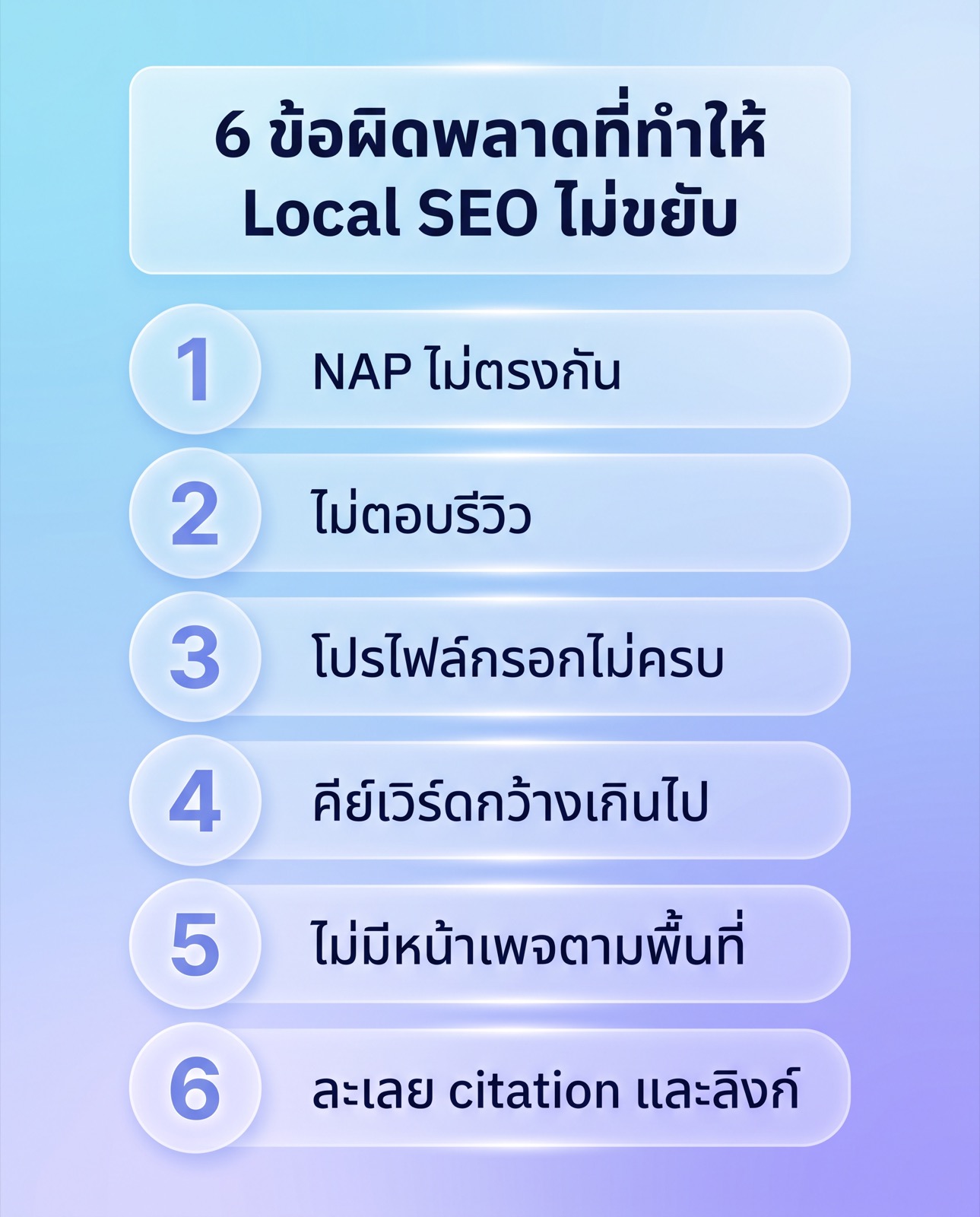
Six common local SEO mistakes you need to fix
These six are why work you already paid for is not producing anything, and almost all of them can be fixed without writing code or hiring anyone new.
1. Inconsistent NAP data
NAP means name, address and phone. Those three have to be written identically everywhere your business is listed: the Google profile, your own website, your Facebook page, business directories, and the store listing page of the mall or market you rent space in.
In Thailand this breaks more easily than people expect, because a Thai address can be written several ways and all of them are correct. One listing writes the soi abbreviated, another spells it out, another drops the subdistrict and district entirely, another includes the mall floor and unit number, another does not. Phone numbers appear both as 02-xxx-xxxx and as +66 2 xxx xxxx. The shop name exists in a Thai version and an English version that are not transliterated the same way. The result is that systems treat them as possibly different businesses, and confidence in the data drops.
The fix is to pick one standard format, write it down in a file, and then correct every listing to match it character by character. That includes hunting down old profiles a previous employee created and left behind. A duplicate profile carrying the old address is one of the most common saboteurs.
2. Not replying to Google reviews
Reviews and owner replies are public, so the reply box is not a private conversation with the reviewer. It is written for the next ten people deciding whether to call you. A profile with four star reviews where the owner answers every one with something useful reads as more trustworthy than a silent five star profile.
The usual mistake is replying only to the good ones and leaving the complaints untouched, or worse, arguing back. What works is a short reply that acknowledges the specific issue, says what you are changing, and offers a private channel to continue. There is no need for a long explanation on a public page.
One more thing to avoid: never buy reviews or have staff review their own shop. Google detects and removes reviews that break its policies, and losing dozens of fake reviews at once drops the score sharply and is hard to recover from.
3. An incomplete Google Business Profile
First things first: the profile has to be verified before it can appear at all. If it is unverified or suspended, nothing else you do matters. Check the verification status before anything else.
Once verified, these are the fields people leave empty and should not:
- Primary category, which has to match what you actually sell rather than a bigger sounding category. Add secondary categories only for services you genuinely offer
- Opening hours, including special hours for long holidays. Songkran and New Year are when wrong hours cost the most customers
- Service area, for businesses that travel to the customer
- Photos: the storefront from the street, the interior, the products, the team. The street level shot is what helps a driver find your entrance
- Products and services, described in the words customers actually use
- Questions and answers. You can post the questions customers ask most and answer them yourself. Leave it empty and someone else will answer, possibly wrongly
- The website link, which should point at the page for that branch rather than the homepage every time
Nobody can tell you how much any single field is worth to ranking, because Google has never published that. But every field above is information a customer uses to decide whether to tap call or tap away, and that is more measurable than position anyway.
4. Keywords that are far too broad
A small restaurant targeting the word restaurant is competing against review sites and marketplaces that have been accumulating links for a decade. The terms worth targeting carry an area, a type and a qualifier: northeastern Thai food in Ari, or orthodontic dental clinic in Lat Phrao.
Thai searchers also use landmarks that are not administrative district names: the name of the BTS or MRT station, the name of the mall, the soi, the name locals use for the neighbourhood. Almost nobody optimises for those, and they are what someone about to travel to you actually types. You can find them without any tool by reading what customers type in your chat inbox and by checking the search terms shown in your profile reports.
5. No local landing page
If you have three branches but the website has a single contact page listing all three addresses together, then no page speaks clearly about any one branch. The fix is a separate page per branch or per service area.
The pages that work carry content that is genuinely specific to that area, not a copy of the last page with the district name swapped. Include that branch's address and phone, that branch's hours, a map and directions written the way a local would give them (which side of the road the entrance is on, where to park, which station exit to take), the services that branch really offers, real photos of that branch, and reviews from that branch's customers.
Ten area pages that differ only by district name are duplicate content. They do not help and they can bury the pages of yours that are good. If you cannot write genuine local content for all of them yet, three good pages beat ten empty ones.
6. Ignoring citations and local backlinks
A citation is anywhere on the internet that states your business name, address and phone, whether or not it links back. A local backlink is a link from a site people in that neighbourhood actually read.
Sources you can realistically earn in Thailand without buying links include the store directory page of the mall or building you rent in, trade associations or provincial chambers of commerce you belong to, schools and universities whose activities you sponsor, local news sites and neighbourhood community pages, partners and suppliers who publish a dealer list, and event organisers who publish an exhibitor list after you take a booth.
If your category is competitive and you are stuck on page two, link building is usually the missing piece rather than anything on the page.
When you can see a symptom but are not sure where the cause lives, this table pairs what you observe with the first place to open.
| What you see | Likely cause | Where to check first |
|---|---|---|
| The profile does not show on the map at all, even for the exact business name | The profile is unverified or suspended | Verification status in the profile dashboard |
| You appear for your business name but not for the service type | The primary category does not match what you sell | Primary and secondary category fields |
| People see the profile but do not tap call or directions | Missing details, no photos, or wrong hours | Opening hours, photos and website link |
| The site ranks for generic terms but not for terms with an area name | No page speaks directly about that area | The landing page for each branch |
| Business details differ across directories | Inconsistent NAP, or an old duplicate profile | Every place the business is listed, old profiles included |
How long does local SEO take to show results
There is no single number that applies to every business, and anyone who promises a fixed number of months before looking at your data is guessing. What can be stated is what the timeline depends on, and what moves early versus late.
The variables that actually set the pace:
- Whether the profile is already verified. If you are still waiting on a postcard or a review, the clock has not even started
- How much stale data is out there. If an old address was copied to dozens of sites, cleaning it up takes many times longer than filling in a new profile
- How dense the competition is within the radius customers will travel. A clinic in Sukhumvit and a clinic in an outer district are playing different games
- The category. Some have hundreds of listings in one area, some have ten
- What the website already ranks for. A site with an existing base moves faster than one launched last month
What should move first are the profile side numbers: how often the profile was shown, the share of searches where people did not search your name, and taps on call, directions and website. These respond fairly quickly to filling in details and adding photos, because they measure human behaviour rather than ranking.
What moves last is map pack position for competitive terms in that neighbourhood, because it depends on your data and every competitor's data at the same time. Do not use it as your only measure in the first months.
The workable way to set expectations is to record a baseline of the profile side numbers on the day you start fixing things, then compare yourself month over month instead of against an industry average that does not exist. If you want a clear starting point for the website itself, an SEO audit beats guessing.
How much does local SEO cost
There is no reliable public price benchmark for the Thai market, and the figures floating around are usually for packages whose scope does not match each other at all. What is more useful is knowing the cost drivers so you can compare quotes yourself.
The drivers that make quotes differ several times over:
- The number of locations and profiles to manage. One branch versus ten is not ten times the work, but it is a lot more
- Whether old data has to be cleaned up. Duplicate profiles, old addresses and dead phone numbers scattered across the web are manual work and one of the biggest time sinks
- How many new web pages have to be built. Genuine area pages have to be written one at a time
- Whether new Thai content is required or existing copy just needs adjusting, and whether you need two languages
- Ongoing review replies and profile updates, which never end, unlike one time setup work
- Whether new photography is needed. A shop with no usable photos has to add a shoot to the scope
On the do it yourself versus agency question, think in time and skill rather than money. The work an owner can definitely do is verifying the profile, completing every field, taking photos, replying to reviews and posting the questions and answers. None of that needs technical skill, but all of it needs consistency, which is exactly where self managed efforts fall apart around month two.
The work usually worth outsourcing is cleaning up large volumes of stale listings, building multiple area pages with the right on page structure, and earning links from local sources, because those three take time and are painful to undo when done wrong.
When you request a quote, always ask for four things. One, a scope that separates one time setup from monthly work. Two, quantities as actual numbers: how many pages, how many profiles, how many directories, not the phrase full management. Three, who owns the accounts and the website when the contract ends, which is the most important question and the least asked. Four, what reporting you get, what it measures and how often. Compare two proposals on those four points and the prices become comparable on their own. For scope that goes beyond location work, look at local SEO services alongside the rest of your SEO plan.
A local SEO checker you can run by hand
No tool is officially endorsed by Google as a local SEO health check. What is available, and more accurate, is a manual audit in this order. Give yourself one point per item.
- Open an incognito window and search your exact business name. Does the profile appear in full, and is every visible field correct?
- Search your service type plus your neighbourhood name. Are you in the map pack? If not, who is, and what does their profile have that yours does not?
- Open the verification status in the profile dashboard. It must be verified with no pending notices
- Read your primary category out loud. Does it match what you want to be found for?
- Audit NAP one listing at a time. Write your standard address and phone on one line, then open every place your business is listed and compare character by character: your own site, social pages, directories, and the mall store listing
- Search your business name to see whether a duplicate or an abandoned old profile is still floating around
- Count your last thirty reviews. How many did the owner answer? Fewer than half scores zero on this item
- Look at the profile photos. Is there a street level shot of the entrance? Is the newest photo more than a year old?
- Open the profile on a phone the way a customer sees it. Tap the call and directions buttons for real. Do they go to the right place?
- Open your website. Is there a page dedicated to the service area, and does that page carry the address and phone as copyable text rather than baked into an image?
- Open the profile reports and read the search terms people used to find you. Are there terms you never considered that deserve content?
- Check the special hours for the next long holiday. Are they set?
Twelve items. Score under eight and you should not be investing in link building or new content yet. Go back and close the basic gaps first, because downstream work does not land while the source data contradicts itself.
What is different about the Thai market
The first difference is addresses. A Thai address carries a house number, moo, soi, road, subdistrict, district and postcode, and different sites truncate different parts. Choosing one standard format and holding to it matters more here than in other languages.
The second is bilingual names. Many businesses have a Thai name and an English name that do not correspond. Use the one that matches the physical signage, and never stuff keywords into the business name hoping for rank, because that breaks policy and can get the listing edited back or suspended.
The third is contact preference. A lot of Thai customers would rather message than call, so put a chat entry point on the branch page and answer during the hours you publish. Publishing that you are open while nobody replies is a one star review waiting to happen.
The fourth is how people describe locations. In Bangkok people orient by train stations and malls rather than district names, while upcountry the reference points are markets, temples and schools. Area pages should be written in that language, because it matches what people type and it genuinely helps customers find you.
The last is seasonality. Songkran, New Year, long weekends and the vegetarian festival for restaurants all change both your hours and what people search for. Setting special hours in advance is a small job that prevents a large problem. Businesses competing both locally and nationally should plan this together with their SEO work for the Thai market from the start.
Frequently asked questions
Can I do local SEO myself without a marketing team?
Yes, and the highest value work happens to be exactly the work an owner can do: verifying the profile, completing every field, taking fresh photos, replying to every review, and posting the questions customers ask most. The limit is not difficulty, it is consistency. Block thirty minutes a week as a standing task, then consider hiring help when the work expands into building area pages and cleaning up large volumes of stale listings.
Do I need a physical storefront to do local SEO?
No. A business that travels to customers can be set up as a service area business without displaying an address people walk into. You still need a real location you can verify during the verification step. What you cannot do is use a PO box or an address that does not exist, because that gets the listing suspended.
How should I reply to a bad review without losing more customers?
Reply briefly, reply quickly, and write it for the third party reading later. Acknowledge the issue plainly, say what you are changing, and invite the person to continue privately. Do not argue the details in public, and do not try to bury it under reviews you created, because policy violating reviews get removed and the fallout hurts your score more than the original complaint.
Is there a local SEO checker tool I can trust?
No tool is officially endorsed by Google, and third party scores are always an approximation. The more accurate approach is the manual twelve point checklist in this article combined with the reports inside your own profile dashboard, which is first party data straight from the source.
What do I need to do when the business moves address?
Change the address on the business profile first, and expect that you may need to verify again. Then work through every place the old address was published: the website, social pages, directories, quotation templates and email signatures. Leftover old addresses are the reason data conflicts can drag on for a year. Build the list on moving day and close it item by item.
Start where it is broken
If you got this far and already know which item your business is stuck on, that is the right starting point. Fix them in order: verify the profile, make NAP consistent, complete every field, then move on to area pages and links. Relevant Audience handles local SEO and broader SEO services for businesses in Thailand. If you want a second look at what to fix first, get in touch.