
TL;DR
- A full audit covers five areas at once: technical crawling and indexation, on-page content, internal link architecture, the external link profile, and whether measurement still records conversions.
- A free scan reports symptoms; a full audit diagnoses causes and orders the fixes by effort against impact, with real example URLs and an owner per item.
- Run it before the SEO work starts, not alongside it: without a baseline you cannot prioritise or measure, and work built on a broken foundation gets redone.
- No reliable public figure exists for what an audit costs or how long it takes in Thailand. Compare scope and deliverables, and build your own baseline from your own data.
A website that has been running for a few years has usually passed through several teams. The theme changed, the host changed, pages were added and quietly retired, tracking code was layered on top of older tracking code, and almost nobody stepped back to look at the whole system at once. A full seo audit is that step back, done methodically, and done before the first monthly SEO invoice rather than alongside work that has already started.
A short definition first. An SEO audit is a structured examination of a website to find what is stopping it from earning the rankings and traffic its existing structure and content should support. The useful output is a prioritised list of problems, with reasons for the order. That is enough of a definition. Anyone who wants a full primer on what an SEO audit is and which tools it uses will find separate guides on this site. This article covers the narrower question that usually gets skipped: what the word full actually means, and why the sequencing matters.
What the word full means in a full seo audit
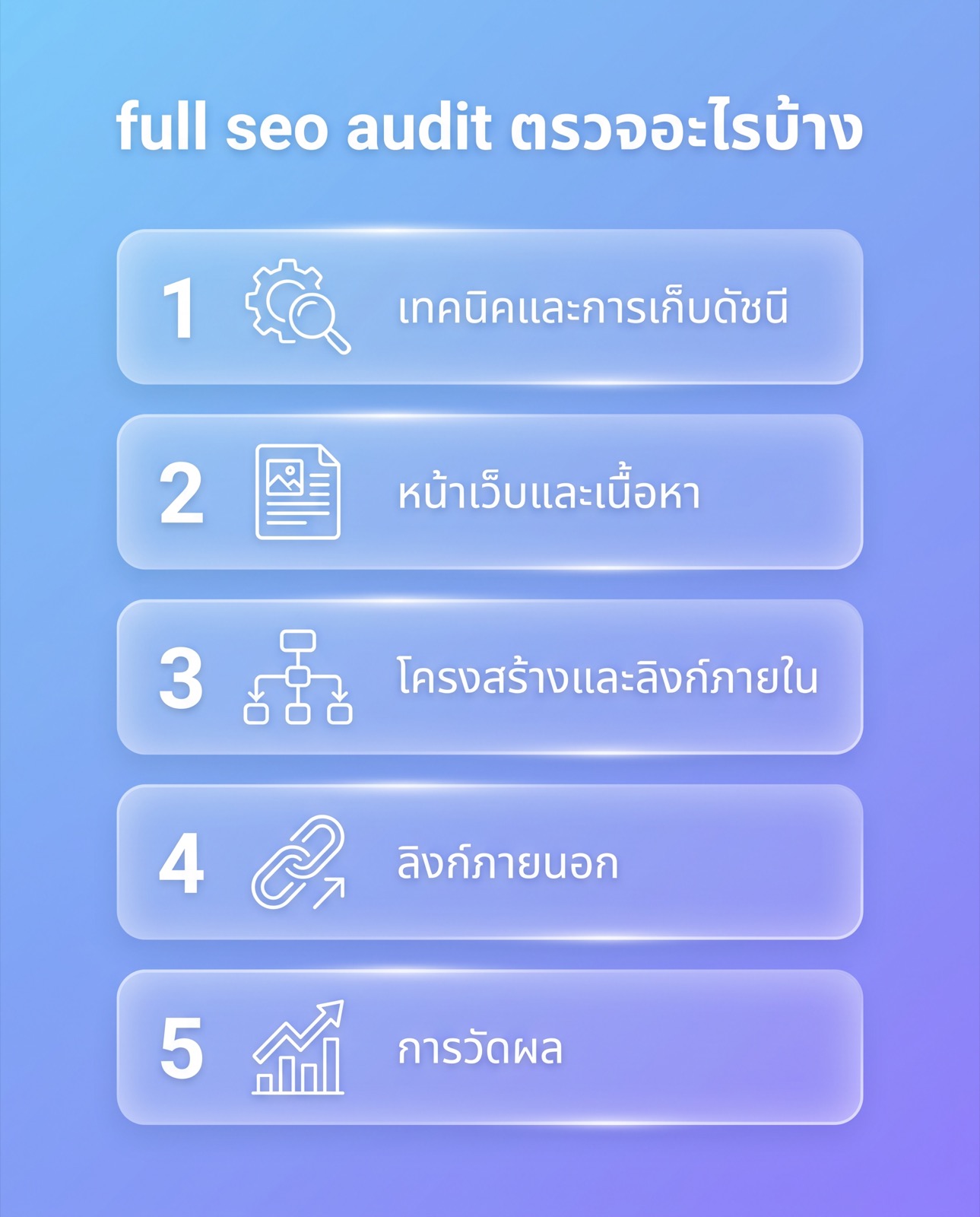
The difference between running a free scanner and commissioning a complete examination is not the number of errors found. It is the number of dimensions examined, and whether anyone joins the findings from each dimension into a single account of what is happening. A complete audit covers five areas that always affect one another.
One, technical crawling and indexation. This starts with the most basic question: what can a crawler reach, and what has it kept. That means reading robots.txt to separate deliberate blocks from accidental ones, checking the HTTP status of every URL the crawl discovers, checking where canonical tags point and whether that matches the URL the business wants ranked, checking that sitemap entries are still live, checking whether the main content renders without waiting for JavaScript, and on a bilingual site checking that hreflang pairs are reciprocal and that each page references itself.
Two, on-page and content. Not a count of pages missing a meta description, but an assessment of whether the content on a page matches the intent behind the query that page is competing for. Which pages are too thin to finish answering the question. Which pages are written so similarly to each other that no one can tell which should rank. And which topics the business should have a page for and does not.
Three, site architecture and internal linking. How many clicks the money pages sit from the homepage. Whether there are orphan pages with no internal links pointing at them. Where internal links concentrate. What the anchor text tells a search engine about each destination. Many sites route nearly all their internal links into the blog and leave service pages stranded at depth.
Four, off-page and the link profile. How many referring domains exist, where they came from, when they appeared, what shape the anchor text distribution has, whether links point at pages that no longer exist, and whether an old link-building engagement left behind patterns that now function as a liability.
Five, measurement integrity. This is the most commonly skipped area, and it makes everything else meaningless when it is broken. Check whether Google Search Console is set up as a domain property or only a URL-prefix property, because the second version hides part of the data. Check that GA4 is still receiving the events counted as conversions. Check for duplicated tags producing double counts. Check what the consent banner is withholding.
The table below compares what an automated scan or a short checklist produces against what a complete examination adds in each area. This comparison is the heart of the article, because almost all of the difference sits in the right-hand column.
| Area examined | Automated scan or short checklist | What a full audit adds |
|---|---|---|
| Technical and indexation | A long list of broken links, slow pages and duplicate titles | A comparison of what can be crawled against what is actually indexed, plus an explanation of what causes the gap, which CMS rule produces it, and where in the system to fix it once |
| On-page and content | Counts of pages missing a meta description or falling under a word threshold | An intent check against the target query, identification of pages competing with each other, and a decision for each page: merge, rewrite or leave alone |
| Architecture and internal links | Click depth from the homepage and a list of orphan pages | A reading of where internal link weight currently flows, what the anchor text signals, and where that weight should move to match commercial priorities |
| Off-page | A referring domain count and a vendor score | The origin and timing of links, the anchor distribution, links pointing at dead pages, and any inherited liabilities that need handling first |
| Measurement | Usually not examined at all | A trace of the real conversion path from button to report, identifying what stopped recording silently, fixed before any performance is counted |
The middle column is not wrong. The tools do their job correctly. They report symptoms. The right-hand column is a diagnosis of what causes those symptoms and what deserves attention first, and that is human work rather than tool output.
Why the audit comes before the SEO work, not during it
The first reason is the baseline. Without a record of the starting state, there is no way to separate the effect of the work from seasonality, an algorithm update, or a change in what competitors are doing. The baseline worth recording is not total clicks. It is clicks and impressions split by page group, the number of indexed pages, the referring domain count, and conversions split by channel.
The second reason is prioritisation. Every budget has an edge, and only so much SEO work fits into a month. Choosing between writing twenty new pages, rebuilding the category structure, or working on page speed produces very different outcomes, and the choice is close to impossible without knowing where the real bottleneck sits. Locating that bottleneck is the job of the audit.
The third reason is the cost of rework. Work built on a broken foundation gets redone. If a team publishes forty articles into a category structure that generates three duplicate URLs per article, there are now forty times as many things to fix instead of one rule to correct at the source. If the tracking was broken from the start, the first three months of the project produce no data anyone can decide anything with.
The fourth reason concerns the contract and is fair to both sides. A scope of work written before anyone has seen the real state of the site is a guess. The client risks paying for work that does not match the problem. The supplier risks committing to outcomes the site will not allow. An audit first means the scope that follows refers to something observed.
There are exceptions and they are worth stating plainly. A site launched a few months ago with fewer than ten pages that nobody has touched will get more from spending the budget on the pages it is missing. A short check that the foundations are not misconfigured is enough there. The other exception is a site that was audited recently and has not acted on any of it. The right move is to work through the existing report rather than pay for a second one.
What actually breaks on a site that has never been audited
The problems found on an unaudited site rarely come from one person being careless. They accumulate from small decisions that were reasonable at the time. Each has a mechanism.
Indexation drifts away from what was intended. Modern site software generates enormous numbers of URLs on its own: tag archives, internal search result pages, URLs carrying sort and filter parameters, pagination that runs further than anyone checks, and sometimes a staging subdomain left open to crawlers. All of it gets crawled and some of it gets indexed. The consequence goes beyond an untidy report. Crawlers spend most of their time on URLs nobody wants ranked, and the search engine is left to pick its own canonical version, which is sometimes not the version the business sells from.
Duplicate and thin pages compete with each other. When two pages answer the same question with similar content, every signal splits. Some internal links point at one, some at the other, and external links do the same. The observable symptom is unstable ranking: the search engine alternates between the two pages somewhere in the middle of the results and neither reaches the position it should. The fix is not more writing. It is choosing which page survives, folding the best material into it, redirecting the other, and moving the internal links across.
Redirect chains accumulate one layer at a time. The first redesign moved old URLs to new ones. The second redesign moved them again without anyone revisiting the first set of rules. Old links pointing at the original URLs now bounce through two or three hops to arrive. Some paths become loops because two rules point back at each other. Some were set as temporary redirects and stayed that way for years. The most damaging pattern is redirecting every old URL to the homepage in one sweep, which leaves both people and search engines unable to reach the content they asked for.
Tracking stops recording without announcing it. Measurement code never reports its own failure. It just stops sending data. The causes seen in practice are ordinary: a button was given a new class or id during a redesign so the trigger bound to the old one no longer fires, a form was moved to a different plugin that does not send the same event, a thank-you page was replaced with an inline confirmation message, or the same tag ended up installed in both the theme and the tag manager and now counts twice. The symptoms worth suspecting are a conversion count that falls off a cliff in one day while traffic holds steady, or numbers that look suspiciously round.
Nobody has opened the link profile. Links acquired from an engagement several years ago are still there and still sending signals every day. If that engagement used the same commercial anchor text across dozens of unrelated sources, the pattern reads as unnatural. In the other direction, plenty of sites have good links pointing at pages that were deleted, which is wasted weight that can be recovered by redirecting to the closest surviving page. None of this can be guessed from looking at your own pages. It has to be looked up.
The benefit, stated as decisions the audit lets you make
The usual benefits list says an audit improves rankings and makes a site healthier, which is not false but does not help anyone decide anything. A more direct framing asks which questions become answerable once the report exists.
- Should the first tranche of budget go to technical fixes or to content. That depends on whether the pages that already exist are being indexed. If they are not, writing more only adds pages nobody sees.
- Which pages should be merged, which rewritten, which left alone. Consolidating pages that compete with each other often moves faster than writing new ones, because scattered signals get pulled back together.
- Whether this business should invest in local search visibility. That depends on whether queries with genuine geographic intent exist for it and whether there are branches or defined service areas behind them.
- Whether to start earning links now or wait. If destination pages still duplicate each other or the wrong version is indexed, acquired links land in the wrong place.
- Whether to begin adapting content so it can be cited by AI-answer surfaces, the work usually filed under GEO. That is decided by how readable and summarisable the pages are, which the content side of the audit reports on.
- Which items need a developer and which the content team can handle. This affects the schedule more than people expect, because the development queue usually sets the delivery date.
- What gets measured from month one. If the audit finds conversions that are not being recorded, that is fixed first, and only then does it make sense to agree on which numbers represent the project.
Those answers are what turn the SEO programme that follows into an actual plan rather than a standard activity list that would fit any site. For businesses competing in the Thai market, language mix in queries, bilingual page sets and mobile-first search behaviour mean that planning for Thai search has to lean on the site's own data more than on general advice.
How to scope and commission one
What belongs in the agreement is the shape of the deliverable, not the page count of the report. Thirty pages exported from a tool are worth less than ten pages that have already sequenced the work.
Deliverables worth insisting on:
- A backlog ordered by effort against expected impact, with the reasoning for the order written down, rather than a list sorted by whatever severity rating the tool assigned.
- Real example URLs from that site for every item. An item with no example may be boilerplate.
- An owner per item, separating developer work, content work and measurement work.
- A verification method per item: which report to look at afterwards, and what change would indicate the fix worked.
- A walkthrough rather than a file drop, because the questions that matter tend to arrive on page three of the report.
Questions worth asking before signing:
- How many URLs will be crawled, and the whole site or a section. Large sites need that agreed at the start.
- Will JavaScript be rendered. If the site builds content client-side, a non-rendering crawl will report empty pages that people can see perfectly well.
- Will the audit use the site's own Google Search Console and GA4 data, or only third-party estimates. Real data and estimated data support different conclusions.
- If a problem needs fixing at the platform level, will the audit produce a specification a developer can act on.
- Can you see an anonymised sample report. One real sample says more than a long description.
To tell a written audit from a generated tool export, watch for four things. Every problem carries equal weight and nothing is marked as safe to postpone. No sentence refers to that specific business, so swapping the domain name would make the document fit another site. A single overall score is presented as the headline, even though a score does not say what to do first. And nothing in it recommends doing nothing. A report written by a person contains items that say this one is not worth the effort, leave it.
Price, turnaround, and the numbers that do not exist
The most common question is what a full audit should cost and how long it should take. There is no reliable public figure for either in the Thai market. No verifiable average price, no standard turnaround, and no honest number for how much traffic an audit recovers. Anyone quoting those confidently is quoting something unverifiable. The reason is straightforward: scope varies too much to average. A ten-page single-language site and a bilingual catalogue with thousands of products are not the same kind of work, and whether the auditor gets access to the analytics accounts can change the hours required substantially.
What replaces price comparison is scope comparison. To compare two quotes fairly, make the scope identical first and then look at the numbers. State how many URLs will be crawled, state how many of the five areas above are included, state whether first-party data is used, and state the delivery format. Once those match, a price difference starts to mean something.
The only benchmark with real meaning is your own history. Before work starts, record at least three months of Google Search Console data split by page group, record the indexed page count, record the referring domain count, and record conversions by channel. That set is comparable because it comes from the same site, the same market and the same season.
Frequently asked questions
How is a full seo audit different from a free website scan?
It differs in how many areas are examined and in having a person diagnose the findings. A free scan reports automatically detectable symptoms such as broken links, duplicate titles or slow pages. A complete audit covers technical health, content, internal link structure, the external link profile and measurement accuracy, then orders the findings against business goals. Free scans remain useful as a quick symptom check between larger pieces of work.
How often should a site get a complete audit?
Audit when something changes the foundation, not on a calendar. Reasonable triggers include the start of a new SEO programme, a redesign or domain migration, a CMS change, a change of team or supplier, and unexplained traffic loss. Between those events, watching the indexation and performance reports regularly is enough.
Can I do this myself without a technical team?
Parts of it, and those parts are worth doing. Without writing any code you can read the indexation report in Google Search Console to see which pages are excluded and why, search for your own domain with a site operator to check whether the pages appearing match what you intended, and submit one real form to confirm a conversion gets recorded. What needs tools and experience is crawling the whole site, reading the link profile, and deciding what to fix first.
Should content work stop while the audit runs?
No, but avoid work that would need redoing. Safe to continue: content answering customer questions that no existing page answers. Worth pausing: creating new categories, changing URL structure, merging or deleting pages, and buying links to pages that might be consolidated later.
Will rankings improve as soon as the audit is finished?
No, because an audit changes nothing on the site. It is a diagnosis rather than a treatment. Rankings move only when the prioritised items get implemented, and the timing varies by item type. Unblocking pages that were kept out of the index can show up quickly once crawlers return, while page consolidation and content work take considerably longer.
Where to start
For a business about to invest seriously in search, the least wasteful order is examine, prioritise, repair the foundation, then accelerate. A full site health check before starting SEO means the next tranche of budget goes to problems that exist rather than to a standard activity list that may have nothing to do with this site's bottleneck.
Relevant Audience provides full website audits covering the five areas described here, delivered as a prioritised backlog with owners assigned per item. For businesses that have finished the diagnosis and want to act on it, the ongoing SEO service continues from the same list.