TL;DR
- Professional SEO work runs in six stages: discovery and audit, keyword research with intent mapping, technical fixes, on-page and content, off-site and digital PR, then reporting and the next cycle.
- Discovery should produce a problem list ordered by impact with an owner against each item, not a two hundred page tool export forwarded without interpretation.
- Technical fixes usually take longest to land because they depend on the development queue, so agree at the start who actually makes the change.
- Pages sitting between position eleven and twenty are the cheapest wins in the content stage, because they are already indexed and already close to the first page.
- Rankings cannot be guaranteed because position is decided by a third party system, but scope can be: what is checked, fixed, delivered and reported.
Hiring an SEO team does not buy one activity. It buys several dozen tasks arranged into six stages: discovery and audit, keyword research mapped to search intent, technical fixes, on-page and content work, off-site work and digital PR, then reporting and the decision about what the next cycle does. A team that does this for a living can tell you which stage the project is in, what is being worked on right now, and what has to be true before that stage is finished.
This article is written for someone about to hire an SEO provider who wants to know what the money buys. It is not a sales document. It exists so that you can ask better questions on the call and judge for yourself whether the proposal in front of you is complete or missing a stage. Each stage below lists the work inside it, roughly how long it takes, what tools it needs, and what it looks like when that stage has quietly been skipped.
Two notes before the detail. The timings are ranges, and they depend on the size of the site and the state it starts in: a ten page site that launched last month and a five thousand page store that has been migrated twice will not take the same time at any stage. And this article does not discuss price, because price follows the scope you agree rather than being a number that can be published on its own.
Why SEO is not a single activity
The word SEO is used so loosely that many people understand it to mean putting keywords into a page. In practice the work under that word splits into three groups that need different skills. The first is technical work, which is about whether a search engine can reach the site, whether it understands the structure once it is there, and whether the pages load fast enough for someone opening them on a phone on a mobile connection. The second is content work, which is about whether a page genuinely answers the question that was typed, and answers it better than the pages already on the first result page. The third is off-site work, which is about whether other sites refer to you, and whether those references come from anywhere that carries weight.
The three run in parallel, but they do not substitute for each other. The best article on the internet does nothing if the page is blocked from being indexed, and the fastest site in the category will not rank if no page on it answers the question being searched. Hiring a team that only does one of the three and expecting the combined result is how a project spends several months without moving a number.
Stage 1: Discovery and audit
The first stage establishes the state of the site before anything is changed. The team collects from three sources: a full crawl of the site with a crawler, the real indexing and impression data in Search Console, and behavioural data from whatever analytics is installed.
What should come out of this stage is a list of problems ordered by impact, not a two hundred page report exported from a tool and forwarded without interpretation. A usable list says how many pages each problem affects, how important those pages are, who has to fix it, and what you should expect to see change once it is fixed.
- Main tasks: full site crawl, indexing status check, page speed check, a real check that the site works on a phone, internal link structure, sitemap and robots file, and a look at what the competitors ranking above you are doing.
- Rough timing: one to three weeks, depending on page count and how quickly the team is given access.
- Sign this stage was skipped: a proposal that already specifies a number of articles per month before anyone has looked at the site.
If you want to see what a full site audit covers, the SEO audit service page breaks the checks out by category.
Stage 2: Keyword research and intent mapping
The second stage works out what people type, and what those words actually mean. Keyword research that stops at a table of search volumes is unfinished work, because volume tells you how many people searched and nothing about what they wanted.
Intent mapping separates the terms where someone is gathering information, the terms where they are comparing options, and the terms where they are ready to buy. Those three need different pages. Informational terms belong on articles, buying terms belong on service or product pages. Putting a buying term on an article sets your own article against your own service page for the same result, which is harder to untangle later than it is to get right at the start.
- Main tasks: pull terms from Search Console and third party tools, group terms that mean the same thing, label the intent of each group, map each group to an existing page, and identify the gaps where no page covers the topic.
- Rough timing: one to two weeks for a mid sized site, longer with several languages or many product categories.
- Sign this stage was skipped: receiving a keyword list with columns for volume and difficulty but no column saying which page each term belongs to.
Thai adds a specific problem at this stage. Thai searchers mix Thai words, transliterated words and English words for the same thing, spellings vary, and spacing is inconsistent, so one group of terms usually has several written forms that need merging before anyone decides whether the topic needs one page or several. A team that works in Thai every day merges them at the start. A team applying an English language process directly tends to produce a list that overlaps itself.
Stage 3: Technical fixes
The third stage makes the site reachable and understandable. This work does not raise rankings by itself in every case, but it is what unlocks the other two groups. A page that is kept out of the index will not rank no matter how good the writing is.
The most common technical problem is duplication. The same page is reachable from several URLs because of filter parameters, sort orders, or the existence of both a trailing slash version and one without. With no canonical page declared, the weight spreads across the copies instead of collecting in one place. The other common one is a page that builds its content entirely with script, where the real content is not in the first response at all.
- Main tasks: resolve duplicate URLs and declare canonicals, fix broken links and redirect chains, make the sitemap match the pages you actually want indexed, improve page speed and image weight, add structured data that matches what is on the page, and check the language configuration when the site runs in both Thai and English.
- Rough timing: two weeks to several months, because this stage depends on the development queue more than it depends on the SEO team.
- Sign this stage was skipped: monthly reports that discuss article counts while not one item on the technical list from stage one has been closed.
The thing to agree at the start is who actually makes the change. Most SEO teams can identify the problem and write the specification, but the fix has to go through someone with permission to change the code or the theme. Without that agreement the problem list migrates from one monthly report to the next with nothing resolved. And when a site is about to be rebuilt or replatformed, the SEO team should be in the room while the structure is being decided rather than called in after launch. The build side of that is covered on the web design page.
Stage 4: On-page and content work
The fourth stage makes each page answer the question it was mapped to in stage two. It splits into improving pages that already exist and creating pages for the gaps that were found.
Improving existing pages usually pays back faster, because those pages are already indexed and already have some history. Pages sitting between position eleven and twenty are the most rewarding group to work on first, since they are already close to the first page. Rewriting the heading to match the question, adding the section that is missing, and pointing internal links at the page will often move it without rewriting the page from scratch.
- Main tasks: rewrite titles and descriptions to match intent, restructure the headings on the page, add the sections competitors cover and you do not, place internal links from related pages, improve images and their alt text, and create new pages for the mapped gaps.
- Rough timing: continuous monthly work rather than a stage that finishes.
- Sign this stage was skipped: new articles published every month while the main service page, which is the page that earns money, is never touched.
The thing to watch is creating new pages that overlap old ones. If two pages answer the same question, the search engine has to pick one, and it often picks the one you did not intend. Before creating any new page, check whether something already covers the topic. If it does, improving the existing page is the safer option.
Stage 5: Off-site work and digital PR
The fifth stage is about getting other sites to refer to you. It is the stage you control least and the one that takes longest, because it depends on other people deciding something, not on you. It is also the stage that separates teams who can sustain a long project from teams who can only do on-page work.
The durable method is to create a reason to be cited: data nobody else has compiled, a tool that is free to use, or a view from someone inside the company that a publication can actually quote, and then to approach the people likely to care. The fast method is buying links in bulk, which runs against search engine guidance and creates a risk you have to clean up later.
- Main tasks: map where competitors earn links, find angles a publication or an industry site would use, do the outreach, review your own link profile periodically, and deal with links that used to point at you and have disappeared.
- Rough timing: the slowest of the six stages to show results, usually counted in quarters rather than weeks.
- Sign this stage was skipped: a proposal that guarantees a fixed number of links per month without saying what kind of site those links will come from.
Two kinds of work get confused here. Link building and digital PR both end in a link, but digital PR starts from something with news value while link building starts from the page you want linked. The link side of it is set out on the link building service page.
Stage 6: Reporting and the next cycle
The sixth stage reads the results and decides what the next round does. A usable report answers three questions: what was done this month, which numbers moved and why, and what happens next month and for what reason. A report that shows a rising graph without connecting it to the work cannot be used to decide anything.
Which numbers matter changes as the project ages. Early on, watch the count of indexed pages, the number of terms starting to appear at all, and the average position of the target groups. In the middle, watch how the target groups move and the traffic arriving on the target pages. Later, watch whether that traffic becomes enquiries or orders. Judging month one by the end of funnel number leads to bad decisions, because it cannot have moved yet.
The tools an SEO team uses
Tools are not the answer, but they do tell you whether a team works from data or from opinion. The standard set falls into four groups.
| Tool group | What it is used for |
|---|---|
| The search engine's own tools | Seeing which pages are indexed, which terms produce impressions, and what problems have been reported |
| A site crawler | Reading the whole site the way a search engine does, to find duplicate URLs, broken links and pages nothing links to |
| Keyword and link research tools | Search volume, which terms competitors rank for, and where each side's links come from |
| Analytics | What visitors do next, and whether search traffic turns into a business result |
The first two groups are first party data. The third is estimated by an outside provider. Volume figures and difficulty scores from those tools are useful for comparing one term against another, but they should not be reported as fact. A team that keeps the two apart in its reporting is a team that understands the data it is using.
What you can do yourself, and what needs a team
Plenty of this work can be done by a site owner without hiring anyone. Verifying the site in Search Console and reading the indexing report, writing titles that describe what the page actually is, compressing images before uploading them, turning the questions customers keep asking into pages, and adding internal links from old articles to the relevant pages. All of it is doable alone and all of it works.
What needs a team is the work that is expensive to get wrong: moving a domain or changing the URL structure, running a site in both Thai and English, resolving duplication on a large store, recovering traffic after a search engine change, and off-site work that depends on relationships with publications. In that group a single mistake costs more than a year of fees.
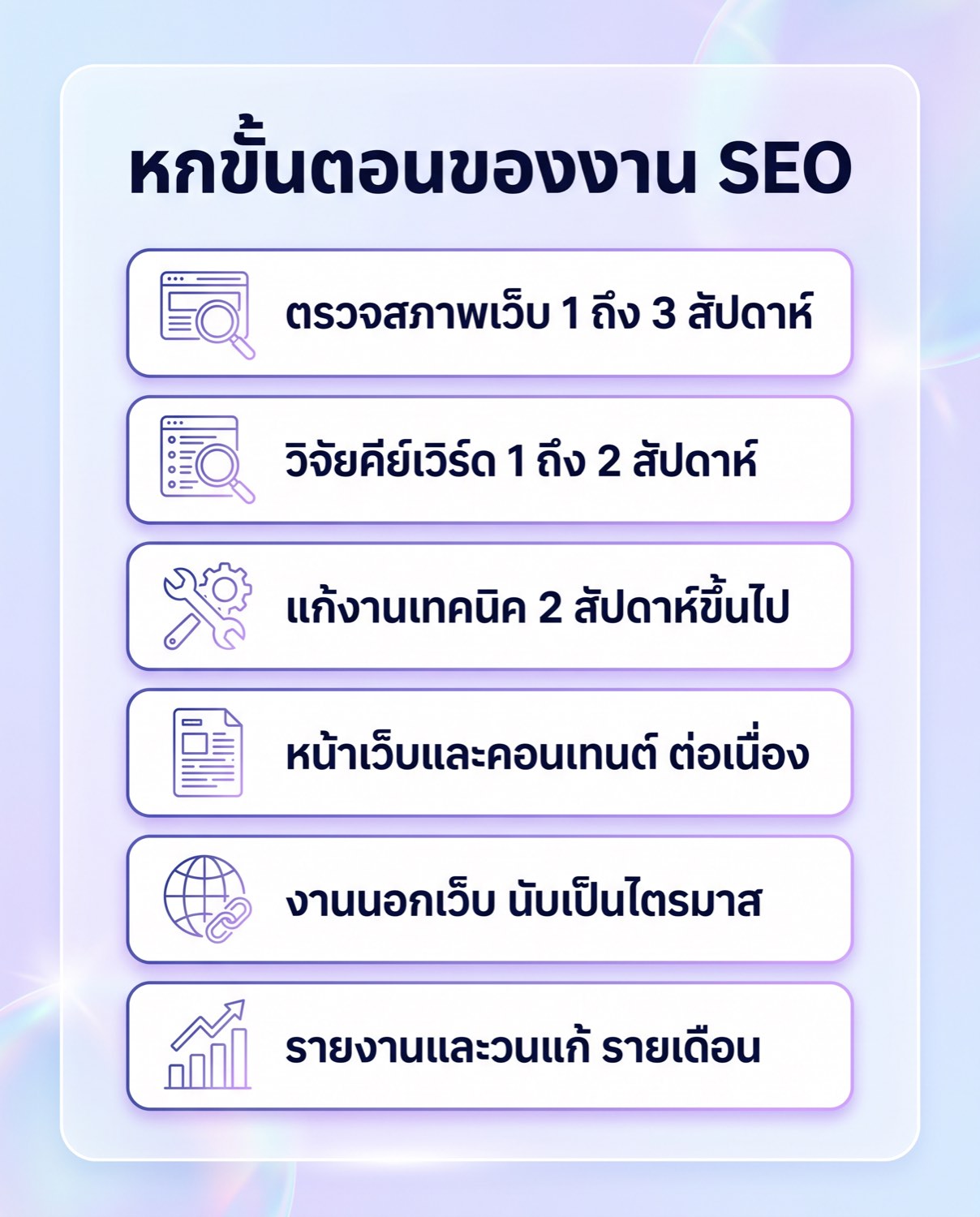
The six stages and roughly how long each takes
The table below is the short version of all six stages. Use it as a checklist while reading a proposal: if a proposal never mentions one of these stages, that is a question to ask before signing rather than something to assume is included.
| Stage | What you should get | Rough timing |
|---|---|---|
| 1. Discovery and audit | A problem list ordered by impact, with an owner against each item | 1 to 3 weeks |
| 2. Keyword research and intent mapping | Term groups mapped to pages, and the gaps no page covers | 1 to 2 weeks |
| 3. Technical fixes | The pages you want indexed are indexed, and duplication is resolved | 2 weeks to several months |
| 4. On-page and content | Existing pages improved and new pages built against the gaps | Continuous, monthly |
| 5. Off-site and digital PR | Links from genuinely relevant sites, with a reason they cited you | Counted in quarters |
| 6. Reporting and the next cycle | A report tying the work to the numbers, and next month's plan | Monthly |
The thing to align on early is when you should expect to see anything. The first signals are usually the number of indexed pages and the number of terms starting to produce impressions, which can move within a few weeks of the technical fixes landing. Movement on competitive terms and the traffic that follows is a matter of months. Anyone promising first page placement by a fixed date is promising something nobody controls, because position is decided by a third party system.
SEO when the answer is written by AI
What has changed recently is that many answers are now summarised at the top of the results page, and AI assistants pull content from sites to answer directly. The consequence is that a page which circles its subject is harder to lift from, while a page that answers the question in its first paragraph, has headings that stand on their own, and puts data in a table, is easier to quote.
This does not delete the six stages. It raises the bar inside stage four. Writing a page now means writing for a reader and for a system reading on behalf of a reader. In practice that means putting the answer in the first sentence of each section, naming the subject inside the sentence that carries the fact rather than referring back to the paragraph above, and using a table when the information genuinely is tabular. That approach is set out on the AI SEO page.
FAQ
Can I do SEO myself instead of hiring a team?
You can do the parts that are cheap to get wrong, such as writing accurate titles, compressing images, turning frequently asked customer questions into pages, and adding internal links. The parts that need a team are the ones that are expensive to get wrong: domain moves, URL structure changes, bilingual sites, and recovering lost traffic. Many small site owners spend the first few months doing it themselves to learn where their problems are, then hire once they know what they are asking for.
How long before I see results?
Early signals such as indexed page counts and terms starting to appear usually move within a few weeks of the technical fixes landing, while rankings on competitive terms and the traffic that follows take months and depend on the starting state of the site and the strength of the competition. A first two months with little visible movement is not necessarily failure, but not being told what is being worked on is a warning sign.
Do I need new articles every month?
No, not while the pages you already have are unoptimised. Writing new pages pays back more slowly than fixing the pages sitting between position eleven and twenty. A monthly article count is easy to sell and does not reflect the work that is needed. The better question is which page will be improved this month, why that one, and what change is expected.
What access does an SEO team need?
At minimum, Search Console, analytics, and the content management system. Much of the technical work also has to go through someone who can change code or the theme. Without a clear owner for that, the problem list gets passed along indefinitely and nothing is closed. Settle access and the route for getting changes made before the first month starts.
Can first position be guaranteed?
No, and a proposal that guarantees rankings deserves scrutiny, because position is decided by a third party system that changes constantly and no provider controls it. What can be guaranteed is scope: what will be checked, what will be fixed, what will be delivered, and which numbers the reporting will use. That belongs in the contract instead of a ranking promise.
If you want to compare a proposal you already have against these six stages, or work out which stage your site is stuck at, the SEO services page sets out the scope of each one.