- Introduction
- The Evolution of Sharing on Instagram
- How the New Story Reshare Feature Works
- Why Instagram is Prioritizing Original Creators
- Combating the Aggregator Problem
- The Shift from Private to Public Engagement
- What This Means for Brands and Businesses in 2025
- Best Practices for Resharing Content
- Conclusion
Introduction
As we navigate through the final month of 2025, the social media landscape continues to shift in fascinating ways. For years, users have navigated a complex web of permissions and workarounds just to share content they enjoy. If you have been an active user on major social platforms, you likely remember the frustration of seeing a great post and having to take a screenshot or use a third-party app just to show it to your own audience. Well, the days of those tedious workarounds are officially behind us.
Instagram has rolled out a significant update that fundamentally changes how content moves across the platform. Users are now able to share any publicly posted Story directly to their own Stories feed, regardless of whether they were tagged in the original post or not. This might sound like a subtle technical tweak, but in the grand scheme of the creator economy, it represents a massive pivot toward open sharing and credit attribution. It is a move designed to amplify original voices while streamlining the user experience.
This update comes at a critical time when the platform is doubling down on authenticity. By allowing seamless resharing, the app is encouraging a culture where credit is automatically given to the originator, rather than lost in a sea of screenshots and uncredited reposts. In this deep dive, we will explore how this feature works, why it was introduced, and how it fits into the broader strategy of protecting original creators in an era dominated by content aggregators.
The Evolution of Sharing on Instagram
To understand the magnitude of this update, we have to look back at how sharing has functioned historically on the platform. For a long time, the ecosystem was somewhat closed. You could share a feed post to your Story, but sharing someone else’s Story to your own was strictly limited. Unless the original creator explicitly tagged your handle in their post, the “Add to Your Story” button simply did not exist for you.
This limitation often forced users into a corner. If you saw a funny update from a celebrity, an inspiring quote from a thought leader, or a beautiful photo from a local business, you could not easily amplify it. This friction led to a behavior that the platform has been trying to correct: the screenshot culture. Users would screenshot the content and upload it as a new image, effectively severing the digital link to the original creator.
!An illustration depicting the evolution of social media sharing, showing a timeline from clunky screenshots in the past to a seamless, connected flow of digital sharing in the present day, emphasizing the connection between users.
Over the last year, specifically since August, we saw the introduction of features allowing the resharing of Reels and feed posts more freely. This new update for Stories is the final piece of that puzzle. It creates a unified experience where almost any piece of public content can be circulated, keeping the ecosystem vibrant and interconnected. It is no longer about just Content Marketing; it is about curating it, and doing so in a way that respects the source.
How the New Story Reshare Feature Works
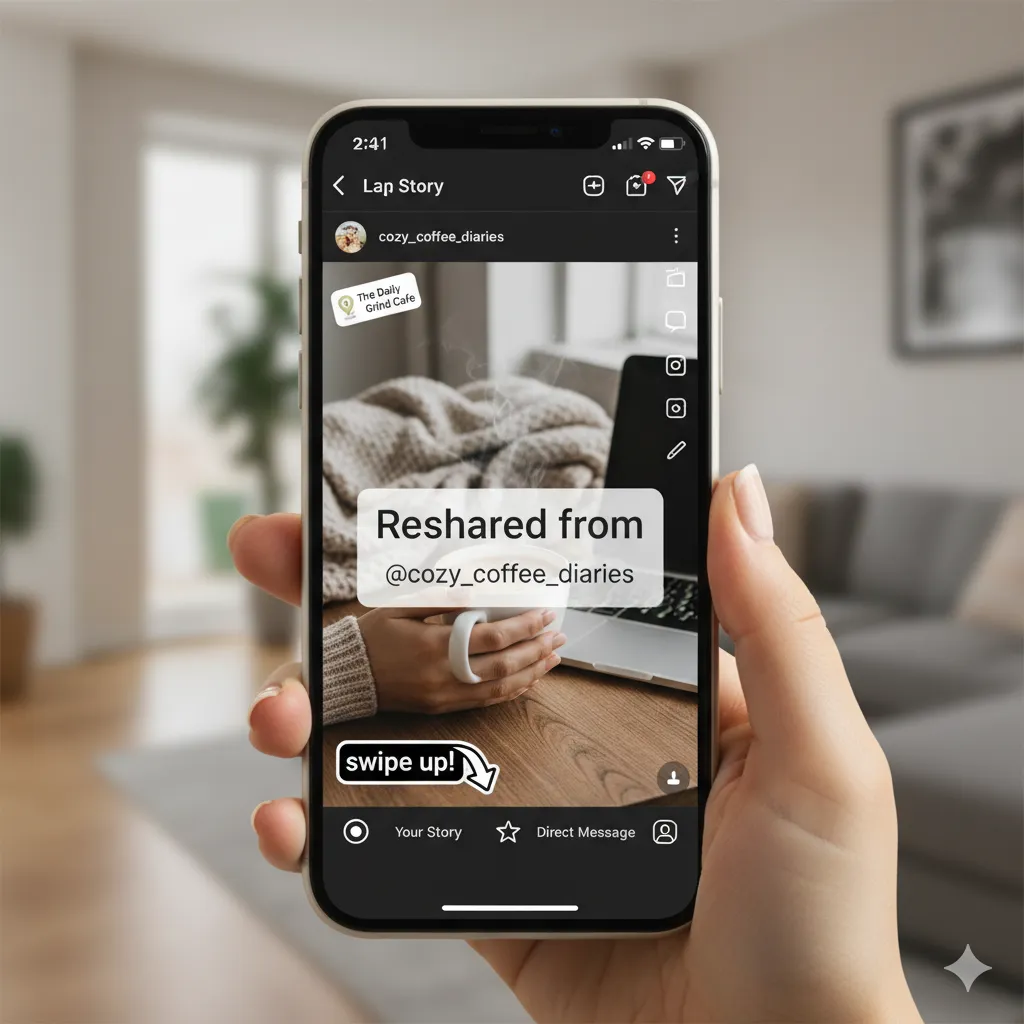
The mechanics of this new feature are designed to be intuitive, removing the friction that previously existed. When viewing a public Story from another user, you will now see an option to share that content directly to your own feed. When you execute this action, the platform automatically formats the post to ensure the original creator is highlighted.
This is distinct from a simple copy-paste job. The system generates a visual link back to the original account. This means that when your followers view your Story, they can tap on the reshared content and be immediately transported to the original poster’s profile. This “clickable” nature is vital. It turns every reshare into a potential growth engine for the original creator, transforming your audience into their potential audience.
It is important to note the distinction regarding privacy. This feature applies to public Stories. The platform continues to respect the privacy settings of closed accounts. If a user has a private profile, their stories cannot be reshared to the public at large, maintaining the boundary between personal sharing and public broadcasting. However, for creators, brands, and public figures who operate openly, this removes the bottleneck of having to tag every single person they want to share their content.
Why Instagram is Prioritizing Original Creators
The driving force behind this update is a renewed focus on the “original creator.” In the vast economy of Influencer Marketing, the person who actually picks up the camera and creates the content is the most valuable asset. Without them, the feed goes stale. However, data from recent years has shown a worrying trend: a small percentage of users create the vast majority of the content.
Back in the early 2020s, industry analysts noted that on platforms like X (formerly Twitter), roughly 10% of users created 80% of the content. By 2025, some estimates suggest that the number of active creators—people actually posting original material rather than just consuming—has shrunk even further. Most people are “lurkers,” scrolling through their feeds without contributing.
!An infographic summarizing the 90-9-1 rule of internet culture, showing a large base of consumers, a smaller group of curators, and a tiny fraction of original creators, highlighting the value of the creator group.
By making it easier to reshare content with proper attribution, Instagram is trying to incentivize that small group of creators to keep going. When a creator sees their Story being reshared by hundreds of people, each time linking back to their profile, it provides a dopamine hit and a metric of success that is far more valuable than a simple like. It validates their work and grows their reach organically. If the platform can make creators feel valued and seen, they are less likely to burn out or move to competing apps.
Combating the Aggregator Problem
One of the more strategic elements of this update is the battle against “aggregator accounts.” These are profiles that do not create anything original. Instead, they scour the internet for viral videos, memes, and interesting stories, download them, and re-upload them as their own. While they often amass huge followings, they rarely give proper credit to the person who made the video.
This practice essentially steals engagement from the artist or creator. If an aggregator account gets a million views on a stolen video, the original creator often gets nothing—no followers, no recognition, and no financial benefit. Throughout 2024 and 2025, we have seen the platform tweak its algorithms to punish these scrapers and boost original content.
The new resharing tool is a functional weapon in this war. By providing a one-tap solution to share content with credit, the platform renders the “screenshot and repost” method obsolete for the average user. Why go through the hassle of screenshotting, cropping, and uploading when you can just tap “Share”? This encourages the average user to share in a way that benefits the ecosystem, leaving aggregators with less utility and clearer disadvantages.
The Shift from Private to Public Engagement
Another fascinating trend that necessitates this feature is the migration of social activity to Direct Messages (DMs). Over the last few years, public posting has declined in favor of private sharing. People are less likely to post a photo to their grid and more likely to send a funny Reel to a group chat.
While this private engagement is great for user retention, it does not help the platform’s public ad inventory or discovery engines. If everyone shares privately, the “Explore” page has nothing new to show. The platform needs public signals to understand what is popular.
!A flowchart illustrating the difference between ‘Dark Social’ sharing (private DMs) and ‘Public Amplification’ (Story resharing), showing how public sharing feeds back into the discovery algorithm.
By allowing users to reshare Stories to their own public Stories, the app is trying to bridge the gap. It is an attempt to pull some of that sharing behavior back out into the open. Instead of just DMing a meme to a friend, a user might now feel comfortable throwing it onto their Story because it is low effort and ephemeral. This keeps the public feed lively and gives the algorithms more data to work with, ensuring that trending topics are actually surfaced to the wider community.
What This Means for Brands and Businesses in 2025
For Digital Marketing For Startups, this update is a goldmine. User-Generated Content (UGC) has always been a powerful form of social proof. When a customer posts a picture of your product or visits your store, you want to amplify that.
Previously, if a customer posted a Story about your coffee shop but forgot to tag you, you were out of luck. You could not reshare it easily. You might have had to DM them to ask for the file or screenshot it, which looks less professional. Now, you can monitor your location tags or brand name mentions and instantly reshare those customer stories to your own business profile.
This creates a community feel. It shows that the brand is listening. Furthermore, it encourages customers to post more. If they know there is a high chance the brand will feature them on their official page, they are more incentivized to create content about their experience. It turns customers into brand ambassadors with zero friction, a key tactic in Ecommerce Marketing.
Best Practices for Resharing Content
With great power comes great responsibility. Just because you can share anyone’s story does not mean you always should. There is an etiquette to this new capability that users should be mindful of to maintain a professional and respectful presence.
First, context is key. Ensure that the story you are resharing makes sense to your audience. Randomly sharing content that has nothing to do with your niche or personal brand can confuse your followers. The goal is curation, not clutter.
Second, consider the “vibe” of the original post. Even if a post is public, sometimes it is meant for a smaller circle. If someone is sharing a vulnerable personal moment, resharing it to a massive business account might feel intrusive, even if technically allowed. Using good judgment is essential.
Lastly, add your own commentary. Don’t just reshare blindly. Use the text tools or Graphic Design features to add your perspective. Why are you sharing this? Do you agree? Is it funny? Adding your own layer of value transforms the act from simple redistribution to actual content creation. This hybrid approach is what keeps followers engaged.
Conclusion
The ability to share any public Story to your own feed marks a mature step forward for Instagram in late 2025. It addresses the critical need to support original creators, combats the plague of content theft by aggregators, and adapts to the changing behaviors of a user base that has grown tired of high-friction sharing methods.
For the everyday user, it makes the app more fun and connected. For creators, it offers a lifeline of credit and exposure. For brands, it unlocks a new tier of community engagement. As we move forward, we can expect this feature to become a standard part of our daily digital interactions, reminding us that social media, at its best, is about connecting with others and celebrating their creativity. By keeping the credit flowing to where it belongs, we build a healthier, more sustainable digital ecosystem for everyone.