TL;DR
- WeChat combines chat, a social feed, official-account publishing, in-app payment, and mini apps in one login.
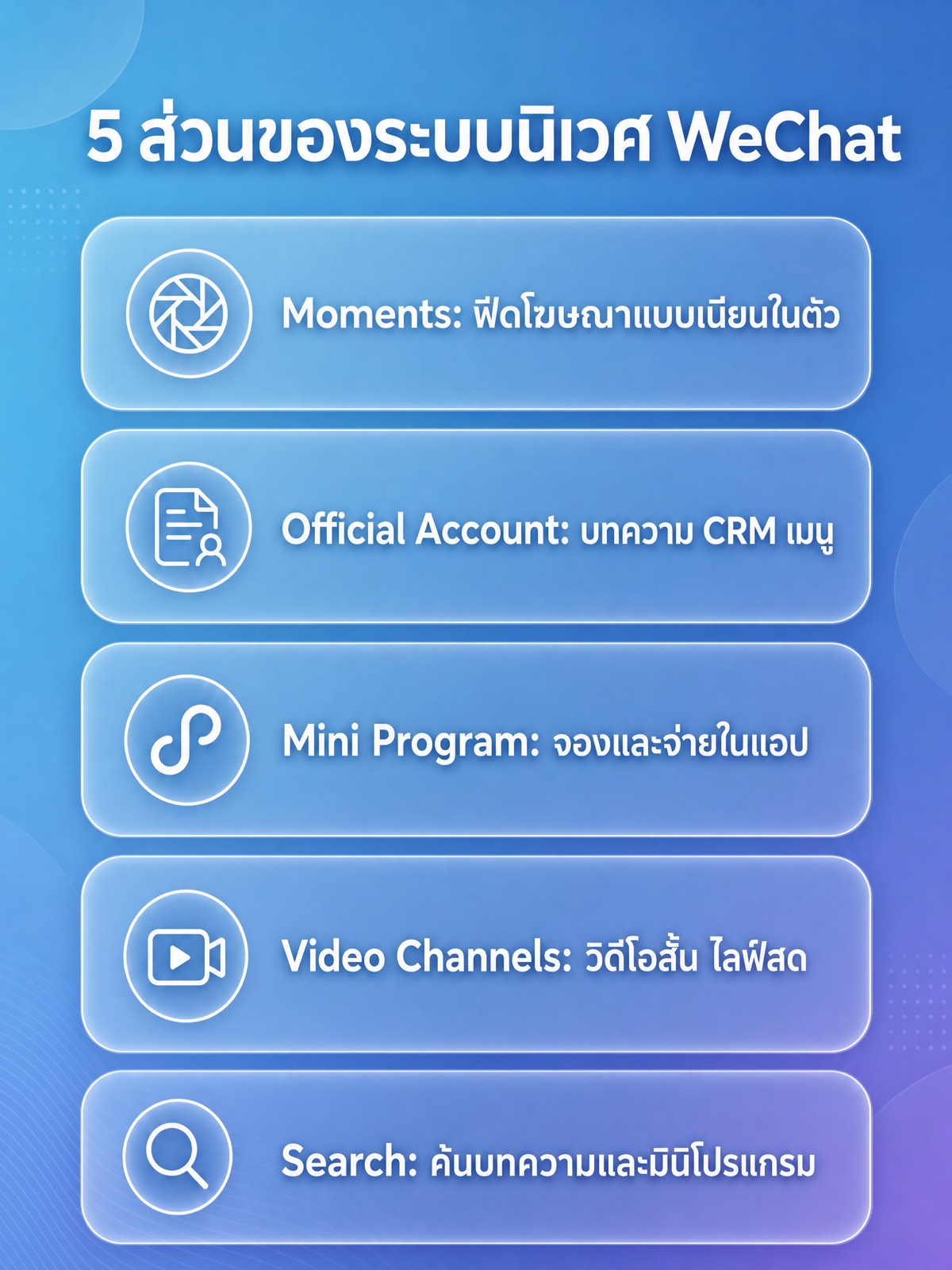
- Moments, Official Account, Mini Program, Video Channels, and search are five separate mechanics, not one channel.
- Official Account posting limits and Mini Program registration are set by WeChat and should be confirmed during onboarding, not assumed.
- Ad formats map to business type: Moments Ads for awareness, Mini Program ads for direct booking, Video Channels for tourist-area F&B.
WeChat is the messaging, social, and payment app that most mainland Chinese travelers, expats, and cross-border buyers treat as their default communication tool, and advertising on WeChat (a search many Thai marketers phrase as "ads on WeChat") means placing content inside its personal feed, its official-account articles, or its in-app mini programs rather than buying banner space on an outside website. For a Thai brand with Chinese hotel guests, luxury shoppers, students, medical tourists, or diners in a Chinatown district, WeChat is frequently the one channel those customers check every day, because several of the apps a Thai audience defaults to are rarely opened once someone is traveling on, or permanently tied to, a mainland Chinese account ecosystem.
What Is WeChat, and Why It Matters for a Thai Brand With Chinese Customers
WeChat is built by Tencent and combines messaging, a social feed, a publishing tool for businesses, an in-app payment system, and a marketplace of lightweight apps into one login. That single identity is the reason it matters commercially: a Chinese user does not switch between four separate apps to chat with friends, read a brand's update, pay a bill, and book a table the way a Thai user might move between LINE, Facebook, a bank app, and a booking app. Everything happens inside one account, which is also why a brand that is absent from WeChat is effectively invisible to a large share of its Chinese-speaking audience, no matter how strong that brand's Thai-language or English-language presence is elsewhere.
Three groups of Chinese customers are relevant to most Thai businesses, and each uses WeChat a little differently. Tourists visiting Thailand tend to research and shortlist before arrival, following Official Accounts or discovering Mini Programs while still at home, then relying on WeChat Pay and QR codes once they land, since it stays the payment method they already trust. Chinese expats living in Thailand keep using the same ecosystem they used at home even after settling here, so they generally do not switch their daily habits to LINE or Facebook, and a brand that wants their repeat business needs to show up inside the app they already open dozens of times a day. Cross-border buyers, people based in mainland China or elsewhere ordering from a Thai seller without ever visiting, discover sellers through in-app search, Video Channels clips, or a link shared inside a chat group, and complete the purchase without leaving WeChat if the seller has a Mini Program storefront connected to ecommerce marketing infrastructure that can fulfill and ship cross-border.
The WeChat Ecosystem in Five Parts
WeChat is not one surface a marketer buys space on. It behaves more like five connected channels that each work by different rules, and treating them as interchangeable is the most common reason a campaign underperforms. A Thai team planning WeChat advertising should map which of the five parts its own audience actually uses before choosing where to spend.
Moments
Moments is the personal social feed, the closest equivalent to a timeline, and it is visible only to a user's own contacts. A brand cannot publish organically into Moments the way a page publishes into an open public feed; the only way a brand's content appears there is as a Moments Ad, a paid unit inserted natively into the scroll and targeted by signals such as location, device type, and declared interest categories, formatted to resemble a normal post from a "friend" with a small sponsored label attached. One behavioral detail worth planning around: when someone comments on or likes a Moments Ad, that interaction is visible only to that person's own contacts and the advertiser, not to the whole audience seeing the ad, so engagement on a Moments Ad does not build the kind of public, cumulative social proof that comments on an open feed post would.
Official Account
An Official Account is the closest thing WeChat has to a combined brand page, email newsletter, and customer-service desk. At registration, Tencent assigns the account a type based on verification status and business category, and that type governs how often the account can post and which features (custom menu, payment integration, customer-service chat) are unlocked. Because those rules and requirements are reviewed and can change, a Thai brand should confirm the exact posting cadence and feature set directly with WeChat, rather than assume a fixed checklist from an old article. A starting Official Account setup typically covers verification, the custom menu, and the account's core publishing workflow. Content is published as articles through WeChat's own publishing tool and delivered into a follower's chat list or a separate subscriptions folder rather than an open feed, which means a follower has to actively open the account to read, not scroll past it passively the way a Facebook post might appear.
Mini Program
A Mini Program is a lightweight application that runs inside WeChat itself, with no separate download or install step. It can be launched from a QR code, an Official Account's menu, a Moments Ad, in-app search, or a link shared in a chat. Businesses use Mini Programs for direct booking, product catalogs and checkout, membership cards, and form intake, with WeChat Pay built directly into the flow so a customer never leaves the app to complete a purchase. Publishing a WeChat Mini Program involves a registration and review process, and the documents and business-registration requirements attached to that process depend on the type of Mini Program and the operator's location, so this is a question to raise with WeChat or an authorized partner at the very start of a project rather than a fixed checklist to copy from a guide.
Video Channels
Video Channels is WeChat's short-video and livestream feed. Unlike Moments, it is distributed algorithmically to viewers beyond a user's own contact list, which makes it the closest thing WeChat has to an open discovery feed. Content can be cross-posted into Moments and into group chats, and Video Channels is increasingly linked directly to Mini Programs and Official Accounts, so a viewer watching a livestream can move straight into booking or buying without leaving the app or the video.
Search
WeChat has its own in-app search bar, sometimes referred to by its Chinese name Sou Yisou, which surfaces Official Account articles, Mini Programs, Video Channels posts, and, depending on integration, broader web results. Because in-app search pulls from a brand's own published articles and a Mini Program's registered name and description, clear naming and keyword-relevant article titles function similarly to on-page SEO for a website: they improve the odds that a user searching inside WeChat, rather than on Google, finds the brand's own content first.
How Chinese User Behavior on WeChat Differs From Thai User Behavior on LINE
Thai marketers who already run line ads often assume WeChat works the same way, since both are chat-first super-apps with an official-account layer and a payment system built in. Several structural mechanics differ enough, though, that a campaign plan built on LINE habits will under-deliver on WeChat if it is not adjusted. The table below lines up the two platforms on points that are documented product behavior rather than opinion or comparative claims about performance.
| Mechanic | On WeChat | On LINE |
|---|---|---|
| Personal feed vs. direct broadcast | Moments is a contacts-only feed; a brand reaches it only through paid Moments Ads inserted into the scroll | The main broadcast channel is a direct message sent from an Official Account into a follower's 1:1 chat list, not a feed post |
| Account tiers | Tencent assigns an Official Account type at verification, which governs posting frequency and unlocked features | The business chooses a LINE Official Account plan, which governs a monthly message quota, with extra messages billed once that quota is used |
| Public/algorithmic feed | Video Channels is the algorithmic public feed, separate from the contacts-only Moments feed | LINE VOOM is the algorithmic public feed, separate from the direct broadcast list |
| Mini app framework | A Mini Program is a fully published application with its own registration and review process | A LINE Mini App runs on LIFF (LINE Front-end Framework) inside LINE without the same standalone registration step |
| In-app payment | WeChat Pay is embedded across Official Accounts, Mini Programs, and Moments Ads checkout flows | LINE Pay serves a similar role inside LINE Mini Apps and select Official Account flows, where supported |
| In-app search | The search bar surfaces Official Account articles, Mini Programs, and Video Channels content broadly | In-app search is narrower, oriented mainly toward finding official accounts and stickers rather than acting as a content search engine |
The practical takeaway is that a Thai brand should not port a LINE broadcast calendar directly onto an Official Account and expect the same open rate, since the account-type rules that govern how often WeChat lets a business post are not something the business itself controls the way a LINE plan tier is. Likewise, a Mini Program should not be scheduled to launch on the same timeline as a LINE Mini App, because the review and registration process is a separate track with its own requirements to confirm with WeChat directly.
WeChat Ad Formats and Which Thai Businesses They Suit
WeChat's advertising system runs on a small number of core paid formats, and each fits a different point in a customer's decision process, from broad awareness inside Moments to a direct booking inside a Mini Program. These are documented ad units on the platform; the exact placement pricing, minimum budgets, and buying mechanics are set by WeChat's advertising platform and its authorized resellers, and should be confirmed there rather than assumed from any outside source.
- Moments Ads insert a native post into the personal feed and target by signals such as location, device, and interest category, which suits broad geo-targeted awareness work: a hotel reaching travelers who show a Thailand-related location signal, or a luxury retailer building recall before a shopping trip.
- Official Account article promotion pushes a published article to a wider audience than the account's own follower base, which suits education agents and medical tourism providers who need to walk a prospective customer through a multi-step process, such as a school application or a treatment pathway, in long-form content before that person is ready to book.
- Mini Program ads open directly into a booking or purchase flow inside a Mini Program, which suits hotels and F&B outlets that already have a reservation, menu, or loyalty Mini Program built, where the goal is an immediate action rather than broad awareness.
- Video Channels placements put a short video in front of viewers beyond a brand's own contacts, which suits F&B businesses in tourist-heavy districts such as Chinatown, where a short clip of a dish or the storefront gives a visiting shopper enough confidence to walk in, and suits hospitality brands showcasing a property before a booking decision.
Mapped against business type, the fit generally looks like this:
| Business type | Best-fit starting format | Why it fits |
|---|---|---|
| Hotels and resorts | Mini Program booking plus Moments Ads | A traveler researching before arrival can book and pay inside the app, and geo-targeted Moments Ads reach that traveler while a trip is still being planned |
| Luxury retail | Moments Ads plus a Service Account for CRM | Brand recall matters before a shopping trip, and a Service Account's customer-service chat supports the personal-shopper style relationship luxury buyers expect |
| Education agents and international schools | Official Account article promotion | Applications involve a multi-step decision that benefits from long-form article content a parent can read and return to |
| Medical tourism providers | Service Account for intake plus Mini Program for forms | Pre-consultation questions and paperwork move faster through a chat-based Service Account and a Mini Program intake form than through email |
| F&B in Chinatown and tourist areas | Video Channels plus a QR-code Mini Program | A short video builds walk-in confidence, and a QR code on the table or storefront moves a visitor straight into a loyalty or ordering Mini Program |
What a Thai Brand Must Prepare Before Starting on WeChat
None of the formats above work without groundwork most Thai teams underestimate, since almost every step depends on a verification or registration process managed by WeChat itself rather than something a brand can configure unilaterally. Before committing to a launch date, work through the following:
- Decide which Official Account type the business needs, and confirm the exact verification documents and posting limits with WeChat during onboarding, since these requirements are reviewed and should never be assumed from an outside article, including this one.
- If a Mini Program is part of the plan, ask WeChat or an authorized partner directly what registration or filing is required for the business's type and location before setting a launch date around it.
- Set up a WeChat Pay merchant account through the process WeChat or an authorized reseller specifies, since this generally runs on a separate onboarding path from the Official Account itself.
- Localize content into simplified Chinese written for a mainland Chinese reader, not a direct translation of existing Thai or English copy, and review it against WeChat's current content and advertising policies before publishing anything.
- Decide whether to manage the ad account directly or through an authorized WeChat advertising reseller, and confirm minimum budgets, billing currency, and account setup requirements with whichever route is chosen.
- Plan a QR code distribution strategy across every physical and digital touchpoint, hotel front desk, restaurant table tents, printed collateral, other social channels, since Mini Programs and Official Accounts are opened far more often by scanning a code than by searching for a name.
- Staff a mainland-Chinese-fluent contact point for Service Account chat and Mini Program customer inquiries, since most of the follow-up conversation after someone sees a Moments Ad or a Video Channels clip happens inside chat rather than through email.
WeChat Advertising for Thai Brands: FAQ
Does a Thai business need a mainland Chinese company to advertise on WeChat?
Not necessarily; a number of Thai and international brands run Official Accounts and advertise on WeChat while based outside mainland China, but the exact registration path, and which Official Account or Mini Program features get unlocked, depends on verification requirements that should be confirmed directly with WeChat or an authorized partner during onboarding rather than assumed in advance.
What is the difference between a WeChat Mini Program and a normal mobile app?
A Mini Program runs inside WeChat itself with no separate download or install step, launched from a QR code, in-app search, or a shared link, while a normal app has to be downloaded from an app store and exists outside the WeChat ecosystem; the tradeoff is that a Mini Program follows WeChat's own review and hosting rules rather than an app store's, and cannot function for a user who does not already have WeChat installed.
How much does WeChat advertising cost compared with LINE ads?
There is no reliable public figure to compare, because both platforms set rates, minimum spends, and bidding mechanics on their own advertising systems and those figures change over time; the accurate approach is to request current minimums and cost ranges directly from WeChat's advertising platform or an authorized reseller, and separately from LINE's ad platform, for the specific format and market a campaign will run in.
Can a brand start with an Official Account alone before paying for ads?
Yes; an Official Account with published articles, and a Mini Program if the business needs one, can operate and be found through in-app search and QR code sharing before any paid Moments Ads or Video Channels promotion begins, which makes it a reasonable way to test content, tone, and messaging before committing an advertising budget.
Do WeChat Moments Ads reach people who are not in mainland China?
Moments Ads can be targeted by signals including device location, which is how a Thailand-based hotel or retailer reaches a mainland Chinese traveler who is already in the country or is showing travel-related signals before a trip; the exact targeting options available for a given campaign should be confirmed with WeChat's advertising platform or an authorized reseller, since targeting capability is controlled by the platform rather than the advertiser.
WeChat rewards a brand that treats it as five connected surfaces, Moments, Official Account, Mini Program, Video Channels, and search, rather than as one banner placement, and it penalizes campaigns built on LINE habits without adjusting for how those five parts actually behave. A Thai team weighing whether to bring in a partner for the account setup, registration, and translation work, or to test the groundwork in-house first, can start simply by mapping which of the five parts its own Chinese customers already touch before spending on any paid format.