
TL;DR
- Shopee does not publish the weight of its ranking factors, so any percentage breakdown of the algorithm is a guess, not documentation.
- Six signals are visible and fixable in Seller Centre: query match, shop performance, price against competitors, conversion rate, review score, and fulfilment speed.
- Ads cannot buy an organic position. They help indirectly by giving a new listing views, orders and reviews sooner, and only where the page already converts.
- The default search tab is sorted by relevance, not by sales, which is the tab where a new shop still has a chance.
- Thai queries run words together with no spaces and mix Thai with English, so a listing needs both scripts in the name or description.
Shops that keep showing up on the first page of Shopee are not there by luck, and not because they spend the most on ads. They are there because their product pages answer more of what Shopee's search system can measure than their competitors do for the same query: the product name contains the words buyers actually type, a healthy share of people who open the page place an order, the shop ships on time, replies to chat, and does not cancel orders. Every one of those is something a seller can fix from Seller Centre.
Ranking matters more than most sellers assume because of how people shop in the app. Buyers decide from what they see on the first screen after searching, then scroll a few more rows before either changing the query or placing an order. A product sitting deeper than that has not lost on quality or price. It was never seen. Position is not a vanity metric here; it decides whether a listing enters the buyer's comparison at all.
What the Shopee algorithm is, and what it can actually judge
The Shopee algorithm, in the sense sellers use the term, is the set of conditions the app uses to pick and order products in search results, category pages, and the recommendation slots on the home page. Shopee does not publish the formula or the weight of each factor in any public document. What a seller genuinely has is the screens in Seller Centre that show which of the shop's numbers the system is tracking, plus whatever changes in the app after editing a listing. Anyone who can quote a percentage weight for each factor is guessing on the system's behalf, not reading a document.
The first thing sellers get wrong is assuming search results have one order. There are buttons at the top of the results that let the buyer re-sort: by relevance, which is the default, by newest listings, by sales, and by price. Plenty of sellers complaining that their product does not appear are looking at the sales-sorted tab, which a new shop loses by construction, because past sales cannot be edited retroactively. The tab where a small shop has a real chance is the default one, because there, text match and listing quality still carry weight.
The second point is that results are not identical on every device. Shopee adapts what it shows to the behaviour of the account running the search, including products viewed before, categories bought from, and the buyer's location relative to the shop's. A seller who opens the app on their own phone and sees their product near the top is usually seeing that because that phone has opened the listing a hundred times. A closer check is to search from a device not logged into the shop account, or to ask someone unconnected to the shop to search and note which row the product turned up in.
The third point is that recommendation slots do not run on queries at all. Slots like the products a buyer might like on the home page, or the similar products that appear under someone else's listing, pick items from product similarity and browsing behaviour rather than typed words. That is why some products get plenty of views while the keyword report from ads shows almost nothing, and why editing a product name alone does nothing for a listing that lives mostly on recommendation traffic.
Six shopee product ranking signals a seller can see and control
The signals below are ones Shopee either shows the seller as a number in Seller Centre or shows the buyer on the listing itself, which makes them checkable and fixable. To repeat the honest caveat: Shopee does not state which signal weighs more than another, and does not publish an order of importance. The list below is ordered by how easy each one is to fix, not by weight in the system.
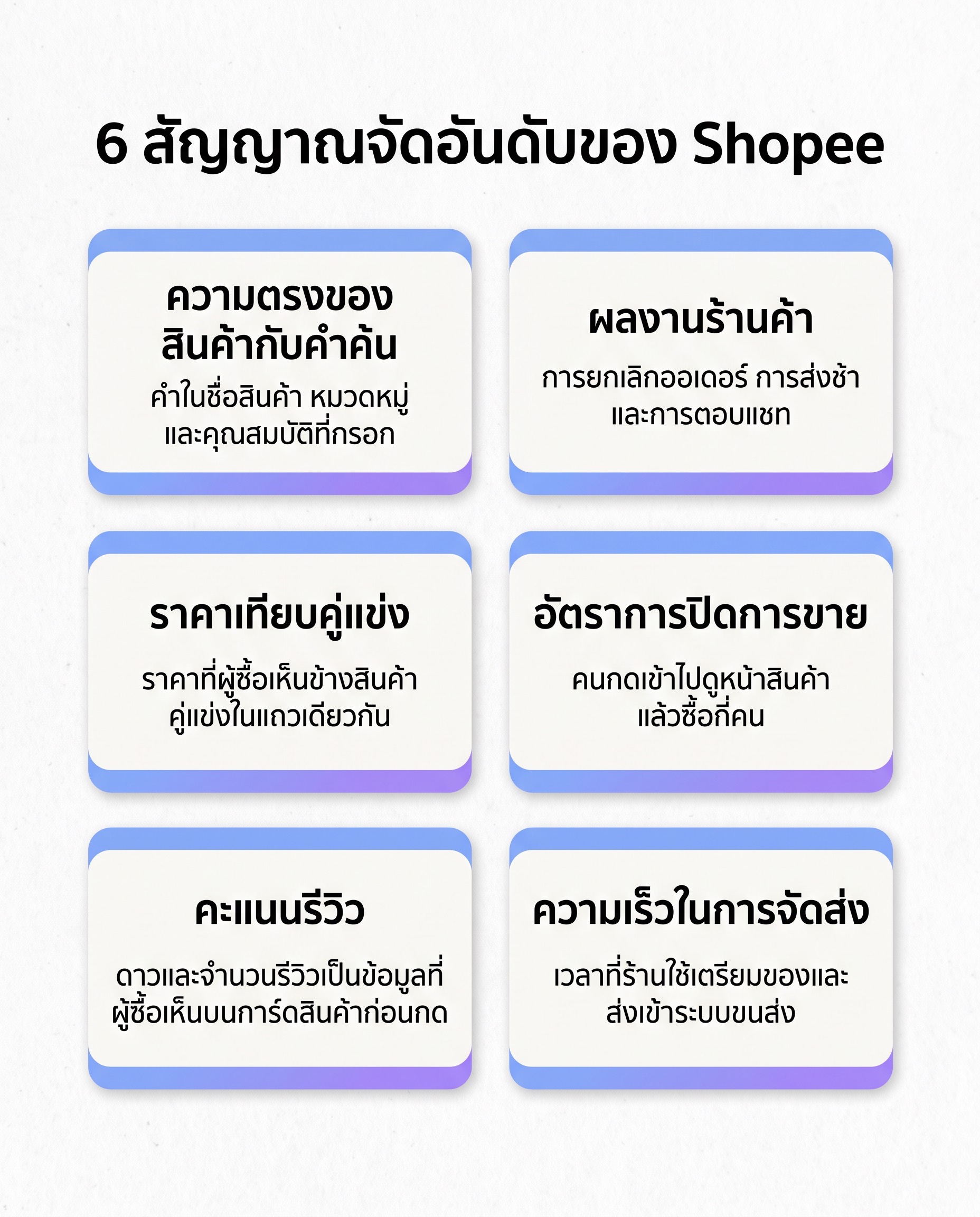
How well the product matches the query
The search system matches what a buyer types against the text on the listing, mainly the product name, the category chosen, and the product attributes filled into the fields the system provides. A listing named in the shop's own marketing language, such as an internal model code or a phrase like our number one bestseller, will not match what buyers type, because nobody searches with those words. A product name that works starts with the words people genuinely use for the item, followed by the attributes people filter on: size, colour, quantity, or compatibility with another model.
The product name field has a character limit, and the add-product screen shows a live counter while typing. Use that counter rather than a number remembered from an old guide. Put the most important words at the front, because a buyer on a phone sees the name truncated after about two lines. Fill in every attribute field the system offers, because those fields are what the filters down the side of the results page run on. A listing with no size filled in disappears the moment a buyer filters by size.
Shop performance
Seller Centre collects the shop's metrics in one place. The ones that bite hardest are the group measuring whether the shop can complete an order: the non-fulfilment rate, which covers orders the shop cancelled and orders that were returned or refunded, the late shipment rate, and the chat response rate. Shopee calculates these from the shop's real behaviour rather than asking the seller to enter them, and it deducts shop points when they pass the thresholds it sets.
A lower position is not the whole price a shop pays when this group deteriorates. A shop carrying penalty points can lose eligibility for platform campaigns, lose its status badge, and in worse cases have visibility limited across the whole shop. Products that used to rank well then fall too, even though nothing on those listings changed.
Price against competitors
Buyers on Shopee compare prices in one view without opening a second tab. The price that counts is not the one the shop considers reasonable, but the one the buyer sees next to competing products in the same row, including shipping and any discount shown on the product card. A listing priced above its neighbours in that row with nothing explaining the difference gets skipped quietly, which becomes the next negative signal: seen but not clicked.
The fix is not an endless race downward. The fix is making the difference visible on the card itself: build a bundle with a different quantity from competitors, put the piece count in the product name, or apply a shop voucher that shows on the card, so someone scanning the row understands in a second why the price is not the same.
Conversion rate
The signal a seller controls most directly, and overlooks most often, is how many people who open the listing go on to buy. Shopee sees this for traffic arriving from search and from recommendation slots. A product with plenty of views and no orders is telling the system this listing is not the answer to that query, and the system responds by handing out less visibility over time. Sellers usually misread this as a sign they need to start advertising.
Fix the listing before the budget. Check that the first image matches what people searched for. Check whether variations that are out of stock have been switched off, because a sold-out variation still on display makes people open the page and leave. Check whether the description answers the questions that keep arriving in chat. Check that the price on the card matches the price after tapping in, because a buyer who taps in and finds a higher price attached to a variation condition leaves immediately.
Review score
Stars and review counts appear on the product card before anyone taps, so they work on two levels. First, they affect whether the buyer taps at all. Second, when fewer people tap, the conversion rate the system measures drops with it. Reviews carrying buyer photos or clips also do the job of a description, because the next buyer scrolls through reviews before reading whatever the shop wrote.
What actually helps is asking for reviews after an order closes through the channels the platform allows, and replying to low-star reviews with a message that visibly resolves the problem, because the next buyer reads that reply. Buying or faking reviews is something the platform detects and penalises, which comes back around and damages the shop performance signals described above.
Fulfilment speed
The time a shop takes to prepare an order and hand it to the courier is the number Shopee measures most precisely, because the system knows when the order arrived and when the parcel was scanned into the logistics network. A shop that sets a long preparation window for its own safety trades that against buyers seeing a later delivery date than a competitor on the same page, and that date is something buyers act on.
Pre-order items deserve the most caution. Listing something as ready to ship and then missing the window hits the late shipment rate and the non-fulfilment rate in one move. Setting expectations honestly from the start costs less than setting them attractively and shipping late.
The table below maps each signal to where in Seller Centre it gets fixed, so it can be worked through with the dashboard open.
| Signal | What the seller controls | Where to fix it |
|---|---|---|
| Match with the query | Words in the product name, category, attributes | The edit-product screen in Seller Centre |
| Shop performance | Cancellations, late shipments, chat replies | The shop performance page and order manager |
| Price against competitors | Unit price, bundles, shop vouchers | Edit-product screen and shop promotion tools |
| Conversion rate | First image, in-stock variations, description | Edit-product screen and business insights report |
| Fulfilment speed | Preparation time and pre-order status | Shop shipping settings and edit-product screen |
How organic ranking differs from paid placement
Bought positions and earned positions sit on the same page and look very similar. The difference is that a bought position carries an ad label on the product card, and the shop pays when someone taps rather than when someone sees it. When the budget runs out or the campaign stops, that position is gone the same day. An earned position does not vanish the moment a seller stops working, but it does get replaced gradually by products producing better signals for the same query.
The most common misunderstanding is that organic position can be bought. It cannot. An ad placement does not move the earned position directly. It does have a traceable indirect effect: orders that came from an ad tap still count as sales and still count toward that listing's conversion rate, and reviews from those orders are real reviews on the page. So advertising helps a new listing build a history faster, but only where the listing already converts.
The flip side is that advertising a listing which does not convert means paying for people to arrive and leave, which loses money and sends the system a negative conversion signal at the same time. The cheaper order of operations is to fix the listing until it converts the traffic arriving on its own, then spend to increase volume, rather than spending to hide a listing problem.
Shopee ad types and what each one suits
Shopee's advertising tools sit in the marketing section of Seller Centre and are divided by where the ad appears, not by budget. Three main groups get used by sellers in Thailand: ads in search results where the seller picks the keywords, ads in the recommendation slots, and ads where the system picks keywords and placements automatically. There are also routes not bought from Shopee directly, such as an affiliate programme paying commission when an order happens, and ads run from social platforms that send people to the Shopee listing.
With shopee search ads keywords the seller chooses the terms and sets a cost per click at the keyword level. This suits products people already know they want and type by name: spare parts, repeat-purchase supplies, or anything with a clear model number. The bigger prize is not the clicks, it is the keyword report, because it shows the words buyers really typed before landing on the listing, which can be moved straight into product names instead of being guessed at.
Shopee discovery ads appear in recommendation slots, both on the home page and under other shops' listings, so they do not depend on anyone typing anything. They suit products people do not know exist, products bought on sight, and products whose search terms are too expensive to contest. The trade-off is that the audience seeing them had no purchase intent yet, so the conversion rate is naturally lower than search placements and the results have to be judged on different thresholds.
Automated ads let the system choose keywords and placements. They suit shops with large catalogues and nobody managing campaigns daily, or work as a first pass to collect keyword data before splitting the terms that perform into a manually chosen campaign. The caution is that the system spreads budget across the products and terms it predicts will work, which may not be the products the shop wants to push, so read the report on where the money went instead of switching it on and walking away.
| Ad type | Where it appears | What it suits |
|---|---|---|
| Search ads | In search results for keywords the seller picks | Products people search for by name or model |
| Discovery ads | Home page and under other shops' listings | Products people buy on sight, not by searching |
| Automated ads | System-chosen keywords and placements | Large catalogues with no daily campaign owner |
| Affiliate programme | Partner channels outside the app | Products that need a review or demo first |
Handing campaign structure and keyword reports to an outside team is the scope of a Shopee Ads service. Planning that covers every sales channel rather than the Shopee storefront alone belongs to ecommerce marketing, which looks at the whole path from first sight of a product to the repeat purchase.
Five reasons a product does not appear in search results
The reasons that recur in shops asking why their product does not show up are rarely obscure technical ones. They are unfilled fields and undone work. The five below are ordered by how often they turn up, with what each one costs the shop.
The product name has none of the words buyers type
A name written like a quotation line item or an internal model code keeps the listing out of the results for every term people actually search. The cost is zero visibility on queries where demand already exists, which is worse than ranking last, because last place still gets scrolled to. The quickest check is to type the words you think buyers use into the app's search box and read the suggestions it fills in. That is the language buyers use. Then compare it against your own product names one at a time.
Not filling the image slots the system provides
Shopee allows several images per listing plus a slot for a short clip, yet many shops upload one photo and stop. Check how many slots are available on your own add-product screen, because it varies over time and by product type. The cost of leaving slots empty is not a lost score. It is the questions left in the buyer's head: what does the colour look like in real life, how big is it next to a hand, what comes in the box. Questions images fail to answer turn into people who open the page and leave, which pushes the conversion rate straight down.
No product description
A description field left empty, or filled with nothing but ask us in chat, leaves the listing with no text to match against longer and more specific queries, and leaves buyers who do not want to chat guessing. The cost is the whole long-tail of search terms plus every buyer ready to purchase but not ready to message. A description that works is the set of answers to the questions customers keep repeating in chat, written as short lines: material, real dimensions, care instructions, what is in the box, return conditions, and which models it fits.
Not replying to chat
The chat response rate is a number Shopee calculates and displays on the shop page for buyers to see. A slow shop loses twice: on the performance metric, and on the confidence of someone about to order. The measurable cost is the orders lost while a buyer waits, because a Thai buyer who asks and gets no answer usually taps the next product on the same page rather than waiting. The immediate fix is automatic replies for repeated questions, then moving those answers up into the product description to reduce the volume of chat at source.
Cancelled orders and late shipments
Cancelling an order because stock ran out does the most damage in this group, because it feeds the non-fulfilment rate, the metric whose penalties run on into campaign eligibility and shop badges. The cost does not stop at the one lost order; it spreads to the visibility of other products in the shop. Prevention is switching off out-of-stock variations immediately, never listing something you have to order from a supplier as ready to ship, and setting a preparation time that matches what the back room can really do.
What Thai sellers have to do differently from English-language guides
Guides translated from English usually skip what matters most for a Thai shop: written Thai does not put spaces between words. Buyers type queries as one long run of characters, the equivalent of oversizedmenstshirt or waterproofnotebookbag. Naming a product therefore involves how the words join together. Picking the right words is only half the job. A name that scatters words across separate lines or splits them with a pile of symbols gives the system text that does not look like what people type.
Second, Thai buyers mix Thai and English inside one query, along the lines of wireless headphones bluetooth or sunscreen with high spf where half the phrase is Thai script and half is not. The same product therefore needs both the Thai and the English words in its name or description rather than one or the other. The same goes for brand names, which people write both transliterated into Thai script and in the original English. A shop that includes only one form is invisible to the other query.
Third, colloquial terms and official terms are not the same. People type the short spoken form far more than the full name printed on the box, and some misspellings have become the form everyone uses. Checking which version people really type can be done from the suggestions the app fills in while typing in the search box, and from the keyword report in the shop's own ad campaigns. Both are Shopee's own data rather than guesswork.
Fourth, delivery behaviour differs. Cash on delivery makes up a large share of orders in the Thai market, and those orders are refused at the door more easily than prepaid ones. Refused parcels feed the non-fulfilment rate. A shop accepting cash on delivery therefore has to work harder on listing clarity and order confirmation, not because the system is biased, but because ambiguity converts into returned parcels faster.
Fifth, campaign periods. The platform's big campaign days change both traffic volume and ad competition within a single day. Comparing results before and after a listing edit where one window overlaps a campaign day will misread the outcome every time. If you are going to compare, use equal-length windows with no campaign day falling on either side.
How to measure whether the fix worked
Seller Centre has a business insights report that breaks numbers down per product. The pair to watch together is the number of people viewing the listing and that listing's conversion rate. If views rise after a name change while conversion holds, the discoverability problem is solved and the next problem is on the page itself. If views hold while conversion improves, the page got better but is still not found often enough. Those two cases need opposite fixes.
For the paid side, read the keyword report before reading the return figures, because the keywords say what kind of demand the money bought. Terms taking clicks without producing orders, repeatedly, should be cut or bid lower. Terms producing orders consistently should be lifted into the product name and description so the listing has a chance of being found on them without paying. That is how an ad budget builds an asset for the shop instead of disappearing with the clicks.
The other thing worth measuring is the people who visited and did not buy. Bringing that group back happens outside the app, through Facebook Ads pointing at the listing and remarketing aimed at people who already viewed the product. Both have to be measured separately from the in-app numbers, because Shopee's reports only count what happens inside the app.
What not to do is change everything on one day. Rename the product, swap the first image, cut the price, and switch on ads all on the same morning, and the result cannot tell you which move worked. Editing one group at a time, leaving a gap for the numbers to settle, and writing down the dates costs less over a year, because historical reports keep no record of what the shop changed and when.
The limits of what anyone outside Shopee knows
There are only two verifiable sources: the numbers Shopee shows the seller in Seller Centre, and what is visible in the app as a buyer. Everything beyond that is inference from outcomes. Shopee does not publish signal weights, does not publish an order of importance, and gives sellers no historical rank report for their listings. A seller who wants to know their position has to search for it and write it down.
In practice that means an offer guaranteeing first-page position on a named query is claiming knowledge nobody outside the platform has. What can be done is improving every measurable signal and then accepting that the outcome also depends on who else is competing for that query. A term locked up by large shops may be worth avoiding in favour of more specific terms with fewer searches that actually convert.
One more limit worth knowing is that platform rules change. Menu names, penalty thresholds, and campaign formats get adjusted periodically. Every time you read any guide, this one included, compare it against the live screens in Seller Centre before acting. The numbers the system shows there are the current truth about the shop. A guide is only a map.
FAQ on Shopee product ranking
Do I have to run ads to rank organically?
No. Earned position is not bought with ad budget, and stopping ads does not by itself remove a position you earned. Advertising helps indirectly, by getting a new listing views, orders, and reviews sooner, which is the history the system evaluates. But if the listing does not convert, advertising only surfaces the negative signal faster. The order to work in is to fix the name, images, and description until the page converts, then spend to add volume.
How many days after editing a product name should I see a change?
Shopee publishes no timeframe, and how long it takes varies with how much search volume the term carries. What you can do is note the edit date and compare views over equal-length windows before and after, with no big campaign day falling on either side. If views have not moved at all once that comparison window has passed, the problem is usually not the name but the wrong category or unfilled attributes.
Does deleting a listing and relisting it help the ranking?
No, and it usually makes things worse, because relisting throws away the accumulated sales and the existing reviews, the two things buyers check before tapping and the system reads as the listing's history. If you want to change the name, images, or details, edit the existing listing. Relisting only makes sense when the item has changed enough to be a different product, such as a new model with genuinely different specifications.
My product is on page one on my own phone but nobody else can find it. Why?
Because Shopee adapts search results to the behaviour of the account doing the searching, and a phone that has opened your own listing a hundred times will see it more often than anyone else does. A closer check is to search from a device not logged into the shop account that has never viewed your products, or ask someone unconnected to the shop to search, and record which row of the results the product appeared in.
Should I always price below competitors?
Not necessarily, because what buyers compare is the total price including shipping against what they get, rather than the price figure on its own. A shop priced higher that states the quantity, the included extras, or the return terms clearly on the card and in the product name can still convert. Cutting the price repeatedly without fixing anything else tends to buy more taps and lose the margin, and it does not address why people were opening the page and leaving.
If you want to start where results show up fastest, pick the three most-viewed products in your own shop and work down the table above field by field. If you would rather have someone review the listing structure, the search terms, and the campaigns together, the team at Relevant Audience covers both the Shopee storefront side and the outside channels feeding it.