TL;DR
- Google emailed advertisers on 5 August 2026 that Search campaigns running automatically created assets, or the campaign-level broad match setting, convert to AI Max for Search starting 1 September 2026; the email was signed by the Google Ads Team with no accompanying blog post.
- The automatically-created-assets group gets search term matching and text customization enabled by default, and Google's description ties text customization to final URL expansion and generated ad copy; campaign-level broad match campaigns get search term matching only.
- Google said the automatically-created-assets group inherits automated query expansion at ad group level unless it has been manually disabled there.
- Pinned assets in responsive search ads remain respected and pinned compliance language keeps its fixed positions, but the email describes no review step for the copy AI Max generates.
- Google's AI Max post, dated 15 April 2026 and updated 11 June 2026, cites an average of 7% more conversions or conversion value at similar CPA or ROAS when the full feature suite is used, and gives Dynamic Search Ads campaigns until February 2027.
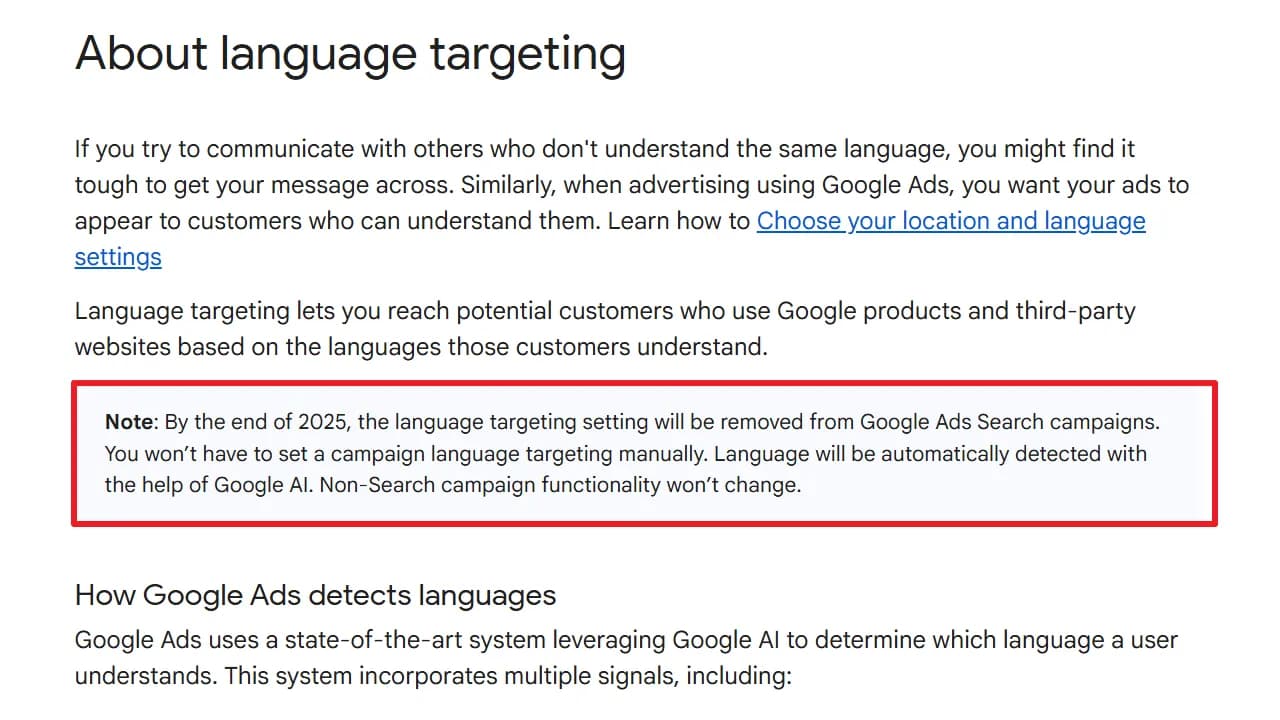
Google emailed advertisers on 5 August 2026 to say that Search campaigns running automatically created assets, or the campaign-level broad match setting, will be converted to AI Max for Search starting 1 September 2026. The email was signed by the Google Ads Team and arrived with no accompanying blog post.
The two affected groups do not start from the same place. One of them gains machine-written ad copy and final URL expansion by default; the other does not.
What Google's 5 August email says
Google's 5 August 2026 email tells advertisers that campaigns using automatically created assets, or campaign-level broad match, convert to AI Max for Search from 1 September 2026. Campaigns in the automatically-created-assets group get search term matching and text customization enabled by default. Campaigns using campaign-level broad match get search term matching only, with no final URL expansion and no generated ad copy by default.
Text customization is the setting that carries the rest of it. In Google's description, text customization is what enables final URL expansion and generated ad copy, so a campaign in the first group picks up both on 1 September unless the default is changed first.
Google also states that the automatically-created-assets group inherits automated query expansion at ad group level unless it has been manually disabled there. That is a setting most accounts have never deliberately looked at, and it sits one level below the campaign the email is about.
The two cohorts, side by side
The defaults Google described on 5 August 2026 split cleanly along the setting a campaign runs today, so the same account can end up with two different behaviours on 1 September.
| Setting | Automatically created assets | Campaign-level broad match |
|---|---|---|
| Search term matching | Enabled by default | Enabled by default |
| Text customization | Enabled by default | Not enabled by default |
| Final URL expansion | Comes with text customization | Not enabled by default |
| Generated ad copy | Comes with text customization | Not enabled by default |
| Automated query expansion (ad group level) | Inherited unless manually disabled | Not addressed in the email |
Pinned assets survive the conversion
Google's 5 August 2026 email states that pinned assets in responsive search ads remain respected, and that pinned compliance language stays in its fixed positions. For advertisers in regulated categories, that sentence decides whether the change is an annoyance or a legal problem.
It does not extend to the copy AI Max generates on top of the pins. The email says pins are respected; it does not describe a review step for generated text.
How AI Max reached a forced date
Google's own AI Max post, dated 15 April 2026 and updated 11 June 2026, says AI Max for Search reached general availability in April 2026. The same post gives Dynamic Search Ads campaigns until February 2027 before they are affected, and cites an average of 7% more conversions or conversion value at similar CPA or ROAS when the full AI Max feature suite is used.
The 7% figure is Google's own, measured across advertisers using the whole suite. It is a reason to test AI Max deliberately. It is not a forecast for a campaign that gets converted without anyone choosing the settings. PPC Land reported the email on 6 August 2026.
What to check before 1 September
The work is a settings audit, not a strategy rewrite, and it has a deadline of 1 September 2026.
- List every Search campaign running automatically created assets. Those are the ones that gain final URL expansion and generated copy by default.
- Check automated query expansion at ad group level inside those campaigns, since Google says the setting is inherited unless it was manually turned off.
- List campaigns using the campaign-level broad match setting separately. They get search term matching only, so the change to expect is in matching, not in creative.
- Confirm that compliance wording is actually pinned rather than merely present in a headline.
Whichever way an account goes, the measurement side needs to hold still while the matching changes underneath it. Loose conversion setup turns a settings change into an argument nobody can settle. Teams reviewing their Google Ads management setup ahead of the date usually find the ad group level, not the campaign level, is where the surprises are, and a clean GA4 measurement baseline is what makes the before-and-after readable.
What this means for Thai marketers
The source states nothing specific to Thailand. What follows is reasoning about the same facts.
Campaign-level broad match is common in lower-volume THB accounts, where broad match is the practical way to find enough traffic to train a bid strategy at all. Those campaigns will have search term matching switched on for them on 1 September 2026, which widens matching further in accounts that already accept loose matching by design.
Accounts running Thai-language ad copy sit in the other group's path. Nothing in Google's email describes a separate approval step for generated copy, in any language, so a Thai brand that cares about how its wording reads should decide about text customization before 1 September rather than review it afterwards.
FAQ: the AI Max auto-upgrade
Do I have to do anything before 1 September?
Only if you want to keep your current defaults. Google's email describes a conversion that happens on 1 September 2026 without advertiser action, so campaigns left alone will run under the AI Max defaults for their group.
Will my ads suddenly be written by Google?
Only in the automatically-created-assets group. Those campaigns get text customization enabled by default, and Google's description ties text customization to generated ad copy and final URL expansion. Campaign-level broad match campaigns get search term matching with no generated copy by default.
Is this live in Thailand?
The source does not say. Google's email gives a date of 1 September 2026 and describes the affected campaign settings, and it names no countries or regions at all.
What happens to my pinned headlines and legal wording?
They stay where you put them. Google's 5 August 2026 email says pinned assets in responsive search ads remain respected and pinned compliance language keeps its fixed positions.
Does this hit Dynamic Search Ads too?
Not on this date. Google's AI Max post, dated 15 April 2026 and updated 11 June 2026, gives Dynamic Search Ads campaigns until February 2027.
If you are not sure which of your Search campaigns fall into which group, that audit is a short one and it is better done in August than in September. Relevant Audience can walk an account through it with you.