
TL;DR
- A citation credits a page, not a brand: an AI answer can link your URL as a source without naming your company anywhere in its text.
- Recommendations usually come from off-site evidence such as Google reviews, independent 'best of' and 'X vs Y' articles, and consistent positioning across the web.
- Mentions depend on entity clarity: the same brand name, descriptor, location and audience on your site, Google Business Profile, social profiles and directories.
- In Thailand, the third-party pages an engine can retrieve for Thai commercial questions include Pantip, Wongnai and Google Maps reviews, so English-only work leaves a gap.
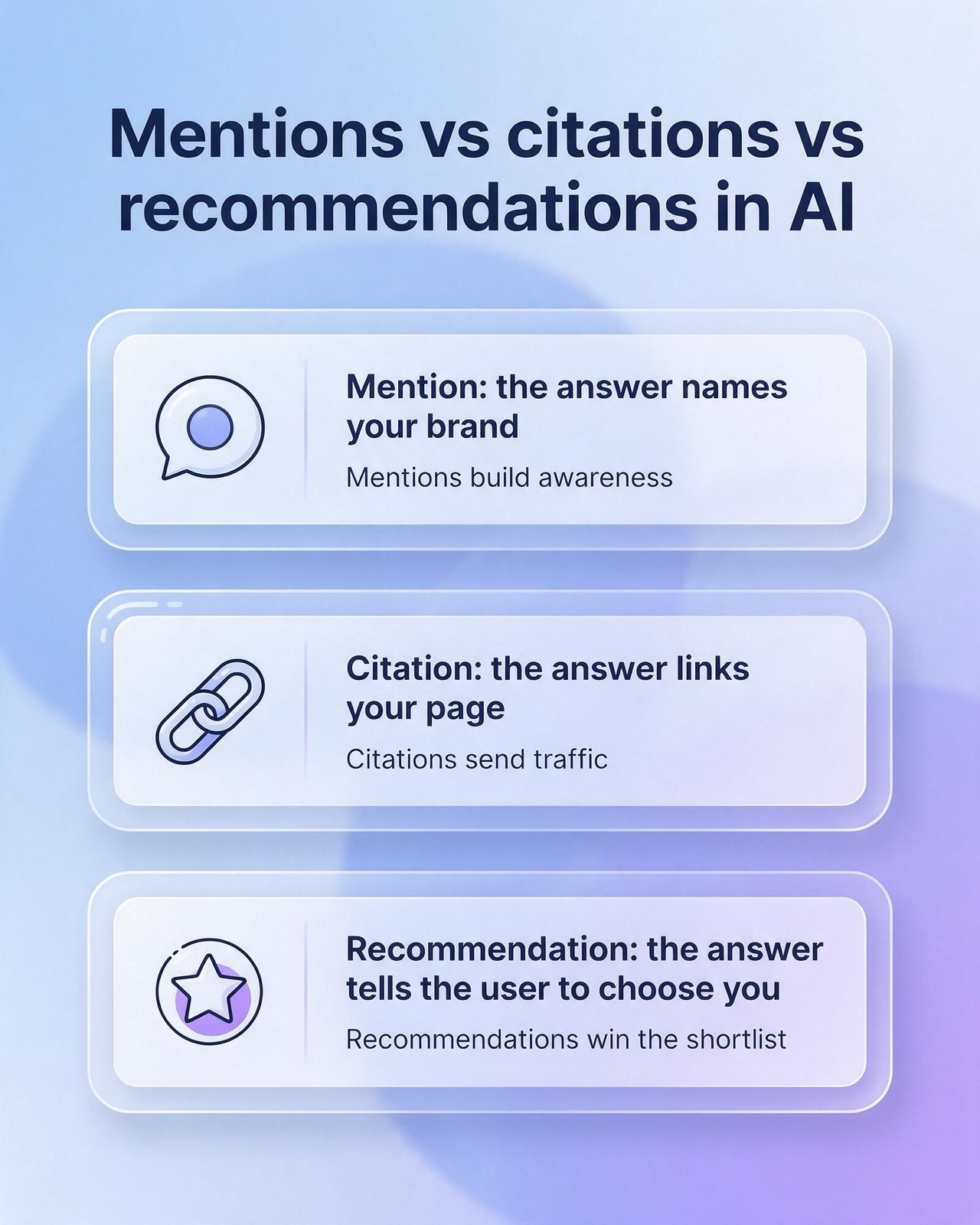
Mentions vs citations vs recommendations in AI comes down to three different things an AI answer can do with your brand: name it, link to your page as a source, or tell the user to choose you. A mention builds awareness, a citation can send a visitor and lends you authority, and a recommendation puts you on the buyer's shortlist, so each one needs a different kind of work to earn.
The three get blurred together in reports and sales decks, which is how teams end up celebrating the wrong number. A brand can be named in hundreds of AI answers and never be suggested as the one to buy. A page can be cited as the source of a definition while a competitor collects the recommendation in the same answer. This guide defines each signal precisely, explains what each is worth to a business, sets out what earns each one, and shows how AI search optimisation can target them one at a time.
What SEO means once AI writes the answer
Classic SEO worked on a list. A search engine returned ranked links, the user picked one, and the job was to be near the top of that list. AI search changes the unit of the result. Google AI Overviews and AI Mode, ChatGPT with search, Perplexity, Gemini and Microsoft Copilot all return a written answer first. Links still exist, but they sit beside or underneath a paragraph that has already done much of the explaining.
That shift matters for one reason: the answer now decides how your brand appears before anyone clicks. In a list of ten blue links, your listing looked roughly like everyone else's. In a generated answer, your brand can be absent, named in passing, credited as a source, or put forward as the best option. Those are very different outcomes, and the old ranking report cannot tell them apart.
SEO in relation to AI is therefore still SEO at its base. Answer engines that search the web retrieve pages through ordinary crawling and indexing, and many of them lean on a conventional search index to find candidates. A page that cannot be crawled, that loads its main text only through scripts the crawler does not run, or that ranks nowhere for the underlying query has little chance of being used. What changes is the layer on top: the page also has to be easy to quote, and the brand has to be described consistently enough across the web that a model connects the right facts to the right name. The site's AI SEO service page covers that combined discipline in more detail.
Brand visibility in AI search has three levels, not one
Brand visibility in AI search is usually reported as a single score: how often the brand "appears". That score hides the question a marketing lead actually needs answered, which is in what role the brand appeared. It helps to think of the three signals as a ladder.
- Mentions build awareness. The user sees your name inside the answer.
- Citations send traffic. The user sees a link to your page and can follow it, and the answer borrows your credibility.
- Recommendations win the shortlist. The answer tells the user that you are a good choice for their need.
The rungs are not strictly sequential. A brand can be recommended without being cited, and a page can be cited without its brand ever being named in the text. But the ladder is a useful way to ask where a brand stands and which rung is missing.
Mentions vs citations vs recommendations in AI: precise definitions
The difference between a mention, a recommendation and a citation in AI is easiest to see in a single answer. Picture a user asking an assistant for "the best accounting software for a small Thai business". The answer names five products, links to three web pages in its source list, and ends by saying which product suits a business that needs Thai tax forms. Each of those parts is a different signal.
Mention: the answer names your brand
A mention is any appearance of your brand name in the generated text. It can be positive, neutral or negative. It can be the subject of the answer or a passing item in a list. It does not need a link, and it does not need the model to have read your website at all, since the name may come from the model's training data or from a third-party page the engine retrieved.
Mentions are the broadest signal and the easiest to inflate. A brand mentioned as an example of what to avoid still counts as a mention in a raw tally, which is why sentiment and position in the answer matter as much as frequency.
Citation: the answer links your page
A citation is a link from the answer to a specific URL that the engine used as a source. Different products show it differently: numbered footnotes, source cards beside the text, a "sources" panel, or link chips at the end of a sentence. What they have in common is that the citation points to a page, not to a brand.
That distinction causes a common confusion. Your page can be cited while the answer text never names your company; the engine takes your explanation, credits the URL in small print, and moves on. The reverse also happens: your brand is named in the text, but the cited source is a review site or a news article about you. A citation is a credit to a document. A mention is a credit to a name.
Recommendation: the answer tells the user to choose you
A recommendation is a mention with a verdict attached. The answer lists your brand and presents it as a fit for the user's need: "for a clinic that wants bookings through LINE, X is a strong option", or "if budget is the main concern, start with Y". Recommendations usually appear in answers to commercial questions such as "best", "which", "alternatives to", "is X worth it" and "X vs Y".
Recommendations are the hardest signal to earn and the most valuable, because they sit at the moment of choice. They are also the least stable. The same question asked twice, or asked with one extra detail about budget or location, can produce a different shortlist.
Where the lines blur
Real answers mix the three. A single sentence can name a brand, recommend it and cite a third-party review of it. When you audit answers, label each appearance on all three dimensions separately (named or not, linked or not, recommended or not) rather than picking one label per answer. That habit alone prevents most reporting mistakes.
What each signal is worth to a business
The three signals pay off in different currencies. Treating them as interchangeable leads to plans that chase the cheapest signal and then wonder why leads did not move.
| Signal | What it gives the business | What it does not give |
|---|---|---|
| Mention | Mentions build awareness: the name enters the buyer's memory and later branded searches | No click, no guarantee the context is positive |
| Citation | Citations send traffic: a possible visit, plus credibility borrowed from being the source | No guarantee the brand is named in the text |
| Recommendation | Recommendations win the shortlist: the brand is put forward at the moment of choice | No direct click in many answers, and the verdict can change between runs |
A few practical consequences follow from the table.
Mentions are an awareness asset. They are worth most to brands in categories where buyers research for weeks before contacting anyone: B2B services, education, property, healthcare. Being named repeatedly while a buyer explores a topic makes the later branded search more likely. They are worth least when the mention is neutral filler in a long list.
Citations are a traffic and authority asset. They are the signal closest to classic SEO, because they reward a specific page. For publishers, software companies with strong documentation and any business that sells through content, citations are where AI search still sends measurable visits. Their weakness is that a cited page can educate the user on behalf of a competitor who wins the recommendation.
Recommendations are a revenue asset. For local services, ecommerce categories with clear "best X" questions, and any business compared head to head with two or three rivals, the recommendation is the signal that maps most closely to enquiries.
What earns a mention
Mentions come from the model having a clear, consistent picture of what your brand is and which topics it belongs to. Four things drive that picture.
- Entity clarity. The brand name, what it does, where it operates and who it serves should be stated the same way on your own site, your Google Business Profile, your social profiles, directories and any knowledge-base entries. Inconsistent descriptions split the signal across several half-entities.
- Topical association. Models connect brands to topics through repeated co-occurrence. A company that publishes and is discussed on one subject area again and again becomes associated with it. A company that writes about everything becomes associated with nothing in particular.
- Third-party coverage. Trade press, industry associations, event listings, podcasts, forums and comparison articles put your name in contexts that you do not control.
- Distinct naming. A brand name that is also a common word, or that is shared with an unrelated company, is harder to attach facts to. Adding a consistent descriptor ("X, the Bangkok payroll software") helps the association.
What earns a citation
Citations are earned page by page. An engine that searches the web retrieves candidate pages, extracts the passages that answer the question, and credits the URLs it used. Pages that get cited tend to share a few traits.
- They are reachable. AI crawlers are not blocked in robots.txt by accident, the main content is in the HTML rather than loaded later, and the page is indexed in the conventional search engines these products draw on.
- They answer in liftable passages. A direct answer in the first sentences under a clear heading, short definitions, numbered steps and tables with real values are easy to extract and credit. An important fact buried in the fourth paragraph of a story is not.
- They carry something original. Your own data, a precise specification, a price list, a documented process or a clear position gives the engine a reason to credit you rather than the ten pages that say the same general thing.
- They are current and specific. A visible update date, accurate details and one clear topic per page make a page a safer source than a long post that covers twelve loosely related questions.
For engines built on a large language model with web search, such as ChatGPT, the same rules apply with a twist: the search step can use a different index from Google, so a page that ranks well in Google is not automatically retrieved. The ChatGPT SEO page explains that engine-specific side.
What earns a recommendation
Recommendations come from evidence about fit, and most of that evidence lives off your site. When an engine is asked which provider to choose, it looks for sources that compare, review and qualify. Four kinds of evidence carry most of the weight.
- Reviews and ratings. Volume, recency and the content of reviews on Google, marketplaces and category platforms tell an engine what you are good at, in customers' words. Reviews that mention the specific need ("fast delivery to Chiang Mai", "English-speaking dentist") help the brand match those specific questions.
- Comparison and list content. Independent "best of", "alternatives" and "X vs Y" articles are exactly the sources engines retrieve for commercial questions. Being absent from them makes a recommendation unlikely.
- Clear positioning on your own pages. A page that says plainly who the product is for, who it is not for, what it costs or what drives the cost, and how it compares on the points buyers care about gives the engine quotable reasons to put you forward for the right user.
- Consistency between what you say and what others say. If your site claims you specialise in one thing and every review talks about something else, the engine has no reason to trust the claim.
AI search optimisation: how to target each signal
AI search optimisation works best when each signal has its own objective and its own set of tasks. A single "be visible in AI" goal tends to collapse into publishing more blog posts, which mostly helps citations and does little for the other two.
Targeting mentions. Start with an entity audit: list every place the brand is described and make the descriptions agree. Then pick two or three topics the brand should be known for and concentrate content, PR and partnerships on them. Measure mentions on informational prompts in those topics, where awareness is built.
Targeting citations. Choose the questions your buyers ask before they buy, and give each one a page that answers it directly in the opening lines, with tables, definitions and original details further down. Fix crawl access and indexing first, because the best passage on the web cannot be cited if the engine cannot fetch it. Refresh these pages on a schedule so the facts stay current.
Targeting recommendations. Map the commercial prompts in your category ("best", "which", "alternatives", "vs") and check which sources the engines use to answer them. Those sources are your target list: review platforms to build up, comparison articles to be included in, directories to correct. On your own site, publish honest comparison and "who it is for" pages. This is the slowest track and the one that most resembles digital PR.
Sequencing. Most brands should fix the foundations first (crawl access, entity consistency, a set of answer-ready pages), because those support all three signals. After that, the order depends on the business model. A content-led business usually leans toward citations. A local service or a business that wins on comparison leans toward recommendations. A new brand in a crowded category often needs mentions first, because an engine rarely recommends a name it does not recognise. A structured programme that covers all three is what generative engine optimisation (GEO) is built around.
What this means for Thai businesses
The three signals behave in specific ways for brands that sell in Thailand.
Language splits the evidence. A Thai user may ask in Thai, in English, or in a mix. A brand with a strong English site and thin Thai content can be cited in English answers and missing from Thai ones, or the other way round. Both language versions of the main pages need the same facts, the same brand descriptor and the same structure.
The third-party sources are local. For Thai commercial questions, the kind of third-party pages an engine can retrieve include Thai forums such as Pantip, review platforms such as Wongnai for food and services, Google Maps reviews, marketplace listings and Thai trade media. Recommendation work in Thailand means paying attention to those sources rather than only to international review sites.
Names travel in two scripts. Many Thai brands are written in both Thai script and Latin letters, sometimes with several romanisations. Pick one Latin spelling and one Thai spelling, use them everywhere, and state both on the About page and in the Google Business Profile so that mentions in either script attach to the same entity.
Classic SEO still feeds the engines. Because the answer engines retrieve from search indexes, a Thai site with technical problems or weak rankings in its own market starts at a disadvantage in AI answers too. Strong foundations in SEO in Thailand remain the base layer for all three signals.
The honest limits
Three limits apply to anyone working on these signals.
First, answers vary. The same prompt can produce different brands and different sources across runs, days, locations and logged-in states. Any single screenshot is an anecdote; only repeated checks across a fixed prompt set show a pattern.
Second, none of it can be bought directly. There is no submission form for AI recommendations, and organic citations in these answers cannot be purchased. Everything in this guide works by changing the evidence the engines read.
Third, the products change often. Interfaces, citation formats and source preferences shift with each product update. Plans should rest on the durable parts (crawlable pages, consistent entities, real reviews, useful content) rather than on any one engine's current habits.
A short note on measurement
Measuring these signals is its own topic, and the site's separate guides on how to measure GEO and how to track AI Overviews visibility cover it in depth. The one rule that belongs here: count mentions, citations and recommendations as three separate numbers on a fixed set of prompts, and never add them into a single visibility score.
Frequently asked questions
What is the difference between a mention, a recommendation and a citation in AI?
A mention means the AI answer names your brand, a citation means it links to one of your pages as a source, and a recommendation means it tells the user your brand is a good choice for their need. The three can occur together or separately, and each has a different business value.
Is a citation more valuable than a mention?
A citation is usually more valuable for traffic, because it gives the user a link to your page, while a mention is usually more valuable for awareness when the brand name appears in a positive context. Which matters more depends on whether the business grows through site visits or through brand recall and later branded searches.
Can a brand be recommended by AI without being cited?
Yes, an answer can recommend a brand while citing only third-party pages such as reviews or comparison articles, or while citing no sources at all. That is why off-site evidence like reviews and inclusion in comparison content matters so much for recommendations.
How long does AI search optimisation take to change these signals?
There is no fixed timeline, since each engine updates its sources on its own schedule.
Do AI recommendations lead to sales leads?
They can, because a recommendation reaches the buyer at the moment of choice, but the lead often arrives through a branded search, a map listing or a direct visit rather than a tracked click from the AI answer. Connecting that demand to a proper enquiry path is covered by the lead generation service.
If you want a plan that sets separate goals for mentions, citations and recommendations and works on the evidence behind each one, the GEO service is the place to start.