
TL;DR
- Video content covers short clips, tutorials, live streams and website videos made to inform, entertain or prompt an action, not only ads that sell directly.
- A video content marketing strategy starts from the business goal, maps video types to decision stages, picks one main platform and keeps a cadence the team can sustain.
- In-house teams win on speed and brand knowledge; professionals win on consistent quality and usually bring strategy and reporting. Mixing both is also an option.
- Match KPIs to goals: Reach and Views for awareness, Watch Time and Shares for engagement, Clicks and Conversions for sales, tracked with UTM parameters and GA4.
Video content is content that communicates through moving images and sound to inform, entertain or persuade viewers to do something next, such as follow a brand, start a chat or buy a product. For a business, video content that works does not start with a camera or an editing app. It starts with a clear goal, a choice of video type that fits that goal, a distribution strategy, and KPIs set before anything is filmed. This article covers the meaning, the types, what makes a good video, how to plan a video content marketing strategy, how to choose between doing it yourself and hiring professionals, and how to measure results with KPIs that are actually usable.
The focus here is strategy and measurement. Production details, such as scriptwriting, opening a clip and production tools, are a topic worth covering separately.
What is video content?
In practical terms, video content is any piece of content a business uses video as its main way of communicating, whether a few-second clip on TikTok, a ten-minute tutorial on YouTube, a live-selling stream on Facebook, or a company introduction video on a website. What they share is that they are made to give viewers something of value while moving the business one step closer to a marketing goal.
It helps to separate video content from video ads. Video ads are made to sell or promote directly and usually need paid spend to be seen. Video content in the broad sense includes videos that teach, tell stories or build a relationship with viewers, which may contain no selling at all. In practice the two work together: videos that perform well organically are often put behind paid spend, and good video ads usually carry content value of their own.
One practical reason businesses use video is that it explains what text struggles to, such as how to use a product, the atmosphere of a place, or before-and-after results.
Types of video content
The choice of video type should depend on which stage of the decision the viewer is at. People who do not know the brand yet need a different kind of video from people comparing options. Below are the types businesses use most, with the goal each one suits.
Brand awareness videos
Videos that tell viewers who the brand is, what it does and how it differs from others, including founder stories, behind-the-scenes videos and videos about brand values. They suit the early stage of a decision, when the goal is for people to remember the brand, not to buy straight away.
Educational and how-to videos
Videos that teach how to solve problems the target audience faces, both directly about the product and about the subjects around it, such as a garden supply shop making clips on caring for plants in the rainy season. This type has a long useful life, because people keep searching for the same topics, especially on YouTube, which also works as a search engine.
Review, demo and comparison videos
Videos that show a product working for real, compare models, or answer questions customers often ask. They suit people who are choosing what to buy. This kind of video can answer questions on the sales team's behalf and reduce hesitation before a decision.
Customer and creator videos
Videos in which real customers share their experience, or creators with a following try the product. If you work with creators, plan it alongside influencer marketing so the agreement on rights to reuse the video is clear from the start.
Short vertical clips and live streams
Short vertical clips are the main format of TikTok, Reels and YouTube Shorts and suit reaching large numbers of new people. Live streams suit selling and answering questions in real time.
Videos for existing customers
Onboarding videos, after-sales troubleshooting videos and new-feature announcements. This type can reduce the load on customer service and support repeat purchases.
What makes good video content?
From a business point of view, a good video is not judged on how beautiful it looks alone, but on whether it moves viewers towards the result you set. The elements good video content shares are these.
- One clear goal: each clip should have one main job, such as making people aware, helping them understand how to use something, or getting them to order.
- Knowing who it is for: a clip for people who do not know the brand needs more context than a clip for existing customers. Knowing the viewer lets you choose the right language, length and level of detail.
- Value that is clear early: viewers should quickly know what they will get by watching on, whether knowledge, an answer or entertainment.
- A fit with the platform: aspect ratio, length and pacing must suit the platform it goes on.
- Understandable without sound: subtitles or on-screen text keep the content understandable for viewers who watch with the sound off.
- Consistent brand identity: stable colours, fonts, music and tone of voice let people recognise which brand a clip comes from, even when scrolling past quickly.
- A clear next step: a clip should say what to do after watching, such as follow, start a chat or visit the website, and that step must genuinely be easy.
Video content marketing for businesses
Video content marketing is the systematic use of video as a marketing tool. It differs from making clips now and then in having goals, a plan, a production cycle and ongoing measurement. The strategy steps are these.
- Start from the business goal, not from clip ideas: first ask what the business needs right now, such as more people knowing a new brand, more qualified leads, or more repeat purchases from existing customers, then decide how video will serve that goal.
- Define the audience and the decision stage: group viewers by stage, from not yet aware, to considering, to ready to buy, then plan which type of video each stage gets.
- Choose a main platform and supporting platforms: there is no need to publish on every platform at once. Choose the platform your audience uses most as the main one, then expand. YouTube suits educational videos people search for, TikTok and Reels suit reaching new people, and LINE suits communicating with people who already know the brand.
- Set content pillars: define three to five core themes the brand will return to consistently, and turn them into series. Series help viewers know what they will get when they come back and help the production team work systematically.
- Build a content calendar and set a cadence: a frequency you can genuinely sustain beats a high frequency you manage for only a month. Pick a rhythm the team can handle, then keep to it.
- Plan both organic and paid distribution: clips that perform well organically are good candidates for paid promotion, for example through TikTok Ads or YouTube ads, because there is already evidence viewers are interested.
- Reuse each video in several forms: one long video can be cut into several short clips, turned into a website article, or used to illustrate an email. Planning reuse before filming makes the work far better value.
- Measure and adjust the next round: set KPIs at the start, review on an agreed cycle, and feed the lessons into the next round's plan. This is covered in detail in the measurement section below.
If the business already has an overall content plan, video should be part of that plan, not a separate one. Good content marketing lines up video, articles and social posts so they support each other.
Creating video content yourself: the steps
Making video with an in-house team works if the workflow is set up well. The steps below focus on managing the work; in-depth production technique is a separate topic.
- Assess your resources: check whether the team has people who can speak on camera, someone to shoot, someone to edit, and how many hours a week are available. Knowing the limits early lets you choose video formats you can really deliver.
- Define roles clearly: who comes up with topics, who shoots, who edits, who approves and who publishes. Video work without an owner tends to stall halfway.
- Write a brand guide for video: gather colours, fonts, logo, subtitle style and things to avoid in one document, so every clip comes out consistent even when different people make them.
- Shoot in batches: filming several clips in one day saves a lot of setup time and gives you a buffer of clips to publish consistently.
- Keep the approval process short: clips that must pass through many layers of approval lose their timing, especially content tied to trends.
- Check rights and legal issues: background music must be licensed for commercial use, people who appear in a clip should give consent, and any collection of personal data must comply with the PDPA.
- Start by testing, then scale: try several formats early on, see which work, then invest more in those formats.
Hiring for video content or doing it yourself: how to choose
There is no single right answer for every business. Doing it yourself gives speed and closeness to the brand, while hiring professionals for video content gives consistent quality and a perspective drawn from working across many brands. Mixing the two is also an option, for example letting the in-house team make daily short clips and hiring professionals for core videos that need a long shelf life. The table below compares the points worth deciding on.
| Point | In-house team | Hiring professionals |
|---|---|---|
| Speed and frequency | Publish quickly and keep up with trends; suits short clips that need to go out often | Needs advance planning and revision rounds; suits work that is not urgent |
| Production quality | Depends on the team's skills and equipment; quality may be inconsistent | Consistent image, sound and editing quality; suits the brand's core videos |
| Understanding of brand and customers | Deepest understanding of product and customers; speaks naturally | Needs time to get up to speed at first, but brings an outside view |
| Strategy and measurement | Must build strategy and measurement knowledge itself | Usually comes with a strategy framework, distribution plan and reporting |
| Costs to consider | Staff time, equipment and the opportunity cost of other work | Fees based on scope, which vary widely with complexity |
Signs that you should consider hiring professionals include an in-house team without time to keep going, videos needed for a major campaign or for use over several years, a need for quality that can compete in your market, or having made videos for a while without knowing whether they work. There are also hybrid options today, such as AI video and photo production, which helps produce several versions of a video in less time.
The cost of hiring for video content varies a great deal with length, number of shooting days, crew size, locations, talent, graphics and the number of versions required. The best approach is to write a clear brief stating how many videos you need, where they will be used and how they will be measured, then request quotes from several providers and compare them on the same scope.
How to measure content results
Useful measurement of video content has to start from the goal, not from whatever numbers the platform shows you. High views do not mean a video succeeded if the goal was sales, and low views do not mean failure if the video was made for a small group of existing customers who watched to the end and bought again. The simple rule is to match KPIs to each level of goal.
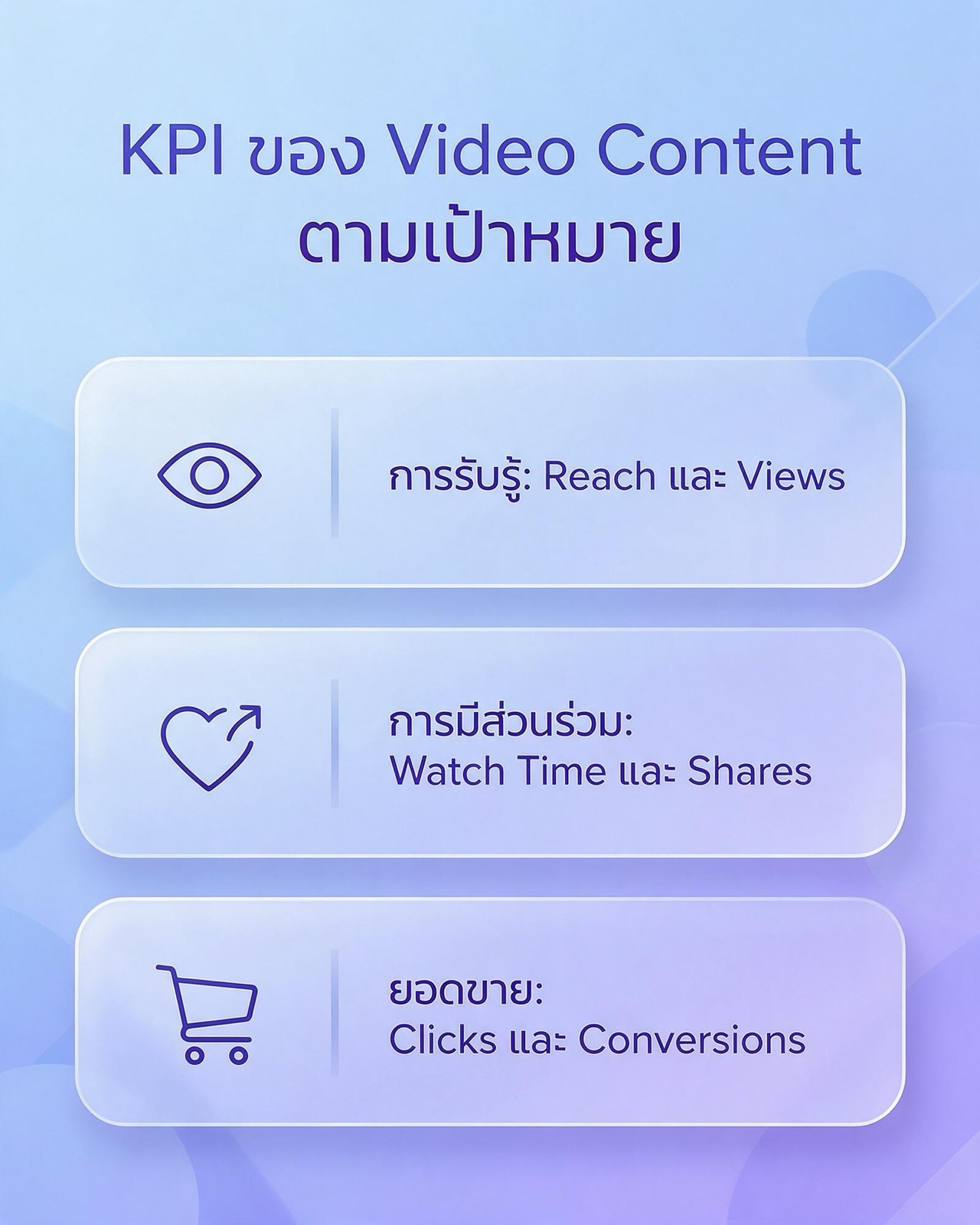
- Awareness: Reach and Views. Use these when the goal is for people to see and remember the brand. The numbers to watch are reach, impressions, views and view rate, plus any rise in searches for the brand name over the same period.
- Engagement: Watch Time and Shares. Use these when the goal is for people to take an interest and build a connection with the brand. The numbers to watch are total watch time, average view duration, the retention graph showing where people stop watching, shares, saves, comments and follower growth.
- Sales: Clicks and Conversions. Use these when the goal is for people to take a business action. The numbers to watch are click-through rate, the number of people who start a chat, fill in a form or buy, and cost per result when running ads.
Setting KPIs that are usable
A good KPI has three parts: a clear metric, a target value and a time period, for example the average view duration of a YouTube tutorial series this quarter. Targets should be based on your own channel's past performance, because the industry averages you see quoted in various places usually rest on very different samples and definitions and cannot be compared directly. If you have no history yet, use the first two or three months to collect a baseline, then set targets.
Knowing the limits of each platform's numbers
Each platform defines a "view" and other metrics differently, so views on one platform cannot be compared one-to-one with another. Before reporting, open the definitions in each platform's analytics and compare results mainly within the same platform.
Connecting video to website results
Numbers inside a video platform only describe what happened on that platform. If you want to know whether a video led people to buy or fill in a form on your website, add UTM parameters to every link leaving the video and set up key events in GA4 to match the actions the business wants, so you can separate the effect of each clip and each platform more clearly. For customers who watch a video and later search for the brand name, watching the trend in brand searches shows indirect effects that links cannot capture.
Reviewing results on a cycle
Set a regular review cycle, for example looking at numbers weekly to catch anomalies and summarising monthly or quarterly to make strategic decisions. The questions to ask in a review are which types of video beat the baseline, where people stop watching, and which videos should be promoted with paid spend or turned into a series.
Video content in the Thai market
Thai businesses have a specific context worth building into a video strategy.
- Mobile-first viewing: design videos to be understandable on a small screen, with on-screen text large enough and important visuals kept away from the edges.
- Accurate Thai subtitles: misspelt or stiffly translated subtitles make a brand look careless. If your audience includes foreigners, consider adding English subtitles too.
- LINE as a follow-on channel: for brands that sell through a LINE Official Account, videos that end by inviting viewers to add the account or start a chat link watching directly to selling.
- Live selling: retail businesses can plan live streams on social media as a sales channel rather than an extra activity.
- Thai creators come in many tiers: beyond the big creators there are niche creators with smaller but well-matched followings. Choose on audience fit rather than follower count.
FAQ about video content
What is video content?
Video content is content that uses video as its main means of communication to inform, entertain or persuade viewers to take a next action. It covers short clips, long videos, live streams and website videos, and differs from video ads in that it does not need to sell directly within the clip.
How long should good video content be?
The best length is whatever is enough for that clip's goal, and no single number works for every case. Awareness clips on short-video platforms tend to be brief, while tutorials on YouTube can be much longer if the content stays useful. Let your own channel's retention graphs decide.
Should I make video content myself or hire professionals?
It depends on your time, skills and how important that particular video is. Doing it yourself suits short clips that need to go out often and follow trends, while hiring professionals suits the brand's core videos, major campaigns, or times when the in-house team cannot keep going. Mixing both is also an option.
Which KPIs should I use to measure video content?
Choose KPIs by goal: for awareness look at Reach and Views, for engagement look at Watch Time and Shares, and for sales look at Clicks and Conversions, connected to website data through UTM parameters and GA4.
How often should I publish videos?
Publish at a frequency the team can sustain, because consistency matters more than volume.
If you want video content to be part of a measurable marketing plan, from strategy and production to paid promotion and reporting, the Relevant Audience team can plan it with you. See the service links in this article for details.