TL;DR
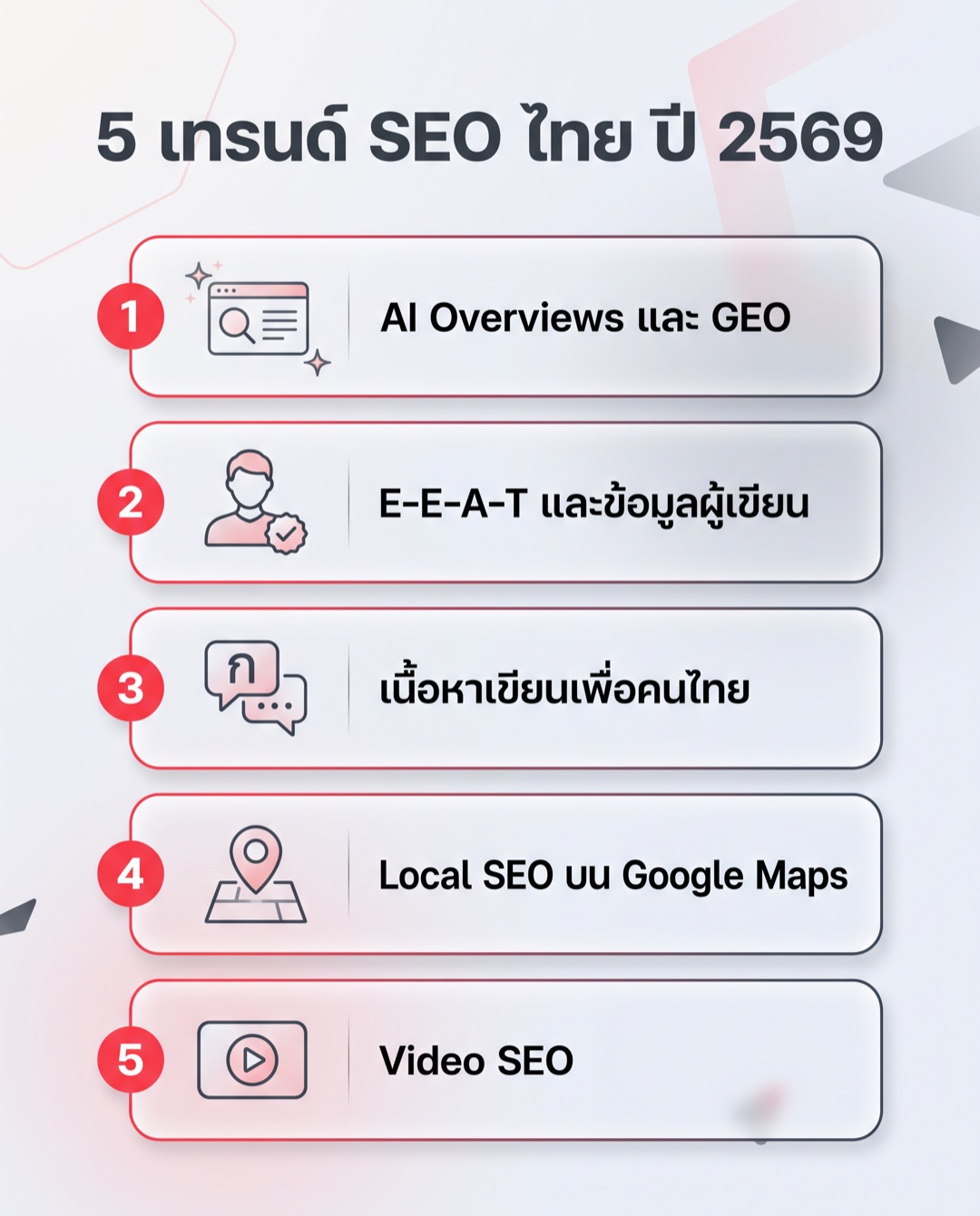
- Five SEO shifts matter for Thai businesses in 2026: AI Overviews and GEO, E-E-A-T and author information, Thai-first content, local SEO on Google Business Profile, and video in search results.
- Google says pages cited in AI features must be indexed and snippet-eligible, with no special markup; the Google-Extended robots.txt token does not remove a site from AI Overviews.
- Google added its scaled content abuse, site reputation abuse and expired domain abuse spam policies in March 2024, covering mass-produced pages whether written by people or AI.
- Business Profile chat ended in 2024, and in September 2026 Google restored post view counts covering 18 months of Search and Maps views.
- There is no reliable public figure for how far AI has cut Google clicks in Thailand; the accurate method is comparing clicks and impressions in your own Search Console reports.
SEO in Thailand in 2026 comes down to five main shifts businesses should adjust to: AI answers on the results page (AI Overviews and AI Mode), author credibility under Google's E-E-A-T framework, content written for Thai readers from the start instead of translated from English, local SEO on Google Business Profile and Google Maps, and video appearing in search results. None of the five makes SEO fundamentals obsolete. They change which fundamentals pay off most, and they change how you measure whether the work is working.
This article explains how each trend works, where it affects Thai businesses, and what to adjust first. It deliberately avoids numbers that cannot be checked. The figure often repeated online, that organic clicks have fallen 30-40% because of AI, has no reliable public source for the Thai market specifically, and real effects vary widely by query type and business. The honest approach is to read your own site's data in Search Console, and each section below explains how.
How Thai SEO in 2026 differs from 2024
Two years ago, many queries still showed a page of ten links with ads and a map pack. What changed since then sits on two fronts: the results page itself, and Google's policies.
- More AI-generated answers on the results page. AI Overviews show a summary answer with source links above the regular results for many queries, and AI Mode lets users ask follow-up questions in a conversation.
- Search Console has a generative AI report. Site owners can now see which pages earn impressions and clicks from AI surfaces, although the counting method has limits worth understanding.
- Spam policies tightened against mass-produced content. In March 2024 Google added its scaled content abuse, site reputation abuse and expired domain abuse policies, aimed at producing large numbers of pages that do not help users, whether written by people or by AI.
- Google Business Profile features changed. The chat feature in Business Profile was shut down in 2024, and in September 2026 Google brought back post view counts, which had been discontinued in early 2023.
With that background, here is what each trend means for a business in Thailand.
Trend 1: AI Overviews, AI Mode and GEO
An AI Overview is an answer box Google generates from several web pages, showing links to the pages it drew on. GEO, or Generative Engine Optimization, is the work of making content more likely to be selected and cited by AI systems, both on Google and in assistants such as ChatGPT, Gemini and Perplexity.
How AI Overviews choose pages
According to Google's documentation, a page that appears as a link in AI features must be indexed and eligible to show a snippet in Google Search, the same as for regular results. There is no special markup or file to install. That cuts two ways. First, a page with technical problems, such as blocked crawling or an accidental noindex, has no chance of being cited at all. Second, there is no shortcut: the pages that get selected are the ones that answer the question clearly and credibly, not the ones carrying an extra tag.
A common misunderstanding concerns the Google-Extended user agent in robots.txt. It controls whether a site's content is used to improve Gemini models, but it does not remove a site from AI Overviews in Google Search. To limit the text shown, you need the nosnippet family of directives, which also affects snippets in regular results.
How it affects Thai businesses
The heaviest effect usually falls on informational queries with short answers, such as "what is X" or "how to do X", because the summary may be enough for the user without a click. Queries that involve comparing options, requesting a quote, viewing products or finding a nearby shop still need a real web page. Businesses that get most of their traffic from basic how-to articles should check that share first.
What to adjust
- Answer the main question in the first two sentences of each section, then expand. Direct answers written as complete, self-contained sentences are easier to lift into an AI answer.
- Add information an AI summary cannot replace, such as comparison tables, step-by-step instructions with screenshots, and your own prices or terms, so that people who see the citation have a reason to click.
- In Search Console, rely mainly on clicks in the generative AI report. The position value for an AI Overview is the position of the whole box, and every link inside gets the same position, so it does not tell you whether you were the first or last source cited.
- Plan GEO work for your highest-value pages first. There is no need to do the whole site at once.
Trend 2: E-E-A-T and author information
E-E-A-T stands for Experience, Expertise, Authoritativeness and Trustworthiness. It is a framework from Google's Search Quality Rater Guidelines. The first E, Experience, was added in December 2022 to give weight to first-hand experience, such as someone who has actually used a product or visited a place.
Is E-E-A-T a ranking factor?
Google explains that E-E-A-T is not a single ranking factor measured as a score. Its raters use the framework to evaluate whether ranking systems are producing good results, and Trust is the most important part of it. Topics that affect people's health, finances or safety, known as YMYL (Your Money or Your Life), are held to a higher standard of trustworthiness than general topics.
Why it matters more in the AI era
When general content can be produced quickly and cheaply, what separates one page from another is evidence of who wrote it, whether they really know the subject, and where the information comes from. Search and AI systems can read those signals from a page when they are stated clearly.
What to adjust
- Create author pages with the person's real name, role, expertise and links to their articles.
- Show the author's name and the last-updated date on each article, and use Article structured data that names the author as a Person with the URL of their author page, so machines can connect the article to the person.
- On YMYL topics, have a genuinely qualified expert write or review the content, and say so on the page.
- Display verifiable business information, such as your address, company registration number, contact channels and, for online shops, a refund policy.
Trend 3: Thai-first content instead of translation dumps
Many sites in Thailand are built in English first and then translated into Thai with automated tools, without review. The problem is not only stiff language. Google has long given text translated by an automated tool without human review or curation before publishing as an example of automatically generated spam, and since 2024 producing large numbers of pages that do not help users has fallen under the scaled content abuse policy.
Thai has features that literal translation misses
- Thai users search in mixed language. Queries like "seo คือ", "ยิงแอด facebook" or "google ads ราคา" mix Thai and English. Translating every term into Thai can leave a page out of step with what people actually type.
- Transliterated words have several spellings. Facebook, for example, is written เฟซบุ๊ก or เฟสบุ๊ค, and "content" as คอนเทนต์ or คอนเท้นท์. Check which form your audience uses more.
- Thai has no spaces between words. Systems have to segment words themselves. Headings written clearly, using keywords as the phrases people really use, are easier for both readers and machines.
- Examples and context need to be Thai. Payment methods, delivery, LINE Official Account, marketplaces such as Shopee and Lazada, and laws such as the PDPA are context that articles translated from overseas usually lack.
What to adjust
- Do keyword research in Thai separately from English, rather than translating a keyword list.
- If the site has several languages, use hreflang so each language version points to the others correctly, and give the Thai version the same depth of content.
- If AI or translation tools help with a draft, have a Thai speaker who knows the subject review and edit it before every publication.
- Reduce duplicate or thin pages. That does more good than producing extra pages to cover every minor query.
Trend 4: Local SEO on Google Business Profile and Google Maps
For restaurants, clinics, hotels, repair shops and any business customers travel to, the Google Business Profile is often the first thing a customer sees, before the website. Google explains that local ranking depends on three main factors: relevance, distance and prominence. Distance cannot be changed, but the other two can.
What has changed recently
- Business Profile chat was shut down in 2024. Thai businesses that talk to customers on LINE therefore need to route people from the profile to a chat channel through the website or a booking page, for example with a LINE Official Account add-friend button on the page the profile links to.
- Post view counts are back. In September 2026 Google began showing view counts on each post card again, covering the past 18 months and combining views from Search and Maps. That makes it possible to see which kinds of posts get seen, although it still does not report clicks.
What to adjust
- Choose the most accurate primary category, then add secondary categories only where they genuinely apply.
- Use your real business name as it appears on your signage. Adding keywords to the name goes against Google's guidelines.
- Keep your name, address and phone number consistent everywhere: the profile, your website, your Facebook Page and review platforms. If you use both a Thai and an English name, use them consistently.
- Ask real customers for reviews regularly and reply to both good and bad reviews. Never buy reviews or offer rewards in exchange for them.
- Publish current posts and photos, then use the returning post view counts to see which topics work. More on setting this up is on our local SEO service page.
Trend 5: Video SEO on YouTube and short video in search results
Google shows more video in results for many queries, both YouTube videos and short-video units that can include clips from several platforms, such as YouTube Shorts, TikTok and Instagram. For how-to, review and product demonstration queries, video can take space on the first page that an article alone does not get.
Mechanics worth knowing
- Google needs to understand that a page's main content is the video. A page that embeds a video should place it prominently and use VideoObject structured data with the title, description, thumbnail and upload date.
- Key moments. Google can show the important segments of a video from YouTube chapters, or from Clip and SeekToAction markup on your own site, which lets a video answer a specific question at a specific point.
- Search Console has a Video pages report. Use it to check whether videos on your site are indexed and what problems they have.
- Thai titles and captions help. Video titles, descriptions and captions that use the words Thai people actually search make it easier for systems to understand a clip.
What to adjust
Start with the ten questions customers ask most often. Check which of those queries already show video on the first page, make a short video that answers each directly, and embed it in the related article. Businesses that already have an advertising budget can reuse the same clips in YouTube advertising, so one production cost serves both purposes.
Summary table: five Thai SEO trends for 2026
The table below summarises which businesses each trend affects most and what to start with.
| Trend | Businesses most affected | Where to start |
|---|---|---|
| AI Overviews and GEO | Sites whose traffic comes from basic question-answering articles | Check clicks in the generative AI report and rework key pages to answer directly with information a summary cannot replace |
| E-E-A-T and author information | Health, finance, legal and online retail | Build author pages and add Article schema naming the author |
| Thai-first content | Multilingual sites translated from English | Separate Thai keyword research and human review of every translated page |
| Local SEO | Shops, clinics, hotels and local service businesses | Fix categories, contact details and the review process in Business Profile |
| Video SEO | Products that need demonstrating and services that need explaining | Make videos answering frequent customer questions and add VideoObject markup |
Three techniques that still work, and three that no longer do
Three techniques that still work
- Clean technical foundations. Pages that can be crawled and indexed, load quickly on mobile and do not duplicate each other at scale remain the first condition for everything, including being cited in AI Overviews. If you are not sure where your site's problems are, an SEO audit is the most cost-effective starting point.
- Content that answers a specific search intent. One page fully meets one need, with information from experience or from the business itself.
- Structured internal linking. Linking supporting articles to the main page on a topic with descriptive anchor text helps both users and systems understand which pages matter.
Three techniques that no longer work and can cause harm
- Producing large numbers of pages to chase every keyword. Whether written by people or AI, pages that do not genuinely help users fall under scaled content abuse and can lower how systems assess the whole site.
- Buying or exchanging links to push rankings. Google's link spam policy prohibits it clearly, and Google's spam detection is designed to neutralise the value of such links.
- Keyword stuffing. Repeating the same term in headings, body copy or a Business Profile name makes pages harder to read and goes against guidelines. It does not help systems that understand the meaning of sentences rank a page higher.
Where to start within 90 days
There is no need to tackle all five trends at once. An order that suits most businesses:
- Weeks 1-2: check technical foundations and indexing in Search Console, and sort your traffic-earning pages into question-answering articles, service pages and product pages.
- Weeks 3-4: read the generative AI report and find pages with many AI impressions but few clicks.
- Month 2: rework 10-20 key pages to answer directly, add business-specific information, add authors and schema, and fix your Business Profile if you are a local business.
- Month 3: make videos answering frequent customer questions, review machine-translated pages, and plan Thai content from real search queries.
Limits to keep in mind before trusting any trends article
Most trends articles, including this one, describe direction rather than guaranteed results. Most public data on AI's effect on traffic comes from the US and European markets and from companies that sell measurement tools, so those figures should not be applied directly to Thai sites. Google also changes the results page often, and what is correct today may need adjusting within months. The most reliable basis for decisions is your own site's data, collected consistently over time.
The Thai market context
A few things about the Thai market make these five trends play out differently. For businesses that close sales in LINE chats or on marketplaces rather than on the website, SEO measurement has to connect to chats and calls, not just form submissions. Mixed Thai-English queries make keyword research more detailed than in a single-language market. And if local competitors have not completed their Google Business Profile information, that is an opening for whoever completes theirs first. Businesses that want one team to plan all five areas together can see how we work as an SEO agency in Thailand.
Frequently asked questions about Thai SEO trends in 2026
Is SEO still worth it with AI Overviews?
Yes, because pages cited in AI Overviews must be indexed and eligible for snippets like any other result, so SEO is a precondition for AI visibility too. What changes is that short question-answering content may get fewer clicks, while service pages, product pages and pages with specific information still earn them.
Do I need to install anything to appear in AI Overviews?
No. Google states there is no special markup or file for AI features; a page needs to meet basic SEO requirements, being indexed and snippet-eligible, and its content needs to answer the question clearly and credibly.
Can I use AI to write Thai articles?
Yes, if someone who knows the subject reviews and edits the content before it is published. Google does not prohibit AI use, but it does prohibit mass-producing content that does not help users, and it has given unreviewed automated translation as an example of spam.
Which trend should a small business start with?
If customers travel to you, start with local SEO on Google Business Profile, because it costs little and affects visibility in your area directly. If you sell online nationwide, start with technical foundations and the product or service pages that generate revenue.
How much have Google clicks fallen in Thailand because of AI?
There is no reliable public figure for the Thai market specifically, and effects vary widely by query and business. The most accurate method is to compare clicks and impressions in your own site's Performance report and generative AI report over the same period.
All five trends point the same way: sites that are clear, credible and genuinely written for Thai readers keep their advantage, whether the answer appears as a link, an AI box or a video. If you would like help deciding where your site should start, talk to Relevant Audience.