
TL;DR
- Google Search Console and Google's guidance for site owners are free, so the barrier to starting SEO in house is time and skill, not access.
- Keyword volume and difficulty numbers in paid SEO tools are each vendor's own estimates, not Google data, so two tools can disagree on the same term.
- Six signals point to outside help, led by search clicks flat for six months or more despite steady work, and not knowing what to fix next.
- A common hybrid split gives one internal person content and small fixes, and an outside team technical audits, internal linking and off-site work.
You can do SEO yourself, and plenty of businesses start exactly that way. The groundwork, such as writing page titles that match what people search for, making sure Google can index every page, and writing content that answers customer questions, is something an owner can learn and do in house. The real question is not whether you can, but what hidden costs come with it: time, technical knowledge, tools, and the ability to read results and tell whether the work is paying off. This article separates where doing it yourself has the edge, where it gets stuck, which signals say it is time to bring in outside help, and why many organisations choose a hybrid model instead of picking one side.
Can you do SEO yourself? Yes, but know what you are trading
SEO requires no licence and no special back-end access, and Google's guidance for site owners is free for anyone to read. Tools such as Google Search Console cost nothing. In that sense anyone can start doing SEO on the first day they have a website.
What people starting out rarely see is that SEO is made of several kinds of work that call for very different skills. Technical work, such as URL structure, page speed, canonical or hreflang settings, requires an understanding of how websites are built. Content work requires keyword research and writing. Off-site work, such as earning links and mentions from other websites, requires relationships and time. Measurement requires reading the data well enough to tell whether a ranking moved because of something you did or because Google changed something. One person can cover all of it, but it is hard to do every part equally well in the time available.
So it helps to treat this as a resource-allocation decision, not a matter of pride about doing it all yourself or a belief that only an outside team can get results. A small business with a handful of products and light competition on its search terms may get the best value from doing it in house. A site with hundreds of pages, several languages, or competition from large players on its key terms will find that the cost of trial and error climbs very quickly.
Five advantages of doing SEO yourself
Before getting to the limits, it is worth accepting that doing it yourself has real advantages, and some of them are things an outside team can never match.
1. Tight control of the budget, paying only for what you need
When you do it yourself, the main costs are your team's time and whatever tools you choose. There is no ongoing monthly service fee. For a young business that is not yet sure how much revenue organic search can bring in, starting in house lets you test the idea without committing a large budget. But your own time has to count as a cost too, because every hour spent learning SEO is an hour not spent selling or looking after customers.
2. Deeper understanding of the business and its customers
An owner, or a team that lives with the product every day, knows which questions customers ask over and over, what words they use for the product, and why they decide to buy. That knowledge is the best raw material for content. An outsider needs interviews and time to reach the same level of understanding, especially in specialist businesses such as industrial machinery, clinics or legal services, where the terminology and context are complex.
3. Fast testing and fixing
If you want to change a page title, rewrite a product description or add frequently asked questions to a service page, an internal team can do it straight away without waiting for a meeting cycle or cross-company approval. That speed is valuable while you are still finding what works, because SEO depends on many rounds of trying.
4. The brand voice is right from the start
Content written by people inside the organisation usually reflects the brand's voice and position more accurately. There are no rounds of revisions because the tone is off or because the writer explained the product from the wrong angle. This matters more now that Google gives weight to the experience and expertise of the author, because people who actually work in the business have first-hand experience to draw on.
5. Knowledge stays inside the organisation
Everything learned along the way, which search terms work, which pages have problems, and the lessons from algorithm changes, stays with the team rather than leaving when a contract ends. If you later decide to bring in an outside team, that grounding still helps you brief them precisely, ask the right questions and check the work you receive.
Five limits people doing their own SEO usually hit
These limits do not mean doing it yourself will fail. They are the points worth knowing about in advance, so you can plan for them or recognise them when they appear.
1. Tool costs rise as the work gets deeper
Google Search Console and Google Analytics are free and enough to get started. But once you want to see which terms competitors rank for, which sites link to you, or to crawl the whole site for technical problems, you usually need paid tools billed monthly, and each is strong in a different area. Teams working in house often have to choose between paying for several tools or working with incomplete data. It is also worth knowing that the search volume and keyword difficulty figures in these tools are estimates from each vendor's own models, not data from Google, so two tools can show very different numbers for the same term.
2. The learning curve is long, and knowledge goes stale fast
SEO basics can be learned fairly quickly. Understanding why a page is not being indexed, why rankings dropped after a system update, or why Thai and English versions of a page compete with each other takes experience across many sites. Google also keeps changing its search systems, and the arrival of AI Overviews and AI Mode has changed how people see results, so some advice from articles written two years ago no longer applies. People doing SEO on the side of their main job rarely keep up.
3. No benchmark to tell whether results are good or bad
When traffic rises, people doing it themselves often cannot tell whether it rose because of their work, because of seasonality, or because a competitor dropped out of the results. When traffic falls, they cannot tell whether the problem is their own site or a change across the whole industry. Teams that look after many sites at once have an advantage here, because they can see whether the same change hit other sites at the same time. A single site has no comparison group like that.
4. Not every area gets covered
People who are good writers tend to do strong content work but avoid the technical side. People from a developer background fix site structure quickly but do not want to write long articles. Almost everyone doing it alone skips off-site work, meaning getting other websites to reference and link back, because it depends on relationships and is slow to measure. The result is a site that is strong in one dimension only, for example excellent content on pages that load slowly and are only partly indexed, so the effort put into the content never pays off in full.
5. No time to iterate
SEO does not end when an article goes live or a fix is made once. You have to go back and see which pages get impressions but no clicks, and which pages sit on page two and stay there, then keep adjusting on a regular schedule. That iteration is where in-house efforts usually stop first, because the core business always claims the time first. The site ends up frozen in whatever state it was left months ago.
Comparison table: in house, outsourced, and hybrid
This table summarises how the three approaches differ on the dimensions that actually drive the decision. It deliberately leaves out prices, because costs depend on the size of the site, the number of languages and how competitive each business's search terms are.
| Dimension | Fully in house | Fully outsourced | Hybrid |
|---|---|---|---|
| Understanding of the business | Deepest | Takes time to learn | Insiders hold the context, outsiders hold the method |
| Technical work | Often the weak point | Specialists available | Handed to the outside team |
| Speed of changes | Fast | Depends on the working rhythm between two companies | Small fixes in house, larger changes planned together |
| Performance benchmark | None | Sees many sites | Benchmark comes from the outside team |
| Knowledge left in the organisation | All of it | Little, unless handed over | Builds up in the internal person |
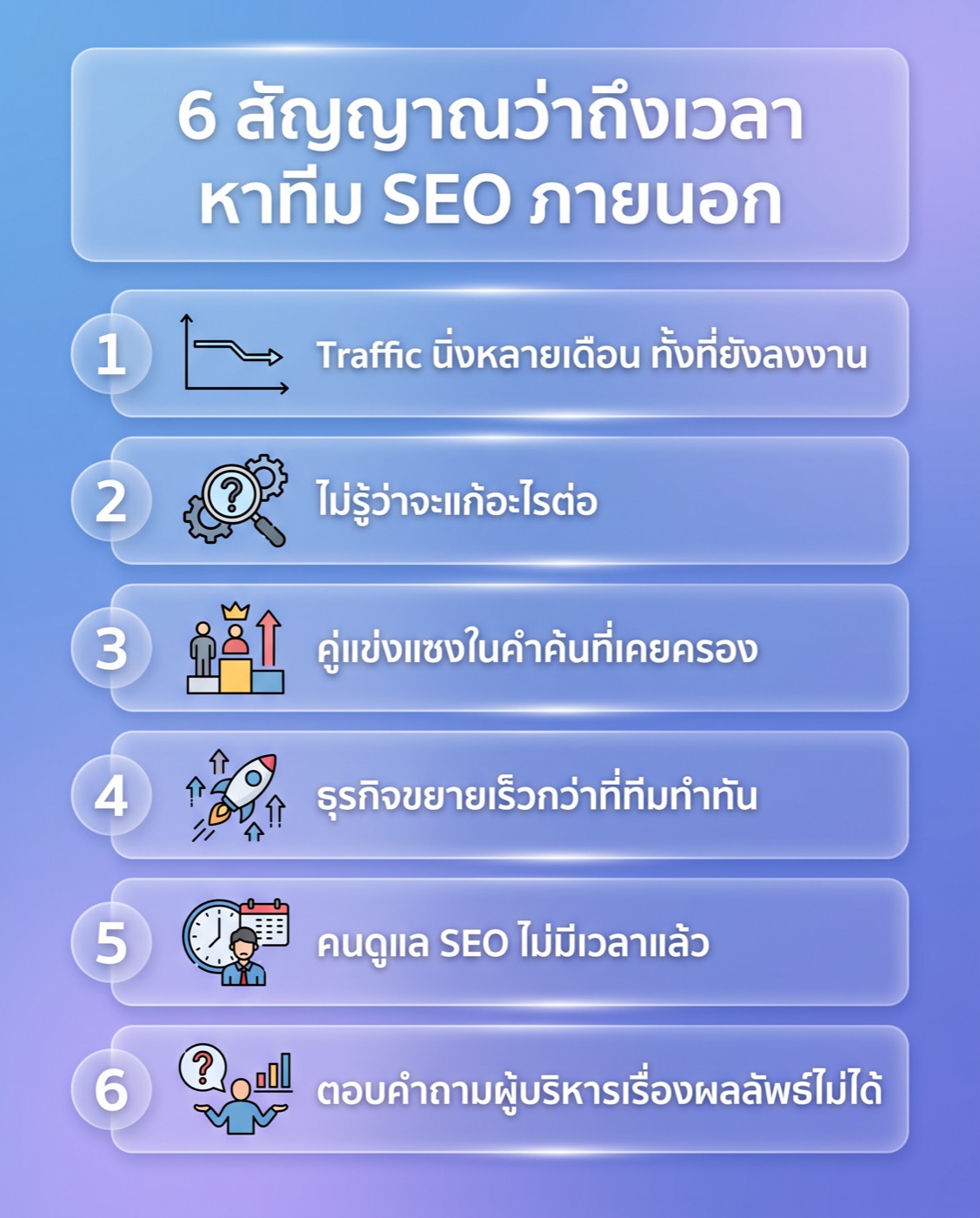
Six signals that it is time to look for an outside team
The signals below are not fixed rules, but when several of them show up together, the cost of carrying on alone is usually higher than it looks.
1. Search traffic has been flat for months despite steady work
If Search Console shows clicks from search flat for six months or more while you keep adding content and fixing the site, what you are doing may not be addressing the site's real constraint. That constraint might be a technical issue you cannot see from the page itself, or a question of domain trust that more content alone will not fix. Before drawing that conclusion, compare with the same period last year to rule out seasonality.
2. You no longer know what to fix next
Many people doing their own SEO have worked through every basic checklist, added keywords to titles and written articles, but cannot see the next step. Once the question changes from "what should I do" to "why isn't it working", the answer usually needs analysis across several layers of data, for example which pages are indexed but get no impressions, or whether Google chose a different canonical page from the one you set. A detailed technical health check such as an SEO audit is the most direct starting point in this situation, because it produces a list of problems ordered by impact instead of guessing one item at a time.
3. Competitors have overtaken you on terms you used to own
If search terms that used to bring customers in are now led by a competitor, and that competitor has started publishing more often or picking up links from news sites, answering with two or three more articles is rarely enough. You need to analyse where the competitor has the edge and plan to close the gap across content, technical and off-site work.
4. The business needs to grow faster than the team can keep up
Launching a new product category, adding English or Chinese, or moving to a new website platform are all moments when SEO work jumps. A migration with the wrong redirects can wipe out a large share of the rankings built up over years. Adding a language with incorrect hreflang settings can show the wrong language version to searchers. With work like this the cost of a mistake is high, so it is worth having someone who has done it before in the planning.
5. The person looking after SEO no longer has time for it
In mid-sized businesses SEO is often handed to a marketer who already runs other channels. When advertising or social media work grows, SEO is usually the first task to slip. The clearest sign is a list of SEO tasks that has sat untouched for months.
6. Leadership asks about results nobody can answer
When leadership starts asking how much revenue SEO generates, or why people are now finding the brand through AI answers rather than clicking through to the site, and the internal team has no measurement set up to answer, the work needs to move beyond checklists. It needs a measurement system that connects organic search to business goals, including visibility in AI-driven search tools, which is what an approach such as GEO covers.
The hybrid model: one person in house, an outside team for technical and off-site work
The option many organisations actually use is neither doing everything in house nor outsourcing everything, but dividing the work by each side's strengths. The idea is simple. People inside the organisation own the parts that depend on understanding the business, and the outside team owns the parts that need specialist expertise or tools the organisation would not justify buying for itself.
How to divide the work so it does not overlap
A common setup looks something like this. One person inside the organisation, perhaps a marketer or content lead, is responsible for the content calendar, writing or reviewing articles so that product information is accurate, working with sales to collect customer questions, and making small site changes that can be done straight away. The outside team is responsible for periodic technical health checks, page structure and internal linking, off-site work such as earning references from relevant sites in ways that follow Google's guidelines, and reporting that includes benchmarks drawn from experience across many sites.
On off-site work it is worth being clear: buying and selling links to influence rankings breaks Google's spam policies and risks the site losing trust. Durable off-site work means giving the brand something others want to cite, such as data it publishes itself, expert commentary the media picks up, or a presence in the industry's reference sources.
What to agree on from day one
- Who can change which parts of the site, so one side's edits do not overwrite the other's, for example an internal edit to a page title the outside team has just restructured.
- One shared set of metrics. Both sides should look at the same Search Console and analytics data and agree how success is measured, such as clicks from product-related search terms or the number of enquiries from organic search.
- A fixed review rhythm. Regular review meetings keep the internal person's small changes and the outside team's larger work moving in the same direction.
- Knowledge transfer. Ask the outside team to explain the reasoning behind each change instead of sending only a list of completed tasks, so that knowledge builds up inside the organisation.
Who the hybrid model does not suit
If nobody in the organisation has any time at all for SEO, a hybrid model turns into full outsourcing with no insider feeding in information, and the content loses the business depth that makes it credible. Going the other way, if the site is very small and its search terms are not very competitive, doing everything in house with an occasional expert site review may be better value than a continuing outside team.
How to start on your own without wasting time
For anyone who decides to start in house first, the order below puts limited time into the work with the biggest effect.
- Set up Google Search Console properly. Verify the domain, submit a sitemap and check the indexing report for important pages that are not indexed. Basic problems such as pages missing from the index always come first, because a page Google has not indexed has no chance of ranking.
- Look at the search terms you already appear for. In the Search Console performance report, find terms with high impressions but an average position around page two. These are the nearest opportunities, because Google already sees the site as relevant, just not relevant enough yet.
- Improve existing pages before writing new ones. Making product or service pages answer customer questions more completely often works faster than starting a new article from scratch.
- Log every change with its date. When results move, you can look back and see what changed beforehand. This goes some way to solving the missing-benchmark problem.
- Set a review point. Decide in advance when you will reassess, and that if the metrics have not moved by then you will start looking for outside help. Setting this point early means the decision is made from data rather than fatigue.
What to think about for Thai businesses
Many Thai business websites run in two languages, and this is where in-house efforts often go wrong. Translating an English page word for word into Thai does not mean Thai users search with the same words. Many Thai users type queries that mix Thai and English, spell foreign brand names in Thai several different ways, or use colloquial terms that are not in any dictionary. Keyword research therefore has to be done separately for each language, not by translating an English keyword list.
Search behaviour is also changing fast. AI-generated summaries on the results page mean some queries now get fewer clicks even when the site holds the same ranking. In-house teams should know that falling clicks do not always mean falling rankings, and should start checking whether the brand is mentioned in the answers AI tools give, which is a focus of AI SEO work.
Finally, there is the question of Thai-language reference material. Most SEO guides are written for the English-speaking and US markets, and some of their examples and advice, such as on search volumes or local results layouts, may not match the Thai market. Testing on your own site is more reliable than following a guide word for word.
Frequently asked questions about doing SEO yourself versus hiring help
How long does DIY SEO take to show results?
There is no fixed timeline, because it depends on the age of the site, how competitive the search terms are and the state of the site at the start. Fixing indexing problems can show up as pages being indexed within a few weeks once Google recrawls them, but moving rankings on competitive terms usually takes several months. Anyone who guarantees a specific ranking timeline deserves hard questions.
Should a small business owner start in house or hire straight away?
A small business with time to learn and search terms that are not highly competitive can start in house and get good value, because understanding the business is the biggest advantage. Set a review point in advance, though, and if the site has technical problems you cannot fix, a one-off site review is a middle path that does not require a long contract.
If we hire an outside team, what does the internal team still need to do?
Quite a lot. At minimum it needs to supply business knowledge, check content for accuracy, approve changes that affect the site and track the shared metrics. An outside team working with no insider feeding in information tends to produce content that follows SEO rules but lacks the depth that makes customers trust it.
How can we tell whether an outside team is doing good work?
Look at whether the team can explain the reasoning behind its work and ties it to the metrics agreed at the start. A good team can say what it changed, why, which metric it expects to move, and what happens if it does not work. A report that lists only completed tasks, with no link to clicks or customer enquiries, is a signal to ask more questions.
Does doing SEO yourself risk a Google penalty?
Not if you follow Google's guidelines. The risk comes from shortcuts such as buying large numbers of links, creating masses of low-quality pages to catch search terms, or stuffing keywords until the text is unreadable. Those tactics are risky no matter whether the site owner or an outsider uses them.
Summary
Doing SEO yourself is a sensible starting point for many businesses, and the advantage of understanding your customers is worth keeping even if you later bring in outside help. The things to watch are the six signals above, especially traffic that stays flat despite the effort and not knowing what to fix next. When several of them appear at once, a hybrid model is usually the route that keeps the internal team's strengths while filling in what is missing. If you are comparing options and want to see how SEO services planned together with an internal team work in practice, you can review the scope of work before deciding.