
TL;DR
- Traditional PR is scored on reach and clippings. Digital PR is scored on the live URLs a story leaves behind: editorial links, brand mentions and citations that search engines and answer engines can still read months later.
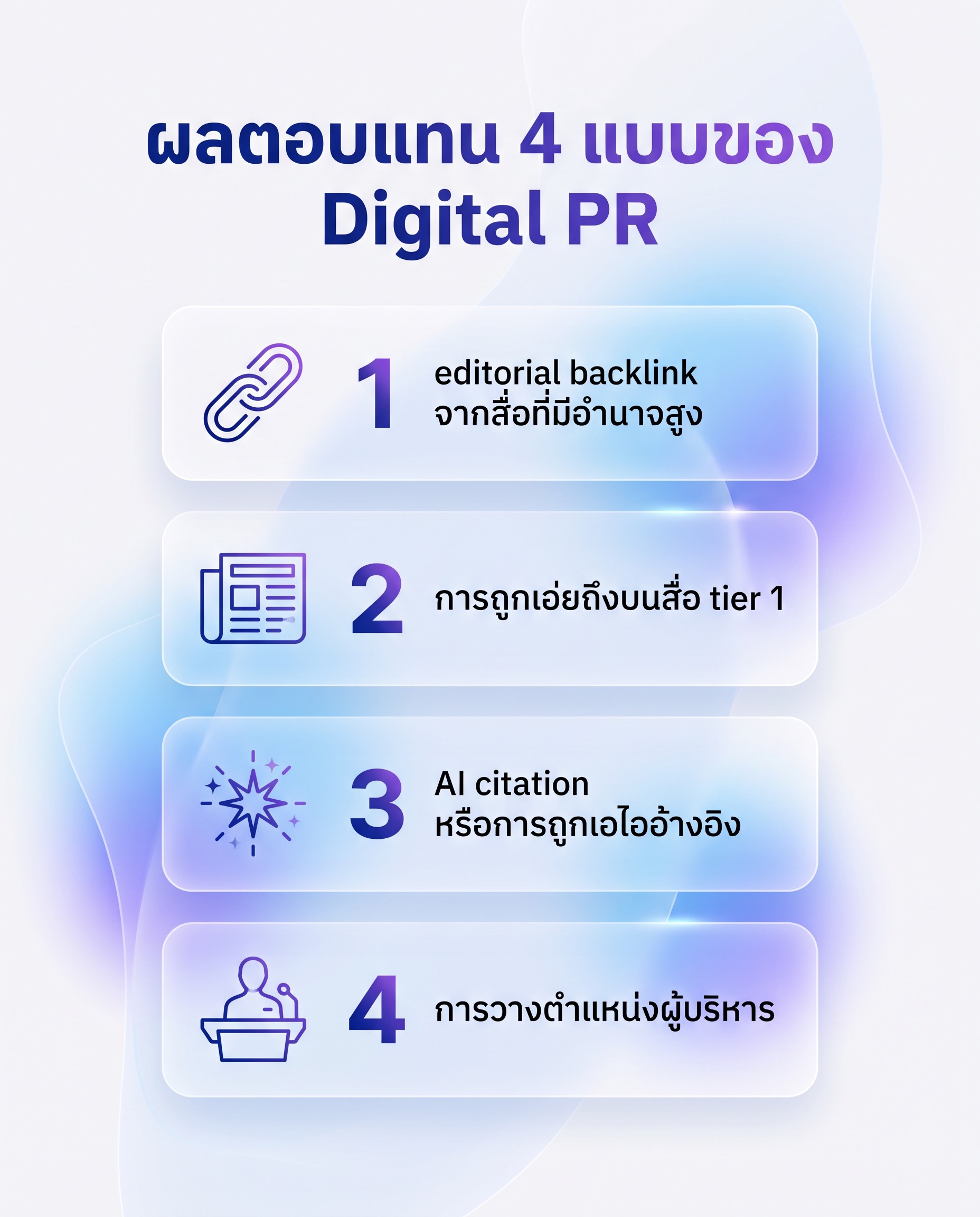
- Four returns are worth separating: an editorial backlink to a page you chose, a tier-1 mention with or without a link, a citation inside an AI answer, and a spokesperson a desk starts calling by name.
- Five formats do the work: data study, reactive comment and newsjacking, executive commentary, product news, and purpose activity. Only reactive work lands the same week; a data study takes weeks before the first placement.
- Thai media runs in tiers: national and business titles, marketing and business trade titles, then vertical publications. A Thai-language desk needs a Thai-language pitch, Thai assets and a spokesperson who interviews in Thai.
- Report referring domains earned, link placement, share of voice against a fixed competitor set, branded search after coverage, and a fixed AI prompt set run on a schedule. Retire advertising value equivalent.
Digital PR is the practice of earning coverage, mentions and links from publishers by giving journalists something worth reporting, and it differs from traditional PR mainly in what counts as a result. A traditional programme is judged on clippings and reach. A digital PR programme is judged on the live URLs it leaves behind: editorial links, brand mentions and citations that search engines and answer engines can still read months later. That difference is why the work now runs alongside SEO instead of sitting in a separate department. This guide covers the definition and where it came from, the four kinds of return a campaign can produce, the campaign formats that produce them, how Thai media is organised in practice, and the metrics that tell you whether any of it worked.
What digital PR is, and how it grew out of traditional PR
Traditional public relations was built around access and relationships. A press officer knew the editors on their patch, sent releases, arranged interviews, handled announcements and managed the bad weeks. Because the output was printed or broadcast, measurement stopped where the medium stopped: circulation, reach, and in the worst cases an estimate of what the same space would have cost as advertising.
Digital PR keeps media relations at the centre and changes the raw material. Instead of an announcement looking for a home, the starting point is a story a publisher would run even if your brand were not attached to it. That might be an analysis of numbers you hold and nobody else has published, an expert view on something already in the news cycle, or a finding an audience genuinely wants. The story is built for one specific desk, and the result is a page with a date, an author and a URL that keeps working.
What carried over from the old model
The parts that did not change are the ones people skip. Journalists still decide what runs. A pitch still has to arrive at the right desk, at the right time, from someone who has read the publication. A spokesperson still needs to be reachable and briefed. Corrections, embargoes and off-the-record conventions all still apply, and breaking them still costs a relationship that took a year to build.
What actually changed
The unit of success moved from the clipping to the live page, so a story that runs and stays online is worth more than a story that ran once and disappeared. Distribution moved from wire-first to pitch-first, because a release sent to everyone is a release that reads as generic to everyone. And the assets that make a pitch land, the research page, the chart, the method note, are now produced by the same people who build content for search, which is why the two functions stopped being separable.
Why digital PR and SEO no longer run in separate lanes
Search ranking depends in part on which other sites reference yours and how they describe you. Off-site references are the part of SEO that on-page work cannot manufacture: you can rewrite a title tag on your own, but you cannot cite yourself. Editorial coverage is the most durable way to earn those references, because a link inside a story a journalist chose to write is the natural editorial link that search guidelines describe.
The second reason is newer. Generative answer engines assemble replies from sources they retrieve, so whether a brand appears in an answer depends on whether it appears in the material being retrieved. Coverage on publications that get pulled into those answers is one input into that, which puts digital PR next to generative engine optimisation rather than in a different budget line.
There is a third reason that gets less attention: entity resolution. Search and answer engines try to work out what a company is, what category it belongs to, where it operates and who speaks for it. Consistent mentions of the company name, its executives and its category across independent publications are how that picture gets built. A brand that is described the same way in twelve unrelated articles is easier for a machine to classify than one that has only ever described itself.
The four returns a digital PR campaign can produce
Treating these as one number is how programmes end up unmeasurable. They are earned differently, they arrive on different timelines, and they are worth different things to different businesses.
An editorial backlink from a high-authority publisher
An editorial backlink is a link inside the body of an article, placed by the writer because it helps the reader, in a slot nobody paid for. That is a different asset from a directory listing or a profile link, because the placement itself carries an implicit judgement that the destination was worth sending a reader to.
Two practical notes. First, many publishers apply nofollow or sponsored attributes as a blanket policy across all outbound links, including genuinely editorial ones. A programme that only counts followed links will misprice its own results, because the mention still carries referral traffic, brand value and a record of where the brand was considered relevant. Second, the page the link points at matters as much as the fact that it exists. A link to the homepage builds authority at the domain level. A link to a research page or a service page moves that page. Ask for the deep link in the pitch, and expect the homepage to be what you get about half the time anyway.
A tier-1 media mention, with or without a link
A named mention in a national or business title does work that a link cannot. It gives a sales team something to point at, it survives in the reader's memory in a way a URL does not, and it tends to move branded search: people who read about a company then look it up. It also feeds the entity picture described above, since the mention usually arrives with context about what the company does and where it operates.
An AI citation
Answer engines name sources. When a brand is quoted or analysed inside an article that gets retrieved for a topic, the brand can end up inside the citation set for questions about that topic, which is separate from ranking in a results page. You can observe this directly: build a fixed set of prompts a buyer might ask, run them on a schedule, and record whether the brand appears and which URLs are named. The honest limit is that these outputs vary between runs and between accounts, so a single check proves very little and a tracked series over months proves something.
Executive positioning
A named person who is quoted repeatedly on one subject becomes the person a desk calls when that subject comes up again. This compounds in a way company mentions do not, because journalists build contact lists around people. It also transfers directly into other channels: the same point of view becomes posts on an executive LinkedIn presence, conference submissions, and material a sales team uses in a first meeting. The requirement is narrowness. A spokesperson with an opinion on everything is a spokesperson with authority on nothing.
The campaign formats, and what each one is good for
The data study
You publish an analysis of numbers, either data only your company can produce or public data nobody has combined in that way before. The sequence is: pick a question a newsroom would plausibly ask, get a dataset you can defend in an email, run the analysis, write a method note that states sample, period and limitations plainly, build a page that holds the full results, then pitch the finding rather than the page. The method note is what separates a study a journalist will use from one they will quietly ignore, because the first thing a good reporter does is look for the reason not to run it. This is the slowest format and the one with the longest tail: a study that becomes a reference keeps earning links for years without further pitching.
Reactive PR and newsjacking
You supply a quote, a correction or a data point on a story that is already running, usually within hours. It needs four things in place before the news happens: a monitoring routine that surfaces relevant stories quickly, a spokesperson who has agreed to be available, pre-approved positions on the subjects your company is likely to be asked about, and authority to send without routing the response through a committee. Where those exist, this is the highest hit rate per hour of work in the whole discipline. Where they do not, the response arrives after the story has closed and none of the effort converts.
Executive commentary
This is the planned version of reactive work. A spokesperson holds a defined point of view on a defined topic, and that view is offered to relevant desks on a schedule rather than only when news breaks. It works for opinion sections, industry columns and expert roundups, and it needs someone who can hold a twenty minute interview without a script.
Product PR
An announcement becomes a story when it changes something for the reader. Trade coverage of a genuine launch is realistic and worth pursuing. National coverage of an incremental feature is not, and pitching it anyway trains a journalist to skip your next email. The useful test before sending: if a competitor sent this exact announcement, would the desk cover it?
Purpose PR
Coverage around what a company does beyond selling: training programmes, environmental work, community projects, industry standards work. It earns coverage when the activity is real, verifiable and has been running long enough to have results. It fails, sometimes publicly and expensively, when a campaign is wrapped around an activity that does not exist yet.
How one campaign actually runs, step by step
- Agree the destination page and the message before the idea. If a campaign cannot name the page it is meant to help and the phrase it wants attached to the brand, coverage will land somewhere that flatters nobody's targets.
- Build the media list by desk, not by outlet. Journalists cover beats. A list of publication names is not a media list; a list of named reporters with the topics they have written about in the last three months is.
- Choose the format from the list. A list weighted toward business desks wants numbers and named executives. A list weighted toward lifestyle or consumer desks wants a human angle and images.
- Produce the asset. The research page, the method note, chart images at a size a publisher can republish, a spokesperson biography and a headshot. Missing assets are the most common reason a warm reply goes cold.
- Write the pitch. Covered in the next section.
- Send in waves. Offer a short exclusive window to the single outlet with the strongest fit, then open the story to the rest of the list when the window closes. Sending to everyone at once removes your only real bargaining chip.
- Handle follow-ups within the hour. Fact checks, additional data cuts, an interview slot, images at print resolution. The reply speed at this stage decides more placements than the pitch did.
- Record everything. Who was pitched, who replied, what published, what the link points at, and how the article describes the brand. Without this the programme cannot be reported on and cannot be improved.
- Reuse the work. The study becomes a page that earns links passively. The quotes become social posts and sales material. The relationships become the list for the next campaign.
What is inside a pitch a journalist opens
- A subject line that states the finding, not the brand name.
- Two opening sentences carrying the finding and why it matters this week.
- The evidence, with a link to the full method rather than the whole method inline.
- What this journalist gets that is hard to get elsewhere: an exclusive window, an unpublished cut of the data, or access to a person.
- Who is available to quote, with their title and when they can talk.
- Assets attached or linked, ready to publish.
- One short paragraph about the company, at the bottom, where it belongs.
The things that get a pitch deleted are equally consistent: a release attached as a PDF with no email body, an opening paragraph about the company's mission, a request to cover our news, and any subject line that could have been sent to two hundred people because it was.
How Thai media is organised, and what that means for a pitch
Thailand's media works in tiers, and the tier decides both the pitch and the realistic outcome.
National and business titles. English-language publications such as Bangkok Post and The Nation reach an audience that includes expatriate business readers, regional investors and international coverage of Thailand. Thai-language business titles such as Prachachat report corporate, industry and economic news for a domestic decision-making audience. These desks want figures, named executives and a reason the story matters now rather than next quarter. They are the hardest to reach and the least forgiving of a weak angle.
Marketing and business trade titles. Publications such as Marketing Oops, Positioning and Brand Buffet cover campaigns, marketing technology, agency moves and brand news for an industry readership. For a business-to-business brand these are frequently the more valuable targets, because the reader is closer to the buyer and because these desks will run category-level analysis that a national daily would turn down. They are also where a first placement is most achievable for a company nobody has heard of yet.
Vertical and niche publications. Property, automotive, healthcare, logistics, food service, developer communities and industry association bulletins. Small audiences, high relevance, and often the only place a technical story can be told at the length it needs.
The split that catches foreign teams out is language. A pitch written in English and sent to a Thai-language desk is usually a pitch that does not run, because someone in that newsroom has to do translation work before they can even assess it. The version that works is a Thai-language pitch with Thai-language assets, a spokesperson who can give the interview in Thai, and figures converted to the units and formats the readership actually uses.
One more local habit worth naming: the release-and-wire model is still strong here, and it still has a job. Press release distribution puts an announcement on the record and gets it in front of desks that expect to receive news that way. It is a different job from digital PR, it produces a different kind of result, and measuring it with digital PR metrics will make it look like a failure when it is simply doing something else.
What to measure, and what to stop reporting
| Campaign type | What it typically earns | How to verify it |
|---|---|---|
| Data study | Editorial links to the research page from stories citing the numbers | New referring domains to that specific URL, and which articles they come from |
| Reactive comment | A named quote, often with no link | Mention tracking on the brand name and the spokesperson name |
| Executive commentary | Repeat quotes on one topic across several outlets | Count of distinct publications quoting the same person on the same subject per quarter |
| Product announcement | Trade coverage and brand mentions | Share of voice in a fixed set of trade titles against a fixed competitor set |
| Purpose activity | Features and occasional broadcast coverage | Mention volume plus a read of how the coverage frames the brand |
Referring domains earned, not link count. Fifty links from one publisher is one relationship, and counting it as fifty results makes a thin quarter look busy.
Link placement quality. Whether the link sits in the body of the article, whether the writer chose it, and whether the article is on a topic near the linked page. A body link in a relevant article and a footer link in an unrelated one are not comparable, whatever the domain metrics say.
Share of voice. Your mentions as a proportion of mentions for a defined set of competitors, in a defined set of publications, over a defined period. All three definitions have to be fixed in advance, because a number that moves whenever the tracking set moves is not a measurement.
Branded search volume and direct traffic after coverage are worth watching for the same reason. A coverage spike that produces no lift in branded queries usually means the mention was buried deep in the article, or the readership was never your buyer.
AI citations get checked against a fixed prompt set. Same prompts, same schedule, recorded results, read as a series rather than a single reading.
Assisted pipeline is the last of them: coverage tagged as a first touch in the CRM. Partial, imperfect, and still more honest than the metric below.
The metric to retire is advertising value equivalent, the practice of pricing coverage as though you had bought the space. It prices earned coverage as advertising, which is precisely the thing digital PR is not, and it inflates in exactly the situations where the coverage was least useful.
Where campaigns go wrong, and what each mistake costs
- Pitching the brand instead of the story. Costs the hours spent and a contact who now recognises your name for the wrong reason.
- One giant send to the whole list. Costs the open rate on every future campaign, which is the asset that took longest to build.
- Hosting the asset on a campaign microsite or a subdomain. Costs the entire search benefit, because the links then point at a property you will retire in a year.
- No spokesperson available when a reply arrives. Costs the placement, which goes to whoever answered the journalist first.
- Counting coverage with no link and no brand name in the body. Costs credibility internally the first time someone reads the article.
- Buying placements and reporting them as earned coverage. Paid placements are advertising, they require disclosure, and links inside them should be marked as such. Reporting them as PR results creates a policy exposure on top of a measurement problem. If the objective is authority signals at volume, a declared link building programme is the honest instrument for that job.
Honest limits worth stating before a budget is signed
No campaign can guarantee coverage, because the decision belongs to a newsroom that owes you nothing. Timing risk is real: a bigger story on your launch day removes your window and there is no appeal. Data studies are slow, and the gap between commissioning and first placement is usually measured in weeks. Attribution stays partial, because the reader who saw a mention in March and searched for you in June leaves no trace connecting the two. And a single campaign will not move a competitive ranking on its own; the outcomes described here come from a programme run over quarters, which is also why one-off campaigns tend to disappoint the people who approved them.
What this means for brands operating in Thailand
The market is small enough that most beats are covered by a manageable number of journalists, which cuts both ways. Building a genuine relationship with a business or marketing desk is achievable in a way it is not in a larger market. Burning one is proportionally more expensive, because there is no deep bench of alternatives on that beat.
Bilingual capability decides how much of the market you can address. A team that can only pitch in English has access to a fraction of the outlets, and the fraction it can reach skews toward an audience that may not be the buyer. A team that can produce the study, the pitch and the interview in Thai is working with the whole list.
The AI angle has a local edge too. Answers about Thai categories, Thai regulations and Thai market conditions draw heavily on Thai-language sources, so Thai coverage does more for visibility in answer engines than an English placement of similar quality. That makes local coverage part of the same effort as a Thailand SEO programme rather than a separate brand exercise.
Questions people ask about digital PR
What is the difference between digital PR and traditional PR?
The difference is what counts as the result: traditional PR is measured on reach, clippings and share of coverage, while digital PR is measured on the durable online assets a story leaves behind, mainly editorial links, brand mentions and citations that search and answer engines can read. The tactics overlap heavily, since both depend on media relations, but the digital version starts from a story built for a specific desk rather than an announcement pushed out to a list.
Does digital PR replace link building?
No, it covers a different part of the same problem: digital PR earns links as a by-product of coverage, which makes them high quality and unpredictable in volume, while a link building programme targets specific pages with a planned number of placements. Most companies that need both authority at volume and credibility at the top end run the two together and measure them separately.
How long before a digital PR campaign shows results?
Reactive work can produce a placement the same week, while a data study usually takes several weeks from brief to first coverage and continues earning links long after the launch push ends. Search effects arrive later still, because a link has to be crawled and then has to accumulate alongside others before it changes anything measurable.
Do nofollow links from news sites have any value?
Yes, though not the same value as a followed editorial link: a nofollow mention on a publication people read still sends referral traffic, still supports how engines understand the brand as an entity, and still functions as credible third-party evidence in a sales conversation. Many publishers apply the attribute across all outbound links regardless of context, so treating nofollow coverage as a zero would write off a large share of tier-1 results.
How do you measure AI citations from PR coverage?
Build a fixed list of prompts a buyer would realistically ask, run them on the same schedule against the same engines, and record whether the brand is named and which URLs are cited. Track it as a series rather than a snapshot, because answers vary between runs, and read it alongside the coverage calendar so you can see which placements coincided with the brand entering the citation set.
Where to take this next
Digital PR pays off when the target page, the message and the measurement are agreed before the first pitch goes out, and when the programme runs long enough for relationships to compound. If you are working out how earned coverage should sit next to your search and content work in Thailand, that conversation is worth having before the first campaign rather than after it.