
TL;DR
- A complete logo service covers the brief, research, a moodboard, concept sketches, the vector build, agreed revision rounds, a multi format file hand off, and a short brand guideline.
- There is no verifiable published price benchmark for logo design in Thailand, so compare quotes on concepts presented, revision rounds, research scope, files and lockups, guideline, and transfer of rights.
- A logo must be delivered as vector, normally AI, EPS, SVG and PDF, plus PNG with transparency and JPG, because the same mark has to work as a favicon and on a building sign.
- In Thailand a logo can be registered as a trademark, and registration is separate from copyright, so who owns the artwork after payment is a contract term the buyer must check in writing.
A professional logo design service turns a business problem into a mark that works everywhere the brand appears, rather than delivering one attractive picture as a PNG file. A complete engagement covers the brief, market and competitor research, a moodboard, concept sketches, the digital build in vector software, an agreed number of revision rounds, a multi format file hand off, and a short brand guideline document. This article explains what each of those parts is, the stages a design team works through, how the different ways of buying a logo differ, and what to read before you sign a quote.
The problem most business owners actually have
People searching for someone to design a logo are usually not stuck on taste. They are stuck on where to start. What exists at that point is a business name, a product, and a broad feeling that the mark should look credible. The search results then run from tools that produce a logo in three minutes to teams that ask for an hour of briefing first, the numbers quoted differ by many multiples, and almost nobody explains what that gap is a gap in.
Two fears follow. The first is ending up with something another business already uses, because the same ready made template can be sold to many buyers at once and nothing stops the shop next door from buying it too. The second is ending up with something attractive that does not fit the business, such as a restaurant with a mark that reads like a software company, or a clinic with lettering too loose to read on a shopfront sign. Both are fixed by process, not by simply paying more.
One more misunderstanding causes bad decisions: treating the logo as if it were the brand. The mark is one component of a full brand identity, which also covers the colour set, typefaces, image treatment, and how the business talks to customers.
What a full logo design service covers
A logo design service that counts as complete has seven parts, and they should appear as separate line items in the quote rather than one line that says logo design.
One, the brief. This gathers what the business sells, who it sells to, who it competes with, where the mark will be used, and the constraints nobody can afford to forget, such as needing both a Thai and an English name, needing to be embroidered on a uniform, or needing to print in one colour on packaging. Those constraints eliminate half the options before anyone draws anything.
Two, research and analysis. This looks at the visual language competitors in the same category already use. If the whole category runs on green and leaves, following it means nobody remembers you, and going against it needs a reason that still lets customers recognise the category. This stage is what separates design work from drawing whatever appeals to the designer.
Three, the moodboard. Reference images, colour ranges, and type samples are put side by side so both parties agree on direction before anyone commits to artwork. This stage saves the most time in the project, because arguing about direction over reference images is far quicker than arguing about it over finished artwork.
Four, concept sketches. These are unfinished and uncoloured on purpose. They test whether the core shape reads without colour helping it. If the shape does not work as pencil lines, adding colour and gradients later will not rescue it.
Five, the digital build. The chosen concept is constructed in vector software, letter spacing is adjusted, stroke weights are balanced, colour values are fixed, and several lockups are produced, such as a horizontal version, a vertical version, and a standalone symbol for narrow spaces.
Six, revision rounds. The number has to be written as a number, and the quote has to define what counts as one round. Consolidating feedback from several people in the company and sending it back once is normally one round. Sending comments in one at a time across a week is usually counted as several. This single definition causes more billing disputes than anything else in a logo project.
Seven, file hand off and a short brand guideline. These are what let the logo keep working after the project closes, and they are what first time buyers overlook most often. The next sections cover both in detail.
The five stages, and what really decides how long they take
Most logo projects move through five stages: briefing, research and direction, concept sketching, build and revisions, then hand off. There is no industry standard duration for any of them that can be cited. What you can do is understand what speeds a project up or slows it down, then have the timeline written into the quote as an agreement between two parties.
A handful of variables decide the pace. The heaviest is how fast the client side approves. One decision maker who replies the same day moves a project faster than a company that circulates work through several departments. Next is the agreed number of revision rounds. Third is the scope of research, since competitor analysis and a check for similarity against marks already in the market make the first stage longer while reducing risk at the end. Fourth is how many alternative directions must be presented. Fifth is how many files and lockups have to be delivered.
What to ask for in writing is a delivery date for each stage, the number of days the client side has to give feedback, and what happens when that window is missed. A contract that states this helps both sides, because a design project that stretches with no defined end usually ends with both parties unhappy.
The files you should receive, and why a logo must be vector
Image files come in two families. Raster files store a picture as a grid of coloured dots, so enlarging one beyond its original size breaks the edges. Vector files store a picture as mathematical descriptions of lines and shapes, so they scale to any size and stay sharp. A logo has to be built and delivered as vector, because the same mark has to sit on an icon a few pixels wide and on a building sign several metres tall.
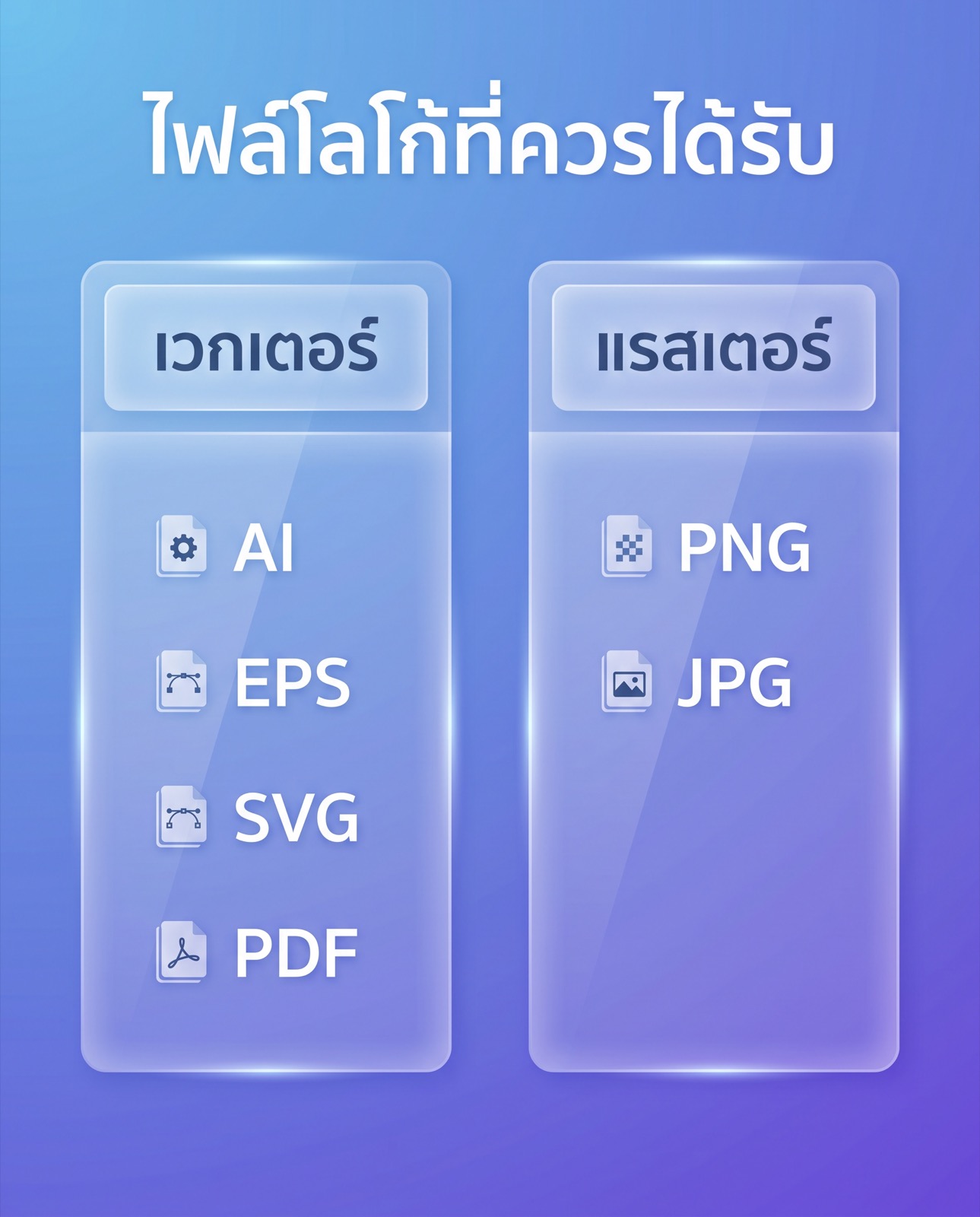
A normal hand off therefore includes both families. On the vector side you should receive an editable master file such as AI, an EPS for print work and suppliers still running older systems, an SVG for the website because browsers render it directly and the file is usually lighter than a bitmap, and a PDF for sending to printers or partners who have no design software. On the raster side you should receive PNG, which supports a transparent background so the mark can sit over photos or colour, and JPG, which has no transparency but is convenient for small files on solid backgrounds.
The question to ask plainly is whether the editable master file is included. Some providers deliver only the exported vector logo files and outputs, which means that any future tweak has to go back through them. That is not wrong in itself, but it is something to know before paying rather than at the moment you need a change.
Beyond formats, ask for the special size cases. A favicon is the small icon in a browser tab, and the space is tight enough that fine strokes disappear entirely. An app icon is clipped by the operating system's own shape and usually loses its corners. Both need a reduced version, such as the first letter alone or the symbol alone. When the design team has not prepared one, the usual outcome is somebody shrinking the full logo until it becomes an unreadable blob of colour. This connects directly to web design, since screens are where a brand mark is seen most often.
What separates professional logo design from work that merely looks nice
The difference is measurable with three tests you can run yourself in a few minutes. First, shrink it. Reduce the logo to roughly thumbnail size and see whether you can still tell what it is. A mark with strokes that are too fine, counters that are too tight, or detail stacked in several layers turns into a smudge the moment it is reduced.
Second, take the colour out and leave one. Real use includes plenty of single colour situations, such as embossing on a box, screen printing on a tote bag, or embroidery on a shirt. If the shape only communicates when a gradient is present, the underlying structure is not strong enough.
Third, put it on a dark background. A logo designed only against white commonly fails on black, on photography, or in an application's dark mode. A team doing the full job delivers a dark background version and states which situation calls for which.
Consistency is the other marker of professional work. When the mark is passed on to other graphic design pieces, it has to be placed at the same proportions and spacing every time, and what produces that is a document that writes the rules down rather than the good intentions of whoever is making the artwork.
What a short brand guideline specifies
A brand guideline document states what must and must not be done with the logo. The short version supplied with a logo project normally covers four things at minimum. The first is clear space around the mark, defined as a proportion of the logo itself, so no text or image crowds it.
The second is minimum permitted size, given in pixels for screen and millimetres for print. The third is exact colour values in every system that will be used, including screen values, four colour process values, and spot colour values if any exist. Written numbers are what let two different printers produce results that match.
The fourth is misuse examples: stretching the proportions, recolouring at will, adding shadows or outlines, and placing it on a background without enough contrast. These are more useful than written rules, because most people who pick up a logo to use it look at the pictures and compare rather than reading the whole document.
When a business needs more than a mark, such as a complete visual system to run across every channel, that work belongs to digital branding, which is broader than designing a single mark and should be scoped as its own project.
Where to get a logo made, compared by what you actually receive
The question of where to have a logo made is easier to answer once you stop comparing on price and start comparing on what is being bought and what risk comes with it. The table below sets out the four main routes Thai businesses use, in terms of the work involved and what to verify first.
| Route | What you are actually buying | What to verify before deciding |
|---|---|---|
| Ready made template or automatic generator | An image that already exists, with a business name applied to it, with no briefing stage | Whether the same design can be sold to other buyers, whether you receive the editable vector master or only an exported image, and what the commercial use terms say |
| Individual freelancer | The time and craft of one person, with scope negotiated directly and flexibly | Whether the scope is written out in full, who covers the work if that person becomes unavailable, and whether a contract assigns the rights |
| Design team or agency | A defined process, several roles each responsible for a different part, and a company as the counterparty | Whether scope includes the brand guideline and the lockup set, how revision rounds are counted, and whether post delivery work is billed separately |
| In house team | The people who understand the business best and can make changes at any time | Whether anyone can work in vector, whether they genuinely have time for it, and who makes the final decision |
No route is right or wrong on its own. A business that wants a temporary mark to test an idea and a business about to produce signage for several branches carry very different costs of getting it wrong, so they should choose differently.
Logo design pricing, and what to know before comparing quotes
There is no verifiable published price benchmark for logo design in Thailand. The figures circulating on various pages are one seller's rate card, not a market average, and they are not the product of systematic data collection. Setting a budget from those numbers risks comparing two entirely different things.
What is more useful is knowing what drives the number on a quote. Once you know that, two quotes that look far apart can be compared on the merits. The main variables are these.
- How many concepts are presented. Presenting one pre selected direction is not the same amount of work as presenting five to choose from.
- How many revision rounds, and how a round is defined. A quote promising unlimited revisions usually has a condition hiding elsewhere. A quote stating a number is easier to compare.
- The scope of research. Whether competitor analysis and a similarity check against existing marks are included.
- How many files and lockups. Only the primary version, or the full set of horizontal, vertical, standalone symbol, single colour, and dark background versions.
- Whether a brand guideline is included. A short document and a full one are jobs of different size.
- Whether transfer of rights is included in the price or billed separately, and what uses it covers.
When requesting quotes from several providers, send the same brief and ask each to answer against those six headings. Quotes that answer all six can be compared. A quote that reads as one line saying logo design followed by one number does not yet contain enough information to compare with anything.
Who cheap logo design suits, and what gets traded away
Cheap work is not automatically bad work. It means part of the process has been removed, and the buyer should know which part. Research usually goes first, then the number of concepts presented, then the file set and multiple lockups, and last the brand guideline.
The economical option makes sense in two situations. The first is a business still testing an idea, unsure what it will sell and to whom, where investing heavily in a mark that may change within months does not pay. The second is a business that already has an internal design team and only needs a starting point to develop further.
What to watch for is the saving that returns later as a cost, such as receiving raster files only and paying to have the mark redrawn in vector when signage is ordered, or discovering the design duplicates another business after material has been printed. If the current mark has drifted away from what the business has become, the more orderly response is to treat it as a rebranding project rather than patching pieces one at a time.
Copyright, trademarks, and what belongs in the contract
In Thailand a logo can be registered as a trademark, and trademark registration is separate from copyright in the artwork itself. Registration records rights to use a mark in connection with the goods or services named in the application. Copyright concerns the created work. The two do not arrive together automatically.
The practical consequence for a buyer is that paying a design fee does not by itself mean every right in the work has moved to the payer. That is a contract term to be written down, not something to assume. Before signing, check that the document states who owns the work once payment is complete, how broad the permitted use is, whether it covers filing the mark for trademark registration, and whether the designer retains the right to show the work in a portfolio.
These are contract questions to read carefully before agreeing. If there is any doubt about rights or the registration process, consult an intellectual property specialist directly. This article explains what to ask about and is not legal advice.
A checklist for choosing a logo design team
Before committing to any provider, work through this list. The answers separate providers far more clearly than their prices do.
- Portfolio. Look for work in adjacent categories, and check whether the pieces differ from each other or look like one formula applied repeatedly.
- Process. Ask them to describe it as stages, from what it starts with to what it ends with. A provider who cannot answer this usually does not have a process.
- Rights. Ask directly who owns the work once payment is complete, and ask for it in the document.
- Files. Ask for the full list of formats, and ask explicitly whether the editable master is included.
- Revision rounds. Ask for a number, and for the definition of what counts as one.
- Timeline. Ask for a delivery date per stage, and for the number of days the client side has to respond.
- Contract and payment terms. Check for defined milestones, cancellation terms, and a statement of what is out of scope.
- After hand off. Ask how additional versions or special sizes will be billed in future.
Where an answer is vague, ask for it in writing. A provider who works systematically will already be happy to supply it.
Talk to Relevant Audience about logo design
Relevant Audience offers logo design for businesses that need a mark which holds up on screen and in print, along with the brand identity work that follows on from it. If you are weighing a new logo against refining the existing one, or you want help working out which scope fits the business, get in touch and talk it through. You do not need a finished brief on day one.
Logo design FAQ
How many days does a logo design project take?
There is no industry standard figure that can be cited, because the duration depends on how fast the client side approves, how many revision rounds are agreed, the scope of research, and how many files have to be delivered. What to do instead is ask for a delivery date per stage in the quote, along with the number of days you have to give feedback, and hold to that document.
Which files do I need to receive for the hand off to be complete?
A complete set normally includes both vector and raster files. On the vector side, the editable master, an EPS for print, an SVG for the web, and a PDF for sending on. On the raster side, PNG with a transparent background and JPG for solid backgrounds. You should also receive a single colour version, a dark background version, and reduced sizes for a favicon and an app icon.
Once I have paid, is the logo automatically mine?
Do not assume so, because ownership after payment is a contract term that has to be written down. Trademark registration and copyright in the artwork are also separate matters. Before signing, check that the document states who holds the rights, how broad the permitted use is, and whether it covers filing for trademark registration. If anything is unclear, consult an intellectual property specialist.
How much does logo design cost in Thailand?
There is no verifiable published price benchmark for the Thai market, and figures found on various pages are individual sellers' rate cards. The comparison that works is on the variables that drive the price: how many concepts are presented, how many revision rounds and how one is defined, the scope of research, how many files and lockups, whether a brand guideline is included, and whether transfer of rights is included. Send the same brief to every provider and ask each to answer against those headings.
Can I just use an automatic logo generator instead?
You can, when what you need is a temporary mark to test a market, but check three things first. Whether the same design can be sold or generated for other users, whether you receive the editable vector master or only an exported image, and what the terms say about commercial use and trademark filing. If the business is about to invest in shopfront signage or a large packaging run, the cost of having to change later is usually greater than the saving.