
TL;DR
- Graphic design services are bought to a brief, and five variables decide the price: scope, usage rights, revision count, file deliverables and turnaround.
- No dependable public price benchmark exists for design work in Thailand, so derive your own by sending one identical brief to several suppliers and comparing itemised quotes.
- Agency, freelance and in-house differ mainly in the shape of the cost and in hidden costs: management time, ramp-up, idle capacity and software licences.
- Ask for source files, font licence terms and written copyright assignment at handover, and specify Thai and English layout requirements before design starts.
Graphic design services are commercial design production bought to a written brief, covering brand systems and logos through to advertising creative, print, packaging, infographics, screen design and motion work. What a buyer actually pays for is a set of usable files, together with the usage rights and source files named in the contract. In practice a business can source that work three ways: hire an agency, hire a freelancer, or employ a designer in house, and each route has a different cost structure and a different set of limits.
This guide is written for the person who has to make the purchase, not for the person who has to do the design. It follows the order in which a real engagement happens: understand the scope, separate the deliverable types, compare the sourcing models, set selection criteria, then run the process through to file handover.
What graphic design services are, from the buyer's side
Seen as a purchase, graphic design services buy a defined body of output, not open-ended access to someone's time. A usable quote therefore has to say what comes back item by item, and what sits outside the scope. Five things carry the substance of the agreement, and those same five are why one brief can be priced several times apart by different suppliers.
- Scope of output. How many pieces, how many sizes, how many languages, how many versions. One design that has to ship in ten sizes is ten pieces of production work.
- Usage rights. Which channels, for how long, in which territories, whether the work can be adapted later, and whether paid advertising use is covered.
- Revision rounds. How a round is counted. One round can mean a single consolidated set of comments from every stakeholder, or a single change requested by one person.
- File deliverables. Final files only, or the editable source files as well, and whether fonts or font licences are included.
- Turnaround. The delivery dates, what happens when your own approvals run late, and what a rush request costs.
These five variables reappear in every section below, because they are the shared language that lets you compare offers from different suppliers. When one of them is missing from a quote, the number on that quote is not comparable to anything.
What a graphic design engagement covers in one contract
Design work is normally bought in one of three shapes, and the right one follows how often the business actually needs output rather than habit.
- Project work. A defined start and end, such as a brand identity system or a packaging set for a new product. Suited to work done once and used for years.
- Retained monthly capacity. Suited to continuous output such as social creative and ad banners. The point to settle in writing is the unit of work, because one supplier's idea of a piece rarely matches yours.
- A pre-priced framework called off as needed. Suited to organisations with irregular demand that want to avoid renegotiating every time.
Whichever shape you pick, the deliverable list should be written at file level rather than by job name: vector files for logos and anything that has to scale without limit, print-ready files with bleed and the correct colour system for print, export sizes for web and social as specified, editable source files, and a brand guideline document where the work is an identity system. What a supplier includes in scope is usually set out on its own graphic design services page, which is worth reading before you get to the quotation stage.
Font handover is the item most often skipped. Commercial fonts carry their own licence conditions, and a licence bought by a designer does not automatically transfer to the client. If you intend your in-house team to edit the files later, agree at the start who buys the font licence and what use it covers.
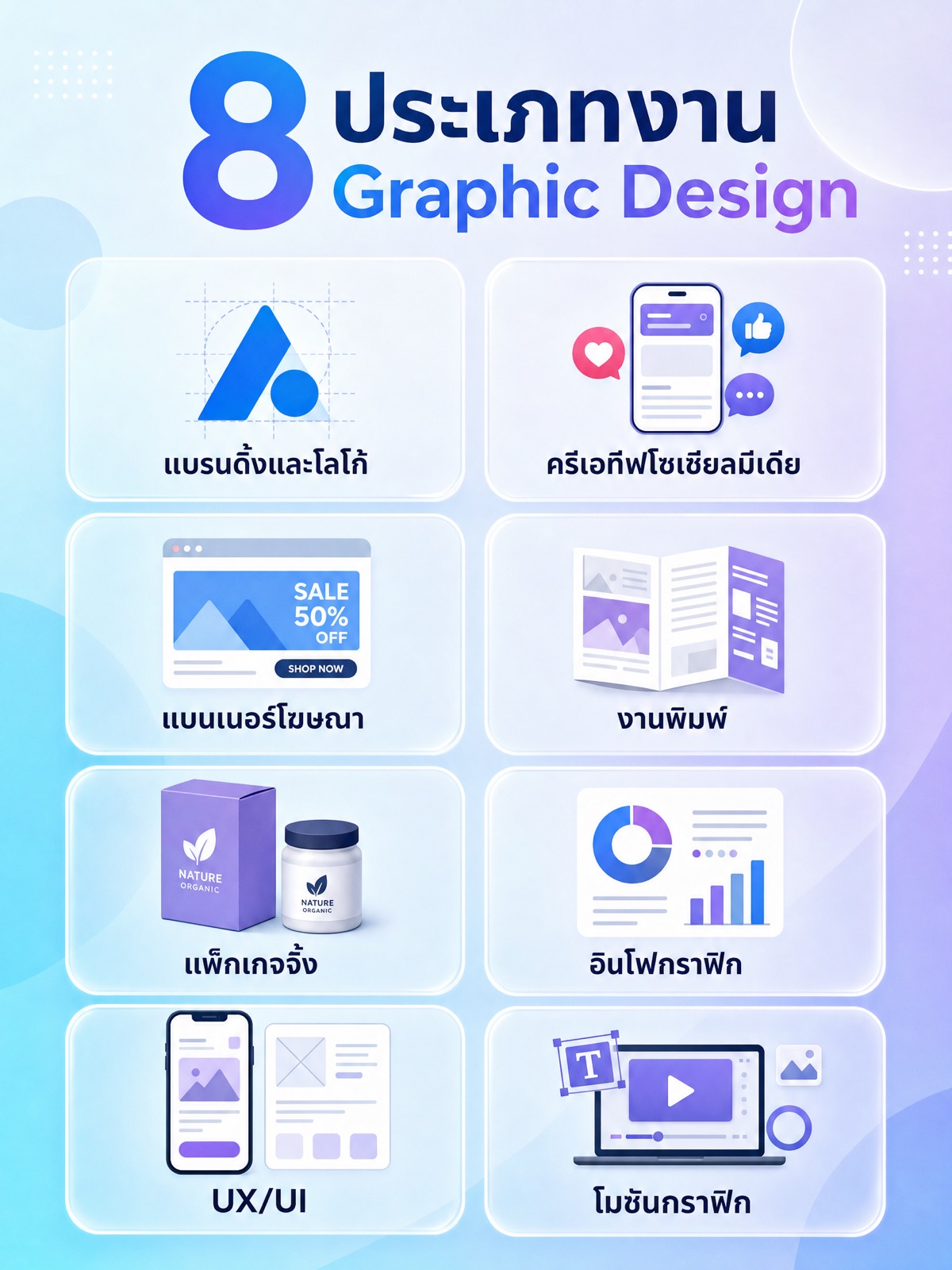
The eight main categories of graphic design work and what each is for
Separating the categories is a procurement matter rather than a question of professional vocabulary, because each one has a different unit of work, a different deliverable set and a different production cycle. Collapsing all of it into the single phrase "design work" is the reason quotes so often turn out to be incomparable.
1. Branding and logo
This category builds the system every other piece has to reference: the logo and its lock-ups, the colour set, the type system and the rules for applying them. The purpose is that work produced by different people at different times still reads as one brand. Ask for vector files of every logo version, the clear space around the mark, the smallest size at which it stays legible, and a guideline document written plainly enough for people outside the design team to follow. If you are starting from nothing or resetting the whole look, the work belongs to brand identity rather than to piece-by-piece production.
2. Social media creative
Feed and story assets for each platform. The purpose is to hold attention for a very short window and land one message. The unit to agree is the number of concepts per month and the number of sizes per concept, because adapting one concept across every aspect ratio is a fresh layout job rather than a resize.
3. Ad banners
Assets tied directly to an ad system, governed by that platform's specifications: pixel dimensions, file weight, accepted formats, and in some systems limits on how much text sits on the image. The purpose is to bring down cost per click and cost per result, so order them as testable sets rather than one-offs, and state in the brief how many Thai and English versions are needed.
4. Print
Brochures, flyers, posters, business cards, signage and decks that will physically print. The purpose is that what leaves the press matches what was approved on screen. Before design starts, get the specification from the printer you will actually use, covering bleed, colour system, stock and finishing, because files built without it usually have to be laid out again.
5. Packaging
Design applied to a real box structure or label die. The purpose is that the product can be read and chosen in a few seconds on a shelf or in a marketplace listing image. Regulatory labelling sits inside this category, both the information a given product type must display and the destination market's requirements for exports, so have whoever owns compliance check the copy before layout begins.
6. Infographics
Turning data or a complicated process into something readable in one image. The business purpose is to cut the time a reader needs to understand something, and to produce an asset other people want to cite. The hard requirement is that the underlying data is final first, because changing a figure after layout usually disturbs the structure of the whole image.
7. UX/UI
Screen design for websites, apps and landing pages. The purpose is that a user completes the task they came to do. This category differs from the rest in that the output has to be handed to developers, so ask for files with a component system, spacing defined as fixed values, states for buttons and forms, and behaviour across screen sizes, rather than one attractive static image.
8. Motion graphics
Short moving image work for advertising, social and product explanation. The purpose is to convey a sequence or an interaction that a still cannot. Cost here tracks duration, the number of scenes, and whether voice-over or subtitles are needed in one language or several, so state all of it in the brief before asking for a price, including which vertical and horizontal versions you need.
Once the categories are separated, list the pieces your business genuinely needs across a year, with rough frequency. That list is the basis for choosing a sourcing model in the next section, because a business that needs social assets every week and a business that needs one identity system should not arrive at the same answer.
Comparing the three options: agency, freelance and in-house
The first table compares the shape of the cost rather than the amount, because the amount depends on each company's scope while the shape is predictable in advance and can be used to decide.
| Option | Shape of the cost | Hidden cost usually forgotten |
|---|---|---|
| Agency | Priced per project or as retained monthly capacity, with project management, quality checking and cover for absence built into the rate | Charges when work falls outside scope or exceeds the agreed rounds, plus the time your side spends writing briefs and consolidating comments |
| Freelance | Priced per piece or per hour, usually the lowest unit rate because there is no management layer inside it | The management time moves fully onto your side, one person's availability becomes a single point of failure, and replacing them means explaining the brand from scratch |
| In-house designer | Fixed salary plus employment overhead, with unit cost falling as volume rises and stays steady | Software licences, equipment, ramp-up time, idle capacity in quiet months, and the stall when the person resigns |
The second table covers the dimensions that are not money but that decide the result: how consistent the brand stays, and how the arrangement copes when volume spikes.
| Option | Continuity and brand consistency | Ability to scale up |
|---|---|---|
| Agency | Depends on whether a brand guideline and a source-file library exist. With those in place people can change and the work still holds its tone | Scales fastest by pulling in more of the same team, provided rush terms are agreed beforehand |
| Freelance | Very consistent while it is the same person, and drops immediately when the person changes, because the brand knowledge sits in one head | Limited to one person's spare capacity. Adding a second freelancer adds another layer of tone to manage |
| In-house designer | Consistent and closest to the product, with concentration risk when that person is on leave or resigns | Hardest to scale at short notice, and usually still needs outside help for a large campaign |
Many businesses do not pick one route. They keep work that needs deep product knowledge and daily turnaround inside, and buy identity systems, campaign work and peak-period capacity outside. If you take the mixed route, write down where the source files and the brand guideline live, because that is where consistency breaks first.
Pricing: why no dependable benchmark exists, and how to derive your own
There is no reliable published price benchmark for graphic design work in Thailand, and the figures that circulate online are usually repeated without the scope that produced them. The reason is direct: the same brief prices differently once you change the five variables set out at the top, namely scope, usage rights, revision count, file deliverables and turnaround. A price quoted without those five is not information you can compare.
An example without any numbers makes it concrete. A logo delivered as image files for social use only, and the same logo delivered as a full vector set with a guideline document and unlimited-term rights for print and paid advertising, are different products in contract terms. Putting their prices side by side tells you nothing about which supplier is cheaper.
Getting a number that is true for your situation follows a clear order.
- Finish the brief first, with all five variables written down and locked.
- Send that same brief to more than one supplier, without disclosing your budget, so the price reflects the scope rather than your ceiling.
- Ask every supplier to itemise, piece by piece, instead of returning a single total.
- Compare line against line on identical scope, and identify what any gap comes from, such as the number of sizes, the number of languages, or a difference in usage rights.
- Keep that set of prices as your own internal benchmark and revise it whenever the scope changes. It is the only benchmark that is accurate for your business.
Before putting two quotes side by side, check that each one specifies everything on this list. If something is missing, ask for it rather than assuming on the supplier's behalf.
- Number of pieces, number of sizes and number of languages delivered
- The file list, including editable source files and the position on fonts
- The extent of usage rights, by channel, by duration and for later adaptation
- The number of revision rounds, the definition of one round, and the rate beyond it
- A stage-by-stage timeline, with the assumption stated for how fast your side approves
- What is excluded, such as stock imagery, font licences, proofs or print management
- Payment terms and the applicable taxes, which your finance team should review before signing
Commissioning design work: writing a brief that makes quotes comparable
Suppliers offering to take on design work are easy to find. What separates the ones who can deliver is the questions they ask back after reading the brief. A well written brief shortens those questions and makes the prices that come back genuinely comparable.
A workable brief has at least eight parts: the business purpose of the piece, the audience and the context in which they will see it, the channels and sizes listed out individually, the status of the copy and whether it is final or draft, the languages required and who will proofread them, the material your side supplies such as product photography and logo files, mandatory elements such as legal text or certification marks, and the approval chain covering who may comment and who decides.
The mistake that stretches a project furthest is the one-line brief, such as asking for a new logo and nothing else. What comes back is a set of quotes built on different assumptions, and the mismatch only surfaces after a supplier has been chosen. The next most costly mistake is starting design while the copy is still moving, because changing text after layout usually means laying the piece out again, especially in bilingual work.
Working with a graphic design agency in Thailand: what to check before signing
When assessing a graphic design agency in Thailand, what separates an agency from a group of freelancers is the system behind it rather than the headcount. Check four things before signing.
- Source file storage and handover. Ask how source files are stored, how versions are named, and when you can request historical files. Anyone who has switched supplier and failed to get the old files back will recognise this one straight away.
- Copyright ownership. Thai copyright law treats work created by an employee in the course of employment separately from work produced under a hire-of-work arrangement, and the outcomes differ. The safe route is to state ownership and assignment explicitly in the contract instead of relying on the statutory default.
- Named responsibility and communication. Who consolidates comments, who answers when the main contact is away, and how rush work enters the queue.
- Personal data handling. If the design work involves customer images, staff images or user data, agree the basis for use and the retention terms in the contract under Thailand's personal data protection law.
For organisations thinking beyond individual assets, where the website, the advertising and the chat channels should all run on one visual system, the scope moves toward a digital branding project, which involves more system-building than piece production and deserves a separate budget line from monthly output.
Hiring a graphic designer: five criteria you can actually decide on
At the selection stage, use criteria you can check against evidence rather than an impression formed by scrolling a portfolio. The five below are in the order worth checking them.
- Portfolio work in your category. Look for work of the same type you intend to commission rather than for work that looks attractive. Someone strong on posters is not automatically strong on screen design or packaging, and it is fair to ask which part of a shown piece they were responsible for.
- Brand consistency across a long body of work. Ask to see several pieces for the same client across a period of time, instead of one standout piece from many clients. Holding a visual system steady is what separates a team that works systematically from one that works piece to piece.
- Turnaround and what governs it. Ask what slows work down inside their process, then judge whether the answer is honest. A team that says it is always fast with no conditions attached is worth questioning further.
- Revision policy. Check how one round is counted, how contradictory comments from different stakeholders are treated, and how a change of direction after concept approval is charged. A policy written down protects both sides.
- Clarity of the quote. Judge it on completeness against the checklist above. The lowest quote that omits file deliverables and usage rights tends to become additional cost later.
One step that helps more than any of the above on its own is a small paid trial with a defined scope, so you see how a supplier actually works before committing to a long agreement. The trial should use a real brief and have its success criteria agreed in advance.
End-to-end design services: the standard process from brief to delivery
An end-to-end design service that works systematically runs five stages, and each stage has something your side must do rather than wait for. Total project duration is governed by the length of your approval chain, the readiness of copy and imagery, the number of sizes to produce, how many revision rounds are actually used, and the downstream production queue such as the printer's schedule, far more than by how fast the designer works.
- Brief. Agree the purpose, the scope, the deliverable list and who approves. Close the stage with a document both sides sign off as accurate. What stretches this stage is your own organisation not yet agreeing internally.
- Concept. A limited number of directions is presented with reasoning tied back to the purpose. Your side picks one direction rather than asking for all of them blended. Failing to choose decisively here is the most common cause of a project expanding.
- Design. The chosen direction is built out across every size and language. Put a checkpoint after the first finished piece so layout problems surface before the same problem is repeated dozens of times.
- Revise. Consolidate comments from every stakeholder into one set per round. Comments should describe the problem and the goal rather than prescribe the fix, and one named person should decide when comments conflict.
- Deliver. Final files and source files are handed over against the list, with a last accuracy check covering spelling, legally required text and a real print or display test. The files then go into a library your side can reach.
Add a sixth stage to the contract where you can: a review after the work has run. Look at which pieces performed in which channel, then feed that back into the next brief. Doing this turns design procurement into a process that improves rather than one that restarts every time.
Production constraints in the Thai market that belong in the brief
Design for businesses in Thailand carries production conditions that English-only work does not, and they belong in the brief at the start rather than being discovered at review.
- Two scripts in one layout. Thai and Latin type have different proportions and sit differently on the baseline. Setting them at the same point size often leaves one side looking small or floating. Fix the font pairing and the size ratio in the brand guideline from the outset.
- Thai font options. Thai families that ship a full weight range and carry a commercial licence covering web embedding, app use and use in a logo are fewer than the Latin equivalents. Check licence terms before selecting a face, not after building a system on it.
- Text length. Thai copy usually runs longer than English carrying the same meaning, so a layout designed around English source text tends to break once Thai goes in. Either design with the real Thai copy from the start, or set a maximum character count per line in the brief.
- Tone marks and stacked vowels. Thai stacks vowels and tone marks above the base character, and line height set too tight clips the upper marks or collides with the line above. Set leading from the actual metrics of the Thai font in use, and check it on a real device rather than only in the design file.
- Emphasis. Thai has no italic convention equivalent to English, so emphasis should come from weight or colour. Line breaking also needs a human check, because Thai does not put spaces between words.
- Sizes for the channels Thai businesses actually use. The deliverable list should name the sizes for the channels in real use, including LINE Official Account rich menus and rich messages, Facebook and Instagram feed and story formats, vertical video for TikTok, cover and detail images for Shopee and Lazada listings, and video thumbnails for YouTube. Leaving these unnamed is why teams go back asking for extra files after delivery.
- Local print production. Get the specification from the printer you will use before design begins, and allow time for proofing and colour correction, because screen colour and printed colour on different stocks do not match.
Frequently asked questions about buying graphic design services
Should I hire an agency or a freelancer
Decide on annual volume and your need for continuity rather than on unit price. If work arrives in waves and you need cover when your main contact is unavailable, an agency is usually better value because the management layer is already in the rate. If volume is low, scope is clear, and you have someone internally who can write briefs and check work, a freelancer gives a lower unit cost.
How much does graphic design cost in Thailand
No dependable public benchmark exists for the Thai market, and a figure quoted without its scope should not be used to set a budget. To get a real number, write a brief that locks scope, usage rights, revision count, file deliverables and turnaround, then request itemised quotes from more than one supplier on that identical brief.
Which files should I ask for at the end of a project
Ask for both the final files and the editable source files, along with the font list and the licence terms attached to those fonts. For logo work request every vector version, for print request press-ready files with bleed and the colour system the printer specified, and for screen work request files with a component system that developers can pick up.
How many revision rounds should I agree
Set it from your own decision structure rather than from a standard number. Count how many parties may comment, then agree that one round means one consolidated set of comments from all of them, and name the person who decides when comments conflict. That reduces the rounds actually used more than adding rounds to the contract does.
Who owns the copyright in commissioned design work
Always state it in the contract, because Thai copyright law treats work created by an employee in the course of employment separately from work produced under a hire-of-work arrangement, and the outcomes are not the same. The contract should cover ownership, the scope of use, adaptation, and handover of source files, so none of it has to be renegotiated at short notice.
Next steps
Start with what you control: list the pieces you need across a year, lock the five variables into a brief, then ask more than one supplier for an itemised quote. Once the brief is stable, comparing offers takes far less time, and you will be able to see for yourself which part of the scope any price difference comes from.
If you would rather have a supplier help define the scope from the start, the coverage and working model are set out on the Relevant Audience graphic design services page, and you can send your brief through to ask for an itemised quote against the scope you have defined.