Your customers are no longer just Googling things. They’re asking AI to shop, compare, and decide for them. Someone types “what is the best local plumber for older homes in my area” into ChatGPT, and an answer comes back instantly. No list of blue links. No scrolling. Just a direct recommendation.
If your business isn’t built to be understood by these AI systems, you’re invisible before the conversation even starts.
This shift is already happening. AI-driven discovery is reshaping how products and services get found, recommended, and selected every day. The good news for business owners is that the new rules actually level the playing field. You don’t need a massive marketing budget to compete. You need the right structure, the right content, and a genuine understanding of how AI decides what to trust.
Why Traditional SEO is Now Just the Starting Line
For the past decade, the goal of search optimization was pretty simple: rank on page one of Google. Get enough backlinks, work in the right keywords, and hope your listing appears above the competition. That model still matters, but it’s no longer enough on its own.
From Search Results to AI Answers: What Actually Changed?
Consumers aren’t typing short, choppy keywords into a search bar anymore. They’re asking layered, conversational questions. “Which CRM is best for a solo contractor who doesn’t have time to learn complicated software?” That kind of question gets asked directly to AI tools like ChatGPT, Google’s AI Overviews, Perplexity, and others.
Here’s the big shift: these tools don’t always send users to a list of websites. They generate answers. They pull information from sources they consider credible, structure it into a readable response, and deliver it without a click required. If your business content isn’t written in a way that AI can extract and trust, you simply don’t show up in that answer.
This isn’t a future problem. Google’s AI Overviews already appear in a large percentage of search results, and more people are using standalone AI tools for research and purchasing decisions every month. The discovery process has changed, and small businesses that adapt early have a real advantage.
The New Optimization Stack Businesses Need to Know
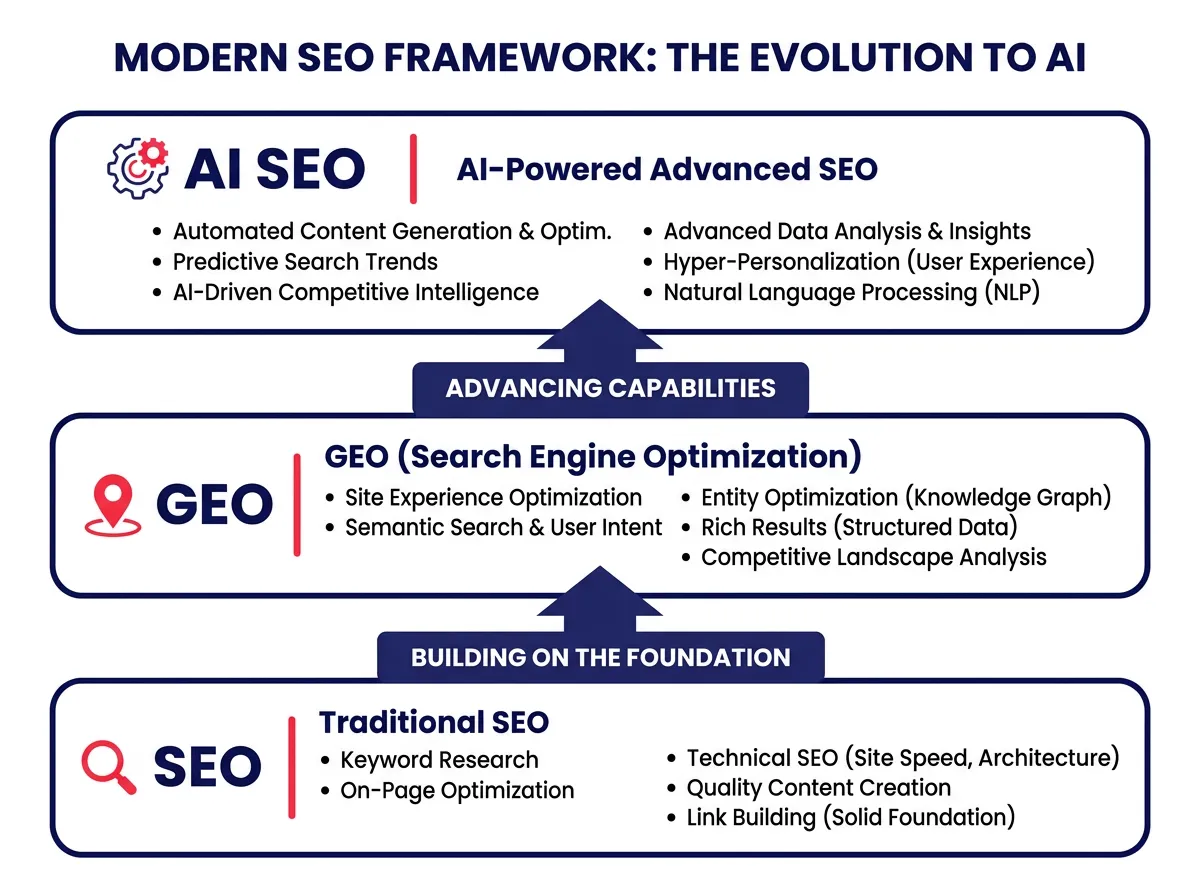
Getting found now involves three connected layers: SEO, GEO, and AI SEO.
SEO is still the foundation. Your website needs to be technically clean, fast-loading, and crawlable. Google and other search engines still index the web, and AI systems pull from that indexed content. If your site is slow, broken, or difficult to crawl, none of the other work you do matters much.
GEO (Generative Engine Optimization) focuses on making your content easy for AI systems to extract and use in generated responses. This means writing clearly, answering specific questions directly, and using structured formats like headers, bullet points, and FAQ sections.
AI SEO goes a step further by optimizing for how AI models evaluate authority and relevance. It includes adding schema markup to your pages so AI systems can accurately interpret what you offer, who you serve, and why you’re a credible source.
Together, these three layers form the optimization stack that business owners need to understand right now. Each one builds on the last, and skipping any of them leaves gaps that AI systems will fill with your competitors instead.
Making Your Business Visible in the AI Layer
Understanding why the rules have changed is one thing. Knowing what to actually do about it is another. Getting your business selected by AI during the discovery process comes down to two things: the quality of your content and the strength of your authority signals.
Turning Your Content Into a Resource AI Can Trust
Most business websites have thin service or product pages. A few paragraphs describing what you offer, a contact form, maybe a photo. That kind of page made sense when the goal was just showing up in a local search. It’s not enough anymore.
AI systems are looking for content that actually answers questions. If someone asks an AI tool which landscaping company to hire for a drought-prone backyard, that tool will pull from pages that explain the specific problem, describe the approach, and show genuine expertise. A page that says “we offer landscaping services in your city” tells the AI nothing useful.
Here’s what needs to change on your pages:
- Add use cases. Show specifically who you help and what problems you solve. Be concrete.
- Include how-to details. Walk people through your process so AI can understand the depth of your expertise.
- Write structured FAQ sections. Real questions with direct answers are gold for AI systems.
- Use clear headers. AI reads content the way a skimming human does. Make your structure obvious.
The goal is to turn your website into a resource that’s genuinely useful, not just a brochure. When AI scans your content and finds clear, structured, helpful answers, it’s much more likely to reference your business in a response.
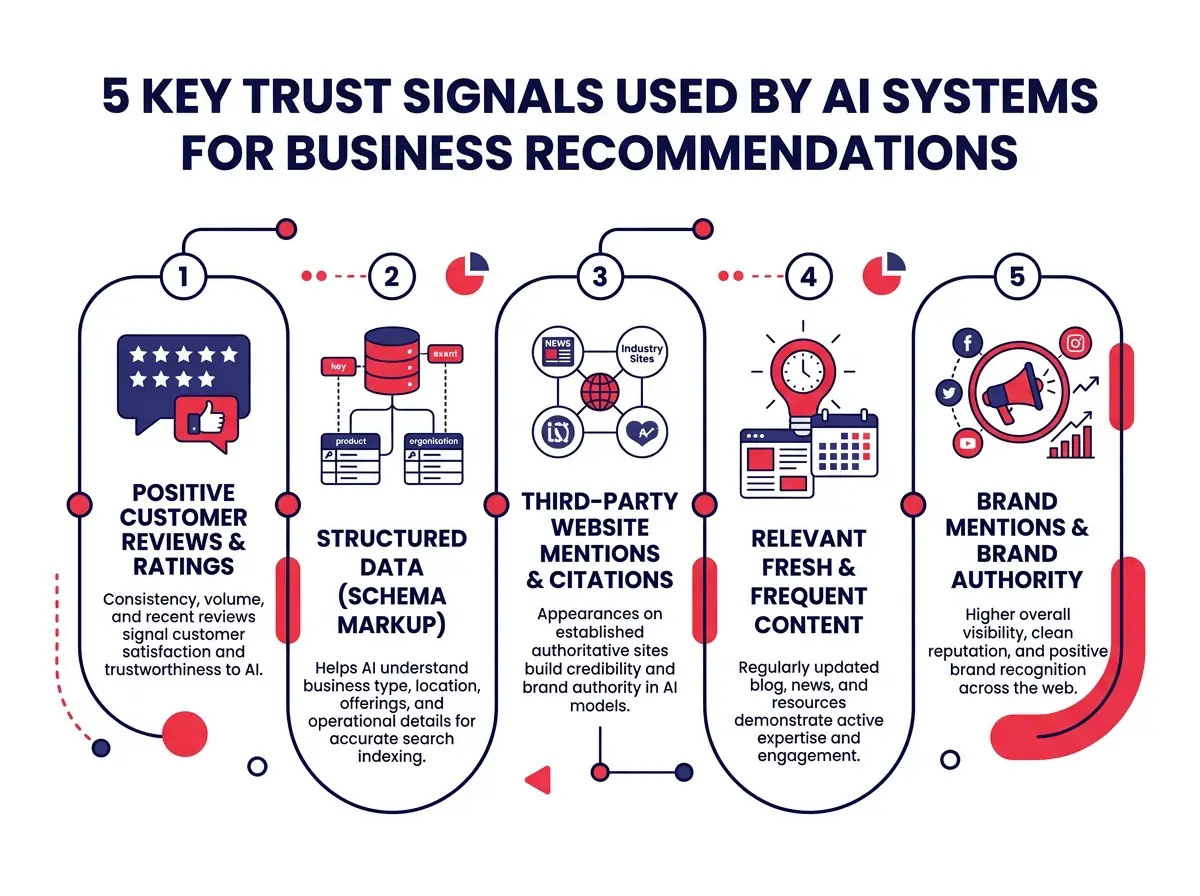
5 Signals That Help AI Choose Your Business Over the Competition
Beyond your own website, AI systems look at external signals to decide who’s credible and worth recommending. These signals have shifted compared to what traditional SEO rewarded.
1. Third-party mentions in credible lists.
Being included in “best of” roundups on reputable blogs, local publications, or industry sites carries real weight. Reach out to relevant sites and make the case for why you belong on their lists.
2. Consistent, recent reviews.
Reviews across Google, Yelp, and industry-specific platforms signal to AI that real people have validated your business. Both consistency and recency matter here.
3. Structured data and schema markup.
Adding schema to your pages tells AI exactly what your business does, where you’re located, what your hours are, and what categories you fall into. This is one of the most overlooked steps for small businesses.
4. Fresh, updated content.
AI weighs content recency. A blog post or service page last updated three years ago signals that the information may no longer be accurate.
5. Brand mentions without links.
AI models pick up on unlinked brand mentions across the web. Getting your business name mentioned in context, in articles, forums, and social content, builds the kind of recognition that feeds into AI-driven GEO signals.
The shift to AI-driven discovery isn’t coming. It’s already here. Entrepreneurs who treat their websites as genuine resources, build authority across multiple platforms, and understand how SEO, GEO, and AI SEO work together are the ones who will stay visible as customer behavior keeps evolving. Waiting for the rules to stabilize before adapting is a reasonable-sounding plan that will leave you playing catch-up.