TL;DR
- Seven readiness checks decide timing: price-only buying, scattered name spellings, mismatched channels, inconsistent team pitches, planned expansion, ad-only discovery, minus one point if the product does not yet sell repeatedly.
- Score 3 or more and start; the five steps are research, position, look and voice, consistent rollout, and quarterly measurement, each with a concrete deliverable.
- Brand consistency can be scored by grading each touchpoint on five criteria (logo, colour, font, tone, description) and tracking the pass rate against your own last quarter.
- IKEA's own pages say its name dates from a 1943 registration while its 1951 red logo later became blue and yellow; Coca-Cola's 1915 bottle brief asked for a shape recognisable in the dark.
Building a brand makes sense once a business has a product that sells repeatedly and starts to see three problems: customers choose it on price, they cannot remember its name, or it looks different on every channel. If the checklist below gets a "yes" on three or more items, start the 5 brand-building steps in this article, from customer research through to quarterly measurement.
This article does not explain what a brand is or why it matters. That ground is covered in the article Branding Strategy: What It Is and Why It Matters on this site. Here the focus is practical: checking whether you are ready, what to do, what each step must produce, and how to tell whether the brand is actually being used consistently.
The brand readiness checklist: is your business ready?
This brand readiness checklist has seven items. Each comes with a check you can run within a week without hiring anyone. Answer from evidence you can see, not from how you feel. If a check leaves you unsure, count it as a no.
1. Customers buy mainly on price
You can see this when sales rise and fall with promotions and customers ask about discounts before they ask about the product. To check, ask your 10 most recent customers why they chose you and write down their exact words. If most answers are "it was cheaper" or "there was a promotion", customers have no other reason to pick you. When a competitor cuts prices further, this group is ready to leave.
2. Customers call the business by different names
Search the business name on Google, Facebook, LINE and review platforms, and count how many ways people write it. Some spell it in English, some in Thai, some use the owner's name, some use the street name. When the name splits into several versions, people who want to buy again cannot find you, and the reviews you earn end up scattered instead of collected under one name. You can also check this in Google Search Console by looking at how many spellings of the brand name appear in your query list.
3. Each channel looks like a different company
Take screenshots of your website home page, Facebook page, LINE Official Account, Shopee or Lazada store, business card, quotation and packaging, then put them side by side on one slide. If the logo has several versions, the colours do not match, the font changes depending on who made the piece, and the business description is written differently each time, a customer who meets you on two channels may not realise it is the same business.
4. Your team describes the business differently
Ask three to five staff members, such as sales, the page admin and whoever answers the phone, to write one sentence answering "What do we do, for whom, and how are we different?" without talking to each other. If the answers differ widely, every customer is hearing a different story. A new logo will not fix this. It starts with agreeing on a position.
5. You are about to expand into a new product, channel or market
Look at the next 12 months. Are you opening a branch, launching an online store, adding a product line or starting to sell abroad? Every expansion puts the brand in front of people who have never heard of you. Without rules for how the brand looks and sounds, each project makes its own decisions from scratch, and fixing that later costs far more.
6. You pay for ads every time you want to be found
Open Google Search Console and separate searches that include your brand name from generic searches. Then open GA4 and look at the share of sessions from the Direct channel. If branded searches are close to zero and nearly all sales come from ads, nobody is thinking of you on their own. The moment ads stop, sales stop with them.
7. The item that says it is not time yet
If the product does not sell repeatedly, past customers do not return, or the target customer changes every month, fix the product and find the right customers first. Building a brand helps people remember and choose something that already works. It cannot rescue a product that does not meet the need. If this item is a yes, subtract one point from items 1 to 6.
Reading the result
Count the yes answers for items 1 to 6, then subtract item 7. At 0 to 2, keep collecting customer information and check again in six months. At 3 to 4, start steps 1 and 2 now, because they cost little and make every later decision easier. At 5 or more, the business is losing opportunities every day and should plan to complete all five steps within a quarter. These thresholds are a decision aid, not an industry standard.
5 brand-building steps you can actually carry out
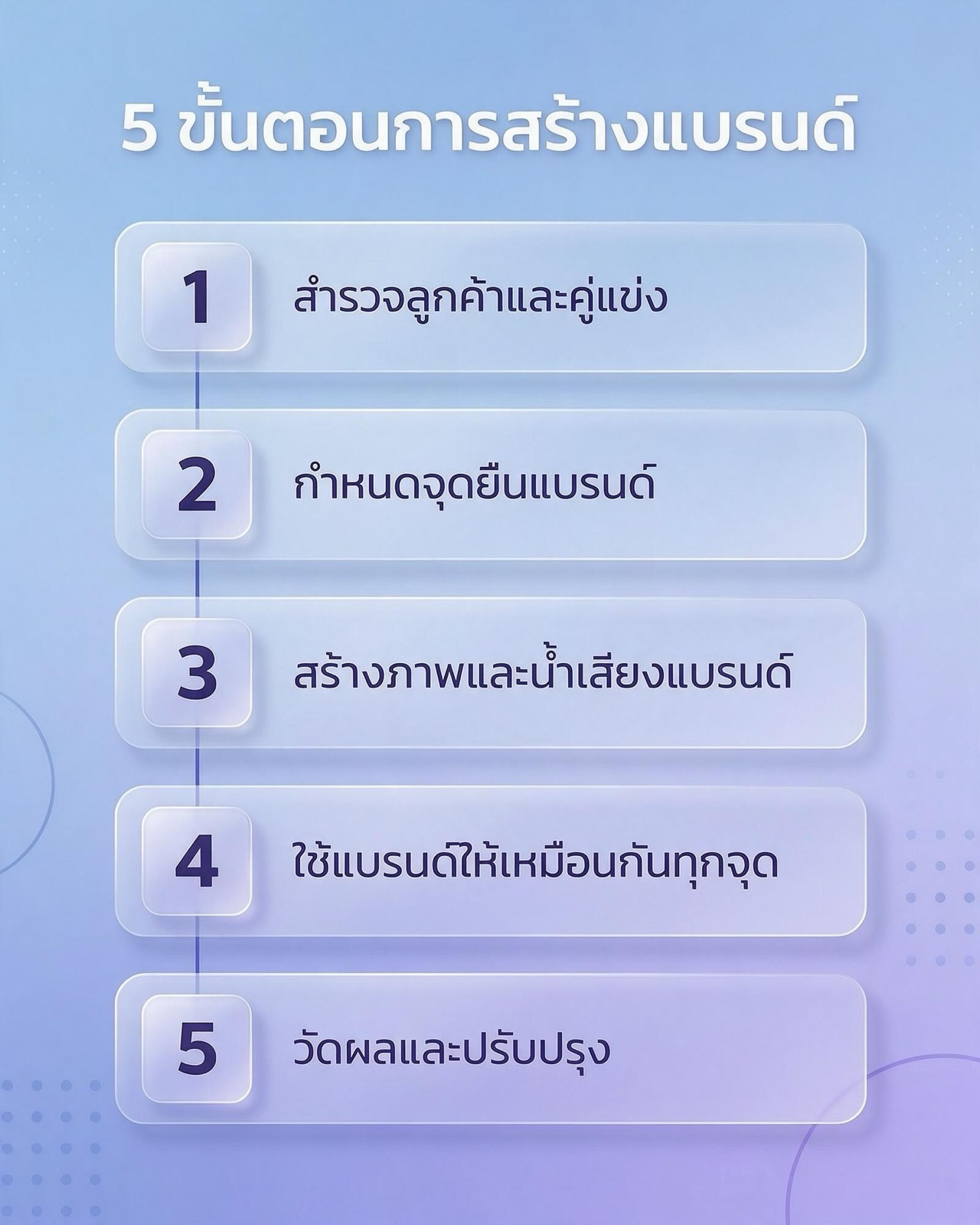
The 5 brand-building steps below are ordered so that each one uses the output of the step before. You can skip a step, but you will end up coming back to it. Each step lists what it must produce as a concrete deliverable and the mistakes that waste the most time.
Step 1: research customers and competitors
Start by talking to 5 to 10 real customers, including people who buy again and people who bought once and disappeared. Ask three things: what were they using before they found you, what made them decide to buy, and what would they say if they recommended you to a friend. Write down their words as spoken. The words customers use often become better brand messages than anything the team invents.
Next, pick 3 to 5 competitors that customers mention. Build a comparison table: what each one promises customers, which main colour it uses, what tone it speaks in, and where its prices sit. The gap where nobody stands yet is what the next step will use.
Deliverables: a one- to two-page summary of customer quotes, and a one-page competitor comparison.
Common mistakes: interviewing only customers who already like you, which produces nothing but compliments, and asking leading questions such as "You like us because of the quality, right?", which makes customers repeat what they just heard.
Step 2: define the brand position
A brand position is a sentence that says who you are the best choice for, at what, and why that claim can be believed. Use this template: "For [customer group] who [have this problem or need], [brand name] is the [type of business] that [main benefit] because [provable reason]." The last slot must be something that can be checked, such as a production method, a guarantee or after-sales service, not words like "care" or "quality".
Add no more than three brand values, each written as a visible behaviour. If a value is "straightforward", follow it with "we show the total price including delivery before the customer orders, and we state the real delivery time". The team then knows what to do in an actual situation.
Deliverables: a one-paragraph position statement, three values with behaviours, and a one-sentence business description that everyone on the team uses word for word.
Common mistakes: trying to be everyone's choice, so the position statement would work for any competitor. Test it by putting a competitor's name in place of yours. If the sentence is still true, it is not a position yet.
Step 3: create the brand's look and voice
This step translates the position into things people see and hear: the name and its spelling in Thai and English, the logo, the colour set, the fonts, the image style and the writing voice. If you do not have a working logo yet, a logo design brief should come from the position in step 2, not from the owner's personal taste. For the full identity system, including colour, type and usage rules, see brand identity.
For a Thai business, choose the Thai font and the Latin font as a pair from the start. Check that the Thai font renders tone marks and upper and lower vowels without collisions, and that it is licensed for commercial use. For voice, write pairs in the form "we are this, not that", for example "friendly, but no teen slang", and agree on sentence-ending particles such as khrap, kha or na kha so that every admin uses the same ones.
Deliverables: a brand starter kit with logo files in every format, primary and secondary colour codes, a Thai and a Latin font, examples of acceptable and unacceptable images, and a one-page voice guide.
Common mistakes: starting this step before steps 1 and 2, which means colours and logo are chosen by taste and have to be redone once the real customer is known. Another is making only a logo and calling it done, when the things customers see most often are posts, chats and packaging.
Step 4: apply the brand the same way everywhere
List every point where customers meet the brand, in the order they actually meet it: search results, Google Business Profile, social posts, the website, LINE OA chats, quotations, packaging, receipts and phone calls. Update them one at a time against the starter kit from step 3, starting with the ones the most people see.
Templates keep consistency alive far better than reminders do. Make templates for posts, highlight covers, quotations and common chat replies. A graphic design team can build a template set that staff can edit text in without breaking the layout. Ongoing content should follow a plan built on the same position; see content marketing for how that planning works.
Deliverables: a touchpoint list with an updated or not-updated status, a template set, and one named person who decides whether a piece passes.
Common mistakes: a big launch followed by everyone making their own posts again, so that three months later the brand has several faces once more. Another is changing colours or the slogan because the team is bored, just as customers are starting to recognise them.
Step 5: measure and improve
Building a brand can be measured, but the measures must reflect recognition and choice, not just likes. Measures a small business can run itself include:
- Branded search volume in Google Search Console, compared quarter on quarter
- The share of sessions from the Direct channel in GA4
- The share of returning customers from your sales system or CRM
- New customers' answers to "Where did you hear about us?" in forms or chats
- The brand consistency score from the audit in the next section
Deliverables: a measurement table updated every quarter, and a short note on what will change this quarter and why.
Common mistakes: expecting results within a month. Recognition builds up over time, so look at the trend over at least two to three quarters before judging, and do not change the position because one month's numbers dipped.
The 5 steps at a glance: deliverables and common mistakes
| Step | Deliverable | Common mistake |
|---|---|---|
| 1. Research customers and competitors | Customer quote summary and a 3 to 5 competitor comparison | Asking only fans, and asking leading questions |
| 2. Define the brand position | Position statement, three values with behaviours | A position broad enough to fit any competitor |
| 3. Create the look and voice | Logo files, colours, Thai and Latin fonts, voice guide | Choosing by taste before knowing the customer |
| 4. Apply it everywhere | Touchpoint list, templates, one decision-maker | Launching, then letting everyone improvise |
| 5. Measure and improve | Quarterly measurement table | Counting likes and expecting results in a month |
How to measure brand consistency with a self-audit
A brand consistency audit needs only a simple grid. Rows are the touchpoints from step 4. Columns are five criteria: the current logo version is used, colours match the codes, the set fonts are used, the tone follows the voice guide, and the business description matches the agreed sentence. Mark each cell pass or fail, then express the passes as a percentage of all cells.
A hypothetical example to show the arithmetic: 10 touchpoints times 5 criteria gives 50 cells. If 35 pass, the score is 70 percent. Next quarter, fix the failing cells, starting with the touchpoints customers see most, then audit again against the same criteria. There is no benchmark for comparing this number with other businesses. Compare it only with your own previous quarter.
Three habits make the audit more accurate. First, have someone who did not make a piece check it, because the maker tends to miss their own errors. Second, keep screenshots from every audit so you can see changes over time. Third, include channels other people manage, such as marketplace storefronts or directory listings set up by resellers, which often still carry an old logo.
Lessons from brands that got it right
These two examples use only information the brands publish on their own company websites. Each was chosen because it teaches something a small business can apply.
IKEA: the name stays, the visuals evolve
IKEA's own history pages explain that the name comes from the initials of founder Ingvar Kamprad, Elmtaryd, the farm where he grew up, and Agunnaryd, the nearby village in Småland, Sweden, and that it was registered as a trading company in 1943. IKEA's logo history page shows that the first logo, in 1951, was round and red, before the blue and yellow logo that the company says connects to its Swedish heritage.
The lesson is that the name and the meaning behind it stay fixed, while the visuals can be updated over time. For a Thai business, settle the name and its Thai and English spellings in step 3, because a later name change affects search, reviews and paperwork. The logo and colours can be refreshed later without starting from zero.
Coca-Cola: write the recognisable feature into the brief
The Coca-Cola Company's history pages say that in 1915 the Coca-Cola Bottling Association funded a distinctive bottle, and eight to 10 glass companies were challenged to design one so distinct it could be recognised by feel in the dark or lying broken on the ground, because imitators were copying the brand to deceive customers. The Root Glass Company's design was chosen in early 1916, and the bottle shape was later recognised as a trademark in the United States.
The lesson is that a recognisable difference has to be written into the design brief rather than hoped for, and once you have it, it needs protecting. A small business may not have a special bottle, but it can define something of its own, such as a packaging colour, a wrapping style or a chat greeting, and repeat it at every touchpoint. In Thailand, trademark applications for names and logos go through the Department of Intellectual Property.
What the two have in common
Both settled the core of the brand clearly and then repeated it for a long time. Changes happened at the edges, such as the logo artwork or pack sizes, not at the core. That is why steps 4 and 5 matter as much as the design work. A brand that looks good on paper but is used inconsistently still goes unremembered.
Building a brand in the Thai market: extra points to plan for
If customers often contact you through LINE OA or Facebook before they visit your website, put the LINE OA profile picture, cover image, greeting message and rich menu near the top of the touchpoint list, not at the end.
The brand name needs one Thai spelling and one English spelling used everywhere, including Google Business Profile, Shopee and Lazada storefronts, and shop signage. If a customer searches the Thai name and finds a different English name, they will not be sure it is the same shop.
Formality in Thai varies a lot between businesses. A brand selling to companies may use formal address and polite particles, while a brand selling to teenagers may use a much more casual register. Neither is always right, but the choice has to fit the position and be used the same way on every channel.
Finally, before printing signage or packaging in volume, search the Department of Intellectual Property's trademark database for similar names or logos that are already registered. Changing after printing costs far more than checking first.
FAQ about building a brand
How long does building a brand take to show results?
Steps 1 to 3 usually take from a few weeks to two or three months depending on the size of the business, but recognition results, such as growth in branded searches, need a trend of at least two to three quarters.
Should the logo or the brand position come first?
The position should come first, because the logo, colours and voice are the visible translation of the position. If the logo comes first, the designer has no brief to judge which option is right, and the choice usually comes down to taste.
Can a business build its brand on its own?
A business can handle steps 1, 2 and 5 on its own, because they rely on customer knowledge the owner already has. Steps 3 and 4 need design skills and templates that work in practice, so many businesses do the first part themselves and bring in specialists for the visual and system work.
Where should a small budget start?
Start with step 2: write the position statement and a one-sentence business description that everyone uses, then fix the name, spelling and description on every channel so they match. This costs almost nothing and gives customers one consistent picture straight away.
What to do next
Run the brand readiness checklist in this article first. If you score three or more, start step 1 this week by talking to five customers. If you want a team to help define the position, design the visual system and roll it out across digital channels, see our digital branding services.