TL;DR
- Search engines are described as working in three stages, crawling, indexing and ranking, and a site that blocks access, links content loosely or ships unclear metadata loses the chance to be indexed at all.
- SEM is paid search, or PPC, that puts a site at the top as soon as the campaign starts, while SEO works on organic results and relies on time, consistency and expertise instead of the same spend.
- SEO has three parts: on-page, meaning E-E-A-T content, ordered H1 to H3 headings, natural keywords, alt text and internal linking; off-page, meaning quality backlinks, digital PR and reviews; and technical, meaning speed, JavaScript, SSL, XML sitemap, schema and mobile support.
- The site structure step keeps high-priority pages no more than 3 to 4 clicks from the homepage, and results are measured on organic traffic, keyword ranking, click-through rate, user engagement and conversion rate.
- SEO, AEO and GEO split by platform: SEO uses long keyword-aligned content for Google Web Search, Bing and Yahoo, AEO uses short FAQ answers for Siri, Alexa and featured snippets, and GEO uses E-E-A-T with statistics for Google AI Overview, ChatGPT and Perplexity.
In an era where the consumer journey begins at the search box, ranking on the first page of Google has become one of the key channels that can determine a business's success. This is especially true as the world enters the age of artificial intelligence (AI), which has completely revolutionized the way information is accessed and presented. As a result, SEO is a strategy that must adapt and reach a deeper level of sophistication than ever before in order to build a strong presence on the modern marketing battlefield.
This article will help you understand what SEO is, from its meaning and fundamentals through to the precise strategic planning steps involved, while revealing the essential techniques that marketers should know before getting started, so you can elevate your business to greater recognition, build credibility, and convert it into sustainable business returns over the long term.
What Is SEO
SEO stands for Search Engine Optimization, referring to the process of fine-tuning a website to be effective and aligned with how search engines work, so that the website appears at the top of organic search results.
The main purpose of doing SEO is not merely to attract people to a website, but also to deliver an excellent experience that precisely meets users' needs, as well as to build credibility in the eyes of both algorithms and humans, so that the search engine chooses our information and website as the best answer for searchers.
Understanding How Search Engines Work
Before getting started with SEO, understanding the basics of how various search engines work is a crucial element that marketers should not overlook.
In general, the system of a search engine such as Google has three main working stages, namely:
- Exploring and gathering information (Crawling)
- Indexing to store information (Indexing)
- Processing to determine rankings (Ranking)
The search engine has a “robot” known as a Crawl Bot, whose job is to explore content on websites around the world. It then takes the information it can understand and categorizes it within a database. When a user types a search term or keyword, the algorithm pulls the information that best matches their intent (Search Intent) and displays it in order of relevance.
If your website has a structure that blocks access, or presents information in a format that the Crawl Bot cannot process effectively—such as a content structure laid out without clear connections, unclear Metadata, or technical obstacles in the underlying code structure that hinder access to information—that website will lose the opportunity to be Indexed and will disappear from search results entirely.
How Do SEO and SEM Differ
In the digital marketing field, besides the term SEO, there is also the term SEM, which creates confusion for new marketers and business owners interested in doing SEO. Although both aim to attract users from the search results page, their processes and investment models are entirely different.
- SEM (Search Engine Marketing): Marketing on a search engine through paid advertising (Paid Search, or PPC – Pay Per Click) so that a website can appear at the top position of the search results page as soon as the advertising campaign begins.
- SEO (Search Engine Optimization): A process focused on organic search results that does not require the same kind of spending as SEM, but instead relies on time, consistency, and expertise in improving the website.
Why SEO Matters for Business
Of course, the importance of SEO lies in bringing a website to the top of search results, but from a business perspective there are also significant benefits across three main areas, as follows:
- Building awareness and credibility (Brand Awareness): Most users tend to trust organic search results more than paid advertisements. If your website consistently appears at the top, your brand automatically earns trust.
- Reaching your target audience precisely (Quality Targeting): Visitors who come from search engines usually have clear search intent, whether they are looking for a solution to a problem or searching for various types of products. Doing SEO to address these needs can significantly increase the rate at which visitors convert into customers (Conversion Rate).
- Generating worthwhile and sustainable returns (Cost-Effective): Once a website successfully secures top positions on the search results page, traffic flows in continuously without needing to inject more Google Ads budget every year. In other words, doing SEO helps reduce marketing costs over the long term and builds an advantage over competitors.
The Components of SEO
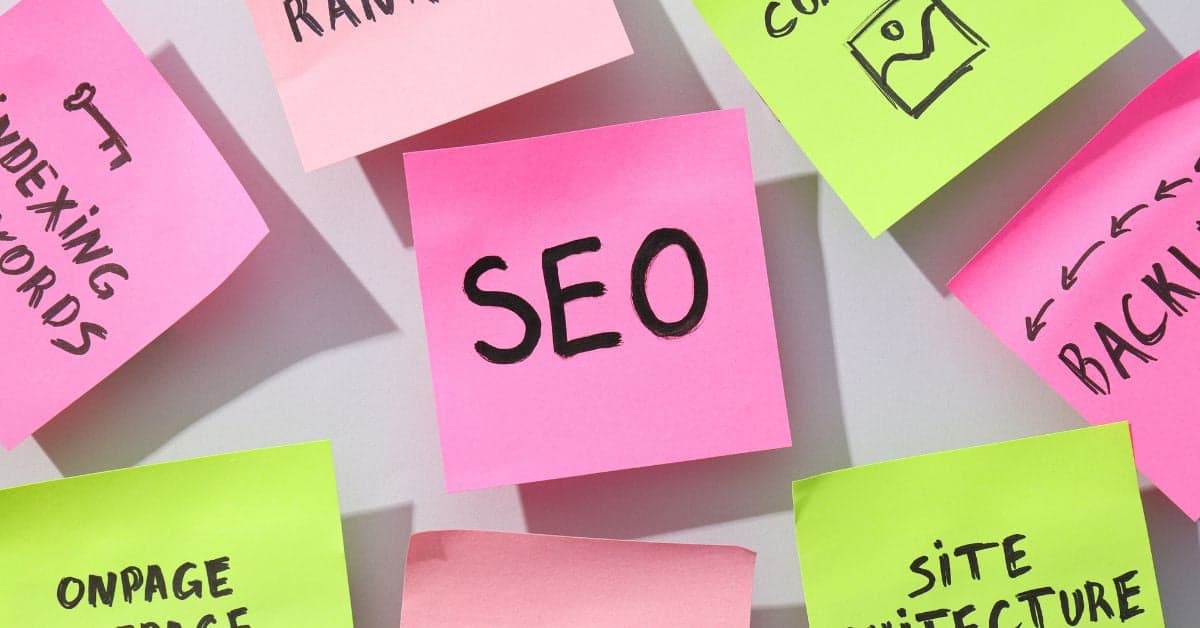
A good SEO strategy is the result of three main components working together in harmony, as follows:
On-page SEO
On-page SEO is the optimization of the structure and content on each page of a website to a point that is complete and suitable for search. Examples of the main strategies used are as follows:
- Writing articles or producing content according to E-E-A-T principles, with a distinctive identity, focused on solving real users' problems rather than writing to please the algorithm.
- Using Heading Tags to structure H1, H2, and H3 systematically in order to divide content into sections that are easy to read.
- Managing keywords by inserting search terms naturally and in a way that aligns with the content's context.
- Choosing images that suit the content appropriately, and adding Alt Text that clearly conveys meaning.
- Doing Internal Linking to connect related content within the website together in order to build the website's structure.
Off-page SEO
Off-page SEO is the building of credibility from outside the website, so that the search engine decides to choose the information on our website. Examples of key strategies are as follows:
- Building quality Backlinks and earning references from websites that provide a highly credible Backlink service.
- Doing Digital PR to build relationships with the media and earn mentions on credible online channels.
- Reviews from users, both on the website and on external platforms.
Technical SEO
Technical SEO is the improvement of the technical structure behind the website, so that the search engine's robots can come in to explore and store information more easily and conveniently. Examples of key strategies are as follows:
- Improving the speed, stability, and user experience of the web pages, as well as managing JavaScript so that the search system can read the information easily.
- Installing a security certificate (SSL/HTTPS) to protect user data, while creating a website map (XML Sitemap) and defining Schema Markup to deliver a clear data structure to the search engine.
- Designing the website to fully support display on mobile phones and other mobile devices.
How to Do SEO to Rank at the Top
Bringing a website to the top requires a systematic and continuous SEO process and strategy. The general steps to follow are as follows:
- Define your goals and analyze your target audience: Understand who your customers are, what problems they have, what kind of information they prefer to search for, and how your business can help solve those problems.
- In-depth Keyword Research: Use analytical tools to find the terms your target audience actually searches for, analyze the level of difficulty in competing with rival websites, and group keywords to align with the Customer Journey, from the stage of becoming aware of a problem through to the purchase decision stage.
- Planning the Site Structure: Design the website structure to be orderly with clearly divided categories, keeping high-priority pages no more than 3-4 clicks away from the Homepage.
- Creating People-First content: Produce articles or content that focus first and foremost on delivering value to the “reader,” not on pleasing robots or algorithms. Emphasize presenting a unique perspective, going deep into the details, and thoroughly answering the questions users wonder about.
- Improving the user experience (UX Optimization): Arrange the elements on the web page so they are easy on the eyes, use a clear Call-to-Action (CTA) to guide users to the next step, reduce menu complexity, and verify that the website's speed meets standard benchmarks.
- Building credibility through Backlinks: Carry out a strategy of distributing content to partner websites, or create content of such high value that other websites are willing to reference it and send links back.
- Auditing and improving technical performance: Regularly check for technical errors, such as broken links (404 Error) or Indexing problems, to ensure that the website is in perfect condition at all times.
How Is SEO Measured
The success of SEO can be measured with clear data and metrics, through tools such as Google Search Console and data analytics platforms, to track results across various dimensions. The key metrics are as follows:
- Organic Traffic: The number of visitors to the website; this is the most fundamental metric in doing SEO.
- Keyword Ranking: The changes in the rankings of the primary and secondary keywords that are the focus of each web page.
- Click-Through Rate (CTR): The rate of people who see your website on the SERP and then decide to click through.
- User Engagement: Such as the average time people spend on a web page, or the number of pages viewed per session, in order to analyze the quality of the content.
- Conversion Rate: The rate at which website visitors, or traffic on the website, turn into sales, sign-ups, or various inquiries.
What You Should Know Before Starting SEO
Terms You Should Know About SEO
Crafting an effective strategy needs to begin with understanding the fundamental terms and concepts that are at the heart of SEO, as follows:
- Organic Traffic: The volume of website visitors who arrive by clicking on non-advertising search results. The advantage of Organic Traffic is its quality and sustainability, since it comes from the searches of real users.
- Keyword: The keyword or search term that consumers type into the search box in relation to the content on your website. Each keyword has both a search volume (Search Volume) and an intent (Search Intent) that differ, such as wanting to find information, compare products, or decide to buy a particular product or service.
- Search Intent: The search intent, or the goal behind a user's search term. For example, when a user searches for “find a lawyer,” the intent could range from looking for a specialized legal advisor to checking the nearest office location. Therefore, doing SEO requires analyzing these intents deeply, in order to deliver content that precisely meets the need.
- Search Engine Results Page (SERP): The search engine's results display page, which today is complex and can present far more than just ordinary search results, such as Featured Snippets or Google AI Overview, which uses artificial intelligence to summarize answers directly for users.
- E-E-A-T: Stands for Experience, Expertise, Authoritativeness, and Trustworthiness—important criteria that Google uses to assess the quality of a website. Especially in the age of AI Search, websites that demonstrate expertise and credibility have a greater chance of being considered for a higher ranking than ordinary content.
- Backlink: A link from an external website that points back to your website, which is like an endorsement of credibility in the online world. In modern SEO strategy, importance is placed on both the quantity and the quality of the links pointing back, which will result in a higher ranking on the search results page.
- Internal Link: An internal website link is the creation of a connection point from one web page to another web page under the same domain. It helps users find additional related information easily, and helps the search engine's robots explore and understand the website's structure deeply, increasing the website's chances of ranking.
How Do SEO, AEO, and GEO Differ?
In an era where AI technology is merging with search behavior, new terms have been defined to describe sub-branches of website optimization, such as AEO and GEO, which differ from SEO as follows:
| SEO (Search Engine Optimization) |
AEO (Answer Engine Optimization) |
GEO (Generative Engine Optimization) |
|
|---|---|---|---|
| Core definition | Optimizing a website so it ranks on a Search Engine | Optimizing information so AI can use it immediately | Optimizing content so AI references and synthesizes it into answers |
| Main goal | Drive people to the website via the SERP | Provide the shortest and most precise answer instantly | Be a source of information that AI Search trusts and chooses to use for summaries |
| Content format | Long, high-quality content aligned with keywords | Question-and-answer format (FAQ) and concise | Uses E-E-A-T principles, with statistical data and analysis |
| Main platforms | Google Web Search, Bing, Yahoo | Voice Search (Siri, Alexa), Featured Snippets | Google AI Overview, ChatGPT, Perplexity |
SEO, AEO, and GEO are not strategies that are separate from one another, but rather work together in an integrated way, so that your brand can cover its visibility space across every form of information search in the modern era. For business opportunities, consulting an SEO company that understands AI and LLM technology is therefore another important option that will help a business stay ahead of competitors sustainably.
Things to Be Careful of When Doing SEO
Although SEO strategy is a powerful marketing tool that delivers sustainable results for a business, if the strategy is planned incorrectly or inappropriate methods are used, it can cause serious damage to the website's ranking and the business's brand. The pitfalls to avoid are as follows:
- Creating content that is not useful, lacking refinement, fact-checking, or a human perspective.
- Using low-quality Backlinks, or ones obtained improperly, such as receiving links from unrelated websites, which may violate the search engine's rules and risk being banned from search.
- Overlooking mobile usability design, making it difficult to use, reducing the chances of ranking on the SERP, and also cutting off the opportunity to reach a segment of customers.
Doing SEO Yourself vs. Hiring an SEO Expert: Which Should You Choose?
One of the most popular questions for business owners is, “Should we do SEO ourselves, or hire an SEO Agency?” The answer to this question depends on factors such as resources, time, and each organization's expectations for results. The points to consider are as follows:
| Doing SEO Yourself (In-house/DIY) | Hiring an Expert or SEO Agency | |
|---|---|---|
| Budget value | Saves on external service fees, but you must invest in staff and tools | Has clear service fees, without bearing the long-term benefits and burdens of employees |
| Technical expertise | Requires time to learn through trial and error, especially in the complex AI era | Has a professional team with real experience and immediate access to the latest technology and tools |
| Control and speed | Allows close control over direction, but may be slow if the personnel lack experience | Can start immediately, with a systematic working process and clearly visible results |
| Sustainability | Suitable for businesses with a strong Content team that want to build internal knowledge and image | Suitable for businesses that want to grow by leaps and bounds and be able to compete in the market |
Having read this far, everyone has surely now received a clear answer as to what SEO is and how deeply important it is to building an online business, both in the present and in the future. Doing SEO is not magic or a shortcut to ranking overnight, but rather an investment in building a strong digital foundation—comprising the delivery of valuable content, the building of credibility, and the improvement of the user experience in every dimension—in order to drive your brand's growth toward sustainable success.
Elevate Your Digital Strategy with Relevant Audience
Relevant Audience, we are a full-service digital agency covering every dimension of online marketing with a team of experts and modern technology, to ensure that your business always stays ahead of competitors.
Our Services
- Paid Performance: Precise ad targeting, covering leading platforms (Google, Meta, TikTok, LINE)
- SEO & GEO: Push your search rankings to the first page, making it easier for customers to discover you
- Creative & Branding: Design a standout brand and content that communicates straight to the heart
- Web Development: Build and develop high-performance websites that meet business needs
- Growth Services: Supplementary services and solutions for businesses that want to grow
Contact us and request a quote today
Tel: 02 038 5055
E-mail: info@relevantaudience.com