
TL;DR
- An SEO specialist is a hands-on role measured on Search Console clicks, impressions and pages held in the index, not on tasks shipped.
- SEO teams usually run five levels: executive, specialist, analyst, manager, director. Most failed hires come from folding three of them into one job ad.
- The content writer owns the copy, the specialist owns titles, canonicals and internal links, and the digital marketer owns media buying.
- Thai-language work adds two problems English sites do not have: no spaces between words, and bilingual pages competing with each other.
An SEO specialist is the person accountable for whether a business gets found in Google, and accountable in numbers for whether that improves month over month. The job splits into three piles: fixing technical problems that stop crawlers from collecting pages, shaping pages to match what people actually type, and reading Google Search Console and GA4 to decide what to fix next. The boundary with nearby roles sits here: a content writer owns the copy, an SEO manager owns the plan and the people, and a digital marketer covers several channels at once without going deep on any single one.
This is written for two readers. The first is an HR lead or founder who has to write a job ad or interview for this role and does not know what to ask. The second is someone considering a move into search work who wants to know what a day looks like. Below: the five roles on an SEO team, the skills that get used, what an SEO specialist does day to day, a comparison table against nearby roles, and the conditions that decide whether to hire in house or buy the work outside.
What an SEO specialist is, and what the work is measured on
An SEO specialist is a hands-on role, accountable for the unpaid search results of one website or one group of client sites. The role is not measured on volume of tasks shipped. It is measured on what moves in the Performance report in Google Search Console: clicks, impressions, average position for the agreed keyword set, and the number of pages Google actually holds in its index.
The common misreading is that this is the person who writes articles that rank. Writing is one input. If crawlers cannot reach the site, because navigation renders only through JavaScript, because duplicate pages carry no canonical, or because a noindex directive was left in place from the build, the best-written article never gets counted. Most of the job is therefore tracing why pages are not being counted, before adding anything new.
The part that gets overlooked is translation. An SEO specialist has to write an explanation a developer can act on, saying what to change and in which file. They write a brief a content person can work from, saying what question the page answers. And they summarise for a director why the numbers moved. Work that is technically right but cannot be explained does not get approved for a second round.
Five roles on an SEO team and how responsibility splits
SEO teams in agencies and in house groups in Thailand usually run five levels. Titles change between companies, but the responsibility lines tend to match. Read the next five paragraphs against the job ad you are about to write. Many ads fold three levels into one role, which is the usual reason interviews go nowhere.
SEO executive
An SEO executive works a queue somebody else set: writing titles and meta descriptions against an agreed template, adding alt text where it is missing, pulling weekly rank data, assembling the monthly report. The role does not yet decide what to fix first, but it has to fix things correctly and on time. Nearly everyone entering search work starts here, and how fast they move up depends on how quickly they get their hands on real technical work.
SEO specialist
An SEO specialist sets the queue, both for themselves and for the executive. They open Search Console to see which pages lost clicks, open URL Inspection to see which canonical Google picked, open a crawl to see how many pages answer with a 404 or sit behind chained redirects, then order the work by whether a page has enough impressions for a fix to show up at all. The real difference from an executive is the willingness to say some requested work should not be done.
SEO analyst
An SEO analyst owns the data side rather than the page-editing side. The main job is joining Search Console data to GA4 and to sales records, to answer whether extra clicks turned into leads or orders. Analysts tend to be strong in spreadsheets at depth, can write queries to pull data, and can build reports that refresh themselves. Companies with large multilingual sites usually need this as a separate seat, because a specialist does not have hours for both.
SEO manager
An SEO manager owns the plan, the budget and the people, not the page-by-page edits. The real work is agreeing with other departments which page groups get the quarter, negotiating release queue space with engineering, reviewing what the specialist ships, and answering when numbers miss what was promised. Good managers have usually done the specialist job, because estimating a queue requires knowing how long each piece really takes.
SEO director or head of SEO
An SEO director decides the things tied to business structure: whether Thai and English live on one domain or separate ones, whether investment goes to category pages or article pages, whether to accept work that conflicts with the long-term approach, and how to argue for engineering or media resources against peers at the same level. This seat reads reports more than it opens tools, but has to know enough to catch a report that looks too good.
Ten skills an SEO specialist needs, and how to test each one in an interview
The list runs from what cannot be missing toward what can be trained later. If you are interviewing, ask each one as a situation rather than as a definition, because definitions take ten seconds to look up.
- Reading Google Search Console past the front page. They should open the Pages report and separate why a page is not held, for example how "crawled currently not indexed" differs from "discovered currently not indexed", and use URL Inspection to compare the canonical you declared against the canonical Google selected.
- Reading a full-site crawl. Given a crawl file they should find which pages answer with the wrong status, which redirect through several hops, which share duplicate titles as a group, and which carry a directive against indexing that nobody asked for.
- Enough HTML to make the edit themselves. Not programming, but knowing where the title tag, meta description, headings, canonical, hreflang and alt attributes sit in a page, and knowing which of those can be changed from the CMS and which need engineering.
- Keyword research that ends in an intent decision, not a word list. They should be able to say this term belongs on a service page, this one belongs in an article, and these two belong on the same page because the people searching want the same answer.
- Designing internal links. They should be able to plan which pages link to which, with what link text, and spot when an important page is getting fewer internal links than an unimportant one.
- Judging external links. They should separate a link from a page real people read from a link inside a network built to sell links, and be willing to refuse a paid link offer that creates a problem later.
- GA4 to the level of configuring a key event. They should read Traffic acquisition split to the organic search channel, read the landing page report, and know why GA4 and Search Console numbers will never match exactly.
- Writing a brief somebody else can work from. A usable brief names the question the page answers, the subheadings required, the internal links to include, and what must not be written because it overlaps an existing page.
- Queue and follow-up discipline. Almost all search work waits on someone else: engineering, content, legal. People who last in this role keep a record of what is blocked, with whom, and for how long.
- Working with Thai on a page. They should know that Thai does not put spaces between words, so tool segmentation and Google segmentation differ, that a Thai URL gets percent-encoded into a long string, and that the same term often exists as both a transliteration and a translation.
The trait that separates strong from adequate is not on the list: patience with work that does not pay back immediately. A structural fix today may show up in reports several weeks later. People who need daily feedback usually do better in paid channels.
What an SEO specialist does day to day
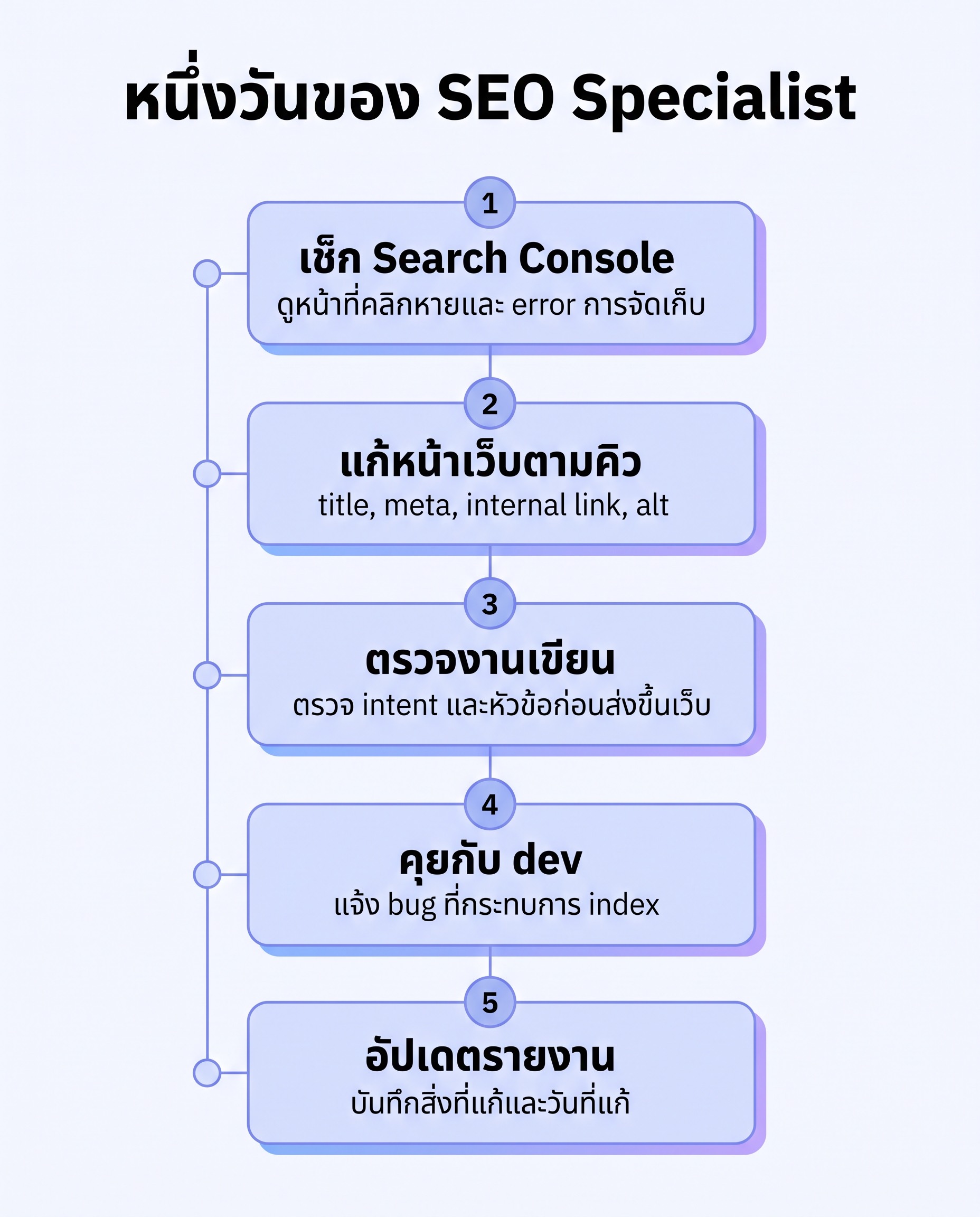
The real calendar looks nothing like the job ad, because most hours go to checking and coordinating rather than producing. The order below is the common shape in teams covering several sites at once.
- Check Search Console: look at pages that lost clicks and at indexing errors. If clicks for a page group dropped oddly, compare against release dates before concluding anything about rankings.
- Work the edit queue: titles, meta descriptions, internal links, alt text. These go faster in batches than one page at a time, and every edit should be logged with its date so the effect can be traced.
- Review writing: check intent and the outline before it goes live. Two questions do the work: does this page answer the question people are actually asking, and does it overlap a page the site already has.
- Talk to engineering: report bugs that affect indexing. A usable report has example URLs, what is happening, what should happen, and the consequence of leaving it.
- Update the log: record what was changed and when. A report with no change log cannot explain which piece of work produced the movement.
The most frequent interruption is a question from another team: marketing wants to change a campaign URL, sales wants a new page this week, engineering is migrating a system and did not mention it. Part of this role is knowing what is about to change on the site, rather than finding out when rankings drop.
Month end brings work that is not on the daily list: pulling the month together, comparing it against the previous month and the same period last year, then writing what worked, what did not, and what happens next. Teams that skip this step repeat the same work without noticing.
SEO specialist vs content writer vs digital marketer
The clearest way to draw the line is to ask who decides and who executes on each task. The table compares five tasks that actually occur in a mid-sized marketing team.
| Task | SEO specialist | Content writer and digital marketer |
|---|---|---|
| Choosing keywords and deciding page intent | Decides and carries the result | The writer takes the topic; the digital marketer rarely works at page level |
| Writing the copy and the headline that keeps people reading | Reviews intent and outline, not the main author | The content writer owns it fully |
| Editing titles, meta descriptions, internal links, canonicals | Owns it fully | Not the core job of either role |
| Explaining the numbers in Search Console and GA4 | Owns the unpaid search share of them | The digital marketer reports across all channels combined |
| Buying media, setting ad budgets, approving ad creative | Not this role | The digital marketer owns it |
When the line is left undrawn, a page ends up with two owners. One wants a headline that earns clicks, the other wants a headline that matches the query. With no agreement on who decides last, the page gets edited back and forth and nobody learns which version performed better. The cheap fix is a line in the team document saying who decides what.
SEO manager and SEO specialist: where the difference sits
An SEO manager owns what gets done and by whom; an SEO specialist owns whether the work is correct against how search actually behaves. In practice the manager spends hours in meetings, negotiating queue space with engineering, and explaining results to people who do not do search work. The specialist spends hours in tools and in pages.
Plenty of mid-sized companies in Thailand hire one person and ask for both. What follows is predictable: that person gets pulled into meetings until there is no time left to edit the site, and the work that stalls is the technical work, which is the work with the most upside. If you are hiring one person anyway, agree up front how many quiet hours a week are protected, and which requests will be declined.
In-house SEO specialist or an outside team
The answer turns on two things: how often your site changes, and whether anyone internal can edit it. Sites with products moving weekly, several languages, or an in-house engineering team benefit from a permanent seat, because most of the value comes from being in the decision loop before the site changes. Sites with static content, a few dozen pages, and an external contractor for edits are usually better served by buying a defined project.
- Signs you need a permanent seat: a weekly queue of site work, an engineering team to coordinate with, and enough pages that structure decisions change the outcome.
- Signs an outside team fits better: nobody internal can log into the site back end, you need one large inspection, or you need several specialisms at once for a short period.
- Signs neither is the right spend yet: the site has no page addressing commercial queries at all. Build the service and product pages first.
The mixed model is what many companies land on: one internal owner who chases work through engineering, plus bought-in work for the specialist pieces, such as a full technical inspection or restructuring the site during a migration. If that sounds like your situation, compare the scope of an SEO audit service against what your own team can do before deciding.
Search work in Thailand: how people get in, and what differs from English-language markets
People arrive in this field in Thailand along three routes: from content work, moving toward the technical side; from web or IT work, moving toward marketing; and from paid advertising, wanting a channel with no cost per click. The second route tends to have an early advantage, because reading pages and talking to engineers comes free.
The clearest difference from English-language markets is that Thai does not put spaces between words, so segmentation is a live variable in every decision. Many Thai queries also mix Latin script inside the same string, usually a brand or model name, and the same concept often exists as both a transliteration and a translation. One page therefore has to accommodate several written forms without turning into something nobody can read.
The other issue is bilingual structure. Many Thai sites run both Thai and English pages but never finish declaring the relationship between them, so the two versions compete with each other in results. This comes up far more often here than on single-language sites, and it is worth asking about in an interview if your business runs two languages.
The newer pressure is being cited in answers that search engines generate themselves. Pages that answer the question in the first sentence and carry checkable detail get lifted more often than pages circling promotional copy. People adapting to this in Thailand tend to start by reformatting existing pages rather than adding more of them. There is more on the approach under AI SEO.
FAQ about the SEO specialist role
Does an SEO specialist need to code?
No, but they need to read HTML and know where things sit in a page. Anyone in this role should open a page source and point to the title tag, the canonical, hreflang, and any directive against indexing, and read a rendering test well enough to say whether content was in the source from the start or added later by JavaScript. Scripting to pull data is an advantage, not a requirement.
Can one person cover SEO specialist and content writer?
Yes if the site is still small and technical work is covered by someone else, but accept less depth on both sides. The two roles use different muscles: one is judged on the quality of the writing, the other on movement in search reports. When time runs short, the person hired to write will ship the writing first, and the technical work stalls.
How long before the work of an SEO specialist shows results?
It depends on which kind of problem is being fixed. Removing a blocker on collection, such as clearing a stale directive against indexing or fixing a canonical pointing at the wrong URL, can change reports within a few weeks. Building new pages to contest a competitive query takes considerably longer. Agreeing early on what gets measured first, for example the count of pages held in the index, lets you judge progress before positions move.
Should an SEO specialist be measured on keyword rankings?
Measure on clicks and impressions from Search Console first, and treat rankings as supporting evidence. Positions reported by third-party tools rarely match what any individual user sees, because results vary by device, location and search history. Tying a bonus to one keyword's position tends to produce a side effect: the team picks terms that move easily and that nobody searches.
What does an SEO specialist earn in Thailand?
This article does not give a salary figure, because there is no reliable, current public source for this role in Thailand that could be cited honestly. The workable method is to read the advertised ranges for the same title on job sites during the week you are hiring, and compare them against the scope you will actually assign. If your ad folds three levels into one role, the ranges you see are not comparable.
If you are weighing an internal team against outside help, it is easier to decide once you know what your site is stuck on. Relevant Audience runs inspections and search plans for Thai-language and bilingual sites. See the scope of our SEO services and SEO in Thailand, or if your constraint is content rather than structure, content marketing.