TL;DR
- On skippable in-stream ads the skip button appears after five seconds, so only that opening reaches every viewer; brand and core idea belong there.
- Bumper ads run six seconds at most and cannot be skipped, which leaves room for one message with the brand visible throughout, not a story.
- Showing the brand early builds recall even among people who skip; showing it late gives the story time but leaves early skippers with nothing.
- Google Ads reports how many plays reach 25, 50, 75 and 100 percent of a video, the most direct way to see where viewers drop off.
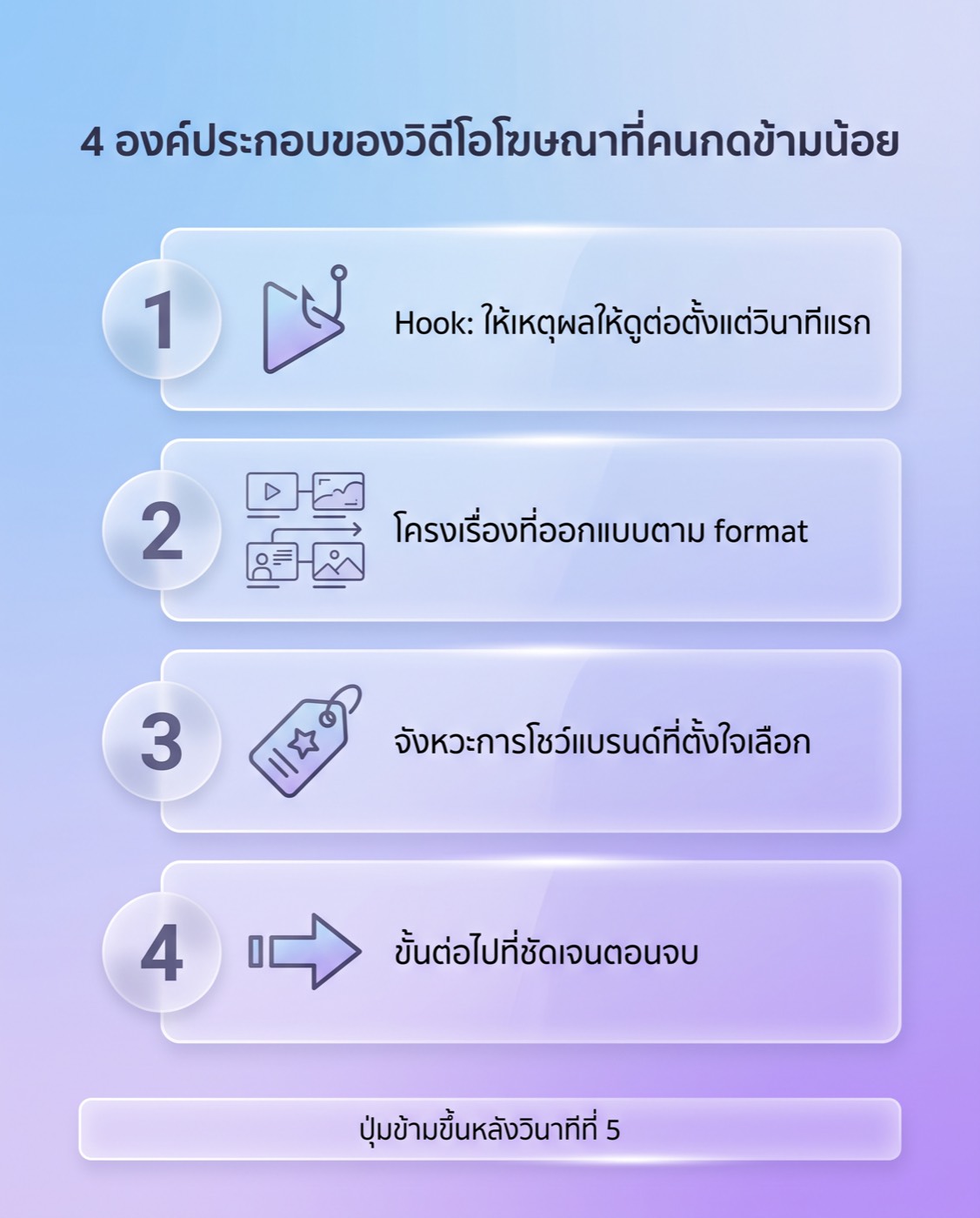
Video ads on YouTube that people rarely skip tend to share four things: a hook that gives a reason to keep watching from the very first second, a story structure designed for the length of the format you are actually buying, brand timing that was chosen on purpose, and a clear next step for the people who stay to the end. On a skippable ad the skip button appears after the fifth second, so the time before that is the only stretch in which a brand is guaranteed to have every viewer with it. This article breaks the four elements down into steps a creative team can put straight into a brief, together with how to measure whether a video you have launched is really holding viewers.
Why people skip, and why the first five seconds are the whole brief
People who see an in-stream ad did not open YouTube to watch advertising. They were about to watch a video they had already chosen, so the ad sits between the viewer and what they want to see. The decision to skip happens quickly, because the viewer is comparing what is in front of them with the video waiting behind it. If the first few seconds offer nothing more interesting, the viewer simply waits for the button to appear.
The mechanical fact to keep in mind while writing is that a skippable ad offers a skip button after five seconds of playback. Everyone who is served the ad sees those five seconds, but after that the audience shrinks to the people who choose to keep watching. That is why the most important thing about the brand has to sit in the opening. If the core message or the brand arrives at the end, it only reaches the minority who watch to the finish.
Another point that is often forgotten is how people watch. A lot of mobile viewing happens with the sound off, or with the volume low in public places. A script that relies on voiceover alone loses that audience from the start. The key message should be understandable from the pictures and the on-screen text as well.
Google publishes its own creative guidance for video ads, called ABCD, which stands for Attract, Brand, Connect and Direct: capture attention, show the brand, build a connection with the viewer, and tell them what to do next. The four elements in this article line up with that framework, but go into the level of detail a scriptwriting team can use straight away.
Element 1: the hook in the first three seconds
A good hook is not a pretty shot or a loud sound. It is a reason, specific to the target audience, to keep watching. Below are three commonly used techniques, each suited to a different situation.
Pattern interrupt: break what the viewer expects
Viewers are used to what ads look like. A logo slowly fading in and music slowly building let the brain file it as "this is an ad" immediately. A pattern interrupt opens with something that does not fit that template, such as starting in the middle of an event already under way, an unexpected camera angle, or an action odd enough that the viewer wants to see what is happening. The caution is that the interruption has to connect to the product within a few seconds. If viewers feel they were tricked into watching, that feeling lands on the brand.
Curiosity gap: open a question people want answered
This technique opens with a gap in information, for example showing the result first and revealing the method afterwards, or asking a question the audience has genuinely wondered about. As an illustrative script, a cookware brand might open on an omelette that is unusually fluffy with on-screen text reading "no baking powder", then reveal that the pan is the reason. The gap has to be closed within the ad. Leaving the question hanging frustrates viewers more than it intrigues them.
Direct address: speak to the audience plainly
Open by naming the group you want, clearly, for example "If you sell online and can't keep up with chat messages". A line like that filters the audience as it goes. The right people feel the ad is talking to them, and the wrong people skip, which helps when the campaign pays per view, because budget is not spent on people outside the target. The downside is that when the target audience is broad, calling out too narrow a group cuts out people who might have been interested.
What all three kinds of hook need
- On-screen text that makes sense with the sound off
- The product, or its context, appearing early, even before any selling starts
- No warm-up; the first frame is already content
- A real link to the ad's core message, not a gag disconnected from what is being sold
Element 2: a story structure designed for the format
A common mistake is to cut one long video and run it in every format, changing only the length. A video designed as a slow-building thirty-second TV spot, cut down to six seconds, often leaves only an opening shot that has not said anything yet. Each format needs its own structure.
Skippable ads: sell the idea early
For skippable ads, think of the first five seconds as the complete ad for the people who will skip, and the rest as an extended version for the people who stay. A structure that works well is to open with the hook and the brand or product in the first second, then deliver the core idea in full, what problem the product solves, within the first fifteen seconds, then add proof, detail or story that builds belief, and close with the next step. People who skip after second five still get the shortest version of the message, people who watch to fifteen seconds get the complete idea, and people who watch to the end get a reason to act.
Bumpers: six seconds, one message
A bumper runs no longer than six seconds and cannot be skipped. There is room for one message, not a story. The right structure is a single shot or two that communicates one main benefit, with the brand visible throughout or nearly throughout, and text short enough to read in six seconds. Bumpers work well when used repeatedly to reinforce the brand, or alongside a longer video that tells the full story. Do not expect a bumper to explain a complex product.
Shorts: vertical, fast, and looking like content
Ads in Shorts sit inside a vertical video feed that people can swipe past instantly. There is no guaranteed five-second window, and a swipe is a faster skip than any skip button. The structure therefore needs a stronger opening and has to blend with the content around it. Videos shot vertically from the start, with someone talking to camera or a close-up of the product in real use, usually fit the feed better than landscape ad footage that has been cropped. Text and product also need to sit clear of the areas the platform's buttons and captions cover.
Structure by format: comparison table
This table summarises the mechanic each format imposes and what the script has to achieve, as a starting point for a brief. Maximum lengths and conditions for each format can differ by campaign type and market, so check them in the Google Ads account before every production.
| Format | Mechanic the script must handle | What the script has to achieve |
|---|---|---|
| Skippable (in-stream) | Skip button appears after second five | Hook and brand in the first five seconds, full idea delivered early |
| Bumper | Six seconds maximum, cannot be skipped | One message, brand visible throughout |
| Shorts | Viewers can swipe past instantly in a vertical feed | Strong opening, shot vertically, looks like content |
| Non-skippable | Viewers must watch to the end, length limited by campaign type | Respect the viewer's time, keep it tight, never pad to fill the slot |
Element 3: brand timing
The question of which second the brand should appear in is a trade-off. There is no single right answer for every campaign.
Showing the brand early, within the first two or three seconds
The advantage is that everyone who sees the ad, including people who skip the moment the button appears, sees the brand. Campaigns aimed at awareness or recall should choose this route. The downside creative teams often worry about is that when viewers know from the start whose ad it is, they may skip sooner. The fix is to show the brand in a form other than a full-screen logo, such as the product being used, packaging in the scene, or the brand name spoken as part of the story.
Showing the brand late, once the story has hold of the viewer
The advantage is that the story has time to capture attention before viewers realise it is an ad, which may keep people watching longer. The downside is that people who skip before the brand appears take nothing away at all, so the budget spent on those impressions builds almost no recall. This route suits brands people already know, or videos whose story is genuinely strong, and it should be tested against a version with early branding before a large budget goes behind it.
A middle path that works in many cases
Many teams let the brand appear unobtrusively from the start, then show the logo clearly in the closing section. That way people who skip still see some of the brand, while the story is not interrupted by a large logo in the first second.
Element 4: a clear next step
The people who watch an ad to the end are the most interested. If the ending does not tell them what to do next, that interest disappears with the next video.
Say the next step inside the video
The end of the video should say, and show as text, what the viewer should do. Pick a single next step, such as viewing the product, booking an appointment or starting a chat. Offering several options at once leads viewers to do nothing. The next step should match the campaign's objective. An awareness campaign might close by inviting people to search for the brand name, while a sales campaign should close by sending people to the product page.
Use the text fields in the ad settings
When you create a video ad in Google Ads there are fields for call-to-action text and a headline shown alongside the video. The wording there should match what the video says at the end. If the video invites people to "see the promotion" but the button reads "learn more", viewers will not be sure what they will find when they tap. The available fields and how they display differ by campaign type and placement, so check the ad preview in the account before going live.
The landing page has to pick up the handover
A clear next step in the video is wasted if the page people land on does not match what the video promised. Someone who saw a promotion in the video should find that promotion as soon as the page opens, not the site's home page where they have to search for it. That page should also load quickly on mobile, because most people who tap through from a video are on their phones.
Video brief templates for three formats
The templates below are empty frameworks for a team to fill with its own brand content. The timings are guidance for scriptwriting, not platform rules, except for the five-second skip threshold and the six-second bumper length, which are mechanics of the formats.
Brief for a skippable ad
- Target audience: who needs to stop and watch, and what problem they have.
- First five seconds: which kind of hook, how the product or brand appears, what the on-screen text says.
- From there to about fifteen seconds: one core idea, delivered completely in this stretch.
- Later section: proof or detail that makes it believable.
- Close: one next step, the call-to-action text in the settings, and the landing page.
- Viewing conditions: is the core message understandable with the sound off?
Brief for a bumper
- One message: the single main benefit you want remembered.
- Visuals: one or two shots that convey that message without explanation.
- Brand: visible for all or nearly all of the six seconds.
- Role in the plan: brand reinforcement, or which longer video it works alongside.
Brief for Shorts
- Shoot vertical from the start: do not crop landscape footage.
- First second: an action or line that stops the swipe.
- Style: someone talking to camera, real product use, or before and after.
- Safe areas: text and product kept clear of the platform's buttons.
- Volume: prepare several versions, because feeds like this wear creative out quickly.
How to measure whether a video really holds viewers
All of the principles above are a starting point, not a guarantee. What shows which video works is the campaign's own data.
- Look at video played percentages. Google Ads reports the share of plays that reach 25, 50, 75 and 100 percent of the video's length. If the numbers drop sharply between the start and 25 percent, the problem is usually the opening. If they fall in the middle, the story may be dragging.
- Read view rate alongside downstream results. A video people watch for a long time but nobody taps through from may be entertaining without selling. Look at both numbers together.
- Be careful comparing view counts across time. YouTube changed how public views are counted so that a view registers from the first frame for videos uploaded from 24 August 2026. The view count on the video page is therefore not a measure of completed viewing, so use the play metrics in your ad reports instead.
- Test one variable at a time. To find out which hook works, make two versions of the video that differ only in the opening and compare them with an experiment in the Google Ads account. If you change several things at once, you cannot tell what caused the difference.
- Give the data enough time. Do not decide from the first few days, when data is thin. Early numbers can swing a lot.
What Thai brands should think about
Thai text on screen has its own issues. Vowels and tone marks sit above and below the line, so Thai script needs more vertical space than English. With a thin or small font, the text becomes hard to read on a phone screen, especially when it is laid over a detailed image. Test readability on a real phone held at arm's length before launch, not on a computer monitor during the edit.
Brands that run ads in both Thai and English should not simply translate the on-screen text. A hook that works in one language may not work in the other. Jokes and the way you call out the audience need to be rethought for the viewer's language and culture, and if the budget allows, test the language groups separately rather than drawing conclusions from combined results.
Production is another consideration. Many versions of a video for several formats and several tests is a load small teams often cannot carry. A route many brands take is to plan one shoot that captures both landscape and vertical footage, then cut multiple versions from that one set, or to use a production service such as AI video and photo production to create test versions faster. Campaign setup, experiments and reading the play-percentage reports are the same work as managing a Google Ads account, because video ads on YouTube are bought and measured through the same system.
What does not exist is a reliable public statistic on how quickly Thai viewers skip ads. Figures passed around on social media usually have no checkable source, so this article does not use them, and recommends using the play data from the brand's own campaigns as the benchmark instead, which is more accurate for each brand's audience and product.
Frequently asked questions about YouTube video ad creative
Should the logo appear in the very first second?
The brand should appear within the first five seconds, but it does not need to be a full-screen logo, because everyone who sees a skippable ad sees that stretch. Showing the product in use, or having the brand name spoken as part of the story, helps people who skip remember the brand without making the video look like an ad from the first frame.
What is the best length for a skippable ad?
There is no single best length. The length should be what the story needs. If the idea can be told in twenty seconds, stretching it to a minute usually loses people halfway. More important than length is delivering the core idea early, then using the play-percentage data to see where people drop off.
Can we reuse videos made for Facebook or TikTok?
Yes, but first check that the aspect ratio and safe areas suit the placement. Vertical videos made for other feeds often work well in Shorts, but text or logos placed near the edges may be covered by YouTube's buttons. Using them as landscape in-stream ads usually requires a new edit.
Why do many people watch to the end but nobody taps through?
The usual causes are an unclear next step, or content that is entertaining but not connected to a reason to buy. Check whether the ending asks for one single action, whether the call-to-action text matches the video, and whether the landing page shows what the video promised straight away.
How often do we need new videos?
There is no fixed cycle. Watch the data for whether results decline as the same people see the same video repeatedly. Vertical feeds such as Shorts tend to wear creative out faster, and preparing several versions to rotate from the start means you do not have to rush new production when results drop.
Summary
Ads that people rarely skip are not luck. They come from scripts that accept that viewers did not come to watch ads, and design every second accordingly. A hook that gives a reason to keep watching, a structure that fits the format, deliberately chosen brand timing and a clear next step are the four things that belong in every brief. After that, let the campaign's play data decide which version goes forward. If you want a team that handles everything from the brief and campaign setup through to creative testing, see the details of our YouTube Ads service.